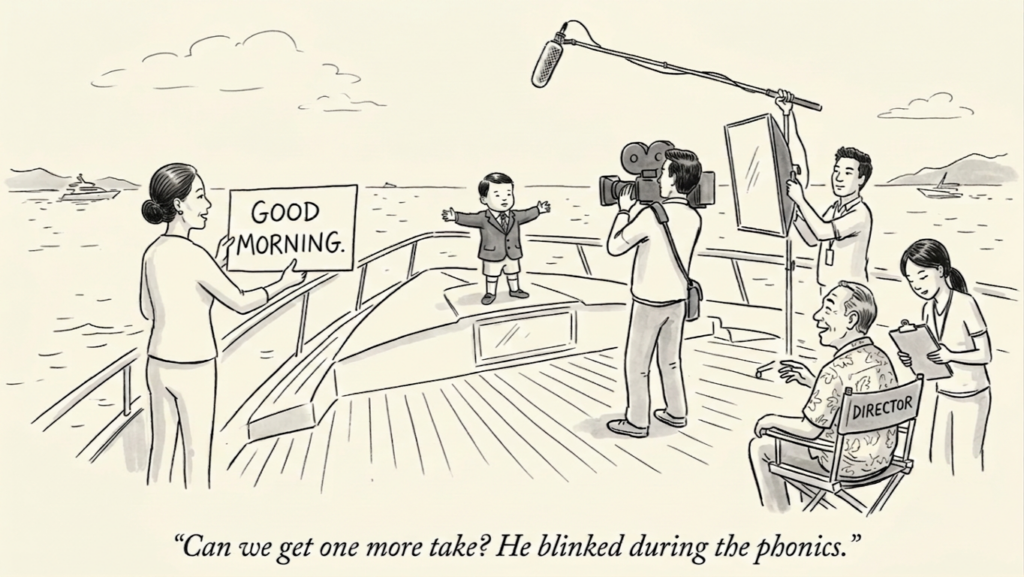
On tambourines, portfolios, and the difference between a town that already knows your grandmother and a city that wants to know your handicap.
In Hong Kong, there is an industry dedicated to preparing children for kindergarten interviews. Not primary school. Not secondary school. Not university, where an interview might reasonably be expected to assess whether a seventeen-year-old has read a book. Kindergarten. An interview. For a child who is two years and eight months old. A child who may or may not have mastered the toilet. A child whose longest sustained monologue to date has been the word “no,” delivered with conviction at varying volumes to various members of the household, none of whom were admissions officers.
The child will be assessed on social skills, communication, fine motor ability, and emotional regulation. The child will be expected to greet the principal proactively. The child will be expected to say “thank you” when receiving a sticker. The child will be expected to walk into the room unassisted, without being carried, because being carried suggests dependence, and dependence is a red flag, and a red flag on a two-year-old is the beginning of a trajectory that ends somewhere other than the school the parents have selected, and the school the parents have selected was selected before the child was born, possibly before the child was conceived, possibly during a conversation at dim sum where someone’s auntie mentioned the name of the school and someone’s mother stiffened slightly and the stiffening was the plan.
“You don’t like competition? But competition will find you!”
There are tutoring centers that offer kindergarten interview preparation for children as young as eighteen months. One of them ran an advertisement featuring a crying toddler and the slogan: “You don’t like competition? But competition will find you!” This is not satire. This is not a parody of a tutoring center. This is a tutoring center. The crying child is the marketing strategy. The tears are the value proposition. The message, decoded from the Cantonese and translated into the universal language of parental anxiety, is: your child is already behind, and your child is one.
Both parents are expected to attend the interview, even if only one is required, to demonstrate commitment. Parents are coached not to answer for the child, not to prompt the child, not to say “speak louder” or “answer quickly,” not to argue with each other in front of the teachers, which apparently happens often enough that it needs to be listed as a don’t, and not to carry the child, which I have already mentioned but which deserves repeating because I still cannot get past the idea that a two-year-old’s method of arriving at a door is being graded.
Some parents hire professionals to produce two-minute video portfolios of their child. These videos can cost thousands of dollars. Some are filmed aboard yachts. Some are filmed on golf courses, the parent and child conversing in English while putting, because nothing says “this toddler is ready for structured learning” like a two-year-old on a yacht discussing phonics in a second language while the South China Sea glitters behind them like a brochure for a life that has already been planned to the minute.
I had one school interview in my life. One. It was at Adams Memorial. My grandmother brought me.
Adams Memorial is a building that has lived more lives than most people. It was a high school first, then a junior high, then an elementary school, and now it sits vacant, which, in Adams, Massachusetts, is less a fate than a tradition, because Adams collects empty buildings the way other towns collect civic pride. It joins the Waverly Mill and every other structure in town that once held something vital and now holds an argument about what to do with it, which is nothing, but that’s another essay and I’ve already written it and someone posted it on Facebook and the town lost its mind.
Adams, for a town of eight thousand people, had an almost absurd number of schools. There was the Hoosac Street School, built in 1887, a brick building with a cupola that looked like it belonged in a novel about a stern headmistress. There was the school on Commercial Street. There was one on Holland Avenue. There was Plunkett, named after a family whose name appeared on half the buildings in town the way the word “exit” appears in a parking garage: everywhere, functional, and no longer noticed. Adams had enough schools for a town three times its size, because Adams had once been a town three times its ambition, a mill town that built schools the way it built churches, one per neighborhood, one per parish, one per cluster of Polish or French-Canadian families who had come for the looms and settled within walking distance of the steeple that matched their accent.
My interview was at Adams Memorial. My grandmother drove me. She did not hire a tutoring consultant. She did not produce a video portfolio. She did not film me on a yacht, because there were no yachts in Adams, and if there had been, my grandmother would have looked at the yacht the way she looked at the street renumbering plan, which is to say with the calm, settled conviction that it was nonsense and that she had soup on the stove.
We arrived. A woman greeted us. The woman asked me to do two things.
Stand on one leg.
Retrieve a tambourine from a toy box.
That was the interview. The whole interview. Stand on one leg, demonstrating, I assume, that I had a functioning vestibular system and was not actively falling over, and retrieve a tambourine from a toy box, demonstrating, I assume, that I could identify a tambourine and had the motor skills to pick it up, which were, as far as Adams Memorial was concerned, the only two qualifications required to begin my formal education in the Commonwealth of Massachusetts.
I stood on one leg. I retrieved the tambourine. I was admitted.
No one asked me to introduce my family. No one assessed my emotional regulation. No one observed whether I could greet the principal proactively or say “thank you” when presented with a sticker. No one checked whether my grandmother carried me in, which she did not, because my grandmother did not carry things that could walk, including me, including opinions that disagreed with hers, including the entire Adams street renumbering initiative, which she killed with one question at a town meeting before the man with the clipboard finished his presentation.
The woman who conducted my interview did not need a portfolio. She did not need a video. She did not need to assess my family’s commitment to education or observe the dynamic between my grandparents. She knew my grandmother. Everyone knew my grandmother. My grandmother was a woman on Cherry Street, and Cherry Street was Cherry Street, and the woman at the school knew that, and the interview was a tambourine.
I think about this when I read about kindergarten interviews in Hong Kong. I think about the eighteen-month-old at the tutoring center, learning to say “good morning” on command. I think about the parents on the yacht. I think about the two-minute video that costs more than my grandmother’s monthly grocery bill in 1981, produced for a child who cannot yet explain why the sky is blue but who can, thanks to six weeks of professional coaching, greet an admissions officer with appropriate eye contact and a firm, age-appropriate handshake, which I am not making up, which is a thing that is taught, a handshake, to a child whose hand is the size of a dinner roll.
And I think about what both systems are actually doing. Because they are doing the same thing. They are answering the same question. The question is: is this child ready?
In Adams, the answer was a tambourine. Can the child stand? Can the child reach into a box and pull something out? Then the child is ready. The child is ready because the child is from Adams and the grandmother is from Cherry Street and the school is across the street from the church and between Bill’s and the Polish Bakery and the teacher will know this child for the next four years and the readiness is not in the interview. The readiness is in the town. The town holds the child. The town has always held the child. The interview is just the part where someone writes it down.
In Hong Kong, the answer is a portfolio. The answer is a video. The answer is a coached greeting and a rehearsed thank-you and an outfit selected for the impression it will make on a teacher who has forty-five seconds to decide whether this child belongs in a system that will carry them from kindergarten to primary to secondary to university to a desk in a firm whose name stiffens postures at dim sum, and the readiness is not in the child. The readiness is in the preparation. The preparation is the proof. The preparation says: we are serious. We have invested. We have done what was required. We began before the child could walk, and we have not stopped, and we will not stop, because the conveyor belt does not stop, and the only thing worse than being on it is being off it, and being off it is not an option, because the sacrifice was not optional.
Both systems love their children. The grandmother who drove me to Adams Memorial loved me the way the mother on the yacht loves her child, completely, without reservation, with the particular ferocity of a person who wants the next generation to have more than this one had. The wish is the same. Do better. The delivery is a tambourine or a yacht. The destination is a child who is ready, or a child who looks ready, or a child who will become ready, or a child who was ready all along and just needed someone, a grandmother or a tutor or a woman at a school with a toy box, to notice.
But there is a question that neither system asks, and the question sits between them the way it always sits, quiet, unasked, waiting for the child to grow up enough to ask it for themselves:
Ready for what?
Somewhere in Sham Shui Po, an eighteen-month-old is learning to shake hands. Her parents have booked twelve sessions. The consultant has reviewed the footage. The portfolio is in post-production. The yacht has been returned to the rental company. The child is ready, or will be, by Tuesday, when the interview happens, and the teacher smiles, and the child says “good morning” with appropriate eye contact, and the parents hold their breath, and the conveyor belt starts, and it does not stop.
Somewhere in Adams, a building that was a high school, then a junior high, then an elementary school, then nothing, sits empty on a street that has not been renumbered. Inside, if you listen, there is no sound. The toy box is gone. The woman is gone. My grandmother is gone.
But I can still stand on one leg. I can still find a tambourine. And fifty-some years later, on an upper floor of a building in Kowloon, eight thousand miles from the place where I was raised, I am not entirely sure anyone has ever asked me to do anything harder.