Ruth handed me a mooncake tonight the way other people hand you a grenade with the pin already pulled, carefully, with both hands, and a warning. “Don’t cut it like a sandwich,” she said. “Cut it into wedges. Like a pie. And offer the first piece to your mother-in-law before you touch it.” I have been married into this family long enough to know better than to argue with mooncake etiquette on the one night of the year it actually matters, so I cut the wedges, and I waited, and the first bite of salted egg yolk and lotus paste landed exactly as rich and exactly as strange to an American palate as it did the first year she made me try it.
Tonight is the Mid-Autumn Festival, the fifteenth day of the eighth lunar month, which this year happens to fall on the twenty-fifth of September, the night the moon is supposed to be at its roundest and brightest of the year. If you’re not from anywhere that celebrates it, the closest thing I can offer you, having lived on both sides of this particular cultural border, is Thanksgiving with the turkey replaced by a small, dense, impossibly rich pastry, and the football replaced by several thousand people craning their necks at the same object in the sky. Both holidays exist for basically the same reason, to drag everyone back to the same table at least once a year, whatever it costs in plane tickets or in-law diplomacy, and to eat something so specific and so laden with tradition that eating it alone feels like a small act of grief. Hong Kong takes this so seriously that tomorrow is a public holiday just to recover from tonight.
The story behind it, the one Ruth’s grandmother told her and the one Ruth has now told me more times than I can count, is about a woman named Chang’e who drank an elixir of immortality meant to be shared with her husband, the archer Houyi, and floated alone up to the moon, where she has apparently been living ever since with a rabbit for company. Every Mid-Autumn Festival, the legend goes, is your one guaranteed night to look up and think of whoever you’re separated from, because Chang’e is up there doing exactly the same thing. It’s a sadder founding myth than a horn of plenty and a boatload of Pilgrims, and I think that sadness is doing real work. Thanksgiving is about abundance. Mid-Autumn is about distance, and the one night a year you’re allowed to feel it out loud.
Which brings us to the mooncake itself, a food I did not understand for at least three Mid-Autumn Festivals and have since come to respect the way you respect a strong espresso you didn’t ask for. The classic Cantonese version is a dense, golden-crusted disc of lotus seed paste with one or more salted duck egg yolks baked into the center, and the yolk count is not a random detail, it’s a scoreboard.
A single yolk is a nice gift. Four yolks, arranged so the cut cross-section shows four small golden moons inside the big one, is the kind of box you give someone you’re trying to impress, or apologize to. For most of the twentieth century, ordinary families couldn’t just buy these outright, neighborhood bakeries ran what were literally called mooncake clubs, where you paid a small deposit every month for most of the year to guarantee your box came festival night, a layaway plan for pastry that tells you everything about how much the tradition mattered to people who didn’t have much spare cash to spend on it.
There’s also a story that mooncakes once carried secret messages, slips of paper baked inside telling people when to rise up against the Mongols. Historians say it’s almost certainly a later invention, a piece of anti-Manchu propaganda from the late Qing dressed up as Yuan-era history, but it tells you something about what people want mooncakes to be: not just dessert, but a vessel for something dangerous and hopeful at the same time. A pastry that can hide a revolution inside it is a pastry that can mean anything you need it to mean.
Hong Kong being Hong Kong, the city couldn’t leave well enough alone and eventually reinvented the thing twice over. In 1989, a bakery called Taipan introduced the snow skin mooncake, a chilled, no-bake version with a soft, mochi-like glutinous rice shell wrapped around lighter fillings, custard, mango, matcha, everything the old lard-heavy crust never had room for. It became its own institution, copied by half the bakeries in the city, until Taipan itself closed its doors last year after forty-one years, undone by rent and unpaid wages and, depending on who you ask, a mainland boycott years earlier after the founder’s son was linked to the 2019 protests. Even a mooncake, in this city, can end up standing for something it never asked to stand for.
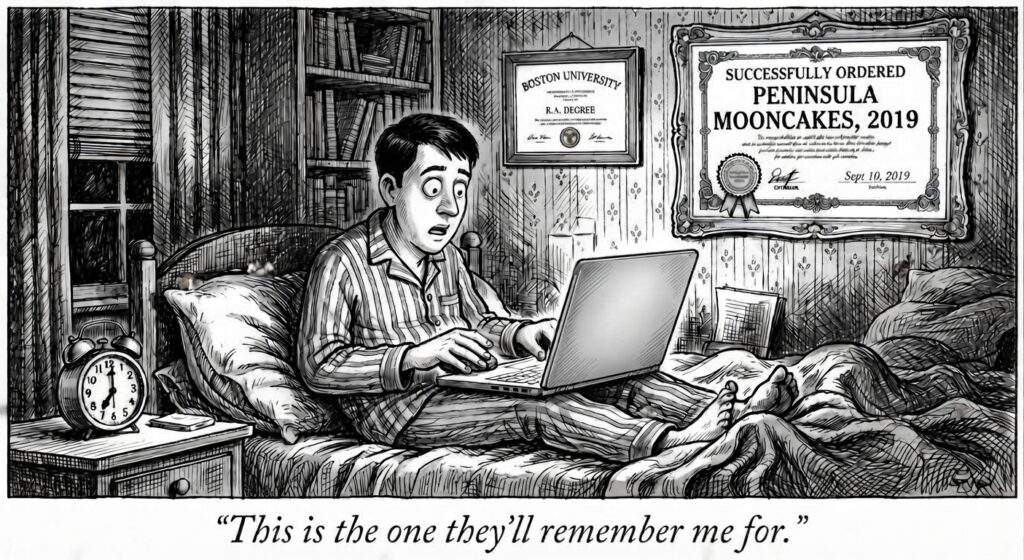
Then there’s the version of the mooncake that has nothing to do with nostalgia and everything to do with status, the hotel box. The Peninsula’s Spring Moon restaurant, which holds a Michelin star, sells egg custard mooncakes that have become genuinely legendary in the specific Hong Kong sense of the word, meaning people set alarms. The online shop goes live at eight in the morning on a set date, there’s a cap on how many boxes you’re allowed to order, and a box of eight runs somewhere around seven hundred Hong Kong dollars, which works out to roughly the price of a decent bottle of wine for something you’re meant to eat in one sitting with your extended family. The hotel’s deluxe hamper, custard mooncakes bundled with dried abalone and conpoy, runs closer to four thousand. None of this is really about the pastry. It’s a corporate gifting economy dressed up as dessert, the Hong Kong equivalent of sending a client a case of good champagne, except everyone in the city is doing it to everyone else, all at once, for about three weeks in September, and the hotel that can make you wait in a digital queue for the privilege gets to call itself the best.
Ruth’s family does not buy from the Peninsula. Ruth’s family makes a production of pretending not to care about the Peninsula while asking, every year, whether anyone at the table managed to get a box. But this year there is no table, or at least not the kind with a dozen chairs and a first wedge offered to the oldest person in the room. This year it’s just the two of us, a box of mooncakes neither of us paid for, and a window.
I asked Ruth about the gesture tonight, the one I’ve seen her make every year, holding her piece up toward the glass before she eats it. “I’m just saying hello to whoever’s not here,” she said, not looking up from her own plate, in the tone of someone explaining something she assumed I already understood. I didn’t, not really, not the way you understand a thing you grew up doing. But I’ve started doing it too, holding the wedge up for a second before I eat it, thinking about a rabbit on the moon I don’t believe in, and finding, every year, that the gesture works anyway. Ruth says I still cut the wedges too thick. I say the moon looks the same size from Adams as it does from here, and she says that’s exactly the point I keep missing.
Comments