A typhoon is heading toward Hong Kong this weekend. Good time to say what needs to be said before the signal goes up and the city goes down.
I have spent the last several months writing about what is happening to the people inside the largest logistics companies on earth. Expeditors. C.H. Robinson. DHL. DSV – Global Transport and Logistics. Kuehne+Nagel. FedEx . A.P. Moller – Maersk. J.B. Hunt Transport Services, Inc. Each story looked different from the inside. Different founders. Different cultures. Different countries. Different CEOs giving different speeches about different values to different employees while walking them out different doors.
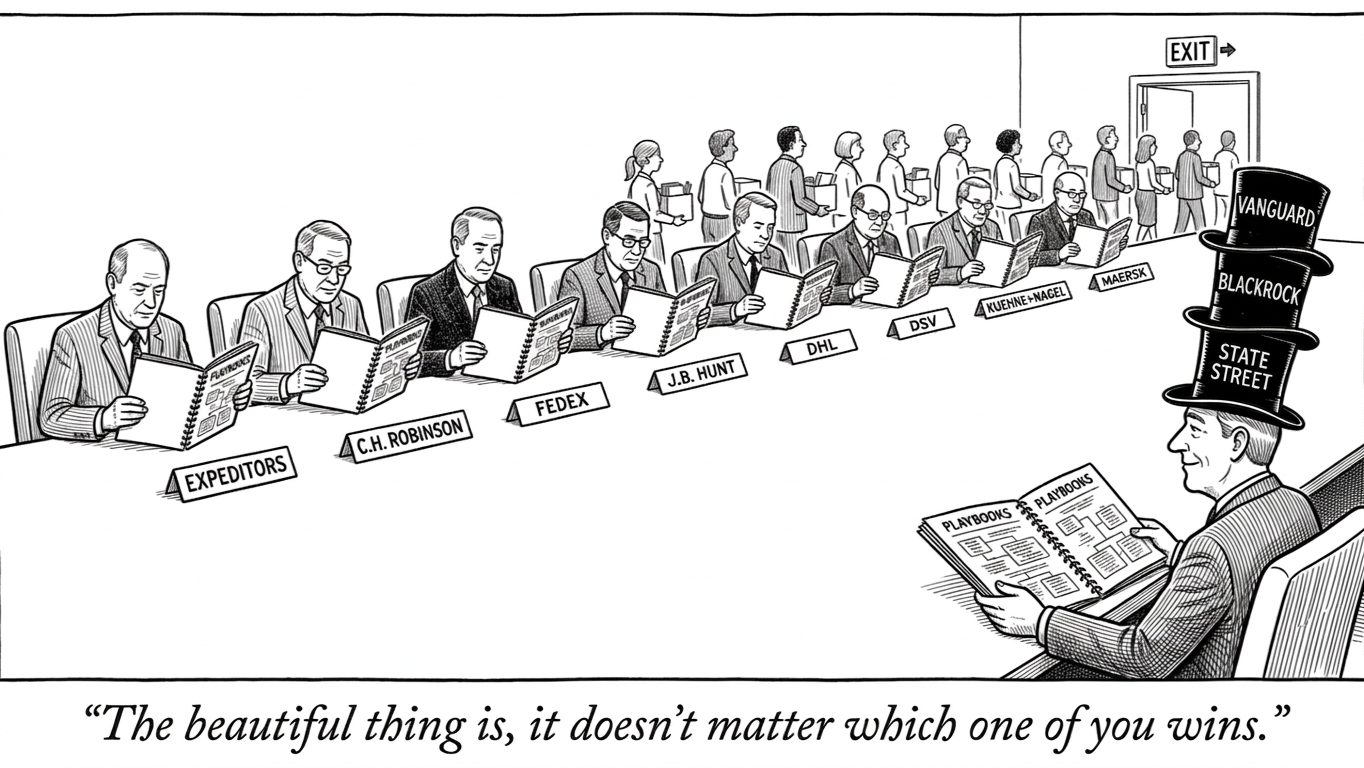
But when you stop looking at the podiums and start looking at the shareholder registers, the pattern stops looking like eight separate business decisions and starts looking like one playbook with eight local franchises.
Here is what the registers show.
At Expeditors, Vanguard Group, across all its affiliated funds and entities, is the largest institutional shareholder, holding approximately 16.6 million shares, roughly 12.5% of the company based on aggregated 13F filings. A single Vanguard subsidiary, Vanguard Capital Management, separately discloses 7.53% in its Schedule 13G. The distinction matters because the proxy vote is cast by the group. The majority of the stock is held by institutional investors.
At C.H. Robinson, Vanguard Group owns over 14.5 million shares worth roughly $2.3 billion. State Street Corp holds over 7.4 million shares. Over 93% of the stock is institutional.
At FedEx, Vanguard holds approximately 20.6 million shares, roughly 8.7% of the company. BlackRock holds approximately 10.4 million shares, roughly 4.4%. State Street holds approximately 9.3 million shares, roughly 4.0%. Together, the Big Three hold over 17% of FedEx.
At J.B. Hunt, Vanguard is the largest institutional shareholder. BlackRock is the second largest.
At DHL Group, the German state development bank KfW holds approximately 18%. BlackRock holds roughly 5.5%. Vanguard holds approximately 3.5%.
At DSV, BlackRock holds 5.53% of the share capital and voting rights, as disclosed to the company in July 2025. Agility Public Warehousing holds approximately 8%.
At Kuehne+Nagel, control is absolute. Klaus-Michael Kuhne, through Kuehne Holding AG, holds 55.4% of voting rights. The Kuhne Foundation holds another 4.7%. BlackRock holds 3.1%. UBS Fund Management holds 3.0%. Vanguard and other institutional investors hold shares through index funds in the free float, but below the Swiss 3% disclosure threshold. The company’s own 2025 annual report states it is not aware of any other shareholder holding more than three percent.
At Maersk, A.P. Moller Holding, the investment arm of the Moller Foundation, owns approximately 41.5% of the share capital and controls approximately 51% of voting rights through a dual-class share structure. BlackRock and Vanguard each hold positions typically estimated between 3% and 5%, largely through passive index funds. Institutional investors collectively account for roughly 27% of the shares.
Now step back and look at the pattern.
The four American-headquartered companies, Expeditors, C.H. Robinson, FedEx, and J.B. Hunt, are dominated by the same three names: Vanguard, BlackRock, and State Street. These are the so-called Big Three passive index fund managers. Between them, they are the largest or among the largest institutional shareholders at every single one of these companies. They do not compete for control. They sit simultaneously on every register, collecting fees, casting proxy votes, and approving executive compensation packages at firms that are supposed to be competing with each other.
The European companies show a variation on the theme. Kuehne+Nagel and Maersk are fortress structures, controlled by founding families through majority stakes and dual-class share systems that make activist intervention mathematically impossible. But even inside those fortresses, BlackRock and Vanguard hold minority stakes through passive funds, and the founding families operate under the same capital market pressure to deliver conversion ratios, EPS growth, and shareholder returns that satisfy the institutional investors who hold the free float.
DSV, following its acquisition of Schenker, is the purest expression of the organism model. No founding family controls it any longer. Agility and BlackRock are the top disclosed holders. The company exists to acquire, digest, and convert headcount into margin.
DHL sits in a category of its own. The German government, through KfW, is a material shareholder. The state privatized its own postal service, sold shares to the market, and now watches from the register while 8,000 postal workers lose their positions. The people delivering the mail are being cut by a company their own government partly owns.
But the mechanism is the same everywhere. And this is the part that should make every logistics worker on earth stop and read what follows.
These shareholders do not care which company wins. Vanguard, BlackRock, and State Street own major stakes in Expeditors AND C.H. Robinson AND FedEx AND J.B. Hunt simultaneously. They do not care whether your company beats the competitor, because they own the competitor too. What they care about is that the sector’s margins expand. And the fastest way to expand a margin in a business where the primary cost is people is to remove the people.
That is why the playbook is identical everywhere.
Every company in this series, without exception, has executed the same sequence in the same window. Hire during the boom. Cut after the boom. Call the cuts attrition, or modernization, or right-sizing, or Lean AI, or Fit for Growth, or DRIVE, or synergy, or restructuring, or any other word that means the same thing without saying it. Deploy AI to automate the work the people used to do. Increase the buyback. Raise the dividend. Reward the executives with equity that vests when EPS hits a target that the headcount reduction was designed to hit. Sell at the top. And tell the people who built the company that their trust was unreasonable, or their skills were outdated, or their position was structurally improved.
The vocabulary is interchangeable because the pressure is interchangeable. The same passive funds that approved Dave Bozeman’s inaugural-year compensation of approximately $28 million at C.H. Robinson, a figure dominated by $21.5 million in sign-on and first-year equity grants, while 5,500 people lost their jobs approved Dan Wall’s compensation at Expeditors while 230 people were walked out by strangers reading identical scripts. The same institutions that nodded along as DSV digested 7,000 Schenker employees in fourteen months nodded along as Kuehne+Nagel cut over 2,000 white-collar workers and won an award for Responsible AI in the same fiscal year.
The nod is the same because the incentive is the same.
And here is the cruelest part.
Many of you own shares in these funds. Your 401k is in a Vanguard target-date fund. Your retirement account holds an S&P 500 index through BlackRock’s iShares. Your pension is managed by State Street. Which means the institution that profits from your termination is, in part, funded by your own savings. You are financing the saw that cuts you. Every payroll deduction you made into that retirement account bought a fractional share in a fund that owns a fractional stake in the company that just told you your position has been structurally improved. The money went up. You went out. And the fund that sits between you and the exit does not know your name, has never visited your office, and will never sit at your kitchen table trying to make the math work without a paycheck.
The founders were different people. Peter Rose planted an oak at Expeditors. Charles Henry Robinson brokered produce on the Red River. Larry Hillblom stuffed documents in a suitcase and flew to Honolulu. The late Fred Smith gambled five thousand dollars on a blackjack table in Las Vegas and won twenty-seven thousand, enough to keep Federal Express alive another week. Leif Tullberg led nine haulers into a Danish cooperative. Captain Peter Maersk Moller painted a star on a funnel because the sky answered a prayer. Johnnie Bryan Hunt picked cotton before he picked up the keys to a truck. August Kuhne and Friedrich Nagel placed an advertisement in a Bremen newspaper with thirty thousand marks. Every one of them built something real, with their hands, with their word, with the people who trusted them enough to show up on Monday.
And every one of those companies is now being run for the benefit of shareholders who have never touched the freight.
The founders built cultures. The institutions built portfolios. The cultures said your word is your bond. The portfolios said your salary is a drag on EPS. The cultures said we do not do that to our people. The portfolios said the conversion ratio needs to improve and I do not care how. The cultures died, or are dying, or are being told they never existed. The portfolios compounded. And the people who believed the culture are sitting in parking lots, at kitchen tables, on trains, in Seattle, in Eden Prairie, in Memphis, in Lowell, in Hamburg, in Copenhagen, in Schindellegi, carrying the same wound in different languages, telling themselves the same lie that the architecture was designed to install: maybe I did something wrong.
You did nothing wrong.
The playbook did this. The playbook runs the same way everywhere because the capital behind it applies the same pressure everywhere. An index fund does not have a flag or a founder or a star on a funnel. It has a ticker symbol and a fee schedule and an algorithm that rebalances quarterly and a proxy voting policy that approves executive compensation packages the vast majority of the time and has never once, in the history of passive investing, voted to keep a single human being employed.
The numbers tell the story the podiums never will.
Expeditors: roughly 2,000 covertly terminated in 2023, then 230 laid off in June 2026. Insiders sold over 60,000 shares and purchased zero.
C.H. Robinson: approximately 5,500 positions eliminated over three years, a 31% reduction. CEO inaugural-year compensation approximately $28 million, including $21.5 million in first-year equity grants, with subsequent annual compensation of approximately $8.8 million. Merit raises canceled. 401k match suspended. Stock up over 100%.
FedEx: approximately 42,000 fewer employees since 2022. Over 475 stations slated for closure. CEO pay ratio 288 to 1. Over $4 billion in DRIVE structural cost reductions achieved through fiscal 2025, with an additional $1 billion targeted in fiscal 2026. Freight division spun off on June 1, 2026, loaded with $3.7 billion in senior notes.
J.B. Hunt: over 8,000 fewer employees in 2023 alone, a 21.6% drop. CEO compensation rose 140% to $11.3 million in fiscal 2024 while no executive bonuses were paid for two consecutive years and employees received 1% raises. Company blog published: “While other companies lay off people during difficult times, J.B. Hunt does not.”
DHL: 8,000 positions being cut from Post and Parcel Germany. Stock surged 12.3% the day of the announcement. Dividend of over 2.1 billion euros. Buyback program of up to 6 billion euros. The cost of the wage increase cited to justify the cuts: 360 million euros, less than one-sixth of the annual dividend.
DSV: 7,000 white-collar positions already cut from the Schenker integration, with up to 13,000 targeted overall. Completion pulled forward by two years. CEO told analysts 45% conversion ratio is the goal. “Was that clear?”
Kuehne+Nagel: over 2,000 positions eliminated. Savings target of 200 million Swiss francs. Won a Responsible AI award in 2025 whose stated principle was that AI should augment human potential, not replace it. Six months later, the people were replaced.
Maersk: approximately 10,000 positions eliminated starting late 2023, plus 1,000 more corporate jobs in 2026. CEO called it “not a diet, a reset of the baseline.” CEO pay ratio 215 to 1. The IT team at the Maidenhead center that saved the company from the NotPetya cyberattack was outsourced to India. Constant Care.
Different founders. Different stars, scrolls, oaks, suitcases, orchards, looms, runways, and prayers. The same headcount reductions. The same AI deployments. The same buybacks. The same executive compensation structures that pay more when more people are cut. The same shareholder registers with the same names appearing over and over, across borders, across oceans, across every company that was ever built by someone who believed that the people mattered.
The people do matter. They always mattered. That part was never a lie.
The lie was the pronoun.
When they said “our people,” they meant the ones who remained useful. When the usefulness ended, so did the “our.” The company does not belong to the people who built it. The company belongs to whoever holds the shares. And the shares, in every case, are held by institutions that have never loaded a container, never cleared a customs entry, never driven a truck through a Minnesota winter, never answered a phone at two in the morning because a shipment went sideways and the customer needed a voice, not a tracking update, a voice, saying I am on it.
Those institutions do not hear your voice. They hear the conversion ratio. They hear the EPS. They hear the vesting schedule. And the vesting schedule sounds better when you are gone.
If you are reading this and you work at any of these companies, or at any company in any industry where the Big Three sit at the top of the register, the person at the next desk is not your competitor. The person at the competing forwarder is not your enemy. You are in the same position. You have always been in the same position. The position is called labor, and the thing on the other side of the table is called capital, and the distance between you and the person at the other company is the distance the playbook was designed to maintain: far enough apart that you never compare notes, never discover the pattern, never realize that the reviews that shifted overnight in Seattle shifted overnight in Eden Prairie and Memphis and Lowell and Hamburg and Copenhagen too.
The keeping apart is the strategy. It has always been the strategy.
My grandfather carried a union card. Textile Workers Union of America, Local 523. When the bosses came for his job, they had to come through the local first. Peter Rose built a no-layoff promise as a substitute for collective bargaining. He gave the workforce the protection without the paperwork. That substitute is gone now. The man who inherited it called it vapor. The protection it replaced is needed again.
The question for every person in logistics, in every country, tonight, is simple: are you going to keep carrying the wound alone, or are you going to look sideways?
The person next to you has the same wound. The person across the ocean has the same wound. The person at the competitor has the same wound. The same names are on every shareholder register. The same playbook is in every boardroom. The same locked email, different letterhead. The same speech about values, different podium. The same paragraph read by a stranger, different building.
Different suitcases. Same destination.
You were never alone. You were kept apart.
Stop being kept apart.