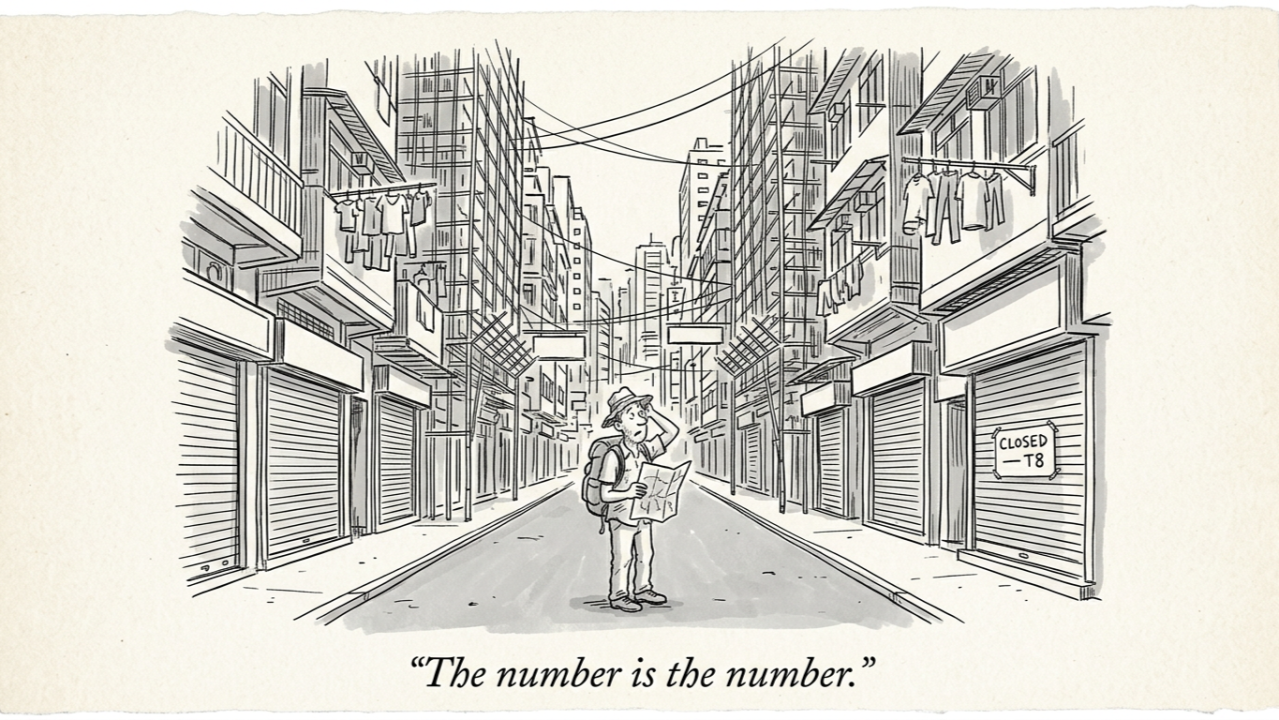
The Number
In most cities, a storm is a nuisance. In Hong Kong, it’s a spectator sport.
I want to tell you about the first time Hong Kong cancelled itself over what appeared to be light rain.
It was a Tuesday. I’d been living here for about three weeks, long enough to find my usual coffee shop and not long enough to understand anything. I woke up, looked out the window, and saw grey skies and a bit of drizzle. The kind of weather that, where I come from, wouldn’t even warrant a jacket. The kind of weather you describe to someone by saying it’s a bit damp out.
I showered. I dressed. I picked up my bag. My wife was sitting on the couch in her pajamas, watching her phone with the intensity of a day trader monitoring a margin call.
The Signal
“What are you doing?” I asked.
“Watching the signal.”
“What signal?”
She looked up at me. Then she looked at my bag. Then she looked at my shoes, which I had put on, like a person who was going to work, because it was a Tuesday, and I had a job, and that’s what you do on Tuesdays when you have a job.
“You’re not going to work,” she said.
“It’s drizzling.”
“It’s a T8.”
I did not know what a T8 was. I want to be very clear about this. I had no idea what system she was referring to, what the T stood for, what the 8 meant, or why any combination of a letter and a number should override the basic social contract between a man and his employer. I had survived blizzards. I had commuted through nor’easters. I once drove forty-five minutes in a snowstorm so bad I could not see the hood of my car because there was a meeting at nine and I was not the kind of person who missed meetings at nine.
“I think I’ll be fine,” I said, reaching for the door.
“Sit down,” my wife said, in a tone that I had learned, even in three weeks, was not a suggestion.
I sat down.
How Hong Kong Decides Reality
She explained the system to me, and the system is this: Hong Kong has a series of escalating typhoon warning signals, 1, 3, 8, 9, 10, issued by the Hong Kong Observatory, which is staffed by people who wield more power over the daily lives of seven million residents than any government minister, CEO, or landlord.
Signal 1 means a tropical cyclone is in the general area and you should be vaguely aware that weather exists. Signal 3 means it’s getting closer and the wind is picking up and you might want to secure your patio furniture if you’re the kind of person who has patio furniture, which in Hong Kong means you are very rich or very optimistic about your balcony.
Signal 8 is where everything changes.
Signal 8 means the city shuts down. Not gradually. Not partially. The whole thing. Schools close. Offices close. The stock exchange closes. Buses stop running. The ferries retreat to harbor. Construction sites, and in Hong Kong there is always a construction site, go silent, the cranes locked, the bamboo scaffolding left to sway in the wind like a prayer that the engineering holds.
If the T8 goes up during working hours, employers are required to let their workers leave, and the announcement triggers a mass exodus so sudden and so total that you’d think someone had yelled fire in a building the size of a city.
This is not optional. This is not a suggestion. The T8 is a legally and culturally binding event that overrides every appointment, every deadline, every meeting that someone spent three weeks scheduling.
Your boss cannot make you come in during a T8. If your boss tries to make you come in during a T8, your boss is wrong, and everyone knows your boss is wrong, and your boss also knows your boss is wrong but is the kind of person who sends emails at midnight and will eventually be left by their spouse.
The City Wants It
“But it’s barely raining,” I said, looking out the window at what I maintained was, at most, a moderate drizzle.
“That’s not the point.”
“What’s the point?”
“The signal is the point.”
This is the thing that took me the longest to understand. The weather outside your window is almost irrelevant. What matters is the number. The Observatory issues the number, and the number determines reality.
I have seen T8 signals where the sky above my apartment was a placid grey and the wind was barely strong enough to inconvenience a napkin. I have also seen days where rain was hammering sideways into buildings and trees were bending at worrying angles and the signal was still at T3, meaning the city was expected to function normally, and it did, because the number said so, and the number is law.
The Observatory does not care about your anecdotal evidence. The Observatory does not care that it’s sunny in Wan Chai. The Observatory has data and models and anemometers and a solemn responsibility to the people of Hong Kong.
This, by the way, is why every person in Hong Kong becomes an amateur meteorologist between June and October. Typhoon season transforms the city into a collective of seven million weather analysts, all of them refreshing the same app, all of them tracking the same spiral of clouds churning somewhere in the South China Sea.
Because here is the truth that everyone in Hong Kong knows and no one will say to a tourist: people want the T8. They want it with a longing that borders on spiritual.
A T8 is a snow day for adults in a city that never sees snow.
It is the universe tapping you on the shoulder and saying, Not today. Today, you rest.
Timing Is Everything
The rituals are immediate and universal. The moment the T8 is hoisted, a cascade of actions unfolds across the territory with the coordination of a military operation, except the objective is comfort. Supermarkets are raided. Not for emergency supplies, for snacks. For beer. For the ingredients to make hotpot.
Then the city goes still. Seven million people in their apartments, eating snacks, watching the rain, or the drizzle, or the clear skies, it doesn’t matter, and refreshing the Observatory website to see if the signal will hold.
The drama of the T8 is not the storm. The drama is the timing.
A typhoon that arrives on a Saturday is a tragedy. A typhoon that arrives on a Friday afternoon is perfection. But the true holy grail is the T8 that goes up on Sunday night and stays up through Monday.
A free Monday. An impossible Monday. A Monday that simply ceases to exist because a weather system five hundred miles wide decided to park itself over the South China Sea at exactly the right moment.
Stop
The lowering of the signal is its own spectacle. The Observatory, in its wisdom, does not simply cancel the T8. It downgrades to a T3, and then announces a two-hour window before public transport resumes and employers can expect workers to return.
My first T8 lasted about six hours. The rain, such as it was, picked up around noon, got genuinely impressive for about forty minutes, and then subsided into the kind of grey mugginess that defines a Hong Kong summer.
“Everything stops.”
I looked out the window. The rain had stopped entirely. A man on the street below was walking his dog. The sky was the color of old dishwater, threatening nothing.
“The weather seems fine now.”
“The signal’s still up.”
I ate another chip. I was beginning to understand.
I’ve been through many typhoons now. I’ve experienced the genuine ones, the T9s and the T10 that came through and rearranged the city, trees down, windows blown in, the harbor churning like a washing machine.
But I’ve also been through the gentle ones. The T8s where the most dangerous thing outside was a rogue umbrella. The days where the gap between the signal and the reality was wide enough to drive a minibus through.
Hong Kong will fight about anything. Property prices. School placements. Whether the air conditioning in the MTR is too cold. But no one argues against the T8.
It is the one point of universal agreement in a city of seven million opinions. The system works not because it’s meteorologically precise, but because it gives this relentless, sleepless, never-stop-moving city permission to do something it desperately needs and cannot otherwise bring itself to do.
Stop.
The T8 is Hong Kong’s off switch. And the city loves it.
I check the Observatory app every morning during typhoon season now. I study the tracking maps. I monitor the coordinates. I have opinions about storm trajectories and I share them in group chats with the confidence of a man who three years ago did not know what a T8 was.
Last September, a tropical cyclone formed east of the Philippines and began moving west. The models were ambiguous. Some showed it curving north, away from Hong Kong. Others showed a direct hit. It was a Thursday.
“If it holds this track,” I told my wife, studying my phone with the focus of a surgeon reading a scan, “we could get a T8 by Friday afternoon. Maybe lasting into Saturday, but that’s wasted. The Friday is what matters.”
She looked at me. She looked at the man who had once put on his shoes in a typhoon because it was a Tuesday and he had a job.
“You’ve changed,” she said.
The typhoon curved north. The T8 never came. Friday was a regular Friday. I went to work. The meeting happened. The coffee was fine.
But somewhere out in the Pacific, another storm is always forming. And when it does, this city will do what it always does, track it, debate it, hope for it, and pretend the whole thing is about the weather.
It was never about the weather.
Comments
One response to “The Number: Hong Kong’s Favorite Weather Event”
Nicely written!