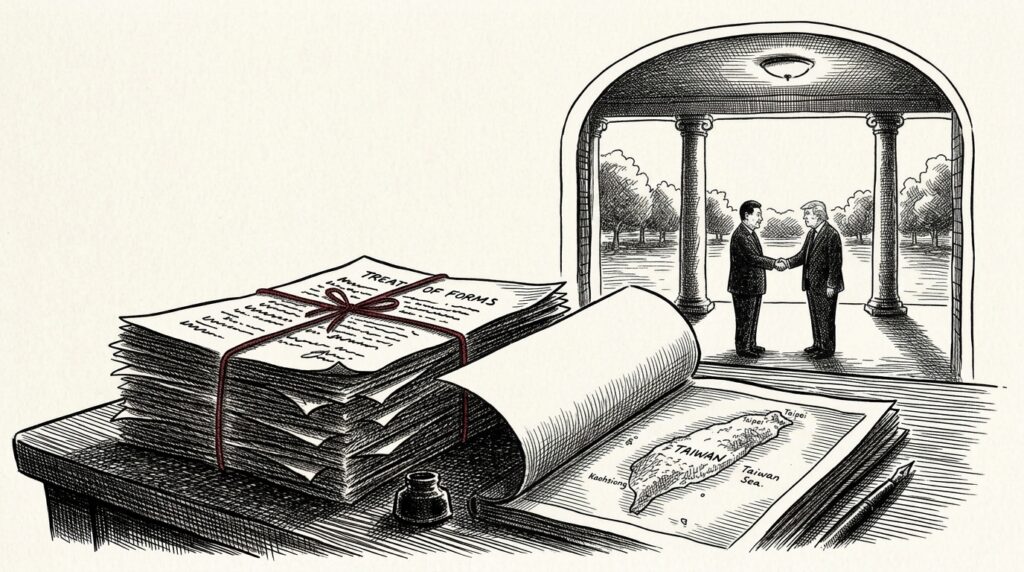
Xi Jinping lands in Washington today for his first visit to the White House in eleven years, and by every account I’ve read from people actually briefed on the agenda, Taiwan is less an item on the list than the ceiling the whole visit is happening under. Beijing has reportedly signaled it might walk away entirely if new arms sales to Taipei get approved before the two leaders sit down. Chinese state television has been calling Taiwan “the most important issue” in the relationship for months now. There’s a protester on a light pole outside the White House as I write this. None of that is speculation, it’s what’s being reported today, this week, by people with far better sourcing inside the building than I have.
Quick housekeeping before I get into it, since I’d rather tell you upfront than bury it: I wrote a book about the history underneath this exact fight, The Wound That Never Closed: Taiwan, China and the End of Strategic Ambiguity, and given the summit, I’ve made it free on Amazon this week, no credit card required, just the orange “Buy Now” button set to $0.00. JUST CLICK HERE. That’s the only mention of it you’ll get until the end. Back to the actual story.
I say all this as someone who’s been watching the narrative around Taiwan shift for a couple of years now, and who’s noticed something that I suspect most people parachuting into this story this week haven’t: there are at least three separate, largely incompatible stories being told simultaneously right now, and almost nobody covering the summit is bothering to explain the seventy years of history that makes all three of them sound plausible to the audience each one is aimed at.
The first story, the one Beijing is telling, is that Taiwan’s return is simply unfinished business, a wound, not a war, and that the current moment is an opportunity, not a threat. That story got a very specific boost last month when a Taiwan-based academic, writing under his own name on a mainland platform, published a detailed institutional proposal for how “one country, two systems” could actually work for the island, complete with a bilateral treaty, a constitutional chapter, an enumerated-powers structure, and a compliance mechanism with automatic suspension if either side breaks the deal. Beijing’s Taiwan Affairs Office publicly praised the essays within two weeks. I don’t think it’s an accident that this proposal surfaced right as the summit was being finalized. Whether or not that timing was coordinated, it gave the “peaceful, structured, already-being-worked-out” story a concrete document to point to, right when the cameras were about to show up.
The second story, the one you’ll hear from Taiwan’s own government and most of the analysts I trust most on this, is that none of that structural detail matters if the guarantor holds interpretive authority over its own guarantees, which is the exact objection Taiwan’s own Mainland Affairs Council raised about the proposal within days, comparing the promise of enforceable autonomy to trying to catch a fish by climbing a tree. This story isn’t optimistic or pessimistic so much as procedural, it says: show me the enforcement mechanism that survives contact with a government that also writes the rules, and I’ll take the offer seriously. Until then, the story goes, “structured” is just “unstructured” with better formatting.
The third story is the one dominating a lot of Western coverage this week, and it’s mostly about Trump and Xi as personalities, deal-making theater, state dinners, tech CEOs at the East Room, whether Taiwan gets traded away for a rare-earths agreement or an end to the Iran war. That story isn’t wrong, exactly, it’s just incomplete in a way that makes the other two stories nearly impossible to evaluate. You can’t judge whether an arms-sale pause is a concession worth worrying about if you don’t know what’s actually being conceded, or what history the concession sits on top of.
Here’s what I keep noticing, watching this coverage roll in: almost none of it explains why 1895 matters to a summit happening in 2026. I get it, deadline pressure is real, and “here’s a Qing dynasty treaty” is a hard sell in a 900-word wire piece. But the reason Beijing can call this “unfinished business” with a straight face, and the reason that framing lands with some audiences and sounds absurd to others, traces directly back to a chain of documents most readers have never seen laid out end to end: the actual text of the Cairo Declaration, what the Potsdam Declaration really said about Japanese sovereignty, what Japan’s 1951 renunciation of Taiwan did and didn’t specify about who the island belonged to afterward, and what UN Resolution 2758 actually says, as opposed to what both sides now claim it says. That last one especially. The resolution is 155 words long. It never mentions Taiwan. And yet you’ll hear “the world has already decided this” from one side of the debate and “this resolution settles nothing” from the other, and both sides are citing the same 155 words.
The book I mentioned up top traces exactly this gap, the space between what the documents actually say and what seventy years of political shorthand have flattened them into, because I got tired of watching people argue about Taiwan using talking points instead of the primary sources underneath them. It traces the whole chain, Shimonoseki through Cairo through the San Francisco Treaty through 2758, lays out the actual military and economic balance rather than the talking-points version of it, and gets into what a real reunification framework would need to survive contact with the enforcement problem Taiwan’s government just raised in public. I finished writing it about a year ago, well before any of this was front-page news, which in hindsight was either good timing or bad timing depending on how you feel about writing a niche book that stopped being niche. If you’re a reporter filing on this summit by tomorrow and don’t have three hours to read four treaties yourself, that’s the fastest way I know to get the actual chain of documents in one place, rather than the flattened version of each one that’s been circulating in group chats and cable panels for a decade.
Xi and Trump will shake hands today, there’ll be a state dinner tonight, and somewhere in a conference room neither of us will ever see, someone will decide how much of Taiwan’s arms package survives the week. Whatever comes out of it, the three stories I described above aren’t going away, and none of them will make much sense to anyone who’s only ever heard one of them.
Comments