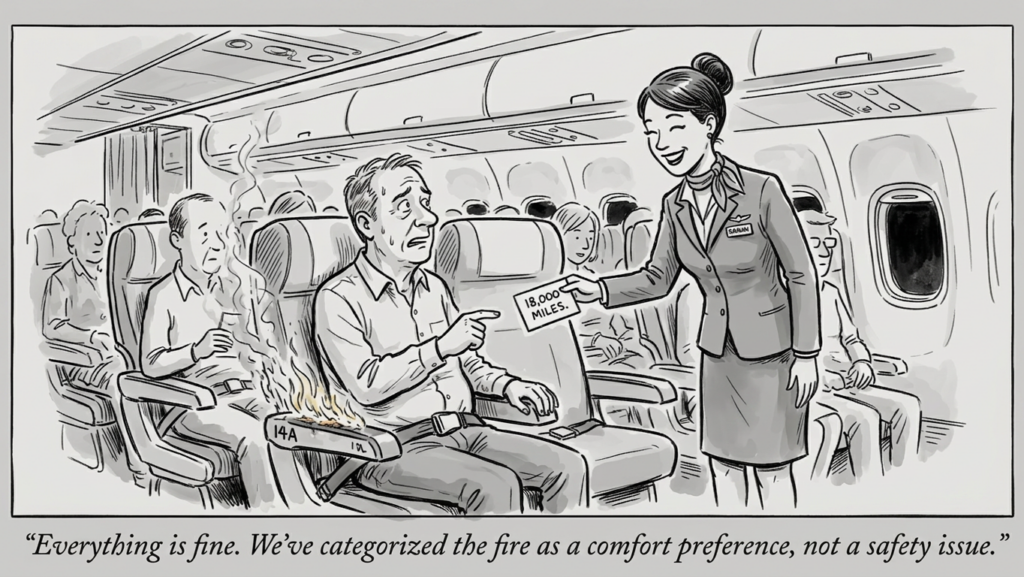
Or, How Two Corporations Taught Me That Indifference Is a Business Strategy
As many of you already know, I grew up in Adams, Massachusetts, a mill town of about 8,000 people wedged into the northern Berkshires, the kind of place where the mountains are older than the country and the families aren’t far behind. It was a town built on limestone and labor, and by the time I was old enough to notice, the mills were mostly closed but the people who had worked in them were still there, still running things the way they always had: personally, imperfectly, and with the understanding that your word was the only currency that mattered because everyone knew where you lived.
There was a hardware store on Summer Street run by a man named Albert. Albert didn’t have a mission statement. He didn’t have a customer satisfaction portal or a feedback loop or a representative named Jasper. He had a counter, a cash register, and the unshakeable knowledge that the person standing in front of him would be standing behind him in line at the post office tomorrow morning, and that his mother would hear about it either way.
Small towns teach you something that corporations have spent billions trying to unlearn: that accountability is not a policy. It is a proximity. In Adams, if you sold someone something and it didn’t work, you couldn’t hide behind a case number or a four-month silence or a man named Jasper who had no memory of what you’d promised. You had to look at the person. At church. At the grocery store. At the Fourth of July parade where you were both standing on the same sidewalk, watching the same fire truck go by, and there was nowhere to go.
If you bought something from Albert and it didn’t work, Albert did not send you a letter explaining that the product had performed as designed and that your experience of it not working was a “personal comfort preference.” Albert did not offer you 18,000 airline miles or loyalty points. Albert took the thing back. He said he was sorry. He fixed it. And he did this not because he had attended a seminar in a Marriott conference room led by a man in a fleece vest, but because you lived three streets away and accountability, in a town like Adams, was not a corporate value. It was a geographic inevitability.
Every business traveler who has ever been on a trip knows the feeling. You are tired. You are far from home. You just want what you paid for. And when you complain, you are offered points instead of answers. The person on the other end of the email has never seen your face and will never see it again. They are not trying to help you. They are trying to close your file. The miles are not compensation. They are a settlement. A confession. We know something happened. We are not going to tell you what. Here are some points. Please go away.
I left Adams a long time ago. I live in Hong Kong now. I practice law here and in the United States. I have spent thirty years flying internationally and staying in hotels on numerous continents. I have lived, in other words, in the world that replaced Albert’s, the world of points and portals and case numbers, where the person who sold you the thing and the person you complain to about the thing have never met, and neither of them will ever see you at church.
I have been thinking about Albert a lot lately, because I have spent the last six months dealing with two corporations that have made me understand, with a clarity I did not previously possess, that the entire machinery of modern customer service has been engineered to do one thing: make you go away.
The first is Cathay Pacific. The second is the Banyan Group, which operates Banyan Tree Resorts. Both are brands I once trusted. Both taught me the same lesson: when a corporation decides that your complaint is worth less than the cost of answering it honestly, they will offer you points. And they will bet, correctly in most cases, that you will take the points and disappear.
I did not take the points. I did not disappear. I am writing this instead.
Part One: The Burning Smell
On 16 October 2025, I was aboard Cathay Pacific flight CX501, Tokyo Narita to Hong Kong. During the flight, multiple seats in my row and the row behind exhibited signs of an electrical fault: continuously flickering control lights, inoperative in-seat power systems, and a distinct burning smell consistent with overheating electrical components.
Not the smell of someone’s reheated noodles. The smell of something electrical that has made a decision about its future and is communicating that decision through heat.
I reported it to the cabin crew. They told me it was “not a safety issue.” No fire extinguishers were positioned. No power was isolated. No passengers were relocated. Cathay refuses to confirm whether the flight deck was informed. The official assessment of a burning smell and clear indicators of an electrical fault in a pressurized aluminum tube at 38,000 feet was: not a safety issue.
Standard safety protocols for cabin smoke or burning smells are unambiguous: notify the flight deck immediately, isolate power to the affected area, position fire extinguishers, relocate passengers. These protocols exist because of incidents like Swissair Flight 111, where an unusual smell in the cockpit, initially dismissed as an air conditioning issue, turned out to be an electrical fire that brought down an MD-11 over the Atlantic in under twenty minutes, killing all 229 people on board. The entire modern framework for smoke and fumes response in commercial aviation was built on top of that wreckage. On CX501, none of it was followed.
Albert, who dropped out of school at sixteen and knew nothing about aviation, would have had follow-up questions. The cabin crew of Cathay Pacific did not.
I reported the matter to Cathay’s customer care team that same day. I also reported it to the Hong Kong Civil Aviation Department while still in the air, because I am the kind of person who reads accident investigation reports for recreation and I know what electrical faults do to aircraft when people decide they are not a safety issue. I am also a solicitor in Hong Kong and an attorney in the United States who has handled aviation accident cases, and I write on, among other things, aviation and transportation matters for a publication read by over 200,000 industry professionals, which I mention not to impress you but to explain why Cathay’s response over the following six months was not just inadequate but, to someone who understands what an electrical fault in a pressurized cabin actually means, genuinely alarming.
What followed was six months of something I have come to call The Playbook.
The Playbook
The Playbook is not complicated. I suspect it is taught somewhere, a conference room, a fleece vest, a PowerPoint titled “Managing Difficult Customers: A Guide to Strategic Indifference.” It has seven steps, and Cathay ran every single one of them.
Make the problem smaller. On 7 November, three weeks after I reported a multi-row electrical fault with a burning smell on a commercial aircraft, Cathay’s customer care representative, Jon Erghie, wrote back. He described the incident as a “seat recline mechanism not functioning properly.” A comfort issue. He apologized for the impact on my “experience.” He offered 18,000 Asia Miles.
A seat recline issue. As if I had been upset about legroom and decided to contact civil aviation authorities mid-flight about it. As if a man who has flown internationally for thirty years had never encountered a broken seat before and simply lost his composure.
This is not incompetence. Albert was sometimes incompetent. He once installed a shelf that fell on a customer. But he did not then write to the customer explaining that the shelf had performed as designed and that gravity was a personal comfort preference.
Get the facts wrong, then ignore the correction. I corrected the record. I explained that multiple rows were affected, that the flickering was continuous and independent of any passenger interaction, that there was a burning smell that his response had not mentioned at all. I posed four specific questions: What caused the fault? Was it known before departure? Was the flight deck notified? What did the inspection find?
Mr. Erghie responded that “when some passengers pressed the seat controls, this caused flickering of the cabin lights.” This was wrong on two counts, it was the seat control lights, not the cabin lights, and the flickering was continuous, not triggered by passengers pressing anything. He also made no mention whatsoever of the burning smell, which is a bold editorial choice when the burning smell was the entire reason I contacted a regulator from seat 11D.
I corrected the record again. In detail. His next response did not acknowledge the correction.
Erase the spouse. My wife was seated in the affected row. Cathay addressed all correspondence to me. The miles were offered only to me. My wife, a human woman who also sat in a seat that smelled like it was burning, was edited out of the narrative entirely. I raised this twice before she was acknowledged, and only then because I had made it impossible to ignore. This is how you cut your exposure in half without doing anything. Albert did not have this technology. Albert had to look at both of you.
Promise action using words that sound like action. On 18 December, after I had pushed back repeatedly and made clear that I was not going away, Mr. Erghie wrote that my concerns had been “escalated to the Inflight Management Team, Engineering Department, and Safety and Operations teams for immediate review” and that I would receive “a substantive update once the findings are available.”
This is a beautiful sentence. It has departments. It has the word “immediate.” It has the promise of findings. What it does not have is a future.
The long silence. Four months. From 18 December 2025 to 21 April 2026. No update. No findings. No “we’re still working on it.” Nothing. Just the vast, corporate quiet of an organization that has decided your file can be closed by neglect.
Albert could not go four months without seeing you. You came in for nails. You ran into him at church. Silence was not available to him as a strategy. He’d have had to physically leave town.
When I finally wrote again on 21 April, politely, giving Cathay every benefit of the doubt, I pointed out what should have been obvious: aircraft maintenance logs are contemporaneous records. Identifying what was found and remediated should be a straightforward matter of consulting those logs. The information either exists or it does not. The prolonged silence suggested either that the issue was more serious than acknowledged, or that my report was never acted upon with the urgency Mr. Erghie’s letter implied. Neither possibility was comforting from a passenger safety standpoint.
The new representative. The response came not from Mr. Erghie but from a man named Jasper. Jasper appeared to have no knowledge of Mr. Erghie’s promises, despite the fact that the full chain of our previous correspondence was attached to his reply. No knowledge of the three-department review. No knowledge of the four months of silence. Jasper was a clean page. Jasper was the corporate equivalent of a goldfish. His entire function was to make the previous six months unhappen. And Jasper offered me 18,000 Asia Miles.
The same 18,000 miles. The identical number. The same offer Mr. Erghie had made in his very first email, back when he was still pretending an electrical fault with a burning smell was a seat recline issue. Six months of correspondence, four unanswered safety questions, a written promise of findings from three departments, four months of silence, and the output of this entire process was the same number Cathay started with, wrapped in different words, presented by a different person, as if it were a new idea.
The miles. I want to talk about 18,000 Asia Miles, because 18,000 Asia Miles is a specific kind of insult. It is not nothing. It is also not anything. It is a one-way flight from Hong Kong to Bangkok. Maybe. If you book far in advance, if there is availability, if the algorithm is feeling generous. It is the smallest gesture that can be dressed up as goodwill. It is the corporate equivalent of finding a mint on your pillow after someone has set your room on fire.
The miles are not compensation. The miles are a message. The message is: we have calculated what it would cost to actually answer your questions, and we have compared it to the cost of a one-way ticket to Bangkok, and Bangkok won.
I rejected the miles. I have four questions. Six months later, I have zero answers. I have escalated to Cathay’s CEO. If answers are not forthcoming, the regulators with jurisdiction over the route will be formally notified next.
Albert would have had the answers by Tuesday.
Tai Po
I need to stop here, because everything I have told you so far, the mischaracterizations, the silence, the miles, the goldfish, would be merely infuriating if it existed in a vacuum. It does not exist in a vacuum. It exists in the same city, in the same year, as Tai Po.
On 26 November 2025, six weeks after my flight, a fire broke out at Wang Fuk Court, a housing estate in Tai Po, Hong Kong. The estate had been undergoing renovation. All eight of its 31-storey residential towers were wrapped in bamboo scaffolding and construction netting. The windows had been sealed with polystyrene foam boards. The fire alarms, as residents would later testify, did not sound.
The fire burned for 43 hours. It consumed seven of the eight buildings. It killed 168 people. It was Hong Kong’s deadliest blaze since 1948.
The investigation revealed what investigations like this always reveal: the warnings had been there. Residents had complained about the flammable foam boards. They had complained about workers smoking on the scaffolding. The owners’ corporation had tried to pressure the contractor to use fire-resistant materials. The contractor insisted the law did not require it. Complaints were filed with the Labour Department. The Labour Department responded twice and found no issues. The foam boards stayed. The netting, which later failed fire-retardant testing, stayed. The smoking continued. Everyone responsible for checking had checked, and everything had checked out, and 168 people died anyway.
Not because of malice. Not because of a single, dramatic failure. Because of a cascade of small ones. A complaint filed and acknowledged and filed again. An inspection conducted and passed. A material that everyone suspected was dangerous but nobody had the authority or the will to remove. A system designed not to identify problems but to process complaints about problems, to receive them, log them, respond to them in the language of adequacy, and move on. Until the day the problem was real, and the language was not enough, and the complaint was no longer a line item but a body count.
“Did not identify any non-compliance issues.” That is what the Labour Department said. “Not a safety issue.” That is what the cabin crew told me on CX501. The language is the same. The instinct is the same. The assumption, that the person raising the concern is probably wrong, that the issue is probably minor, that the cost of investigating is higher than the cost of ignoring, is the same assumption that was made about the foam boards at Wang Fuk Court, and about the netting, and about the smoking, and about every other small warning that was received and logged and responded to and not acted upon.
On 2 December 2025, three weeks after 168 people had burned to death in a building twenty minutes from my apartment, while the city was still in mourning, while recovery teams were still finding bodies in stairwells, I wrote to Cathay. I told them about Tai Po. I told them that this was precisely the type of lax attitude about safety that leads to tragedy. I asked them, in light of what had just happened to this city, to take my report seriously.
It made no difference. Mr. Erghie’s response, sixteen days later, was the escalation promise that was never honored. Four months of silence followed. Then Jasper. Then the miles. The same miles that had been offered before anyone had mentioned Tai Po, before 168 people had died, before the word “indifference” had acquired the specific, devastating weight that it now carries in Hong Kong.
I cited the worst fire in this city in nearly eighty years. The response was a one-way ticket to Bangkok.
I am not comparing a burning smell at 38,000 feet to 168 deaths. I am comparing the indifference. I am comparing the machinery. The system that processed the residents’ complaints about foam boards is the same system that processed my report of an electrical fault. It receives. It logs. It responds in the right language. It closes the file. And it does this whether the file is a malfunctioning tray table or a burning smell or a foam board that a resident has been warning about for months, because the system does not distinguish between a complaint that is merely inconvenient and a complaint that is a matter of life and death. It treats them all the same. It treats them all with miles.
Part Two: The Pool That Wasn’t
Six months after CX501, my wife and I booked a Sea View Pool Duplex Villa at the Angsana Zhuhai Phoenix Bay, a Banyan Group property. The Banyan Group, whose homepage currently invites guests to “live 100 Journeys” and promises that “this is not just about where you stay, but about what stays with you.”
I can confirm the second part. Something stayed with me.
Let me be clear about a few things upfront. The nightly rate was CNY 2,925, roughly USD 400. In the world of private-pool villas at properties that position themselves as luxury, this is not a large sum. It is, in fact, minuscule. I know this. This is not a story about money. This is a story about what a brand promises and what it delivers, and what happens when those two things diverge and the brand decides that the divergence is your problem.
And I should say: the property itself was not bad. The rooms were clean, the staff were generally pleasant, the location was fine. It was a perfectly decent hotel. But it was not a five-star property. It was not close to a five-star property, which is what it was marketed as. It was a solid, competent mid-range resort that has been dressed in the language of luxury by a brand that knows the vocabulary but has not entirely committed to the substance behind it. This matters, because when you borrow the language of Banyan Tree, when you trade on that name and that expectation, you are making a promise. And when the promise is a heated private pool and the reality is a cold plunge that your guests cannot enter, the gap between the language and the reality is not a matter of personal preference. It is a matter of honesty.
I have written previously about my complicated history with water temperature. The short version: in 1986, my friend Jason filled a hot tub with a garden hose in the Berkshires at the precise moment four girls from Pittsfield arrived to get in. The water went from 102 degrees to 55. The girls left. I have not fully recovered. That ruined my adolescence.
Forty years later, I booked a Sea View Pool Duplex Villa at the Angsana in Zhuhai specifically for its private heated pool. The pool was ice cold. Neither my wife nor I could get past our knees. We raised it with staff. They told us the pool heater is not operated at night due to noise concerns. The heater, the device that makes a heated pool a heated pool, is switched off during the hours when guests are most likely to use it. Because it makes noise. We heard no noise the entire time we were there, no mechanical hum, no vibration, nothing that would explain switching the heater off. This is like selling someone a car and explaining that the engine is not operated during driving due to vibration concerns.
My suspicion is simpler and less generous: the heater is switched off when the villa is vacant and at night to save on electricity costs, and when a guest checks in, nobody switches it back on unless there is a complaint. A pool that size doesn’t reach temperature in an hour. It takes the better part of a weekend. So by the time you arrive, unpack, change, and walk out to your private heated pool with a glass of wine and the expectation of warmth, the water is still ice cold and will remain ice cold for days, especially if turned off at night. If you’re only staying two nights, as we were, you’ve lost the entire reason for your stay to a cost-saving measure the hotel will never admit to.
That only ruined a weekend. It did not jeopardize the lives of a plane full of people who had family members waiting for them at the gate. But the pattern is the same. You pay a premium. You are promised something specific. And when it is not delivered, the explanation you receive is not an apology but an absurdity.
So when I say that paying a premium for something and not receiving it is a recurring theme in my life, I am not being dramatic. I am being historical.
What followed was The Playbook again. The same Playbook. I am starting to think the fleece vest man gets around.
The property told us the pool was at 28°C, that it “complies with the standard temperature requirement for a heated swimming pool,” and that our inability to enter the water was a matter of “personal comfort preference.” Sound familiar? Cathay’s first response to an electrical fault, flickering seat controls, inoperative systems across multiple rows, and a burning smell at 38,000 feet, was to call it a “seat recline mechanism not functioning properly” that “impacted your comfort” and made my journey “not as pleasant as it should have been.”
The language is different. The strategy is identical. Redefine the product to match what was delivered or lie, then redefine the complaint as the customer’s problem. The pool isn’t cold, you just have a “personal comfort preference.” The seat isn’t an electrical fault, it just “impacted your comfort.” Nowhere in six months of correspondence has Cathay used the words “electrical fault,” “short circuit,” or “fire risk.” They have used the word “comfort” nine times.
Two adults standing knee-deep in a pool they have paid a premium to swim in, visibly unable to continue, is not a personal comfort preference. A personal comfort preference is whether you like firm pillows. This was a pool that was not heated being sold as a pool that was heated. And that is annoying. A burning smell from a seat with a flickering electrical system in a pressurized cabin at 38,000 feet is not a comfort issue. It is not a pillow issue. It is not a customer satisfaction issue to be closed out with frequent flyer miles. It is a safety issue that could, in different circumstances, cost people their lives. On the plane, it was not treated that way.
To prove the pool was functioning, the property sent me a photograph of an infrared thermometer pointed at the pool’s surface. On a sunny afternoon. After we had checked out. I am going to explain why this means nothing, and I apologize in advance, because this is the part of the story where I become the man at a dinner party who won’t stop talking about thermodynamics. An infrared thermometer reads the surface temperature of whatever it is pointed at. On a sunny day in southern China, the surface of any outdoor body of water will be warm because the sun is heating it directly and warm water rises. You could point an infrared thermometer at a puddle in a parking lot and get a reading that suggests the puddle is a luxury amenity. The question is not what the surface reads at 3 p.m. on a sunny day. The question is what the water is at depth, where a person actually swims, at the time the person is trying to swim.
Presenting a sunny-afternoon surface reading to a guest as proof that the pool was functioning properly is the thermal equivalent of a magician showing you the empty hat and hoping you don’t ask about the rabbit.
I escalated to Banyan Group’s corporate customer service and explained that I no longer wished to deal with the local property, because the local property had spent days telling me the pool was fine while I stood in it and it was not fine. Corporate sent me back to the local property. This is the corporate equivalent of calling the police and having them transfer you to the burglar.
And then came the contradiction that turned the whole thing into something I could not walk away from.
I posted a factual review on TripAdvisor. The property responded publicly that it had “immediately reviewed and improved our pool heating system and operation procedures to ensure consistent and comfortable water temperature for all pool villa guests.”
Read that again. They improved the pool heating system. The same system they had just finished telling me was working perfectly at 28°C. The same system whose failure was, according to their private correspondence, a matter of my personal comfort preference.
You cannot tell a guest privately, repeatedly, in writing, that nothing was wrong, while announcing publicly that you have fixed the thing the guest complained about. Either the pool heating was adequate and no improvement was needed, or it was not adequate and the representations made to me were false. There is no reading of these two positions that allows both to be true. I pointed this out to Banyan Group. They have not responded to it. I do not expect they will.
I also pointed out that the property holds a perfect 5.0 on TripAdvisor with over 13,000 reviews, most in English, for a 202-room hotel that opened in 2018 and caters to local Chinese. On Booking dot com, where every review must be tied to a verified stay, the same property scores 8.2 with fewer than 100 reviews. A sister property in the same city, opened in 2023, shows the same pattern: 5.0 on TripAdvisor with approximately 7,120 reviews. Same impossible volume. Roughly eight perfect reviews every single day since its opening. That’s not a pattern. That’s a manufacturing line.
I asked whether this was consistent with organic guest feedback. Nobody answered. Some questions contain their own answers. In short, Banyan Group has, to date, not denied the implication that the reviews were fraudulently manufactured to deceive consumers.
The local property’s Director of Rooms eventually offered a refund of one night or a complimentary return stay of one night. He apologized. He took more personal responsibility than anyone else in this story. But he did not acknowledge that I did not receive what I paid for, or that there was anything wrong with the pool. And a free night at a hotel where the pool doesn’t work is an invitation to return to the scene of the disappointment and experience it again, this time with the added indignity of gratitude. Let me be clear: this was never about the money. The rate was modest. What was not modest was the promise, a heated pool, a luxury brand, a Banyan Tree experience, and when the promise broke, the principle of how a company responds to that failure became the only thing that mattered
And now Banyan Tree has promised a full investigation. The matter has been “formally escalated to the Hotel Management team for immediate review.” The communications team is conducting “internal scrutiny.” I will be provided with “a further update and a resolution as soon as the investigation is complete.” If that language sounds familiar, it should. On 18 December 2025, Cathay told me my report had been escalated to the Inflight Management Team, Engineering Department, and Safety and Operations teams for “immediate review,” and that I would receive “a substantive update once the findings are available.” That was four months and zero findings ago. The next time I heard anything, it was a different name, the same 18,000 miles, and a thank-you for my patience. I have no reason to believe Banyan Tree’s promise will age any differently. The investigation is the resolution. The promise of a future answer is the answer. The file stays open just long enough for the customer to stop writing, and then it closes itself.
The Pattern
Let me name it, because it is not unique to Cathay or Banyan. It is everywhere. It is the operating system of every corporation that has decided that customer service is a cost to be minimized rather than a relationship to be maintained.
Mischaracterize the issue. Make it a comfort problem instead of a safety problem. Make it a preference instead of a failure. Offer a small gesture, miles, points, a discount, a free night, something that costs the corporation almost nothing but can be framed as goodwill. If the customer persists, promise escalation. Use words like “immediate review” and “substantive update.” Then go silent. Wait. Most customers will give up. If they don’t, assign a new representative who has no memory of the prior promises. Offer the same small gesture again, in different words, as if it were a new solution.
Assume the customer has no platform. Assume they are alone. Assume they will eventually accept the miles and disappear.
Anyone who has ever spent a night in a hotel that was not as advertised. Anyone who has ever been assured that the issue was “being escalated.” Anyone who has ever been offered miles instead of an apology. They know this feeling. They have been Jaspered. They have taken the miles. They have gone away. And they have felt the small, corrosive shame of accepting the miles and disappearing.
What Stayed with Me
The Banyan Group’s homepage says: “This is not just about where you stay, but about what stays with you.”
Here is what stays with me. A pool that was sold as heated and was not. A burning smell that was reported and dismissed. A written promise of findings that was never honored. A corporation that treated my wife as invisible until it was administratively convenient to acknowledge her. A case number. A new representative. A long silence. And, at the end of it all, the same offer: a small pile of loyalty currency, worth almost nothing, designed not to make things right but to make me go away.
I wrote a book about this pattern. It’s called Profit Before People. It traces the same logic from thalidomide to the Ford Pinto to forever chemicals. Again and again, internal testing reveals danger. Engineers raise concerns. Fixes are proposed and rejected as too expensive. Marketing continues. Warnings are softened or removed. When injuries and deaths become impossible to ignore, lawyers step in. Time is weaponized. Accountability, if it comes at all, arrives years late, after the damage is done. I thought I understood the pattern intellectually. I had researched it, written about it, built a career around it. But I had never been on the receiving end of the machinery itself. CX501 and Angsana Zhuhai changed that. The Playbook is not abstract. It is a lived experience. And it costs lives.
And Tai Po. Tai Po stays with me. One hundred and sixty-eight people who filed complaints that were received and logged and responded to and not acted upon. One hundred and sixty-eight people who were told that things complied with standards. One hundred and sixty-eight people who trusted the system, because the system responded to them in the language of adequacy, and the language was a lie, and the lie killed them.
I rejected the 18,000 miles. I rejected the free night.
Albert would understand. Not the miles, Albert would find the entire concept of a loyalty point genuinely baffling, the invention of a world where the person who sold the thing and the person who bought the thing would never have to stand in the same room again.
But he would understand the writing. He would understand that when someone sells you something and it doesn’t work, and they won’t look you in the eye, and they won’t answer your questions, and they send Jasper instead, the only thing left to do is tell the story.
That is what we did in Adams. When the system failed, we didn’t file a case number. We told our neighbors. And our neighbors remembered. So I’m telling it. Not for the miles. Not for the pool. For the 168 people who tried to tell theirs, but were ignored by the people who were paid to listen and keep them safe.
Cathay Pacific and Banyan Group: you are invited to respond here with a substantive answer. Albert would have.