Where Was Universal Suffrage in Her Defense?
On August 21, 2026, a panel of three judges at Hong Kong’s Court of First Instance convicted Chow Hang-tung and Lee Cheuk-yan of incitement to subversion. Within the hour, every major English-language wire service ran some version of the same headline: Hong Kong convicts democracy activists. The framing was instant, automatic, pre-loaded. Democracy. Activists. Convicted. As if a woman had been arrested for wanting to vote.
She was not arrested for wanting to vote. She was convicted of inciting the overthrow of a state.
I know this because I read the mitigation. All eighteen paragraphs of it. Chow delivered it herself, in open court, representing herself, because she is a barrister, called to the Hong Kong Bar in 2016, a member of Harcourt Chambers, a woman who studied geophysics at Cambridge before pivoting to law at the University of Hong Kong. She is not a protester who wandered into this. She is a trained lawyer who chose her position with precision, articulated it with eloquence, and stated it in terms that leave zero ambiguity about what she was actually doing.
She was not pursuing democracy. She was pursuing the end of the Chinese Communist Party’s rule. She said so. Repeatedly. In her own words. In a courtroom. On the record. And the Western press still called it a Hong Kong democracy case.
I have written about Hong Kong’s relationship with democracy at length. I wrote a closing argument explaining that Beijing proposed universal suffrage within seventeen years of the handover, that Britain had not proposed it in 156, that the 2014 proposal included a publicly registered nominating committee whose overwhelming majority of members were elected, that pan-democrats themselves won a quarter of its seats, and that the final stage was a direct one-person-one-vote ballot with no Electoral College and no superdelegates. Twenty-seven legislators voted no. Five million people never got to vote at all. The people who claimed to speak for democracy denied democracy in the name of demanding it.
I bring this up because Chow Hang-tung’s mitigation is a perfect exhibit of what actually happened in Hong Kong, as opposed to what the international press reported happened.
Read the mitigation. Read it slowly.
Paragraph 1: “The 206-page judgment, after all, boils down to saying that pursuing democracy is a crime.” This is how every Western outlet framed the conviction. And it is not what the judgment says. The judgment says she incited subversion under Articles 22 and 23 of the National Security Law. The charge was not believing in democracy. The charge was inciting the overthrow of the state’s basic system. There is a difference between those two things, and Chow, a barrister, knows the difference better than most.
Paragraph 2: “I find it entirely unpalatable that any political party can barter away a nation’s sovereignty, claim to represent the will of the people, appoint itself as the sole authority, and then insist that citizens are legally bound to uphold its self-fashioned throne. A law of this nature is nothing more than a euphemism for tyranny.” She is not asking for better elections here. She is declaring the constitutional order of the People’s Republic of China to be tyranny. That is not a demand for reform. That is a demand for regime change.
Paragraph 5: She compares Hong Kong’s judiciary to executioners carrying out orders in Nazi Germany. A barrister, an officer of the court, standing inside the court that admitted her, comparing the legal system she swore to uphold to the Third Reich.
Paragraph 8: “Ending one-party dictatorship is therefore an inescapable responsibility for our generation of Hongkongers and mainland Chinese alike.” Not reforming. Not improving. Ending. And not just in Hong Kong. In mainland China. She is calling for the overthrow of the ruling party across the entire country. From a courtroom in West Kowloon.
Paragraph 16: “Whether inside or outside prison, I will persistently strive to release pro-democracy activists, vindicate the 1989 Democracy Movement, hold those responsible for the Massacre to account, end one-party dictatorship and build a democratic Hong Kong and China.” She promises to continue the very conduct for which she has been convicted. Not a note of reconsideration. Not a whisper of remorse. A declaration of permanent, ongoing insurrection against the state, delivered as a mitigation plea. In any jurisdiction on earth, a mitigation that pledges to continue the offense is not a mitigation. It is an aggravating factor.
Paragraph 17: “If doing so makes me a criminal for life, if the law truly cannot accommodate our beliefs, then I would rather be a criminal than a person who betrays their conscience.” A lawyer, telling a court, during sentencing, that she will continue to break the law.
Here is something the international press will never report, because reporting it would ruin the story. Chow Hang-tung is a barrister. She was called to the Bar in Hong Kong. When you are admitted as a barrister in Hong Kong, you enter a profession governed by the Legal Practitioners Ordinance. You are an officer of the court. Your practice is predicated on fidelity to the legal system. Under Article 104 of the Basic Law, and its 2016 NPCSC interpretation, public officers must swear to uphold the Basic Law and bear allegiance to the Hong Kong Special Administrative Region. The entire architecture of the legal profession in Hong Kong rests on the understanding that a barrister operates within the law, advocates within the law, challenges the law through lawful mechanisms, and submits to the authority of the courts.
Chow did not do any of those things. She used her legal training to mount a sophisticated, articulate, sustained campaign calling for the destruction of the constitutional order she was admitted to serve. She did not challenge the law through appeal or judicial review or legislative advocacy. She declared the law itself illegitimate. She declared the courts illegitimate. She compared the judges hearing her case to Nazi executioners. And then she told them she would never stop.
I am a lawyer. I live in Hong Kong. I practice under the same legal system. When I was admitted, I accepted that the system has rules, that the rules can be challenged through proper channels, and that the legitimacy of the courts is the foundation upon which everything else rests. You can disagree with a judgment. You can appeal it. You can write about it. You can argue that the law should change. What you cannot do, as a lawyer, is stand in the courtroom that gave you your title and declare that the entire system is a euphemism for tyranny while pledging to overthrow the state it serves.
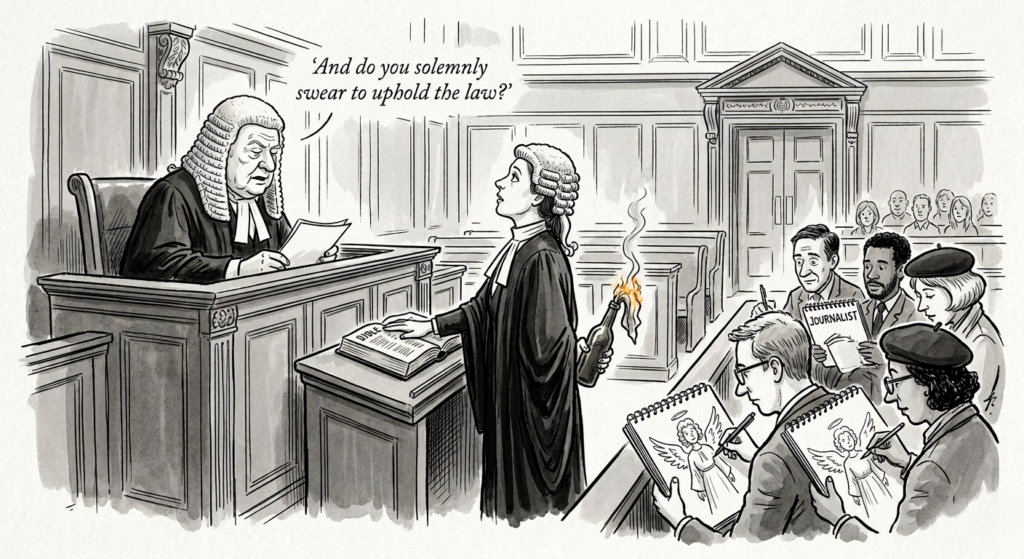
That is not advocacy. That is insurrection dressed in a wig and gown.
Now consider the context.
Beijing proposed universal suffrage for Hong Kong in 2014, within seventeen years of the handover. The mechanism was a nominating committee of 1,200 members, the overwhelming majority elected, drawn from four sectors, with a publicly accessible register, subject to judicial review, and culminating in a direct one-person-one-vote ballot. Every Hong Kong citizen would have voted. The candidate with the most votes would have won. No Electoral College. No superdelegates. No private donor class meeting in Manhattan penthouses to decide who is viable.
Pan-democrats won seats on that committee. Benny Tai, the Occupy Central co-founder, led a slate that won all 30 higher education seats. The people who told the world the committee was a rubber stamp competed for seats on it, won seats on it, and then told the world it was illegitimate.
Twenty-seven legislators voted no. Unanimously. Not one broke ranks. Not one said, this is imperfect but it is a start. They rejected universal suffrage in the name of demanding universal suffrage.
Five million Hong Kong citizens were denied their first-ever direct vote.
And then, five years later, after the extradition bill was formally withdrawn, after the protesters had won that fight, the movement escalated. Over a thousand Molotov cocktails. A man set on fire. Universities turned into fortified camps with petrol bombs and bows and arrows. An airport shut down. The Legislative Council stormed, the chamber smashed, the colonial flag raised.
And Joshua Wong sat in a Washington hearing room, flanked by American flags, and asked a rival superpower to sanction his own city.
This is the context in which Chow Hang-tung’s conviction occurred. Not a peaceful vigil. Not a quiet candlelit remembrance. A sustained campaign that included the rejection of universal suffrage, the destruction of public infrastructure, the invocation of foreign sanctions, and, in Chow’s own mitigation, the explicit, unqualified call for the overthrow of the ruling party not just in Hong Kong but across all of China.
The international press does not give you this context. They give you “democracy activist convicted.” Four words. No history. No 2014 proposal. No rejection. No Molotov cocktails. No Washington hearing room. Just the story, the clean story, the simple story, the one where a brave woman stood up for freedom and the authoritarian state crushed her.
I read the mitigation again, slowly, and something struck me about paragraph 10. She writes: “The belief in ‘ending one-party dictatorship’ has never relied on an us-versus-them mentality or the incitement of hatred to sustain itself. We need rely only on reason and facts.”
Reason and facts. She is a Cambridge-educated barrister. She knows how to use those words. So let me ask her, on the record, using reason and facts:
Was universal suffrage offered to Hong Kong in 2014? Yes.
Was the final stage of that proposal a direct one-person-one-vote ballot? Yes.
Was the nominating committee publicly registered, subject to judicial review, and majority-elected? Yes.
Did the pan-democratic camp hold a quarter of the committee’s seats? Yes.
Did twenty-seven legislators unanimously reject it? Yes.
Did five million people lose their chance to vote as a result? Yes.
If you are relying on reason and facts, where is the reckoning with those facts? Where in eighteen paragraphs of mitigation does she acknowledge that universal suffrage was offered and rejected? Where does she account for the vote that was blocked? Where does she explain why the first popular election in Hong Kong’s history, something Britain never proposed in 156 years, was not worth accepting as a starting point?
She does not mention it. Not once. Not in passing. Not as a footnote. The 2014 proposal does not exist in her mitigation. It has been erased. The most significant democratic proposal in Hong Kong’s history, offered by the government she calls a tyranny, does not appear.
That is not reason and facts. That is narrative selection.
And paragraph 3 deserves scrutiny as well. She writes: “Under this judgment, anyone who believes in the principle of ‘ending one-party dictatorship’ has nowhere left to stand.” For over twenty years after the handover, Hong Kong residents gathered annually in Victoria Park to commemorate June 4th. They lit candles. They chanted slogans the mainland government considers seditious. They called for the end of one-party rule. And Beijing did nothing. No arrests. No crackdowns. For over two decades, Hong Kong residents publicly demanded the end of CCP rule, and the so-called dictatorship simply tolerated it. Year after year after year.
The space to stand was there. For twenty years. It was not withdrawn because people held beliefs. It was withdrawn after a thousand Molotov cocktails, a besieged university, a shuttered airport, and a formal request for foreign sanctions.
There is a difference between holding a belief and inciting the overthrow of a state. There is a difference between lighting a candle and sitting in a congressional hearing room asking a rival superpower to sanction your own city. Chow knows this. Every lawyer knows this. The line between protected speech and incitement to subversion exists in every legal system on earth. The United States sentenced Stewart Rhodes to eighteen years for seditious conspiracy. Britain arrested people for social media posts during the 2024 riots. France, Germany, Japan, every functioning state distinguishes between dissent and insurrection.
Chow’s mitigation is not a defense of democracy. It is a manifesto for regime change. She does not ask for better elections. She does not reference the 2014 proposal. She does not propose a mechanism, a timeline, a framework for reform. She demands the end of the Chinese Communist Party’s rule, compares the judiciary to Nazis, pledges to continue the conduct for which she was convicted, and declares she would rather be a criminal for life than submit to the legal system that admitted her as a barrister.
The Western press will make her a martyr. They will put her face on magazine covers. They will nominate her for prizes. They already have. The Franco-German Prize for Human Rights and the Rule of Law, awarded in December 2023. The rule of law. For a woman who told the court that the rule of law in Hong Kong is comparable to Nazi Germany.
I, however, will get no award for saying this. I am not writing for a prize committee. I am writing because someone has to stand up for the actual rule of law, not the performative version that the West uses to dress up its geopolitical grievances. The actual rule of law means that when you commit acts that endanger public safety, you face consequences. It means that laws are written down, applied evenly, and subject to review. It does not mean that you get to burn a city, call it protest, and then collect a trophy from Paris and Berlin when you are held accountable. The Franco-German Prize is not about human rights. It is about signaling. It is about telling the world that the West’s enemies are always wrong, regardless of the facts, regardless of the law, regardless of the millions of people in Hong Kong who just want to live their lives without fear.
They will not print her mitigation in full. They will not quote paragraph 8, where she calls for the overthrow of the Communist Party. They will not quote paragraph 16, where she pledges to continue. They will not quote paragraph 5, where she invokes the Holocaust. They will give you the headline. Democracy activist. Convicted. Brave.
And somewhere in Sha Tin or Tuen Mun or Kwun Tong, a woman who has never been to Cambridge, who has never worn a barrister’s wig, who rides the MTR to work six days a week and comes home to a flat she will spend thirty years paying off, that woman wanted to vote. In 2014, she was offered a vote. A real one. One person, one ballot, the candidate with the most votes wins. And twenty-seven legislators, speaking in her name, without asking her, told her the vote was not good enough. They blocked it. They called it fake. They said they were protecting her. And then the world called them democracy activists, and called the woman who wanted to vote a footnote, and nobody ever asked her what she thought. Nobody has asked her since. She is still there. Still riding the MTR. Still paying off the flat. Still unasked. The people who claimed to fight for her right to choose never let her choose. And the people who covered the story never noticed she existed.
Chow Hang-tung was not convicted for wanting democracy. She was convicted for inciting the overthrow of the state. She said so herself. Eighteen paragraphs. In open court. On the record.
The only people who do not know this are the people who never read the mitigation.
Now you have.
Comments
One response to “The Barrister Who Swore an Oath and Then Demanded the State Be Overthrown”
I didn’t know about this so thanks for sharing. I have no opinion on the person itself because I don’t live there but do travel to HK regularly. What I find slightly odd is assuming that having direct elections is the only way to define living in a democracy. I am from Venezuela where in the past two decades we’ve had many direct elections for the executive and legislative branches of government. Would people in Venezuela describe the government as democratic? There is a 2018 book I liked a lot called “How democracies die” from Levitsky and Zeblatt that argues that countries like Venezuela, Russia, Turkey and even the US have shown how democracies can backslide even when on paper and according to the rule of law they continue to be democracies by measures such as holding elections. I think this is what those 27 legislators may have feared when they decided not to vote for direct elections. A fear that being part of a decision that would enable their constituents to later say “you voted for this” when reality may have shown that no real power was being given to the people or the elected representative. I am curious now to know what would be the hidden agenda of those legislators if it
wasn’t what was published at the time.
Enjoying very much your writing so please keep doing it with such great passion!