I was standing on the Mid-Levels escalator, which is where half the ideas for this site come from, riding up from Central, reading the IMD competitiveness rankings on my phone. Hong Kong, number two in the world. I screenshot it and texted Ruth. She replied in four words: “Yes. We live here.”
That is the entire bull case, compressed into a text message by a woman who does not believe the world requires my annotations. But the world gets them anyway, because I have been writing about Hong Kong’s economy for a while now, my previous deep dive on HSBC and the IPO market is here if you want the backstory, and the numbers coming out of this city in the first half of 2026 are not incremental. They are structural. And almost nobody outside of Asia is paying attention.
So here are ten reasons, and then Ruth gets the last word, because she always does.
One. The economy is growing faster than anyone predicted, and the government just revised its own forecast upward.
Hong Kong’s real GDP grew 5.1% in the first half of 2026 over the prior year. That is the strongest half-yearly performance in nearly five years. Q1 came in at 5.9%, Q2 at 4.3%. The government originally forecast 2.5% to 3.5% for the full year. In August, it revised that up to 3.5% to 4.5%. Standard Chartered went further and called 4.3%. HKU’s forecast team revised upward by a full percentage point. Nobody is cutting estimates. Everyone is raising them. The medium-term trend growth forecast through 2030 sits at 3% per annum, which for a mature, high-income economy with per capita GDP north of US$59,000 is not a number you ignore.
Two. Hong Kong is the world’s number-one IPO market again, and the pipeline is absurd.
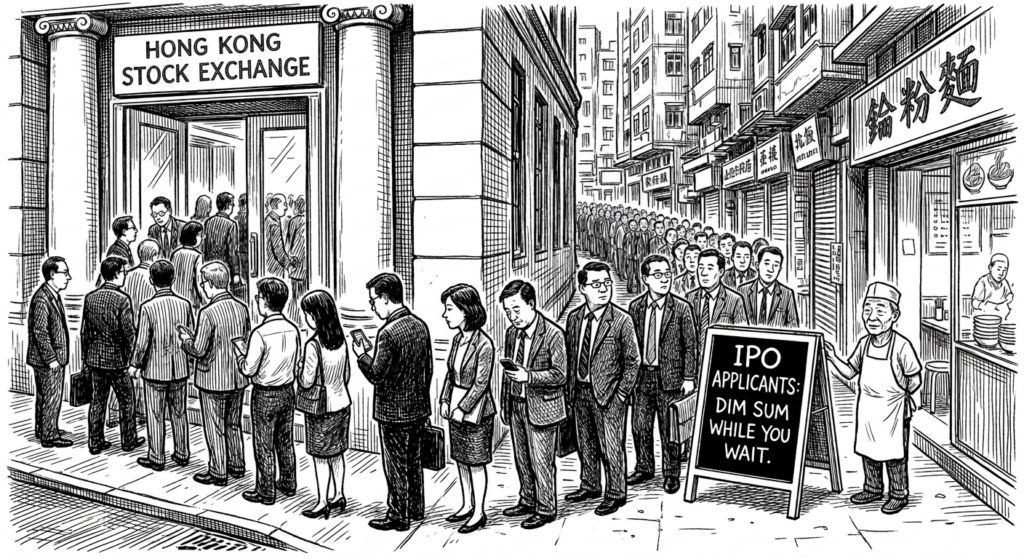
In Q1 2026, Hong Kong raised HK$109.9 billion across 40 new listings, a 489% increase in proceeds over the same quarter the prior year. It topped every exchange on the planet. Nasdaq overtook it in Q2, lifted by SpaceX and a cluster of AI listings, but the pipeline in Hong Kong is deeper and broader. By early August, HKEX CEO Bonnie Chan told an event in Kuala Lumpur that total proceeds had already hit US$41 billion, surpassing the entire 2025 total. By the end of July, the number was HK$328.2 billion, up 154% year on year. As of March, there were 366 active IPO applications in the pipeline, the highest in years, diversified across TMT, healthcare, life sciences, and industrials. Deloitte expects approximately 160 IPOs raising at least HK$300 billion for the full year, and PwC’s projection runs even higher at HK$380 billion. Money is not fleeing Hong Kong. Money is lining up.
Three. Chinese companies have stopped listing in New York, and Hong Kong is collecting every single one of them.
In the first half of 2026, one Chinese company completed a US listing. One. It raised $12 million. In the same period the year before, 39 Chinese companies raised $886 million on American exchanges. That near-total freeze is the structural backdrop. A+H listings, where mainland-listed companies simultaneously list in Hong Kong, accounted for 61% of IPO proceeds in Q1 alone. As of March, 101 active A+H applications sat in the queue with a combined market capitalization of roughly RMB 4.85 trillion. The decoupling of Chinese capital from US markets is not a theory anymore. It is a flow, and the flow is landing here.
Four. AI is not a buzzword in Hong Kong. It is 70% of the city’s merchandise exports.
AI-related products now comprise approximately 70% of Hong Kong’s total merchandise exports. That sentence deserves to be read twice. Exports of AI-related products surged 53.1% in the first half of 2026, outpacing the 39.1% increase in overall merchandise exports. Private sector investment in machinery, equipment, and intellectual property, most of it AI-driven, grew 34.6% in 2025 and accelerated to 38.4% in the first half of 2026. Total goods exports surged 28.9% year on year in real terms in Q2. Hong Kong is not a bystander in the global AI investment cycle. It is one of the primary financial and logistics conduits through which that cycle operates.
Five. Hong Kong just overtook Switzerland as the world’s largest cross-border wealth management hub.
The Boston Consulting Group’s Global Wealth Report 2026, published in late May, confirmed it: Hong Kong’s cross-boundary wealth rose 10.7% in 2025 to US$2.9 trillion. BCG projects 9% average annual growth through 2030, with Hong Kong maintaining first place globally. As of end-2025, more than 3,380 single family offices were operating in Hong Kong, a 25% increase over two years. The number of foreign regional headquarters in the city rose 7.1% year on year to 1,510 in 2025. The wealth is not passing through. It is setting up offices.
Six. Stock Connect has become the most consequential piece of cross-border financial infrastructure on Earth, and it is still expanding.
Southbound trading into Hong Kong has surged to record levels, with average daily exchange turnover hitting HK$283 billion in the first half of 2026 and peaking above HK$319 billion in June. Northbound Stock Connect trading into China rose 42% year on year in 2025. Northbound Bond Connect activity surpassed RMB 1 trillion for the first time in a single month in March 2026. The Southbound channel now covers 564 Hong Kong-listed stocks and 23 ETFs, the Northbound channel 3,265 eligible A-shares and 365 ETFs. Cross-boundary Wealth Management Connect in the Greater Bay Area has grown to 180,600 individual investors as of end-April 2026. Swap Connect provides the first mutual-market derivatives access in the world. Brian Roberts, HKEX’s Managing Director and Head of Equities Product Development, made the point at the FIA Forum in April that Hong Kong is, functionally, where the world comes to risk-manage China exposure. There is no second-place alternative. There is no comparable infrastructure anywhere else.
Seven. The property market has turned, and the numbers are not ambiguous.
Residential property transactions hit a 14-year high of 22,156 in Q2 2026, up 32% year on year. Total transactions in the first half reached 40,810, a 41% increase. Overall flat prices rose 3% in Q2, bringing the year-to-date gain to 8%. Consumer durables spending expanded at strong double-digit rates for four consecutive quarters, suggesting households are not just buying property but making discretionary purchases across the board. Spending abroad declined, indicating a partial reallocation of consumption toward the domestic economy. People are spending here because they believe the floor is in.
Eight. The fiscal position is clean and getting cleaner.
Hong Kong’s consolidated account returned to surplus in 2025-26 at HK$11.2 billion after three consecutive years of deficit. Fiscal reserves stood at HK$635.2 billion as of May 2026. Government debt-to-GDP is projected to rise from 14.4% to 19.9% over the medium term, which in any comparative context is essentially nothing. For reference, the IMF put US federal debt-to-GDP at around 123%. Hong Kong’s 2026-27 budget projects surpluses in each of the next five years. The government issued HK$27.6 billion in green bonds and infrastructure bonds, drawing subscriptions of nearly HK$240 billion, oversubscribed 8.6 times, from investors across more than 30 markets. This is a government that can borrow at essentially unlimited scale relative to its needs and chooses not to.
Nine. The Northern Metropolis is no longer a PowerPoint. It is a construction site.
Three hundred square kilometers of development spanning Hong Kong’s northern border with Shenzhen. Four economic zones running west to east. Expected to generate at least 13% of GDP, create 500,000 jobs, and accommodate 2.5 million people across 900,000 residential units. In August 2026, the first major land disposal was awarded to a consortium including JD.com for HK$1.03 billion, with total projected investment of HK$16.8 billion. The Northern Metropolis Development Bill was gazetted in July 2026 to compress statutory approval timelines. The Fanling Bypass Eastern Section opened in May. Site formation for I&T land at San Tin Technopole is completing this year. The government established a dedicated HK$10 billion industrial development company for Hung Shui Kiu. Singapore’s prime minister toured the Hetao cooperation zone in March, and Singapore’s consul general has publicly described the project’s “massive potential.” Annual capital works expenditure is running above HK$120 billion. This is not a plan. It is steel and concrete.
Ten. Hong Kong is the second most competitive economy in the world, and the labor market is tight.
The IMD World Competitiveness Ranking for 2026 placed Hong Kong second globally, topping the categories of tax policy and business legislation, and placing second in finance, third in international trade and international investment. Unemployment sits at 3.7% with underemployment at 1.5%. Nominal average employment earnings continue to grow. Inflation remains moderate at 2.5% underlying, well-anchored by low energy intensity and stable supply from the mainland. The city is competitive, employed, and not overheating. That combination does not occur by accident and does not last forever, which is exactly why the window matters.
I told Ruth I was finishing the piece and asked if she had anything to add. She looked up from her phone, said “You forgot the food,” and went back to what she was doing.
She is right. But that one is a different article.