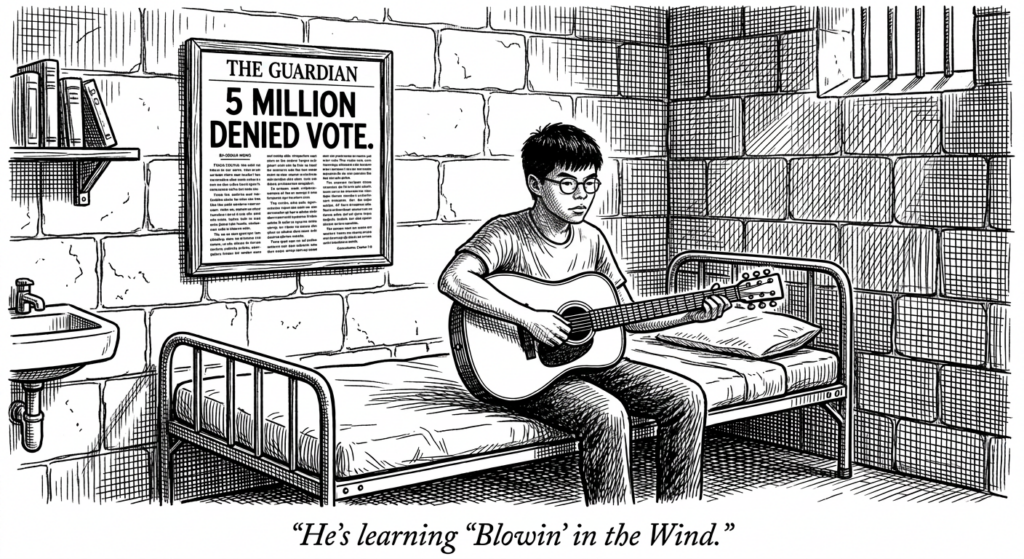
Joshua Wong Should Not Go to Jail for Conspiracy, He Should Go to Jail for Denying Me the Right to Vote. Or: Twenty-Five Years, Not One Less!
I grew up in Adams, Massachusetts. A mill town in the Berkshires that most people have never heard of and nobody has any reason to visit. The Berkshire Cotton Manufacturing Company built the place, employed the place, and when it left, killed the place. One thousand jobs vanished in 1958. A quarter of the population followed. The looms went quiet and the quiet never lifted.
Every few years, a politician would show up. State rep, selectman candidate, someone running for something. They would stand in the VFW hall or the parking lot of the dollar store (then the five and dime) and tell us they were going to fight for us. Going to bring the jobs back. The speeches were good. Some of them were very good. The people clapping wanted to believe, and belief is the cheapest thing in politics.
Then the politician would win, or lose, and nothing would change, and the dollar store would still be the biggest employer on Park Street, and someone’s cousin would move to Springfield because there was nothing left.
The thing Adams taught me before I had language for it is that the people who talk loudest about saving you are not always the ones with your interests at heart. Sometimes they need you to stay broken. Sometimes your pain is their platform. Sometimes the fight is the product, and winning would put them out of business.
I carried that lesson across the Pacific. It turns out it applies in Hong Kong too.
Joshua Wong pleaded guilty today. September 2, 2026. Conspiracy to collude with foreign forces to endanger national security. His second national security case. The Western press ran the story the way it always runs Hong Kong stories. “Prominent pro-democracy activist.” National security law that “effectively stifled the city’s once-thriving pro-democracy movement.” His lawyer hoping for a sentence that would not be “crushing.” A friend saying Wong learned guitar in prison. A brave young man ground down by an authoritarian machine. Simple story. Roll the footage.
One of the reporters who filed today’s coverage was Kanis Leung, writing from Hong Kong, the same Kanis Leung who wrote the bookstores piece I responded to here. She is still in Hong Kong. Still writing. Still publishing, under her own name, on the open internet, articles that frame the Hong Kong government in terms no Beijing loyalist would recognize as friendly. The Western press describes this city as a place where critical speech is impossible, and the bylines keep coming from inside, filed by journalists who remain unjailed and unharassed. Leung’s continued presence in the city she reports from is the most economical rebuttal to her own framing, and nobody seems to find that contradiction worth exploring.
Here is what the coverage did not do. It did not mention the 2014 electoral reform proposal. It did not mention the vote on June 18, 2015. It did not mention that five million people were about to cast a ballot for the first time in Hong Kong’s history and that the movement Wong led helped stop it. It did not mention Article 45 of the Basic Law. It did not provide a single sentence of context about what Wong actually did to democracy in Hong Kong before Beijing did anything to Wong.
And here is what the coverage buried. Wong pleaded guilty. He did not contest the charges. He stood in court and confirmed the prosecution’s account of what he did. The reporting itself states that Wong and Nathan Law agreed around 2016 to lobby foreign governments to impose sanctions, blockades, and other hostile measures against Hong Kong and China, that Wong testified before the US Congressional-Executive Commission on China in 2019 in support of the Hong Kong Human Rights and Democracy Act, that after the national security law took effect Wong continued the foreign pressure campaign through social media and foreign press, that he shared petitions urging digital forensic companies to stop cooperating with Hong Kong police, that one company subsequently did stop, that Wong claimed credit for this in a work report. And then the coverage states plainly: “Wong confirmed he agreed with the details read out by the prosecution.”
He confirmed it. He said yes, that is what I did. The press is still calling him a democracy activist. He admitted, under oath, that he conspired with foreign forces to impose hostile measures on his own city, and the Western press is framing it as persecution. He is not disputing the facts. He is not claiming he was framed. He pleaded guilty, confirmed the details, and admitted to the conduct. The press simply does not want you to focus on that part, because if you do, the story stops being about a brave dissident and starts being about a man who asked a rival superpower to economically punish seven and a half million people, and then admitted it.
But the conspiracy charge is not what this article is about. The courts will handle that. Wong’s lawyer asked for less than ten years, reduced by half for the guilty plea and the delay in prosecution. The judge will decide.
What this article is about is what Joshua Wong did to Hong Kong before any of that. What he did on the public record, in broad daylight, with cameras rolling, that the Western press has celebrated as heroism for a decade and that I, a Hong Kong resident who wanted to vote for my Chief Executive, experience as something closer to theft.
Joshua Wong helped deny me the right to vote. He helped deny five million people the right to vote. And then he helped make sure the people he denied that vote to would be punished for it economically. He did both of these things while calling himself a democrat.
I have written about this before. Readers of my earlier pieces, the one on the false prophets, the bookstores, the Singapore comparison, and readers of my book Hong Kong Belongs to Hongkongers, already know the bones of this argument. If you have read those pieces, skip ahead. If you have not, stay with me, because what follows is the single most important thing the Western press has never explained to you about Hong Kong, and they have never explained it because explaining it would destroy the story they have been selling for a decade.
In August 2014, the Standing Committee of the National People’s Congress issued a decision on electoral reform. For the first time in Hong Kong’s history, not since 1997, the first time ever, the Chief Executive would be elected by universal suffrage. Five million eligible voters would cast a ballot. Candidates would be vetted first by a nominating committee of 1,200 members, the vast majority were freely elected, exactly as Article 45 of the Basic Law had specified since 1990, seven years before the handover, in a document negotiated between Britain and China and published for the world to read. The committee would nominate two or three candidates. Then the public would choose. One person, one vote. No Electoral College. No superdelegates. Most votes wins.
That was the offer. A real vote, for a real leader, by millions of real people, through the exact mechanism Hong Kong’s own constitution had always described.
Twenty-seven pan-democratic legislators voted it down. Unanimously. On June 18, 2015, in the Legislative Council chamber, every single one of them voted no. Not one broke ranks. Not one said, this is imperfect but it is a start. The movement that claimed to speak for democracy could not tolerate a single moment of democratic debate about whether five million people should be allowed to vote.
And those twenty-seven legislators were themselves freely elected. No nominating committee screened them. No Beijing filter kept them off the ballot. They ran, they won, they took their seats, and then they used those seats to make sure the people who elected them would never get to vote for the person who actually runs the city.
Wong was not in the chamber that day. He did not cast a vote. What he did was worse. He built the political atmosphere in which voting yes was impossible. He and his circle, Nathan Law who would later flee to London and who today’s prosecution names as Wong’s co-conspirator, Yau Wai-ching who would use her swearing-in to drape a banner reading “Hong Kong is not China” across the lectern, the whole generation of maximalists who were better at performing democracy than practicing it, they created the framework in which accepting Beijing’s offer became betrayal. Wong turned “no compromise” into a tribal marker. He turned a historic proposal into a purity test. And anyone who suggested that voting under imperfect rules might be better than not voting at all was branded a sellout.
The demand Wong and his allies pushed was “civil nomination,” the right for any citizen to nominate a candidate directly, bypassing the nominating committee. This was not a demand for better democracy. It was a demand that violated the Basic Law. Article 45 says what it says. The Chief Executive shall be selected by universal suffrage “upon nomination by a broadly representative nominating committee in accordance with democratic procedures.” Civil nomination is not in the text. The Hong Kong Bar Association, hardly a pro-Beijing cheerleading squad, confirmed the Basic Law does not provide for it. Wong knew this. His advisors knew this. They demanded something the constitution did not allow, called the constitution illegitimate when it did not deliver, and wrapped themselves in the language of constitutional rights while rejecting the constitution’s own mechanism. That is not activism. That is regime change wearing a democracy costume.
And the demand was never designed to be met. It was designed to be rejected, because rejection served the narrative. If Beijing said no, Wong could tell the world Beijing refused democracy. If Beijing said yes, the Basic Law would need to be amended through a process so complex it might never conclude, which would also let him say Beijing was blocking democracy. Every possible outcome produced the same headline. That is not negotiation. That is stagecraft. And five million people paid for it.
There is a feeling I remember from Adams. I was maybe fourteen. There was a town meeting about the old Arnold Print Works site, the second mill that closed, the one that took another five hundred jobs in 1982. Some developer had a plan. It was not a great plan. Small-scale commercial, maybe some apartments, nothing that was going to restore the town to what it was. Some people at the meeting wanted to hold out for something better. A bigger developer. A grander vision. And I remember my father, who did not talk much in public, saying something like, you take what is on the table. You take it and you build from there, because the alternative is an empty lot and an empty lot does not negotiate.
The developer left. The lot sat empty for years. It might still be empty.
That is what Wong did to Hong Kong. He told five million people that the offer on the table was not good enough for them. Not that it was imperfect. Not that it needed improvement. He told them it was beneath them. And he offered nothing in its place except the warm feeling of having said no, which is the cheapest currency in politics and the only one that never buys anything.
The reform package died. The 2017 Chief Executive election proceeded under the old system, selection by a small committee with no popular vote. The thing they rejected was not replaced by something better. It was replaced by nothing. And then, after Wong and his allies spent four more years escalating, from protests to airport shutdowns to petrol bombs to sitting in a Washington hearing room asking Marco Rubio to sanction his own city, it was replaced by something worse. The 2021 electoral overhaul made the system more restrictive than anything that existed before 2014.
Wong demanded everything. He got nothing. Then he got less than nothing. That is his legacy.
And Wong did not just deny us the vote. He helped make sure we would pay for being denied it. The Hong Kong Human Rights and Democracy Act that Wong personally testified in support of before Congress in September 2019 was the legal trigger for everything that followed. In May 2020, Secretary of State Pompeo used the Act to certify that Hong Kong was no longer sufficiently autonomous to justify preferential treatment under US law. On July 14, 2020, Trump signed Executive Order 13936, revoking Hong Kong’s special trade status. The consequences landed on seven and a half million people who never asked for any of it.
Goods manufactured in Hong Kong were suddenly required to be labeled “Made in China,” stripping local businesses of the brand identity and trade advantages they had built over decades, and exposing Hong Kong exports to Section 301 tariffs originally aimed at Beijing. The US suspended export license exceptions, meaning Hong Kong was now treated the same as mainland China for controlled technology and dual-use goods. Reciprocal shipping income tax exemptions were revoked. Defense exports were halted. Every financial institution in the city faced elevated compliance costs as banks raised their internal risk ratings for Hong Kong, layering on additional due diligence, enhanced screening, and Hong Kong Autonomy Act reporting requirements that made ordinary transactions slower and more expensive. The HKMA had to issue formal guidance reminding institutions that unilateral foreign sanctions had no legal status in Hong Kong, creating the bizarre spectacle of a city’s own regulator managing the fallout of sanctions that one of its own residents had traveled to Washington to request.
None of this hurt Beijing. Beijing adapted. Capital flows adjusted. The sanctions became, as one analysis put it, a tool with “diminishing returns” where “rising compliance burdens for American firms did not result in any change in Beijing’s political behaviour.” The Executive Order was eventually allowed to lapse in 2026 because it had become largely symbolic, a spent instrument that had accomplished nothing against its supposed target. But for the nurse in Kwun Tong, the teacher in Sha Tin, the shop owner in Mong Kok, the small manufacturer who suddenly had to relabel every product, the trade company whose export licensing process doubled in complexity overnight, the damage was not symbolic. It was their Monday. Wong asked a rival superpower to punish the residents of Hong Kong, and nobody in the Western press has ever framed it that way.
Wong confirmed today that he did all of this. He confirmed the lobbying. He confirmed the coordination with Nathan Law. He confirmed the foreign pressure campaigns. He confirmed claiming credit when a digital forensics company stopped supplying Hong Kong police. He confirmed it in open court, on the record, and the press is calling him a hero.
His lawyer told the court today that Wong has been in prison for nearly six years. That he has read books. That he has “matured substantially in his thinking.” That he learned guitar. That he hopes to take care of his parents after release.
I do not doubt any of that. I hope the maturity includes understanding what he took from the people of this city when he helped make sure they would never cast a ballot for their leader. I hope he has sat with the fact that the 2021 electoral overhaul, the system that everyone agrees is worse, exists in direct response to the escalation cycle he helped ignite. I hope the guitar helps.
But the press will not frame it that way. They will spend the next week running the old footage. The skinny kid. The megaphone. The crowd. They will say “democracy activist” in every paragraph. They will not mention 2014. They will not mention June 18, 2015. They will not mention that civil nomination violated the Basic Law. They will not mention that five million people were about to vote for the first time and that the man they are mourning helped stop it.
The real story is that a group of people who called themselves democrats looked at five million voters and decided those voters could not be trusted with an imperfect choice. They made that decision for an entire city. They never held a referendum. They never asked. Then the loudest voice among them spent years lobbying foreign governments to impose economic punishment on the city he claimed to love, punishment that landed on ordinary people and accomplished nothing against the government it was aimed at, and then admitted to all of it in open court, and the press called him a hero.
My father, who worked with his hands in a town that forgot him, would have had a word for people like that. He would have called them what they are.
Not prophets. Not activists. Not heroes.
Just politicians. The kind who stand in the parking lot, give a hell of a speech, and leave you with an empty lot.
Wong is in jail. He pleaded guilty. He confirmed the facts. The courts will sentence him.
But if you want to understand what he really did to Hong Kong, do not read the indictment. Read the Basic Law. Read Article 45. Read the vote record from June 18, 2015. And then ask yourself when, if ever, five million people in this city will get the chance that Wong and his allies took away from them while telling the world they were fighting to give it to them.
I wanted to vote. I still want to vote. The Basic Law still says I will, eventually. The conditions were right in 2014. They are not right now. The man the Western press is calling a democracy activist today is one of the primary reasons why.
He should be sentenced for the conspiracy if that is what the law requires. He confirmed he did it.
But he should be remembered for something worse.
He killed my vote. And yours. And five million others. And he called it principle.
The lot is still empty.
Comments
2 responses to “Joshua Wong Should Not Go to Jail for Conspiracy”
I agree with your analysis. Joshua did a disservice to HK and its people. That said, among the articles that you have written perhaps there is one to be written about the true grit of the people of Hong Kong. I have lived in HK for 20+ years and seen this city post handover, during SARS, the GFC, Covid…and what amazes me is the Grit of the people to just carry on! Of course provided that Ruth agrees with it…
I like your idea. I will ask Ruth.