There are places in the world where air conditioning is a comfort. A civilized agreement between man and machine that the goal is comfort, not hypothermia.
Hong Kong is not one of those places.
Hong Kong air-conditions its buildings the way other cities arm their militaries: with overwhelming force, disproportionate to any conceivable threat, deployed at maximum capacity at all times. The enemy is heat. And Hong Kong has decided that the appropriate response to heat is not to cool the air but to murder it. To take 34 degrees, 95 percent humidity, the kind of weather that makes your shirt a second skin before you’ve finished crossing the street, and replace it, the moment you step through any door, with something that would make a Norwegian reach for a jacket.
I have been in walk-in freezers warmer than the lobby of my office building. I once walked into a Pacific Coffee in Tsim Sha Tsui and my glasses fogged so aggressively from the temperature differential that I couldn’t see the counter and ordered what turned out to be a matcha something, which I drank in silence because I deserved it.
You spend your entire day moving between two temperatures, neither comfortable, and the transition between them is so violent that your body never acclimates to either one. You are never the right temperature. There is no in between. In between is the three seconds you spend in the revolving door, and even the revolving door is air-conditioned.
My wife, Ruth, navigates this system the way she navigates everything in Hong Kong: with complete competence and no sympathy for the fact that I cannot.
Ruth carries a cardigan. She carries it the way a soldier carries a sidearm: at all times, in all conditions. It lives in her handbag, folded with a precision that would satisfy a drill sergeant, and it comes out the moment she crosses any threshold between the outside world and the inside world, which in Hong Kong is not a boundary so much as a climate border, a checkpoint between Southeast Asia and Scandinavia that you cross forty times a day without a passport.
She puts it on in restaurants. In shopping malls. In movie theaters, where the air conditioning is set to a temperature intended to preserve the film stock rather than the audience. She puts it on in our flat, where we have our own air conditioning, which I set to 21 degrees, which she sets to 24, which I set back to 21, which she sets back to 24, which constitutes the longest-running territorial dispute in the history of our marriage and possibly in the history of Mei Foo.
Here is how the thermostat war works. I set the air conditioning to 21 before bed. Ruth gets into bed, pulls the duvet to her chin, and says: “It’s cold.”
“It’s 21.”
“It’s too cold.”
“21 is the universally agreed-upon temperature of human comfort. NASA sets the Space Station to 21. Hotels set their rooms to 21. The entire Western world has collectively decided that 21 degrees is the Goldilocks temperature.”
“Set it to 24.”
“24 is not air conditioning. 24 is turning the machine on so it makes noise. I could open the window and get 24.”
She reaches across me, picks up the remote, and sets it to 24. Without sitting up. Without opening her eyes. The room begins, immediately, to warm.
I wait until she’s asleep. I set it back to 21. This works for about forty-five minutes. Then Ruth, demonstrably unconscious, dreaming about whatever she dreams about, which I suspect involves a world where the thermostat is permanently set to 26 and every businessman on every flight has packed a second pair of pants for reasons he cannot explain, rolls over, picks up the remote without waking, and sets it back to 24.
I have watched her do this. Eyes closed. In the dark. In a state any medical professional would classify as sleep. It is the most remarkable display of muscle memory I have ever witnessed. It is like watching a pianist play a concerto in their sleep, except the concerto is three degrees Celsius and the audience is me, sweating.
“You run hot,” she told me once, in the tone of a woman delivering a diagnosis.
“I don’t run hot. You run cold. You grew up in a city that air-conditions everything to 18 degrees and then you go outside into 34 and your body has lost the ability to regulate its own temperature. You’ve outsourced thermoregulation to Daikin.”
She looked at me with the look. The look that says: you are being foreign again.
“Daikin is a Japanese company,” she said.
That was her entire response. Not a rebuttal. A correction of my brand attribution. I had delivered a closing argument about thermal biology, and she had responded with a fact about the country of origin of our air conditioning unit, and somehow she had won the exchange.
The office is worse.
My office in North Point is air-conditioned to what I estimate is 19 degrees. I wear a jacket indoors, in a subtropical city, in summer, because if I do not I will be cold.
I need to explain something here, because without context the full humiliation of that sentence does not land.
I am from New England. I grew up in a place where cold is not a condition, it is an identity. Where winter is not something that happens to you, it is something you survive, and the surviving is the point, and complaining about it is a moral failing on par with rooting for the Yankees. I am the kind of person who shoveled snow in shorts. Not as a dare. Not as a fraternity stunt. Not because I had lost a bet or was trying to impress anyone, though there was no one to impress because the only witness was the neighbor’s dog, who was also outside and who also did not appear cold, because he was a Labrador, and Labradors do not acknowledge weather.
I shoveled the driveway in basketball shorts and a hoodie with the sleeves pushed up, in January, in the kind of cold that makes your nostrils stick together when you inhale, and I was fine. I was better than fine. I was a New Englander, which meant I was constitutionally incapable of admitting that I was anything other than fine. I went to the office in shorts when there was frost on the car. Not to make a statement. Because that’s what I wore. Because I didn’t think about it. Because the calculation in New England is not “what is the temperature” but “can I physically survive the walk from the car to the building,” and if the answer is yes, the shorts stay on.
This is who I was. A man who wore shorts in weather that would concern a Canadian. A man whose relationship to cold was not adversarial but proprietary, the cold was mine, I grew up in it, I owned it, and it could not touch me because I had decided that it couldn’t, and in New England, deciding that you are not cold is the same as not being cold, because no one will challenge you on it, because they are also in shorts.
And now I am in two jackets. In a subtropical city. In July. Nineteen degrees in the office, which is warmer than most February days I shoveled through in shorts, and I am shivering. Not performatively. Actually shivering. My hands are cold. I drink hot water. I look at the thermostat on the wall, which is set to a temperature I once considered balmy, and I think: what happened to me?
What happened to me is Hong Kong. What happened to me is twelve years of moving between 34 degrees outside and 19 degrees inside, forty times a day, until my body forgot what it was for. My internal thermostat, the one calibrated by decades of New England winters, the one that allowed me to shovel a driveway in shorts and feel like a reasonable person, has been destroyed. Recalibrated. Replaced by a system that no longer knows what temperature it wants to be, that cannot acclimate to either extreme, that exists in a permanent state of thermal confusion, like a computer running two operating systems at once, both of them crashing.
If my father could see me, in the two jackets, drinking the hot water, reaching for a space heater in a city closer to the equator than Cairo, he would not say anything. He would not need to. He is from New England. New Englanders do not say things. He would look at me, and in his silence would be the entire history of men who chopped their own firewood and drove in snowstorms and never once, not once, wore a second jacket indoors, and his silence would be louder than anything Ruth has ever not said, which is significant, because Ruth’s silences are professionally devastating.
My Hong Kong colleagues sit at their desks in short sleeves, drinking hot water, because of course they do, because in Hong Kong you fight cold air conditioning not by turning it down but by drinking boiling water, which is like fighting a house fire by setting yourself on fire so at least you’ll be warm.
And the low point, the absolute nadir of my campaign against Hong Kong’s thermal regime, occurred at my former firm in Sheung Wan, where I was a partner and where I committed the single greatest tactical error of my professional life.
I brought a space heater to the office.
A small, personal, under-desk space heater. I was a partner. Not a junior associate. A man whose name was on things. A man who had, in a previous life, shoveled snow in shorts. And here I was, smuggling a ceramic heat source into a building that was already located in one of the hottest cities on earth, because the air conditioning had so thoroughly defeated me that I needed supplemental warmth at my desk in a place where the outdoor temperature was sufficient to cook an egg on a taxi hood. If there is a more complete portrait of institutional surrender, I have not seen it.
I could have installed a sauna in the conference room and called it a wellness initiative. That is the point of making partner: the hierarchy answers to you.
What I had not accounted for was that Hong Kong does not run on hierarchy. Hong Kong runs on aunties.
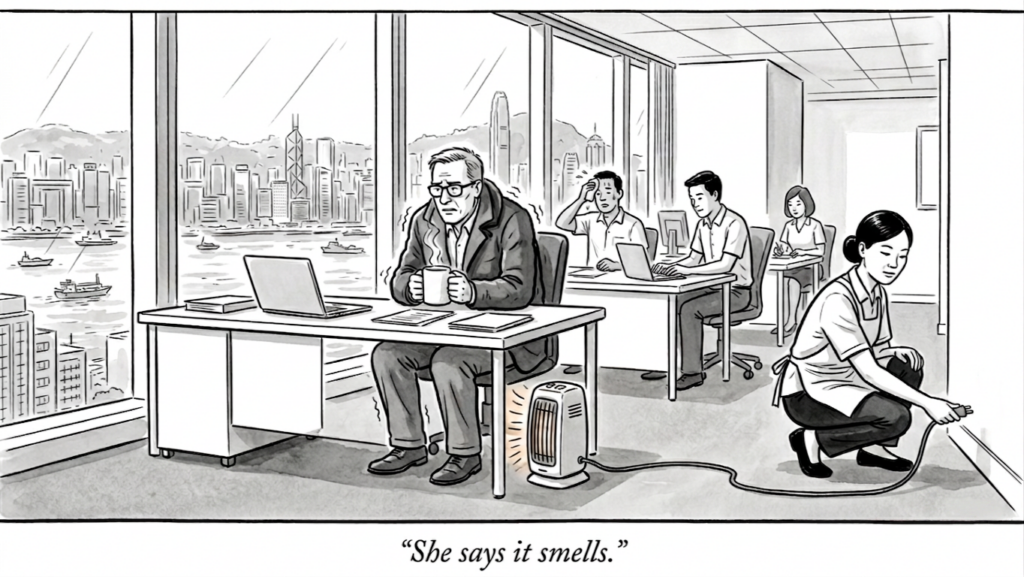
Our office auntie, the woman who cleaned the kitchen and maintained the common areas with the quiet, territorial authority of someone who has been in the building longer than the lease, spotted the heater within six hours. It was under my desk. Behind the modesty panel. You would have had to crouch down to see it, or you would have had to be our office auntie, who apparently conducted nightly reconnaissance of the entire floor with the thoroughness of a UN weapons inspector.
She didn’t say anything to me. She said something to Wendy, the office manager, who appeared at my door.
“The auntie wants to know why you have a heater.”
“Because it’s cold.”
Wendy paused. This was the pause of a woman translating between two civilizations in real time.
“She says it smells.”
It did not smell. It was a brand-new ceramic heater from Fortress. It was the least smelly object in a building whose kitchen regularly hosted reheated fish balls and fermented tofu at lunchtime, neither of which had ever been reported to the auntie because the auntie was the one reheating them.
“It doesn’t smell,” I said.
“She says it does.”
This was not a negotiation. This was a notification. Wendy understood the power dynamics of this office far better than any org chart could capture. Partners come and go. The auntie is forever.
I kept the heater. I was a partner. I had rights.
The auntie began unplugging it.
Not when I was watching. Never confrontational. Strategic. I would leave for a meeting, come back an hour later, and find the heater off and the plug resting neatly on the floor beside the outlet, coiled with the deliberate care of someone who wanted me to know this was not an accident.
I would plug it back in. She would unplug it. This went on for two weeks. A silent, bloodless war fought entirely through a three-pronged plug, in which neither side acknowledged the other, in which the entire conflict existed in the six inches between plug and outlet and in the vast, unbridgeable distance between a man who thought seniority meant something and a woman who knew it didn’t.
She won. Of course she won. She won the way Hong Kong always wins: not through force or authority but through the slow, inexorable application of will by someone who has no title and no power and who does not need any of those things because she has something better. She has the building. She has the kitchen. She has the plug.
I took the heater home. I put on a second jacket. I drank hot water.
I drank the hot water.
This is the part that haunts me. I caught myself, one Tuesday afternoon in June, at my desk, in my two jackets, reaching for a cup of hot water that I had poured voluntarily, without anyone suggesting it, without Ruth watching, because I was cold, because the air conditioning had reduced me to a man who drinks hot water in summer, and I thought: this is it. I have been colonized. Twelve years and it got inside me, not through the food or the language but through the thermostat. The man who shoveled snow in shorts is gone. He died quietly, somewhere around year eight, and in his place is a man in two jackets who drinks hot water in a subtropical office and does not find this strange, and the not finding it strange is the strangest part of all.
I texted Ruth. Told her I’d drunk hot water. Voluntarily. At my desk. In June.
She sent back one word: Finally.
That night, I came home. Ruth was on the couch with the air conditioning set to 24 and a blanket over her legs. A blanket. In Hong Kong. In July. She had achieved the temperature she wanted by turning on a machine and then counteracting that machine with a blanket, which is the most Hong Kong thing I have ever witnessed, a city that air-conditions itself into winter and then bundles up for warmth, that creates the problem and the solution simultaneously and sees no contradiction.
I sat down next to her. I did not adjust the thermostat. I did not deliver a speech about thermal efficiency. I sat there, in the 24-degree air, and said nothing, because after twelve years I have learned that the thermostat war is not about temperature. It is about territory. It is about who this city belongs to. And it does not belong to me. It belongs to Ruth. It belongs to Hong Kong. It belongs to the Daikin unit on the wall and the women with cardigans in their handbags and the aunties with their plugs.
I pulled a corner of the blanket over my legs.
Ruth didn’t say anything. She just shifted slightly, made room, and gave me more of the blanket, the way you give someone more of the blanket when they have finally, after twelve years, stopped fighting and started adjusting.
The thermostat read 24.
I let it.