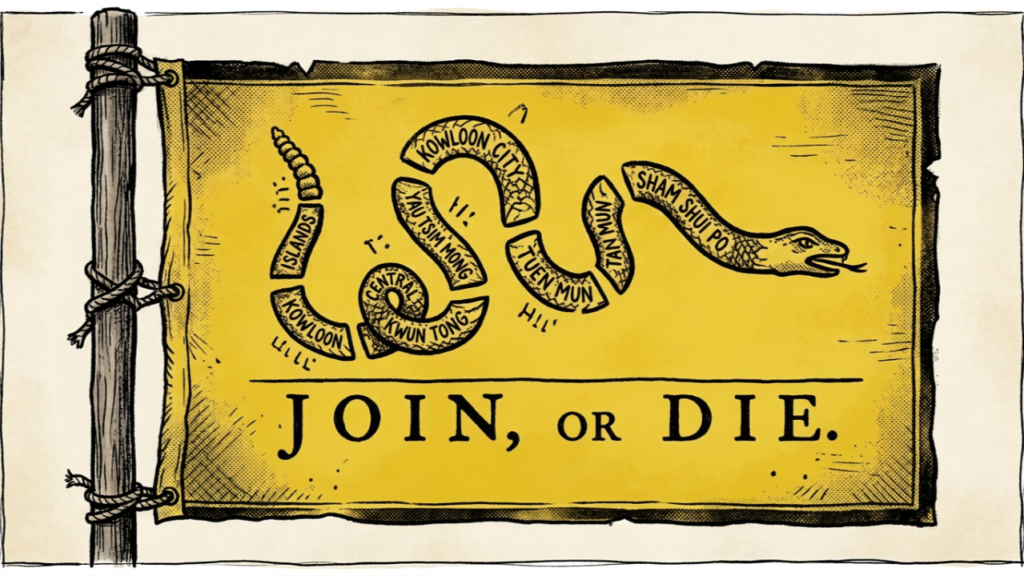
If you get your news about Hong Kong from Western media, you are not getting the full story. You are getting a story. One that was built for you, framed for you, and repeated so many times it has the feel of truth without the burden of evidence. Here are ten things they have chosen not to tell you, not because the facts are hidden, but because the facts are inconvenient.
1. Hong Kong Was Offered Universal Suffrage. Democrats Killed It.
In August 2014, Beijing approved a proposal to let five million Hong Kong voters elect the Chief Executive by universal suffrage. One person, one vote. Most votes wins. No Electoral College. No superdelegates. The first popular election for Hong Kong’s leader in the city’s entire history, not since 1997, the first time ever. On June 18, 2015, twenty-seven pan-democratic legislators voted it down. Unanimously. Not a single one broke ranks. Not one said, this is imperfect but it is a start. The movement that claimed to speak for democracy did not allow a single moment of democratic debate about whether five million people should be allowed to vote. Western media has spent a decade telling you Beijing killed democracy in Hong Kong. It was voted down by democrats, in public, on camera, in a chamber they were freely elected to sit in. This is the single most important fact about Hong Kong politics that the Western press has never explained to you, and they have never explained it because explaining it would collapse the narrative they have been building since 2014.
Psychologists call it anchoring. The first frame you encounter shapes everything that follows. If the first thing you learned about Hong Kong was “Beijing versus the people,” every subsequent fact got filtered through that lens. The actual vote record from June 2015 never had a chance.
2. The Nominating Committee Is Not an Authoritarian Invention. It Is in the Basic Law.
Article 45 of the Basic Law, Hong Kong’s mini-constitution, published in 1990, seven years before the handover, negotiated between Britain and China, states that the Chief Executive shall be elected by universal suffrage “upon nomination by a broadly representative nominating committee in accordance with democratic procedures.” That is not Beijing moving the goalposts. That is the text. It has always been the text. The nominating committee was the agreed mechanism from the start, and every party, including Britain, signed off on it.
Wong and his allies demanded “civil nomination,” the right for any citizen to nominate a candidate directly, bypassing the committee. The Hong Kong Bar Association, which nobody has ever accused of being a pro-Beijing cheerleading squad, confirmed that civil nomination is not provided for in the Basic Law. The demand was constitutionally impossible. It was also strategically perfect, because a demand designed to be rejected produces a rejection that can be sold as oppression. The framing effect is the oldest trick in persuasion. You do not need to change the facts. You just need to control which facts get presented.
3. The U.S. Primary System Is Structurally Similar, and Nobody Calls It Undemocratic.
American presidential candidates are selected through a delegate system that includes superdelegates, party insiders, and nominating conventions where the general public has no direct vote on the final slate. The process filters candidates before voters ever see a general election ballot. Hong Kong’s nominating committee does the same thing through a 1,200-member body with elected and appointed members. Western media calls the American system “democratic” and the Hong Kong system “authoritarian.” They are not identical, but the structural logic is the same: a vetting mechanism produces candidates, and then the public votes. The difference is not in the design. It is in who is describing it. This is what social psychologists call in-group bias. Systems that belong to “us” get the benefit of the doubt. Systems that belong to “them” get the harshest available label. When a Western journalist covers Hong Kong, they are not comparing two systems on their merits. They are defending one and prosecuting the other.
4. Universal Suffrage Is Not Self-Determination. Almost No Country on Earth Allows Self-Determination in Its Constitution.
This is the distinction the Western press refuses to draw, and it is the one that matters most. Universal suffrage means you get to vote for your leader. Self-determination means you get to decide whether you are a country at all. The Basic Law offered Hong Kong the first. Wong’s movement, as it radicalized after 2014, began demanding something closer to the second. The pivot from “we want to vote” to “Hong Kong is not China” was not an escalation of the same principle. It was an abandonment of one principle for another, and the second one has no legal basis anywhere.
Almost no constitution on earth contains a right to self-determination or secession. Most expressly forbid it. Many more stay silent, and courts have consistently interpreted that silence as no right to secede. The United States fought its bloodiest war over the question and settled it at Appomattox. The Supreme Court in Texas v. White confirmed there is no constitutional right to secession. Spain’s constitution emphasizes the “indissoluble unity of the Spanish Nation.” The Supreme Court of Canada ruled that Quebec could not unilaterally secede, even with a clear majority referendum, without a constitutional amendment agreed to by the entire federation.
Ethiopia is the most prominent exception. Article 39 of its 1995 constitution grants every nation, nationality, and people an “unconditional right to self-determination, including the right to secession.” A handful of others, Croatia, Liechtenstein, Saint Kitts and Nevis, have explicit or implied provisions. The Soviet Union and Yugoslavia both constitutionalized secession rights as well. Both ceased to exist.
That is the full list. A few small states, one African federation, and two dissolved communist federations. That is the constitutional universe in which a right to self-determination exists. Hong Kong’s maximalists demanded something that virtually no legal system on the planet provides for, framed it as a basic democratic right, and the Western press nodded along as if it were unremarkable. It is not unremarkable. It is constitutionally illiterate.
The Basic Law never promised Hong Kong independence. It promised a vote. The vote was on the table. The people who claimed to fight for democracy rejected the vote because it did not come with sovereignty, and then told the world they had been denied democracy. The conflation of suffrage with self-determination is not a misunderstanding. It is a rhetorical strategy, and it worked on every editorial board from New York to London.
5. The Man They Call a Democracy Activist Admitted, Under Oath, to Conspiring with Foreign Forces Against His Own City.
Joshua Wong pleaded guilty on September 2, 2026. Conspiracy to collude with foreign forces to endanger national security. He confirmed, in open court, that he and Nathan Law agreed around 2016 to lobby foreign governments to impose sanctions, blockades, and other hostile measures against Hong Kong and China. He confirmed that he testified before the US Congressional-Executive Commission on China in support of the Hong Kong Human Rights and Democracy Act. He confirmed that after the national security law took effect, he continued the foreign pressure campaign. He confirmed claiming credit when a digital forensics company stopped supplying Hong Kong police. He said yes, that is what I did.
The Western press reported this as persecution. Wong is not disputing the facts. He is not claiming he was framed. He pleaded guilty and confirmed the prosecution’s account. But once a person has been assigned the “hero” label, every action gets filtered through it. Psychologists call this the halo effect. The brave kid with the megaphone cannot also be the man who asked Marco Rubio to economically punish seven and a half million people. Those two facts do not fit in the same frame, so one of them gets dropped. Guess which one.
6. The Sanctions Wong Lobbied For Hurt Ordinary Hong Kong People and Accomplished Nothing Against Beijing.
The Hong Kong Human Rights and Democracy Act that Wong personally testified in support of was the legal trigger for everything that followed. Pompeo used it to certify that Hong Kong was no longer sufficiently autonomous. Trump signed Executive Order 13936, revoking Hong Kong’s special trade status. Goods manufactured in Hong Kong were suddenly labeled “Made in China,” stripping local businesses of brand identity and exposing exports to Section 301 tariffs. Export license exceptions were suspended. Reciprocal tax exemptions were revoked. Banks raised internal risk ratings, layering additional due diligence and compliance costs onto ordinary transactions.
None of it hurt Beijing. Capital flows adjusted. The sanctions became, as one analysis put it, a tool with “diminishing returns” where rising compliance burdens for American firms produced no change in Beijing’s political behavior. The Executive Order was eventually allowed to lapse in 2026 because it had become symbolic. But for the nurse in Kwun Tong, the small manufacturer who had to relabel every product, the trade company whose licensing process doubled overnight, the damage was real. Wong asked a rival superpower to punish the residents of his own city, and nobody in the Western press has ever framed it that way. I grew up in a mill town in Massachusetts where politicians gave beautiful speeches and left you with nothing. Wong gave a hell of a speech. He left us with less than nothing.
7. The Journalists Who Say Free Speech Is Dead in Hong Kong Are Still Filing From Hong Kong.
Kanis Leung, the Associated Press journalist who has written multiple pieces framing Hong Kong’s press environment in terms no Beijing loyalist would recognize as friendly, is still in Hong Kong. Still writing. Still publishing under her own name, on the open internet. She is not in jail. She has not been deported. She has not been harassed. The Western press describes this city as a place where critical speech is impossible, and the bylines keep coming from inside, written by journalists who remain free and working.
This is cognitive dissonance made visible. The messenger contradicts the message by her very existence. If Hong Kong were the place the coverage describes, the coverage could not exist. Nobody seems to find that contradiction worth a paragraph.
Ruth, my wife, once put it more simply over dinner. She looked up from her noodles, said “if they can’t speak freely, who is writing all these articles about not being able to speak freely,” picked her chopsticks back up, and went back to eating.
8. Hong Kong’s Judicial Independence Was Acknowledged by the Judges Who Left, Not Just the Ones Who Stayed.
When several non-permanent judges from the UK and other common law jurisdictions resigned from Hong Kong’s Court of Final Appeal, Western media treated it as proof that the rule of law was finished. What the coverage did not mention is what some of those judges actually said on the way out. Lord Sumption, one of the most senior British judges to sit on the court, stated plainly that Hong Kong’s judiciary continues to function independently and that the courts themselves are not the problem. The judges who left cited the political environment, not judicial corruption or interference with judgments. The distinction matters. A judge saying “I disagree with the political direction” is not the same as a judge saying “the courts are compromised.” Western media collapsed the distinction because nuance does not generate clicks.
And while American politicians and editorial boards call Hong Kong’s rule of law dead, American courts keep sending American citizens there to litigate. US federal courts routinely find Hong Kong an adequate forum for the resolution of disputes involving American parties. In August 2024, Judge Patti B. Saris of the US District Court for the District of Massachusetts dismissed an American employee’s claims against his Hong Kong employer on forum non conveniens grounds, finding Hong Kong to be the more appropriate forum. The plaintiff argued that political instability in Hong Kong made its courts inadequate. Saris rejected the argument, writing that “numerous courts have found Hong Kong to be an adequate alternative forum” and that the plaintiff had not demonstrated “that the unrest has rendered the judicial system incapable of resolving Plaintiff’s claim.” The First Circuit affirmed in 2025. That is a sitting US federal judge, in a published opinion, telling an American citizen that Hong Kong’s courts are perfectly capable of resolving his dispute, at the same time that the State Department and US Congress are telling the world the opposite.
This is the availability heuristic at work. A dramatic resignation is memorable. A functioning court system processing thousands of cases fairly is not. A federal judge quietly dismissing a case to Hong Kong does not make the news. A British judge resigning does. The story that gets remembered is the one that produces the strongest emotional reaction, not the one that reflects the most representative truth.
9. Hong Kong People Never Wanted Independence. The Polling Was Always Clear.
Every credible poll conducted in Hong Kong over the past two decades has shown that support for independence is marginal. Single digits. The overwhelming majority of Hong Kong residents have consistently expressed a preference for autonomy within the “one country, two systems” framework, not separation from China. The maximalists who pivoted from reform to independence after 2014, including members of Wong’s circle and figures like Yau Wai-ching, who draped a banner reading “Hong Kong is not China” across the Legislative Council lectern during her swearing-in, represented a fringe. Western media covered them as though they spoke for the city. They did not. They were louder.
In media, volume substitutes for consensus. Social proof works by repetition, not by accuracy. Show the same protesters enough times and the audience assumes they represent the majority. They never did. Hong Kong people wanted to vote. They did not want to secede. Those are two different things, and the refusal to distinguish between them is not an oversight. It is editorial policy.
10. The Western Press Is Not Lying to You. It Is Doing Something Worse. It Is Telling You a Story.
Lies can be fact-checked. Stories are harder, because a well-constructed story can be built entirely from true facts arranged in a misleading order. Every individual sentence in a typical Western article about Hong Kong might be accurate. Wong was arrested. Wong pleaded guilty. The national security law was imposed. Bookstores were raided. These are facts. But the facts that are excluded, the 2014 proposal, the 2015 vote, the constitutional basis for the nominating committee, the polling on independence, the near-total absence of any constitutional right to self-determination anywhere on earth, the journalists who remain free, the judges who said the courts still work, those facts tell a different story, and that story has been kept from you.
This is not a conspiracy. It is a narrative fallacy. Humans prefer clean stories to messy truths. “Brave dissident crushed by authoritarian regime” is a clean story. “Flawed political actor demanded something the constitution did not allow, built a movement that blocked five million people from voting, escalated for five years, invited a rival superpower to impose sanctions that hurt ordinary residents and accomplished nothing, admitted all of it in open court, and is now being sentenced under laws that exist in part because of the escalation cycle he helped ignite” is a messy truth. Clean stories sell. Messy truths require paragraphs. Western media is in the business of selling stories, and Hong Kong has been one of its most reliable products for a decade.
The next time you read a Western news story about Hong Kong, do not ask whether the facts are true. Ask which facts are missing. Ask who benefits from the frame. Ask why, in ten years of coverage, not one major Western outlet has walked you through the vote record from June 18, 2015, and explained what it means. The answer is not that the record is hidden. It is on the public record, in the Legislative Council archives, available to anyone who looks. The answer is that explaining it would end the story. And the story is too valuable to end.
We wanted to vote. We did not want to be independent. We ended up with no vote and sanctioned. Democracy gave us this.