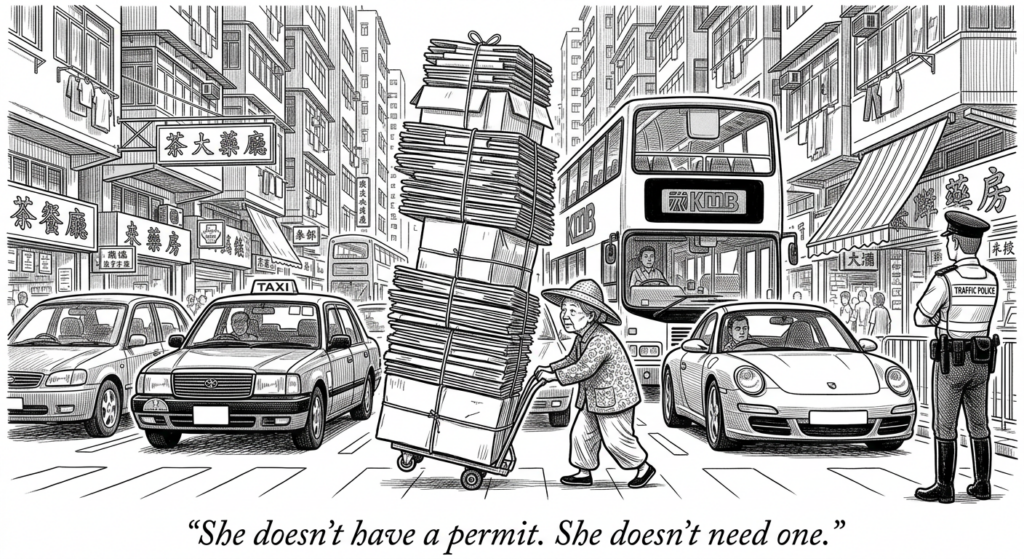
In a city obsessed with efficiency, they are the most efficient of all.
Hong Kong will sell you a story about itself. The skyline. The harbour. The neon. The impossible density of it all, eight million people stacked on top of each other in a city that looked at usable land and said, “We’ll make more.”
It is a city of glass towers and Michelin-starred restaurants and hedge fund managers who earn more before breakfast than I will earn in a calendar year. It is a city where a parking space sells for more than a house in most countries, where a studio apartment the size of a generous closet will set you back two million US dollars, and where people accept this because the dim sum is just that good.
This is the Hong Kong you see from the Peak Tram. The one on the postcards.
Then you come down to street level, and you meet the cardboard grannies.
I don’t know when I first noticed them. That’s the thing, they’re everywhere and nowhere, the way a heartbeat is everywhere and nowhere. You don’t hear it until you listen.
She was maybe five feet tall. Maybe. She was pushing a cart stacked with flattened cardboard that was, by any reasonable engineering standard, four times her volume and twice her weight. The stack rose above her head like a brown, corrugated sail. She was moving at a pace I would describe as “aggressive.”She was seventy years old, or eighty, or possibly a hundred and twelve. It is genuinely impossible to tell, because the cardboard grannies of Hong Kong exist outside of normal biological time.
They are fueled by something science has not yet identified.
I was standing on the sidewalk in Sham Shui Po, eating an egg waffle and feeling quite pleased with myself for navigating a neighborhood that most expat guides describe as “authentic,” which is code for “your Mandarin Oriental concierge has never been here.”
The granny was approaching from my left. I did not move, because I did not think I needed to move. She was an elderly woman with a cart. I was a full-grown man with an egg waffle. Physics was on my side.
Physics was not on my side.
She did not slow down. She did not make eye contact. She simply adjusted her trajectory by perhaps two degrees, and the cart, this towering, improbable monument to recycled commerce, threaded past me with the clearance of a Formula One car entering the pit lane. I felt the cardboard brush my elbow. A flap kissed my shirt. By the time I turned around, she was ten meters away and accelerating.
My egg waffle, I realized, was gone. I don’t know how. I don’t know where. I choose not to investigate this further.
The cardboard grannies are a fixture of Hong Kong’s streets in the way that taxis are a fixture, or humidity is a fixture, or the faint smell of dried seafood in Sheung Wan is a fixture. They collect cardboard. They flatten it. They stack it with a precision that would make a Tetris champion weep. And they haul it to recycling depots where they sell it by the kilogram for what works out to about enough money to buy a bottle of water and a pork bun.
The economics, on paper, are brutal. A kilogram of cardboard fetches around one Hong Kong dollar. A good day might net fifty or sixty dollars, call it seven or eight US. The work is physical, repetitive, and conducted in a climate that alternates between “aggressive sauna” and “slightly less aggressive sauna with rain.”
And yet.
I have never, in my years in this city, seen a cardboard granny who looked like she wanted your pity. I have seen one stare down a delivery truck that was blocking her route until the driver reversed. I have seen one negotiate a price at a recycling depot with the energy of a corporate litigator billing nine hundred dollars an hour. I have seen one sit on her cart during a break, eating a tangerine in the sunshine, with an expression of such profound contentment that I briefly reconsidered every life choice I had ever made.
My wife, who grew up here, tried to explain it to me once.
“They don’t do it because they have to,” she said. “Some of them do. But a lot of them do it because they want to. Because sitting at home is worse.”
“Worse than pushing a hundred kilos of cardboard through Mong Kok in August?”
“Much worse.”
I thought about my own retirement plans, which at that point consisted of vague notions about a sofa and an internet connection and slowly becoming one with the cushions.I looked at the granny across the street. She was reorganizing her stack with the focus of an air traffic controller. She removed a piece that didn’t meet her standards, too bent, maybe, or the wrong corrugation, and discarded it with a flick of the wrist. Quality control. She had standards. The cardboard would be neat, or it would not be her cardboard.
I quietly revised my retirement plans.
There is a technique to cardboard collection, and it is genuinely impressive. The grannies don’t just pick up cardboard. They process it. They appear outside restaurants and shops at precisely the right moment, after delivery, before cleanup, and strip the boxes down with a speed that suggests muscle memory measured in decades. A box that would take me thirty seconds of fumbling and mild swearing to flatten is dismantled in two moves. Crack, fold. Done. Next.
They know which shops get deliveries on which days. They know which alleys have the best cardboard. They have, I am fairly certain, a territory system that would be immediately recognizable to anyone who has studied organized crime or bird migration. You do not collect cardboard on someone else’s block.
This is understood. This does not need to be discussed.
I once watched two grannies meet at the invisible border of their respective territories. They exchanged a nod. It contained the same energy as two heads of state meeting at a summit, mutual recognition, respect, and the unspoken understanding that any violation of the established order would be met with consequences.
I do not know what those consequences are. I do not want to know.
The thing that nobody tells you about the cardboard grannies, the thing you have to see for yourself, is how they move through traffic.
Hong Kong traffic is not for the faint of heart to begin with.
The streets are narrow and busy, delivery trucks double-park with impunity, taxis change lanes the way other people change their minds, and the buses move with the quiet menace of blue whales who are late for something. It’s a lot, even if you’re in a car. Even if you’re on a sidewalk. Even if you’re watching from a window.
The grannies push their carts straight into it.
Not at crosswalks. Not at lights. They push into traffic the way Moses parted the Red Sea, except Moses had divine intervention and the grannies have something more powerful: the absolute, radiant certainty that they have the right of way.
And they do. They always do. Because nobody, not the taxi driver late for a pickup, not the bus driver on a schedule, not the Porsche Cayenne with the vanity plate, nobody is going to be the person who hit a grandmother carrying cardboard. It is the most powerful force field in the city. It is more effective than any traffic law ever written.
I watched one cross six lanes of Canton Road during rush hour. She didn’t look. She didn’t hurry. The cart was piled so high it had its own weather system. Cars stopped. Buses stopped. A police officer watched from the corner and did absolutely nothing, because what was he going to do? What was anyone going to do? She had cardboard to deliver, and the entire machinery of urban Hong Kong was going to wait until she was finished. It took her about ninety seconds. It was the most powerful thing I’ve ever seen.
There are people who look at the cardboard grannies and see a problem. A policy failure. Evidence that the social safety net has holes. And they’re not entirely wrong, Hong Kong’s elderly poverty rate is real, and the city’s wealth gap could swallow lesser cities whole. These are serious issues that serious people should seriously address.
But if all you see is a problem, you’re missing something.
You’re missing the grandmother in North Point who has been collecting from the same three streets for twenty-two years and who is, by any reasonable definition, the unelected mayor of those three streets. The shop owners save their boxes for her. The restaurant staff bring her tea. The children wave. She is a landmark. She is infrastructure.
You’re missing the two women in Sham Shui Po who work as a team, one collecting while the other sorts, communicating in a shorthand so efficient it makes language feel wasteful. They have been doing this together for longer than some of the buildings around them have been standing.
You’re missing the woman I see every Saturday morning in my neighborhood, whose cart is always immaculate, whose cardboard is always perfectly aligned, and who always, always, has a small transistor radio wedged between the stacks, playing Cantonese opera at a volume that announces her arrival two blocks before she appears. She is her own parade.
Hong Kong is building, always building. New towers. New malls. New train lines. The city reinvents itself every few yearswith the restless energy of someone who can never quite get the furniture right. What was a street market becomes a luxury development. What was a dai pai dong becomes an artisanal coffee shop. The skyline you photographed three years ago is already out of date.
In the middle of all this, between the cranes and the scaffolding and the glass and the steel, there is a woman, five feet tall, pushing a cart.
She is not sentimental about the old Hong Kong. She is not mourning what was lost. She is working. She has been working since before the towers went up, and she will be working after the next ones replace them. She is not a metaphor. She is too busy to be a metaphor.
But if she were a metaphor, and I know she’d have no patience for this kind of talk, so I’ll be quick, she’d be a metaphor for the thing I love most about this city. The thing underneath the glass and the neon and the real estate prices that make your eyes water. The stubbornness. The refusal to stop. The insistence on getting up every morning and doing the work, not because someone told you to, not because an app optimized your schedule, but because the cardboard isn’t going to collect itself.
I take the MTR most days. I ride the escalator when the hill feels steep. I tap my Octopus card and glide through the system, seamless and frictionless. But some mornings, I take the long way to work. Down the back streets, past the recycling depot, through the alleys where the boxes pile up outside restaurants that aren’t yet open. And if I’m lucky, I hear it before I see it, the rattle of wheels on uneven pavement, the faint crackle of Cantonese opera from a transistor radio, the unmistakable sound of a cart loaded with more cardboard than should be physically possible.
She rounds the corner. She doesn’t see me. She wouldn’t care if she did.
She has places to be.