Not long ago, Dan Wall sat in a studio at Seattle University to record an episode of The Leadership Playbook. The episode was titled “Unlimited Opportunity: Leading with Humility, Grit, and Care.”
Listen to it. I’m serious. Not as an exercise in outrage. Listen to it the way a juror listens to a witness, carefully, with an ear for what the person wants you to believe about who they are.
Wall tells his origin story. His dad was a truck driver. His mom waited tables at the Kent Bowling Alley. They didn’t have a lot of money, he says, but they didn’t know any better. College was never discussed. His parents didn’t understand financial aid. He thought he was lucky because he didn’t have to take the SAT on a Saturday like his friends. He was voted, he tells the audience with a laugh, most likely not to succeed in the class of ’86 at Kentwood High School.
His first dream was to be a truck driver like his dad. His hero. But you had to be twenty-three to get a CDL, so he needed to fill five years. He got fired from construction jobs. He wasn’t, he admits, real handy. Then his aunt Gina called. She worked at a small freight forwarding company near SeaTac called Expeditors International. They needed a messenger. Someone to run documents up and down Air Cargo Road. They’d give him a company car.
He bombed the first interview. The district manager asked where he saw himself in five years, and Wall said he’d be driving trucks for someone else. He didn’t get the job. Two months later, his aunt called again. Another opening. The previous messenger had been promoted into the office. His aunt coached him: go back, tell them you want to be in logistics your whole life. So he went back, and this time, when the district manager asked what was different, Wall dropped the act. “Tim, I’ll be honest with you. I have no idea what I wanna do in five years, but if you do hire me, I promise I won’t let you down. I’ll work hard. I’ll do everything I’m asked to do and even more. Just give me a chance.”
Tim gave him a chance. That was 1987. Wall was eighteen years old.
He tells the Seattle University audience what happened next with the pacing of a man who has lived inside the memory so long it has become scripture. He ran documents. He loved it. He hustled. He got promoted into operations. He was employee of the month, employee of the year, until three and a half years in, when the recognition stopped and he had to look in the mirror and realize he’d gotten complacent. He doubled down. Within a year and a half, he was offered the district manager role in Denver. He was twenty-three. His dad said it was time to get the CDL. Wall told him he was moving to Colorado. His dad asked how much it paid. Wall told him. His dad said, “Yeah, you don’t wanna be a truck driver. Go do that.”
Denver, then Detroit, then back to Seattle, then corporate. Along the way, a transformation. He enrolled in Seattle University’s Executive Leadership Program, sent there by CEO Peter Rose, who told him, “If they can fix you, they can fix anyone.” The program changed him. He’d been a manager, he says. Good at making people do stuff. What he learned at Seattle U was the difference between making and inspiring. He stopped saying “I” and started saying “we.” The facilitator, not the hero. The leader who understands that the people in the room will probably have better ideas than he does.
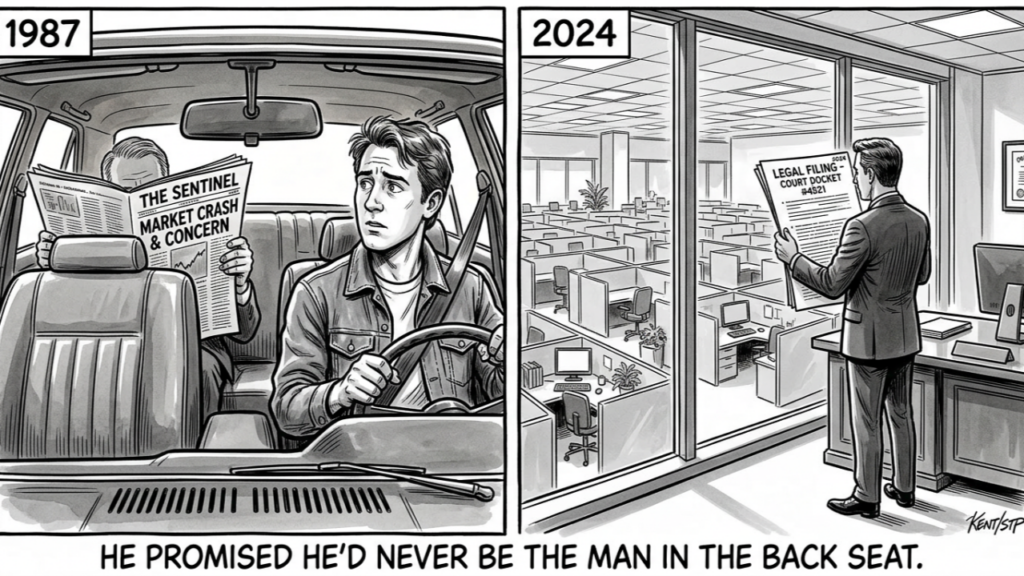
He tells a story from his first week as a messenger. Peter Rose asked him to drive the company’s then-CEO, John, to pick up a car. Wall was thrilled. Eighteen years old, driving the CEO. He was going to ask questions, get mentored, go home and tell his parents he’d met the top man. Instead, John climbed into the back seat. Like it was an Uber, Wall says, except Uber didn’t exist yet. Then John pulled up a newspaper. No conversation. No eye contact. When they arrived, John jumped out without a word.
Wall went back to the office. Peter Rose was waiting at his desk. “How was that?” Wall told him it was horrible. And then he made a vow: “Peter, if I ever become an executive, I would never treat anybody like that.”
Peter didn’t look surprised. He told Wall that John wouldn’t be here in six months. And Peter was right. Peter understood people the way only someone whose word meant something could understand them. His word was rock solid. Oak. When Peter Rose told you something, you could build a career on it. You could build a company on it. And for forty years, that is exactly what Expeditors did. The promise wasn’t a slogan. It was oak, because the man who planted it was oak.
He tells the audience what that vow became. “Your title doesn’t describe how important you are. It just describes the job you do, and every role is critical, and we treat each other that way.” He describes the culture as selfless. “My export is your import,” he says. Everyone pulling for each other. No backstabbing, no climbing over one another. A connected workforce that looks out for its own.
He talks about his Opportunity Knocks program, his capstone project at Seattle U. The idea was to formalize what Expeditors had done for him: take kids who didn’t think they could go to college, weren’t sure how they’d earn a living wage, and bring them into a professional environment, teach them how to operate in it, and give them a chance. The way Tim gave him a chance. The way Peter Rose gave him a chance. He says at his retirement, he hopes they show every Opportunity Knocks youth who was hired and what they went on to do. He gets emotional when he mentions that the parents came up to him at a gathering and asked if they could have jobs at Expeditors too, because their kids loved it so much.
And then he says the thing I cannot stop hearing.
He is talking about what separates him from other CEOs. He is talking about what it means to care. And he says this, on the microphone, to a room full of students and alumni and faculty:
“I don’t wanna be these, one of these companies that, you know, ‘Oops, we accidentally hired 14,000 too many people, and now we have to let them go.’ Like, that’s somebody’s livelihood. That’s somebody’s job. That’s somebody’s family that’s gonna be impacted. That matters. And not to say that we won’t lay people off, but boy, we’re gonna try like hell never to have to do that.”
That’s somebody’s livelihood. That’s somebody’s job. That’s somebody’s family.
That matters.
He said that.
He said that knowing that Expeditors had already terminated approximately two thousand employees in 2023 and 2024 for pretextual reasons. He stood in front of that microphone and mocked companies that treat layoffs as casual arithmetic, oops, we hired too many, while sitting on the knowledge that his own company had already done exactly that to two thousand people and was likely planning to do it again. The audience didn’t know. The employees who would be next didn’t know. But Wall knew. He said “that matters” into a microphone while his company was already proving, by its conduct, that it didn’t.
And here’s the thing. It would be easy to dismiss a CEO who says the right words on a podcast as performing. But if you’ve spent any time with Dan Wall’s public presence, you know he doesn’t come across as corporate. He comes across as real. Scroll through his Twitter feed and you’ll find memes. He posted a photo of himself dressed up with his friends and joked that they looked like they were straight out of Animal House. He seemed like a down-to-earth guy. The kind of CEO who doesn’t take himself too seriously. The kind of person who means what he says because he’s still, at some level, the kid from Kent who drove a company car up and down Air Cargo Road. That’s what makes the docket not just disappointing but disorienting. It is one thing to watch a polished executive fall short of a scripted talking point. It is another to watch a guy who posts memes and cracks jokes about Animal House authorize a legal position that calls his own employees unreasonable for believing in him.
Now hold the docket in your other hand.
I was writing about this long before The Seattle Times reported the death of a no-layoff policy the company now claims never existed. The Seattle Times did important journalism in documenting what many employees already suspected. But what their reporting surfaced as a policy change, the federal docket reveals as something worse. Not a change. A denial. The company didn’t tell the Seattle Times it had ended the policy. Its lawyers told a federal judge the policy never existed at all. In the federal litigation I’ve been covering for months, Expeditors’ legal team, representing the company, authorized by its leadership, filing under its name, submitted signed motions arguing first that the no-layoff policy never existed. And then, in the alternative, that even if it did exist, it was “precisely the type of vague promise of future conduct that courts have rejected.” They argued further that any employee who relied on that promise was “unreasonable.”
Read them side by side. Take your time.
On the podcast, Wall mocks companies that treat layoffs as casual arithmetic. Oops, we hired too many people, now we have to let them go. He frames that attitude as the antithesis of everything Expeditors stands for. He promises his company will try like hell never to do it. He grounds that promise in a moral claim: these are livelihoods, these are families, this matters.
In the courthouse, his lawyers told a federal judge that the promise he was describing on that stage, the one his entire company was built around, the one he invoked as proof of his character, was legally meaningless. And that the employees who believed it were unreasonable to do so.
The podcast says: we will try like hell never to do that to you.
The docket says: and you were a fool to believe us.
Someone will argue that legal filings are written by lawyers, not CEOs. That litigation strategy is technical. That you can’t hold a leader personally accountable for the arguments his attorneys make in a motion to dismiss.
That argument misunderstands how corporate litigation works. Legal filings are authorized representations of the company’s official position. They carry the company’s name, its authority, and the professional obligations of the attorneys who sign them. They are not freelance opinions. They are what the institution has decided, at the highest level, to tell a federal judge under penalty of sanctions. If Expeditors’ lawyers told the court that the no-layoff promise was meaningless and reliance on it was unreasonable, it is because the company, Dan Wall’s company, made a deliberate decision to take that position.
Wall could have instructed his lawyers differently. He could have said: the policy was real, we honored it for forty years, and we made a painful decision to end it. That would have been honest. It is legally defensible. It would have been consistent with the man on the podcast. It would have been consistent with the man who told Peter Rose he would never treat people the way John treated him in that car.
He didn’t. Instead, his company told a federal judge that the promise never existed and, if it did, that believing in it was irrational. That is not a legal strategy chosen for tactical convenience. That is a window into what the institution actually believes when the microphone is off and the stakes are real.
And Wall chose the coward’s door. No press statement. No public address to the employees whose retirement security was at stake. No town hall, no company-wide email, no moment where he stood in front of the people who built Expeditors and explained why the promise changed. Just silence, lawyers, and a docket number. Cowards hide. Wall hid.
And here is what makes it worse than the car. John was rude. John was dismissive. John climbed into the back seat, pulled up a newspaper, and treated an eighteen-year-old kid like he wasn’t there. That was bad enough to scar Wall for decades, bad enough to generate a vow he has retold on stages and in studios and in leadership programs for thirty-seven years. But John didn’t deny the promise. John didn’t tell Wall the car ride never happened. John didn’t instruct an attorney to file a motion arguing that Wall’s expectation of basic human decency was “precisely the type of vague hope that courts have rejected.” John was silent. That was his sin. Wall’s sin is worse. He didn’t ignore his people. He denied them. He turned their trust into a legal liability and their loyalty into evidence of poor judgment. John pulled up a newspaper. Wall pulled up a motion to dismiss.
But there is something even worse than the denial, and it has to do with the man Wall credits for everything.
Peter Rose is the one who made the promise. Peter Rose is the man whose word I described a few paragraphs ago as oak, and I chose that word carefully, because everything Wall said about him on that podcast earns it. Rock solid. The man whose word you could build a career on, build a company on. Peter Rose is the man who looked at an eighteen-year-old messenger and saw something worth investing in. Who sent Wall to Seattle University because he believed Wall could become more than a manager. Who predicted that John would be gone in six months, not because he had inside information, but because he understood character, because he could see the difference between a man who treats people right and a man who pulls up a newspaper. Peter Rose made a judgment about Dan Wall. He believed Wall was made of the same stuff he was. That Wall would carry the word forward. That the oak would hold.
The no-layoff promise was Peter Rose’s promise. It was part of his legacy, part of the culture he planted and tended for decades, part of the reason twenty thousand people came to work at Expeditors and stayed. When Wall’s lawyers told a federal judge that the promise never existed, they weren’t just denying a corporate policy. They were denying Peter Rose’s word. The oak. The foundation Wall told a university audience you could build a company on.
Wall stood on that stage and used Peter Rose’s memory to prove his own character. He invoked Rose’s name to show the audience where his values came from. And then he authorized a legal position that told a federal court that Peter Rose’s word, the oak, the foundation, the thing that made Expeditors different from every other company, was precisely the type of vague assurance that courts have rejected. He took the man who gave him everything, the man who believed Wall was made of the same stuff, and he told a judge that man’s promise was legally meaningless.
Peter Rose looked at Dan Wall and saw himself. The docket shows him what Wall actually became.
That is how Dan Wall honored the memory of the man who made him. Not with silence, the way John dishonored Wall in the car. With erasure. He didn’t just fail to carry the word forward. He sent lawyers into a federal courthouse to argue the word was never real. Peter Rose’s word was oak. Dan Wall’s lawyers called it vapor. And the man who made a judgment about Wall’s character, who believed the kid from Kent would protect what he built, is not here to see what his judgment produced.
But the company didn’t stop at denying its own promise in federal court. When someone tried to hold them accountable, they came after me.
The company’s conduct in this litigation has not been limited to polite legal arguments in signed briefs. Bar complaints were filed against me. Not against my client. Against his lawyer. They were dismissed. False accusations were leveled against me, and they stopped only after I threatened to sue a board member for defamation. Let that sink in. They didn’t go after the man who lost his job. They went after the man holding the pen. The complaints didn’t fail because I backed down. They failed because they had no merit. The accusations didn’t stop because the company found its conscience. They stopped because I threatened consequences. Every weapon the company aimed at the attorney trying to expose the gap between the podcast and the docket broke in its hands, and the company only put them down when it realized that I could fire back.
And when Brian Carrabes sat for his deposition, a routine legal proceeding where a witness answers questions under oath, armed men showed up. Not metaphorically armed. Armed. Whatever justification the company offers, whatever its lawyers say about security protocols or standard procedure, the message it sends is unmistakable. This is not a company engaged in a good-faith legal dispute with former employees it once claimed to cherish. This is a company that first denied its own promise, then attacked the lawyer trying to prove it existed, and then hired armed men to sit in on a deposition. The man on the podcast talked about humility, grit, and care. The man who authorized this litigation hired guns for a deposition.
There is a meaningful difference between what people say when they are performing and what they say when they are under oath. Podcasts are performances. You control the narrative, you choose the anecdotes, you present the version of yourself you most want the world to see. There is no cross-examination. No opposing counsel. No consequence for overstatement. Just a host who wants you to be interesting and a microphone that lets you be whoever you’d like.
Federal court is different. In federal court, words are weighed. Misrepresentations carry sanctions. Positions taken in signed filings become the permanent record of what a party believes and contends. When a company tells a federal judge something, it is telling the truth as it wants the law to understand it.
So when Expeditors tells a podcast audience that its culture of caring for people is the foundation of everything it does, and tells a federal judge that employees who believed in that culture were unreasonable, the question isn’t which statement is more flattering. The question is which one was made in a forum where lying has consequences.
You already know the answer.
And there is another document that makes the dissonance even harder to sit with. Expeditors maintains a Code of Business Conduct. Every employee is required to review it, be tested on it annually, and certify their compliance with it. Violation of the Code can result in termination. The Code tells employees they have a responsibility to do what is right, and that doing right means complying with both the letter and the spirit of the company’s policies. It warns employees, in the company’s own words, against exploiting “general language, technicalities, or other loopholes.” It promises an open-door policy. It commits the company to an environment of honesty, integrity, and mutual respect. Employees don’t experience the Code as a suggestion. They experience it as a condition of employment. They click the box. They pass the test. They sign their name. Every year. And they understand, because the company has made it very clear, that if they fail to comply, they can be fired.
But when employees pointed to that same Code and said the company violated its own standards, Expeditors’ lawyers argued in federal court that the Code created no binding obligations for the company. The document that can end an employee’s career for noncompliance, the one the company enforces downward with annual testing and certification and the explicit threat of termination, imposes no reciprocal obligation upward. The company that warns its people not to exploit loopholes built its entire legal defense out of one. The Code is a loyalty oath that runs in one direction. And every employee who has read the docket now knows which direction that is.
I’ve written two pieces about Expeditors before this one. In the first, I documented how the company outsourced its public defense to a paid vendor rather than face its own workforce. In the second, I gave Wall the benefit of the doubt and wrote the honest speech he could have given, the one a leader with real humility would have delivered. I gave him the room to rise to the moment. He didn’t take it.
This piece is not about what the company did to the people it let go. I’ve said what I have to say about that. This piece is about what it is doing, right now, to the people who stayed.
Twenty thousand employees still work at Expeditors. Or at least they did before he terminated 230 of them. They got their notice on a Monday. Hard to love. Wall himself used that number on the podcast. “We have 20,000 people,” he said. “If I’m gonna know 20,000 people, it’s gotta be those people.” They are the ones he was speaking to, whether he intended to or not. They are the ones who heard him describe a culture of humility and care and thought: that’s why I’m here. They are the ones who, when the layoffs hit and the bootcamps started and the LinkedIn posts exploded, looked at their own desks and ran the private calculus every employee runs in a moment like this: Am I safe? Is this still the company I joined? Can I trust what they’re telling me?
And I know they are reading this. This is not speculation. The analytics on these pieces tell a story of their own. Each article has generated tens of thousands of impressions and thousands of views. Sixty-five percent of readers work in transportation, logistics, supply chain, and storage. Forty-six percent work at companies with more than ten thousand employees. Nineteen percent work at Expeditors itself. One in four holds a senior-level position. Eleven percent are in the Greater Seattle Area, the company’s own backyard. Thousands of new followers have found these pieces and stayed, not because the writing is exceptional, but because the gap between the microphone and the courthouse is real and the people inside the building know it. These are not casual readers. They are the workforce Dan Wall claims to lead with humility, grit, and care, and they are paying close attention.
Think about what that means. Think about who these readers are. Many of them came to Expeditors the same way Wall did. No degree. No pedigree. A family that didn’t talk about college. A parent who drove trucks or waited tables or worked a register. They heard the same promise Wall heard: this company hires for attitude and trains for skill. Your title doesn’t describe how important you are. Unlimited opportunity. They believed it the way Wall believed it when he was eighteen, running documents up and down Air Cargo Road, because it was true. It was true for forty years. It was true for Wall himself, the living proof, the messenger who became CEO.
And now those employees have access to the federal filings. Some have read my pieces. Some have read the docket directly. And they are staring at a gap that no town hall, no internal email, no future podcast episode can bridge: their CEO told a university audience that he puts their livelihoods at the center of every decision, and his legal team told a federal judge that employees who took the company at its word were unreasonable to do so.
Which version do you plan your life around?
That is not a rhetorical question. It is a practical one. It is the question every Expeditors employee is running quietly right now, whether they say it out loud or not. Because the answer determines everything, whether you stay or start looking, whether you tell your family you’re secure or start hedging, whether you give this company your next ten years or your next ten months.
Wall said something else on that podcast that lodges in the chest. He was talking about customer service, but the principle he described applies to everything. “I try to tell people that secret all the time,” he said. “If you take really good care of our customers, I’m gonna wanna pay you more money to stick around. I don’t want you going to the competition.”
He was describing loyalty as a transaction. You give care, you get security. You invest in the company, the company invests in you. That was the deal. That was the operating principle he articulated as the secret to career longevity at Expeditors. And then his legal team went to court and argued that the employees who held up their end of that exact bargain, who gave their care, who stayed instead of going to the competition, were unreasonable for believing the other side of the deal was real.
And the competition is listening. Kuehne+Nagel is listening. DHL is listening. DSV – Global Transport and Logistics is listening. C.H. Robinson, Flexport, DB Schenker. They are all listening. They read the same LinkedIn analytics you do. They see the same workforce uncertainty you created. And they don’t need to run a recruiting campaign. You ran it for them. Every employee who reads the docket and starts quietly updating a résumé is not wondering whether to leave logistics. They are wondering which competitor will honor the promise that Expeditors just told a federal judge was never real.
He also said this: “Monday happens every seven days. You better love it.”
There are people who loved their Mondays at Expeditors. Who oriented their entire lives around those Mondays. Who turned down other offers because of those Mondays. And then one Monday, the company told them their jobs were gone. And the Monday after that, its lawyers told a judge that their belief in the permanence of those Mondays was irrational.
Monday happens every seven days. It is hard to love it when that is the day they hand you a termination notice. And it is harder still to love it when you survived that Monday but know the next one might be yours. Twenty thousand people wake up every Monday morning and go to work for a company whose lawyers have told a federal judge that the promise those Mondays were built on was never real. That is what Monday feels like now at Expeditors. Not a day to love. A day to survive.
And here is what the employees still inside the building already know that Wall may not yet understand: people who have been shown the gap between the microphone and the courthouse do not listen to the next speech the same way. They listen for the distance between what is said and what is signed. And once they learn to hear it, they hear it in everything. Every town hall. Every all-hands. Every leadership email that opens with “I want to be transparent with you.” The word transparent starts to curdle when you’ve read a legal filing that argues transparency was never owed.
Wall told the Seattle University audience that he has a goal of visiting fifty offices a year. That within three and a half years, he’ll have visited every office. He described what he does: he walks the room, stops by desks, asks people about the pictures of their families, connects before the town hall starts. He said he tells management, “Leave me alone. I’m just gonna walk around and meet everybody.”
Imagine being an Expeditors employee in one of those offices now. Imagine Dan Wall walking up to your desk, asking about the photo of your kids, shaking your hand, telling you that every role is critical and that your title just describes the job you do. And imagine knowing, because you have read the filing or because someone you trust has told you about it, that his company argued in federal court that the promise this culture was built on was vague and unenforceable, and that the people who believed in it were unreasonable.
Do you smile? Do you nod? Do you say, “Great to meet you, Dan”?
Or do you hear the back door of a car shutting, and a newspaper going up, and silence where a conversation should have been?
That is the damage I cannot stop thinking about. Not the legal exposure. Not the headlines. Not the stock price. The damage is that Dan Wall has taught his own workforce to distrust his voice.
He has shown them, through the federal docket, that his public words and his institutional positions live in different universes. That the warm, humble, gritty leader on the podcast is a character performed for external consumption, and that the cold, legalistic, deny-everything posture of the courtroom is the real engine that actually runs the company. The podcast is the lobby. The docket is the building.
Once that lesson is absorbed, it does not reverse. It compounds. Every future promise Wall makes will be filtered through the docket. Every claim about culture, about loyalty, about putting people first, will be silently footnoted by twenty thousand people who know what the company argued when it was under oath and thought no one was paying attention.
Wall told the audience that his parents didn’t care about his grades. They cared about character. “Are they respectful? Do they treat people right? Do they listen?” He said he carried that into his own parenting. He said it set the foundation of being able to develop relationships that were pretty key in his career.
And he’s right. Character is the foundation. Which is exactly why the docket is so devastating. Because the question his parents would have asked, the question that mattered more than grades or titles or revenue, is simple: does he treat people right?
I don’t know Dan Wall’s parents. I never met them. But I know people like them. I grew up in Adams, Massachusetts, a small mill town in the Berkshires where the mountains are beautiful and the money is short. My family looked a lot like the one Wall described on that podcast. People who worked with their hands. People who didn’t talk about college because no one they knew had gone. People like my neighbors, Dick and Lorraine, who I probably gave more gray hair than their own sons with my antics. People who didn’t have much to give their children except a set of principles, and who gave those principles with a seriousness that wealthy families reserve for trust funds. Your word is your bond. You look people in the eye. You don’t say one thing and do another. You treat people right, especially the ones who can’t do anything for you. Those weren’t bumper stickers. They were the only inheritance families like ours could afford, and they were worth more than anything that could be deposited in a bank.
I know what parents like that would say if they read the docket. They wouldn’t understand the legal strategy. They wouldn’t care about motions to dismiss or promissory estoppel or the enforceability of implied contracts. They would understand something simpler and more damning: their kid told people one thing and then his lawyers said another. He made a promise with his voice and broke it with his signature. They would be devastated. Not angry. Devastated. Because the principles they gave him, the ones he talks about so movingly on that podcast, the ones about character and respect and treating people right, those were the most valuable things they had. They gave him everything. And what the docket shows is that those principles have been reduced to a performance, something to invoke on a microphone when the audience is friendly and discard in a filing when the stakes are real.
Not only are my parents proud of me, but so is the town of Adams. Not because of anything I’ve accomplished, but because I never wavered from the values they gave me. As John Mellencamp sang, “I cannot forget from where it is that I come from. I cannot forget the people who love me.” That song could have been written about Adams. About the Berkshires. About every mill town and bowling alley and truck stop where parents handed their kids a set of principles and prayed those kids would hold on to them when the money got good and the temptation got real. I held on. And the people who raised me know it.
The podcast says yes, he treats people right. The docket says it doesn’t matter, because the promise to treat people right was never binding.
Wall began his career because someone gave him a chance. Tim the district manager, despite the bad interview, despite the kid who wanted to be a truck driver, looked at an eighteen-year-old and said yes. Wall has told that story so many times it has become the creation myth of his leadership identity. The company that takes chances on people. The culture that sees potential where others see risk.
The people his company laid off were the same bet. They were the messengers, the operations clerks, the ones who showed up with attitude and no degree and were told the company would take care of them if they took care of it. They held up their end. And when they turned to the company and said, “You promised,” the company’s lawyers replied: that promise was precisely the type of vague assurance that courts have rejected.
Tim took a chance on Dan Wall. Dan Wall’s Expeditors told a federal court that the people it took a chance on were unreasonable for believing the chance was real.
The podcast was meant to be a leadership asset. It is now an exhibit. Not because Wall said anything false on it. The old Expeditors he described was real. The culture was real. The promise was real. That is what makes this so painful. He is not lying about the past. He is desecrating it in the present. His own legal team, acting on his authority, told a federal court that the culture he celebrated on that microphone was legally meaningless and that the employees who believed in it were fools.
He turned his own testimonial into evidence against himself. And the people still inside the building are the jury.
I also don’t know Dan Wall. I’ve only encountered two versions of him: the one on the podcast, and the one on the docket. I spent months giving him the benefit of the doubt, publicly, in writing, because I believe people deserve the chance to rise to a moment before they are judged for failing it. The way Tim gave him a second interview. The way Peter Rose saw potential in a kid who didn’t see it in himself.
The podcast was titled Unlimited Opportunity: Leading with Humility, Grit, and Care. But Wall got the casting wrong. He is not the one who demonstrated humility, grit, and care. His employees are. Humility is what they were made to feel when they were walked out of a building they gave their careers to, when the company they trusted told a federal judge their trust was unreasonable. Grit is what they will need to pick up the pieces, to update a résumé they never expected to write, to explain to a hiring manager why they left a company they loved, to sit across a kitchen table and tell someone who depends on them that the promise was not real. And care? Care is what they gave, for years, for decades, to a company whose lawyers argued in court that giving it was irrational. Wall titled his episode Leading with Humility, Grit, and Care. He was right about the words. He was just wrong about who embodied them.
But you cannot be both people. You cannot sit in a studio and talk about humility while your lawyers argue that the people who trusted you were irrational. You cannot claim grit as your leadership brand while your employees are the ones who need it to survive what you did to them. You cannot mock companies that say “oops, we hired too many people” and then let your lawyers argue that the promise not to do exactly that was never real. You cannot tell the story of an eighteen-year-old kid whose aunt got him an interview and whose boss gave him a chance and then instruct your attorneys to argue that the people who believed in that same chance were unreasonable for doing so.
You cannot celebrate the culture that built you while your legal team burns the house down behind you.
At some point you have to choose. The podcast or the docket. The leader who cares, or the institution that calls caring unreasonable. The man who vowed never to treat people the way John treated him in that car, or the CEO whose legal filings do something far worse than pull up a newspaper. They pull up a motion to dismiss.
Twenty thousand people are waiting to see which one he picks. But most of them, quietly, have already decided for themselves. They listened to the podcast. Then they read the filing. And they did what any reasonable person would do.
They believed the one that was signed under oath.