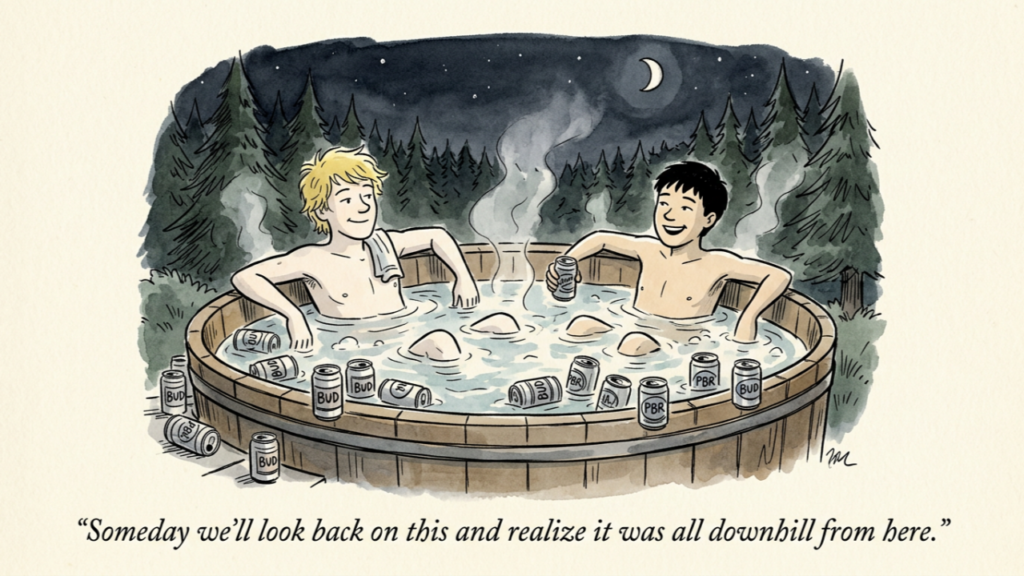
On Old Milwaukee, plausible deniability, and the night Jason turned the greatest moment of my adolescence into a cryogenics experiment.
There is a list that every man keeps, somewhere in the back of his mind, of moments he would like to do over. Not the big ones. Not the career decisions or the marriages or the time you said the wrong thing at a funeral. Those are too heavy for the list. The list is for the other moments, the ones that were so close to being perfect, so nearly, agonizingly, almost right, that the memory of them doesn’t sting so much as itch, permanently, in a place you can’t quite reach.
I have one. Just one. And it involves a hot tub, a garden hose, four girls from Pittsfield, Massachusetts and my friend Jason, who, on a Saturday night in 1986, committed an act of such breathtaking, irreversible stupidity that I have spent forty years trying to forgive him and have not yet fully succeeded.
But I’m getting ahead of myself. To understand what happened in the hot tub, you first have to understand how we got there. And to understand how we got there, you have to understand Bob.
The El Camino and the Economy of Shifty
Bob Bellora, known to everyone in Adams, Massachusetts as “Shifty,” was a year older than the rest of us, which, at fifteen, is the difference between a civilian and a god. The nickname had nothing to do with his character, which was generous, and everything to do with his poker face, which was nonexistent. When Shifty played cards, and we played often, in basements and garages and anywhere else that would have us, his eyes betrayed him with the mechanical regularity of a metronome. Every time he drew a bad hand, which was most of the time, his eyes would dart, left-right-left, as though he were watching a very small, very fast tennis match that only he could see. You didn’t need to read his cards. You just needed to read his pupils.
He had also mastered a move that I have never seen replicated, before or since: the one-handed wallet flip. When Shifty lost a hand, which was often, because you cannot bluff when your eyeballs are semaphoring your holdings to the entire table, he would reach into his back pocket and, in a single fluid motion, flip open his wallet, extract a bill, and slide it across the table without breaking conversation. It was the only graceful thing about his poker game. The man lost with the efficiency of a machine and the style of a man who had made peace with it.
But Shifty had something none of the rest of us had, something more valuable than poker skills or money or even dignity: he had a driver’s license. And he had an El Camino.
For the uninitiated, the El Camino is a vehicle that answers a question nobody asked: what if a car were also a truck? Half sedan, half pickup, entirely absurd, a vehicle designed for a man who wants to take his wife to dinner and haul lumber on the same trip. Shifty’s El Camino was our chariot. Every weekend, we piled into it, and I mean piled, four or five of us crammed into a vehicle with only a pocket full of beer money and a prayer, and set off on whatever adventure the night had in store. Some of us rode in the back, in the bed, lying flat against the cold metal with the stars overhead and the Berkshire wind tearing past and a complete disregard for traffic law, seatbelt regulations, and the basic physics of what happens to an unsecured teenager at a sudden stop.
Behind the driver’s seat, there was a spot where the carpet could be dislodged, creating a gap just wide enough to slide things from the cab into the bed of the truck. This was not a design feature. This was a modification, born of necessity, and its purpose was singular and sacred: it was a beer chute. You bought the beer, you slid it through the gap, and it disappeared into the bed of the El Camino, invisible to anyone who might pull you over, which in Adams meant Officer Somebody, who knew your father, who knew your grandfather, who would not arrest you but would absolutely tell your mother, and your mother would tell the Red Carpet or Adams Lunch, which have since been replaced by the Daily Grind, and by 7:45 AM your entire life would be over.
The beer chute kept us alive. Socially, if not legally.
Pop’s Variety and the Woman in Pink
Our weekly excursions began, almost without exception, at Pop’s Variety Store in North Adams. Pop’s was the kind of place that exists in every small New England town and survives by asking no questions. It sold cigarettes, candy, lottery tickets, and beer, and it did so with the moral flexibility of an institution that understood its customer base and had made its peace with God.
The drinking age was twenty-one. We were fifteen. This mattered, in theory. In practice, it mattered only if the wrong person was working.
The right person was a woman, large, unsmiling, draped in a pink sweater that she wore with the consistency of a uniform and the enthusiasm of a woman who had stopped caring about things like fashion, or carding minors, sometime during the Ford administration. When the woman in the pink sweater was behind the counter, you were golden. She didn’t ask for ID. She didn’t make eye contact. She barely acknowledged your existence. She was, in her own way, a saint, a patron saint of underage drinking in northern Berkshire County, dispensing grace one transaction at a time.
My friend Paul and I had reduced the operation to a science. We were the procurement division. The only ones in the group who could pull it off, which meant we weren’t just buying for ourselves, we were buying for everyone. Shifty, Jason, whoever else was riding in the El Camino that night. The entire social calendar of six or seven fifteen-year-old boys in Adams, Massachusetts, depended on two of them being able to walk into a variety store and walk out with enough Old Milwaukee to fuel whatever insanity the evening required.
Always Old Milwaukee. Not because we liked it, nobody likes Old Milwaukee; Old Milwaukee is not a beer you like, it is a beer you tolerate because it costs $5.50 a twelve-pack and you are fifteen and your entire beer budget comes from paper routes, odd jobs, and whatever you can extract from Shifty at the poker table, which is, admittedly, a reliable income stream given his cardplaying.
We did not browse. We did not linger. We did not make the rookie mistake of wandering the aisles like tourists, drawing attention, giving the woman in the pink sweater time to develop a conscience. We walked in with exact change, counted in the car, sorted by denomination, arranged in order, ready to deploy, grabbed the twelve-packs from the cooler nearest the door, stacked them on the counter, put the money down, and walked out. Multiple twelve-packs. One transaction. No small talk. No eye contact. No hesitation. The entire operation took under a minute, which, when you are fifteen years old and purchasing enough beer to supply a small platoon, is a land-speed record. It was a heist. It was beautiful. The Secret Service could not have extracted a protectee from a hostile environment with more precision than Paul and I extracted three twelve-packs of Old Milwaukee from Pop’s Variety on a Friday night.
Back in the El Camino, the twelve-packs slid through the gap behind the driver’s seat, disappeared into the bed, and we were on our way. Shifty’s eyes darted in the rearview mirror, not because he was nervous; that was just what his eyes did, and the night began.
The Hot Tub
Shifty’s house was, by Adams standards, impressive. Nice area of town. The kind of house that had things. Waterbeds, plural, because in the mid-1980s, waterbeds were the ultimate signifier of a household that had arrived, a household that said we are not content to sleep on springs like common people; we will sleep on heated water, and we will do so in rooms with ceiling fans and wood paneling, and you will respect us. And a hot tub. An outdoor hot tub. In a backyard. In Adams, Massachusetts, where the concept of a hot tub was so exotic, so extravagant, so aggressively Californian, that having one was roughly equivalent to parking a yacht in your driveway.
Shifty’s parents were out of town. I won’t say where they went or for how long, because in Adams, even forty years later, someone’s mother will read this and there will be a conversation at the Daily Grind, and I’ve already given the Daily Grind enough material for several news cycles. Suffice it to say: the house was ours. The hot tub was ours. And Jason and I, armed with a case of Old Milwaukee and the kind of ambition that only fifteen-year-old boys in a small town with absolutely nothing else to do can summon, decided to get in the hot tub and stay there.
We stayed there for hours.
I want to be precise about this. Not an hour. Not a casual soak. We were in that hot tub for the kind of duration usually associated with endurance events and hostage situations. We sat across from each other, beers lined up on the edge like soldiers at attention, and we drank and talked and drank and talked and drank. The steam rose around us. The Old Milwaukee, which had been cold, became warm, because even the beer couldn’t maintain its composure in that heat, but we drank it anyway, because when you are fifteen and in a hot tub with a case of beer and no parental supervision, you do not let temperature compromise the mission.
We did not get out. Not once. Not to get food. Not to stretch. Not to use the bathroom.
I want to be very clear about this: we did not use the bathroom. We had no reason to use the bathroom. Two fifteen-year-old boys who had been drinking beer for several hours in a body of warm water had absolutely no reason, at any point, to need to use the bathroom. The human body, as I understand it, simply absorbs beer when submerged in hot water, like some kind of osmotic process, and no further biological events occur. I am certain of this. Jason is certain of this. The hot tub, if it could speak, would probably tell a different story, but hot tubs can’t speak, which is, in this case, a mercy.
We were pruned. Our fingers looked like topographic maps. Our skin had taken on the consistency of wet paper. We were, by any objective measure, two teenagers who had been marinating in a stew of hot water, Old Milwaukee, and, nothing else, for far too long.
And then Jason did the thing.
The Hose
I don’t know why. He doesn’t know why. There are moments in the history of human decision-making that resist explanation, moments where a person does something so inexplicably, so profoundly counterproductive that the only possible explanation is that God needed a laugh and briefly took the wheel.
Jason got out of the hot tub, the first time either of us had moved in hours, walked across the yard, picked up the garden hose, turned it on, and began filling the hot tub.
With cold water. From the garden hose. In the Berkshires. Where the groundwater temperature, even in summer, hovers somewhere between “refreshing” and “cardiac event.”
“What are you doing?” I asked.
“Filling it up,” he said.
“Why?”
“It’s low.”
It was not low. It was not appreciably lower than it had been when we got in. Whatever volume had been lost to evaporation and splashing was negligible, a few inches at most, nothing that would affect the structural integrity of the hot tub experience. But Jason had identified a problem that did not exist and was solving it with the enthusiasm of a man defusing a bomb.
The water from the hose hit the tub and I felt it immediately, a cold current snaking through the warm water like a rumor through the Daily Grind, subtle at first, easy to ignore, and then impossible to escape. I shifted to the far side. The cold followed. I pulled my legs up. The cold found them. The hot tub, which had been a bath, was becoming a pool. Which was becoming a pond. Which was becoming, minute by minute, degree by degree, something that a Norwegian would use for cardiovascular training.
“Jason.”
“Yeah?”
“Turn off the hose.”
“Almost done.”
He was not almost done. He left the hose running for fifteen minutes. Fifteen minutes. In that time, the hot tub completed a transformation so total, so absolute, that it constituted a violation of the Geneva Convention. What had been, for hours, a perfect 102-degree sanctuary of warmth and Old Milwaukee and adolescent contentment was now, approximately, 55 degrees and falling. It was an ice bath. It was a punishment. It was the kind of cold that doesn’t just lower your body temperature but rearranges your personality. I could feel my skeleton.
Jason turned off the hose, got back in, and made the face. The face of a man who has just realized, too late, that he has done something that cannot be undone.
“It’s cold,” he said.
“It’s cold.”
“It wasn’t this cold when I started.”
“No. It wasn’t.”
We sat there, in what was now essentially a kiddie pool filled with glacial runoff and the lingering ghost of Old Milwaukee, and stared at each other with the silent, mutual recognition of two people who have just watched something precious die and know exactly who killed it.
And then the girls arrived.
The Girls from Pittsfield
In Adams, in 1986, Pittsfield was the big city. I realize how that sounds. I realize that Pittsfield, Massachusetts, a former General Electric company town of 45,000 people in the middle of the Berkshires, is not, by any global or even regional standard, a metropolis. But to us, to kids from a town of 8,000 where the most exciting thing that happened on a Friday night was someone’s mother reporting something to someone else’s mother at the post office, Pittsfield was Manhattan. It was Paris. It had multiple movie theaters. It had girls who didn’t already know your grandfather.
Billy Joel had a song about uptown girls, and in our minds, that was what Pittsfield girls were. Sophisticated. Worldly. Glamorous. Women of experience and mystery, from a city with a Sears and a JCPenney, who probably drank cocktails and knew about things. We were, in this belief, spectacularly wrong. The four girls from Pittsfield who showed up at Shifty’s house that night were fifteen-year-old girls from Pittsfield, which is to say they were exactly like fifteen-year-old girls from Adams except they had a slightly longer drive home. But we didn’t know that yet. We didn’t know anything yet. We were fifteen. Our entire understanding of women came from movies and the one time, and I need to tell you about this, the one time I had seen a naked woman in my life.
I was six. My family was at the Williams Inn in Williamstown, a lovely New England inn that, among its amenities, had a sauna. I wandered away from my parents, because that is what six-year-olds do, and I opened the sauna door, because that is also what six-year-olds do, and inside was a couple. A naked couple. Doing what naked couples do in saunas, which, at six, I understood to be “sitting in a very hot room with no clothes on for reasons that adults presumably find enjoyable but that I, a child, find confusing and slightly frightening.”
I stood there. They looked at me. I looked at them. There was a long moment in which all three of us evaluated the situation and found it wanting. Then I closed the door and ran away screaming, carrying with me a memory that would, for the next nine years, represent the entirety of my experience with the unclothed human form.
That was my frame of reference. That was all I had. A six-year-old’s three-second glimpse of a startled couple in a Williamstown sauna. This was the romantic education I brought to Shifty’s hot tub on the night the girls from Pittsfield arrived.
There were four of them. They came in through the back gate with the confidence of people who had been invited, which they had been, someone at the gathering knew them from somewhere, a detail I never fully investigated because in a small town the connections between people are so numerous and so tangled that asking “how do you know them” is like asking “why is the sky blue”: technically answerable, but not worth the time.
They saw the hot tub. They saw us in the hot tub, two boys, pruned beyond recognition, surrounded by empty cans of Old Milwaukee, sitting in water that was, unbeknownst to them, now the temperature of a mountain stream in early April.
Someone, I don’t remember who, I may have blocked it out, I may have repressed it the way the mind represses things too painful to carry in active memory, made a suggestion. A not-entirely-serious suggestion. The kind of suggestion you make at fifteen when you have no idea what you’re doing and even less idea what you’d do if it worked.
“You guys should get in.”
I expected laughter. I expected dismissal. I expected the look, the look that fifteen-year-old girls give fifteen-year-old boys when the fifteen-year-old boys have said something so far beyond the realm of possibility that it doesn’t even merit a verbal response, just a glance, a turn, and a departure.
They started taking off their clothes.
Not all of their clothes. Their outer clothes. They stripped down to their underwear, and not the kind of underwear you’d see in the Sears catalog, which was the only frame of reference a fifteen-year-old boy from Adams had for such things, and which featured sensible, full-coverage, cotton undergarments in white or beige, modeled by women who looked like they had strong opinions about fabric softener and were due at a church potluck by noon. This was not that. This was something else entirely. They stripped down casually, as though this were a thing that people did, as though getting into a hot tub in your underwear at a stranger’s house with two boys you’d never met was simply how Saturday nights worked in Pittsfield, which, for all I knew, it was, because Pittsfield had multiple movie theaters and clearly operated on a different social frequency than anything I had ever experienced in Adams.
Think about what this moment meant. Think about the magnitude. I was fifteen years old. My entire experience with the female form consisted of a traumatic three-second sauna encounter at the Williams Inn when I was six. And now, in Shifty’s backyard, under the Berkshire stars, four girls from Pittsfield were climbing into a hot tub in their underwear, and I was already in it, and this was happening, this was actually happening, and the universe, which had been stingy and cruel and had offered me nothing but Old Milwaukee and pumpkins and the back of an El Camino for fifteen years, was finally, finally delivering.
They put one foot in.
The screaming was immediate.
The Aftermath
“OH MY GOD.”
“IT’S FREEZING.”
“WHAT IS WRONG WITH THIS?”
“WHY IS IT COLD?”
They recoiled from the water the way a hand recoils from a stove. One of them had gotten in up to her knees before the temperature registered, and she came out of that tub like she’d been launched, water streaming off her, arms wrapped around herself, staring at us with an expression that combined betrayal, confusion, and the dawning suspicion that she had driven all the way from Pittsfield to get into a bathtub full of ice water with two idiots.
“It’s a hot tub,” she said. “It’s supposed to be hot.”
She was right. She was unimpeachably, inarguably, devastatingly right. A hot tub is supposed to be hot. It says so in the name. The word “hot” is right there, first word, same billing, same promise, same fundamental covenant between man and appliance as a hot toddy, which, my wife would learn years later in an Adams bar, is also not immune to temperature-related betrayal.
Jason said nothing. He had sunk lower in the water, the cold, terrible water, until only his eyes were visible above the surface, like a man trying to disappear into the scene of his own crime.
“Come back in,” I said, with the desperate, shivering conviction of a diplomat whose peace talks are collapsing. “It’ll warm up.”
It was not going to warm up. A hot tub that has been filled with garden hose water for fifteen minutes does not warm up on command. It warms up over the course of hours, if the heater is running, which I wasn’t even sure it was, because Jason may have dislodged something when he turned the tub into a reservoir. But I was fifteen, and there were four girls in their underwear standing three feet away from me, and I would have said anything. I would have told them the water was heated by volcanic vents. I would have told them it was a Swedish hydrotherapy technique. I would have told them it was supposed to be cold, that cold was the new hot, that we had deliberately engineered this experience for their benefit, because I was fifteen and desperate and turning blue and the greatest opportunity of my adolescent life was putting its clothes back on.
They put their clothes back on.
They didn’t storm out. They didn’t yell. They did something worse. They looked at us, two shivering, pruned, slightly blue fifteen-year-old boys sitting in a tub of cold water surrounded by a graveyard of Old Milwaukee cans, with pity. Genuine, unreserved, Pittsfield pity. The kind of pity you feel for a dog that has chased a car and caught it and now doesn’t know what to do. They gathered their things. They said something polite, the way you say something polite when you’re leaving a party that was never a party. And they walked out through the back gate and drove away, back to Pittsfield, back to the big city, back to whatever sophisticated, temperature-controlled social lives awaited them there.
Jason and I sat in the cold tub for a long time after they left. We didn’t speak. There was nothing to say. The Old Milwaukee was gone. The girls were gone. The warmth was gone. Everything that had mattered was gone, replaced by 55-degree water and the kind of silence that exists between two friends when one of them has done something unforgivable and both of them know it.
Finally, Jason spoke.
“I think the heater’s kicking back in,” he said.
It wasn’t.
The Do-Over
I told Ruth this story last week. I hadn’t planned to. It came out the way these things always come out, sideways, unprovoked, triggered by something that shouldn’t have mattered but did.
We’d just gotten back from Zhuhai. We’d booked a Sea View Pool Duplex Villa at the Angsana, a Banyan Tree property, specifically, solely, because it had a private heated pool. I want to be clear about this. The pool was the reason. The pool was the entire reason. We did not book a Sea View Pool Duplex Villa for the sea view or the duplex or the villa. We booked it for the pool. The private, heated pool.
Not cool. Not brisk. Not refreshing in a way you weren’t expecting. The water was so cold that neither I nor my wife could physically enter it beyond knee height. We spent two nights paying a premium for a private heated pool we could not use, which made it, functionally, a private unheated decorative water feature, which is not what the brochure promised and not what I paid for and not, this is the part that matters, not what I have been chasing for forty years.
Because it hit me, standing on the steps of that pool in Zhuhai with the water biting at my knees, that this had happened before. That this was, in some fundamental and possibly cosmic sense, the same moment. A body of water that was supposed to be hot. A promise that was supposed to be kept. And me, again, standing at the edge of it, betrayed.
I turned to Ruth and said, “Let me tell you about the hot tub.”
She listened with the expression she reserves for stories about Adams, the one that starts as amusement and gradually transitions into something closer to disgust.
“So the girls left,” she said.
“The girls left.”
“Because the water was cold.”
“Because Jason filled the hot tub with a garden hose.”
“And you never saw them again.”
“Never saw them again.”
She picked up her chopsticks, which is what Ruth does when she’s about to deliver a verdict. The chopsticks are her gavel.
“You know,” she said, “in Hong Kong, when a boy likes a girl, he takes her to dinner. Maybe a movie. Maybe the waterfront. He takes her to meet his parents. He does not sit in a tub of cold water for four hours surrounded by cheap beer and wait for her to take her clothes off.”
“It was a hot tub,” I said. “It was hot when we started.”
“And then your friend filled it with a hose.”
“Yes.”
“A garden hose.”
“Yes.”
“And you’re telling me this is the one thing in your life you’d do over.”
“The one thing.”
She looked at me for a long time. “Not law school? Not moving to Hong Kong? Not the time you took me to the Rainforest Cafe and told the hostess that Trevor, Trevor, the physician who is the same age as you, was your autistic son so you could skip the wait, and then he started making monkey sounds at the top of his lungs, and you just sat there while the entire restaurant stared at us?” She paused, and something crossed her face that wasn’t quite the memory of anger but wasn’t quite not, the look of a woman who has forgiven something in principle but reserved the right to revisit it at any time, without warning, for the rest of your natural life. “Not the time you tried to auction me off at a Chinese Auction at the Notre Dame Church because I am Chinese and you thought it would be funny?”
“The hot tub,” I said. “If I could go back to one moment, it’s the hot tub. Ten seconds before Jason picked up that hose. I would tackle him. I would sit on him. I would explain to him, calmly and carefully, that the water level was fine, that the water temperature was fine, that everything was fine, and that under no circumstances should any new water, from any source, at any temperature, enter this tub for the remainder of the evening.”
“And then the girls would have stayed.”
“And then the girls would have stayed.”
“In their underwear.”
“In their underwear.”
“In the warm water.”
“In the warm, perfect, 102-degree water. With us. Under the stars. In Shifty’s backyard. In Adams, Massachusetts. On the single greatest night of my fifteen-year-old life.”
Ruth ate a piece of fish. She chewed slowly. She put her chopsticks down.
“You would have had no idea what to do,” she said.
She was right. She was unimpeachably, inarguably, devastatingly right. I still wouldn’t. Even if Jason hadn’t picked up the hose. Even if the water had stayed at a perfect 102. Even if the girls had gotten in and stayed in and the stars had aligned and the universe had delivered everything it had promised in that one shining, impossible moment, I would have had no idea what to do. My entire education in the female form was a three-second sauna encounter at the Williams Inn when I was six. I had no moves. I had no lines. I had Old Milwaukee on my breath and pruned fingers and the romantic instincts of a boy who had spent every Saturday night of his adolescence in the back of an El Camino buying beer from a woman in a pink sweater.
But that’s not the point. The point was never what would have happened next. The point is that for one moment, one brief, shimmering, perfect moment, between the girls taking off their clothes and the water telling the truth, anything was possible. The universe had opened a door. A door that had never opened before and would never open in quite the same way again. And Jason, my friend, my good and dear and stupid friend, had spent fifteen minutes filling that door with garden hose water until it froze shut.
That’s the thing about do-overs. You don’t want them for the moments that went wrong. You want them for the moments that almost went right. The moments where you could see it, the life you were supposed to be living, the night you were supposed to be having, the story you were supposed to be telling for the rest of your life, shimmering on the surface of the water like a reflection, perfect and clear and almost close enough to touch.
And then someone turns on a hose, and the reflection goes cold, and the girls go home to Pittsfield, and you’re left sitting in a tub of ice water with your best friend and twelve empty cans of Old Milwaukee and a memory that will itch, gently and permanently, for the next forty years.
Jason, if you’re reading this: I forgive you. Mostly. The statute of limitations on a garden hose has to expire eventually.
But if anyone from Pittsfield is reading this, anyone who was fifteen in 1986 and once drove to Adams to get into a hot tub that turned out to be an ice bath, I just want you to know: it was hot when we got in. It was perfect. You should have been there an hour earlier, when the water was warm and the beer was cold and two boys from Adams were waiting under the stars with no plan, no moves, and no idea what they’d do if the night actually went their way.
Which, thanks to Jason and a garden hose, it didn’t. But God, for a minute there, it almost did.
.