I have a scar on my left shin from a lawn dart. A Jart. The real kind, the kind that is now illegal to sell in the United States, the kind with a weighted steel tip and plastic fins that was marketed as a backyard game for the whole family. The kind that should have killed me. My friend, David, threw it. He did not throw it at me. He threw it in my general direction, which in 1982 was the same thing as being careful. It hit me on the downswing of its arc, point first, went maybe a quarter inch into my leg, and I pulled it out and threw it back at him. I was nine. Nobody went inside. Nobody called anyone. I bled into my tube sock and we kept playing until my David’s mom yelled that dinner was ready. I still have the scar. It is the shape of a small star. I have never once considered suing David.
I do not know when America decided that childhood was a condition to be survived rather than a process that made you into something. But I know what it made me into, and I know it is the reason I can live where I live and move how I move and not be afraid of things that are simply ordinary if you grew up when I grew up.
I drank from garden hoses. Specifically, I drank from the garden hose behind the Blair’s house, which had been attached to that spigot since roughly the Hoover administration and tasted like hot metal and lawn chemicals and the faint sweetness of whatever was growing in the coil where it kinked near the fence. You let it run for three seconds. The first burst was the temperature of soup. Then it went cold and you drank until your ears hurt, and then you wiped your mouth with the back of your arm and you were hydrated. That was the system. I did not carry a water bottle until I was thirty-four years old.
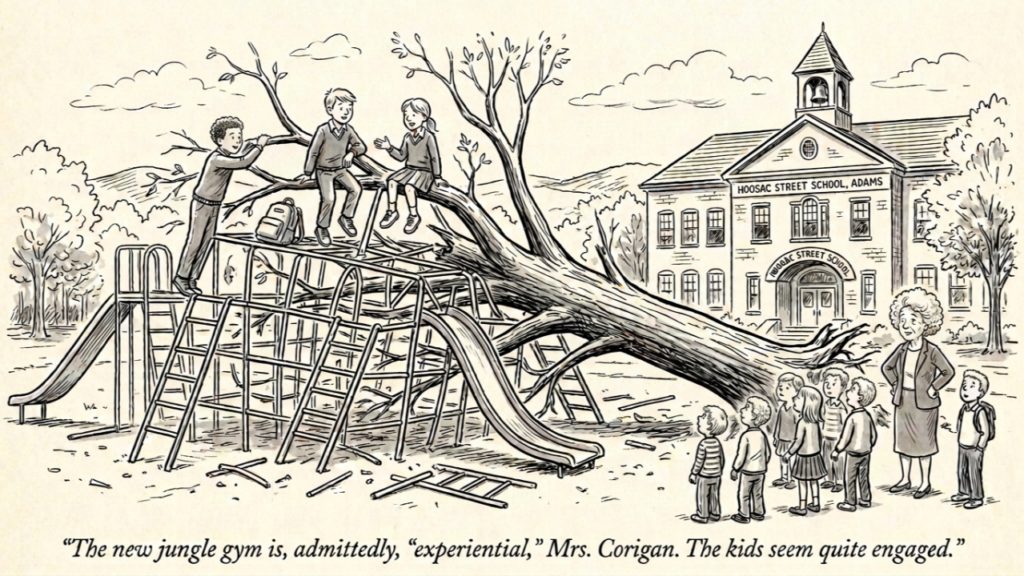
The Hoosac Street School had a jungle gym that was not a jungle gym in the way people use that word now. It was a structure. It was massive. Metal pipes, welded together, tall enough that a fall from the top was not a scrape, it was a decision. Kids climbed it. Small kids. They climbed to the top and they sat up there like birds on a power line and nobody told them to come down because the whole point was to climb it. You learned where your hands needed to be. You learned what your weight felt like when you were twenty feet up and the bar was wet. You learned what fear was for, which is to tell you to pay attention, not to tell you to stop. One day they were cutting down a tree near it and the tree fell the wrong way and smashed the whole thing flat. Destroyed it completely. Pipes bent, joints snapped, the whole structure compressed into something that looked like modern art. They never replaced it. They just left the empty space where it had been. Poured asphalt over the spot eventually. That was it. Kids at that school after 1978 or whatever year it was just never had it. They never got to learn what it felt like to be high up with nothing but their own grip keeping them there.
We rode in the back of Stan Kopala’s pickup truck.Some people think I mean down a dirt road at low speed. I do not. I mean to Notch Road. I mean at speed. I mean there were several of us back there, wind going sideways, holding on to the sides of the bed or not holding on at all, and Stan driving the way Stan drove, which was not slow. We were going to ride dirt bikes. Not the kind with speed limiters and kill switches that parents buy now from catalogs with safety ratings. Dirt bikes. Fast ones. On trails that were not trails so much as suggestions carved into the hillside by other kids on other dirt bikes who were also going too fast. Nobody wore pads. Some of us wore helmets, the old kind that were basically a shell with a strap. You crashed and you got up or you crashed and someone came back for you. Nobody’s mother was called. You walked it off or you sat on a rock until you could walk it off.
We shot guns. I need to clarify this because I think for some people reading this it will sound like I am describing a militia compound or a family of outlaws. I am not. I am describing normal life. We had guns. We shot them. In the woods, at cans, at targets, at whatever needed shooting. By the time I was sixteen I could drive and carry my own gun, which I did, which many of us did. This was not remarkable. This was not commented on. This was an average day in the life of a teenager in a place where teenagers were treated as people who were almost adults rather than large children who could not be trusted with anything sharper than a opinion. I had a vehicle and a firearm and the responsibility that came with both, and nobody considered this strange because the whole framework of growing up was: here is something dangerous, learn how to handle it, do not be stupid. That was the whole curriculum.
The playground near my house had a metal slide that I am fairly certain was designed by someone who wanted to understand what temperature human skin could tolerate before separating from the body. In June it was not a slide. It was a griddle. You went down it in shorts because you did not have another option and you were not going to be the kid who did not go down it. The sound your thighs made was not a sound thighs should make. It was the sound of a steak hitting a pan. You did not tell anyone. You peeled yourself off the bottom and you got back in line because there were nine kids behind you and weakness was not something you showed in 1984. The ground under that slide was gravel. Small, sharp gravel. I landed on my hands once and picked rocks out of my palms during dinner. My mother looked at them and said wash your hands. That was the medical consultation.
The merry-go-round. Let me talk about the merry-go-round. It was a metal disc that spun on a pole and the entire point of it was to get it going fast enough that someone flew off. That was the game. The game was centrifugal force and the prize was not flying off. I flew off. Multiple times. Into the gravel. Which, again, was made of small rocks. Not rubber. Not foam. Not the soft bouncy recycled-tire material they use now. Rocks. My elbow still clicks from one of those landings. I was eight. I got up and got back on because the alternative was going home, and going home before the streetlights came on was a kind of social death that no physical injury could compete with.
The streetlights. That was it. That was the whole parenting framework. Be somewhere, anywhere, do anything, with anyone, and be home when those lights come on. Between breakfast and dusk you were a free agent in the world. No phone. No GPS. No check-in. My mother did not know where I was for six to ten hours a day for the entire duration of my childhood and she was fine with this because every mother on the street was also fine with this because this was how it worked. I could have been at the quarry. I was sometimes at the quarry. But I was there. At age ten. Unsupervised. Looking down into it.
My father drove with a beer between his legs. Not occasionally. Routinely. There was a cooler in the back seat. It was a small Igloo cooler, red and white, and it had Budweiser in it and it was there every time we went anywhere that took more than twenty minutes. He drove with one hand and drank with the other and nobody in the car thought about it because every father did this. My mother smoked with the windows up. Not cracked. Up. The car was a Buick and it smelled like Parliaments and vinyl and the particular smell of a car heater running in winter with no fresh air coming in. I sat in the back seat in a cloud. There was no car seat. There was no booster. There was the back seat, and you sat in it, and if he stopped short you caught yourself on the front seat or you didn’t.
I learned to drive when I was twelve. Not legally. In a field. My uncle put me in his Cadillac and said figure it out. The car was a manual. I stalled it six times. He laughed and drank his beer and told me to try again. By the end of the afternoon I could get it into third gear and I felt like I had conquered something real. I had. I was twelve years old and I could drive a stick shift and no one was going to give me a certificate for it. No one needed to.
Here is why any of this matters.
I live in Hong Kong. I have lived in Asia for years. And Asia did not get the memo. Asia did not decide that human beings are made of glass and need to be protected from every surface, every corner, every uneven step, every decision that has not been pre-approved by a committee. The scaffolding on a forty-story building here is bamboo. Bamboo poles lashed together with knots by guys in sandals who are smoking while they do it. It holds. It has always held. It holds because the men who built it grew up in a world that expected competence rather than compliance.
The minibus takes a corner and you hold on or you do not hold on. There is no announcement. There is no warning. The driver has been doing this for thirty years and he does not care about your comfort and he does not need to care because everyone on that bus knows the deal. The deal is hold on. Ruth grew up on those buses. She does not think about holding on. Her hand goes to the rail the way my hand went to the side of Stan’s truck bed. Automatically. Competently. Without fear.
She crossed Nathan Road by herself when she was eight years old. Nathan Road, which if you have not been there, is six lanes of taxis and buses and trucks that do not slow down and do not care and the crosswalk signal is a suggestion that everyone, including small children, interprets loosely. She did it because she had to get to school. Her parents were at work. There was no one to take her. So she crossed. Every day. For years. She is not traumatized by this. She is good at crossing streets. There is a difference.
I watch Americans visit Hong Kong and freeze on the sidewalk. They stand at a crossing and wait for the signal and the signal comes and they still hesitate because a taxi is turning and it is not going to stop and they do not know what to do because nothing in their life has prepared them to make a decision in real time with real consequences. They grew up on rubber playground surfaces. They were driven to school until they were sixteen. They wore helmets on tricycles. And now they are adults who cannot cross a street in a city that expects them to be adults.
I am not saying the 1970s and 1980s were better. I am saying they produced people who could function in places that do not care about them. Places that assume competence. Places that do not have a sign for every danger or a railing for every edge or a warning for every hot surface. I fit in Hong Kong because Hong Kong operates the way my childhood operated. Pay attention. Move your body. Hold on to something. Do not wait for someone to tell you it is safe. Figure out if it is safe. That is your job. The jungle gym at Hoosac Street School taught me that. Stan Kopala’s truck taught me that. A dirt bike at speed on Notch Road with no pads and a borrowed helmet taught me that. A gun at sixteen with no adult standing over my shoulder taught me that. The world is not soft. It was never soft. The question is whether you learn that at eight, when the stakes are a scar and a story, or at twenty-eight, when the stakes are everything else.
Ruth says Americans are afraid of everything. She says this while jaywalking across Queens Road with a hot coffee in one hand and her phone in the other, threading through a gap between a bus and a delivery truck that exists for maybe a second and a half. She does not look up. She has done this ten thousand times. She is not brave. She was never taught to be afraid of ordinary life.
I drank from a garden hose that tasted like 1978. I rode in the back of a pickup to go ride dirt bikes that went faster than most people drive. I carried a gun before I could vote. She crossed six lanes of traffic at eight years old. Different decades. Different continents. Same operating system.
The operating system is: the world does not owe you padding. It never did. Move through it like it is yours or stand on the sidewalk and wait for a sign that is never coming.
The sign is never coming.