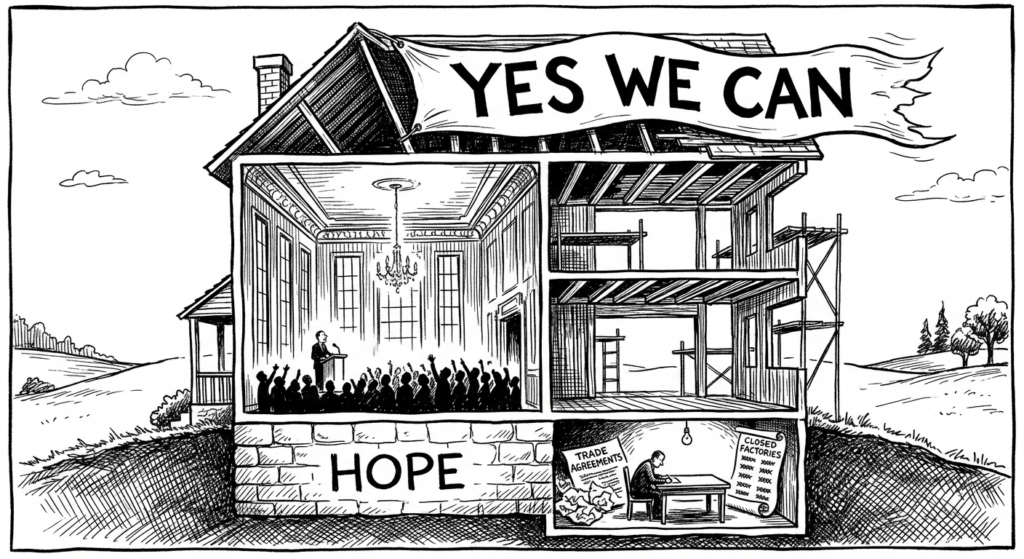
I listened to the speech again last night. The New Hampshire one, after Obama lost the primary to Hillary Clinton, January 2008. I pulled it up on YouTube, sat on the couch in our flat in Mei Foo, and let the whole thing run. I hadn’t heard it in years. I thought the cadence would still land. It didn’t. What I heard was a man making a series of very specific promises, in very plain English, to a room full of people who deserved better than what he was about to give them. Every applause line was a contract. He broke them one at a time, methodically, over eight years, and somehow left office popular enough to sell out an arena tour.
Ruth walked past the screen, stopped for about four seconds, and said, “He sounds like a guy selling you a kitchen renovation.” She picked her tea back up and went back to whatever she was reading.
She was right. Let me walk through the renovation estimate, line by line, and then show you the kitchen.
“You can be the new majority who can lead this nation out of a long political darkness, Democrats, Independents and Republicans who are tired of the division and distraction that has clouded Washington; who know that we can disagree without being disagreeable; who understand that if we mobilize our voices to challenge the money and influence that’s stood in our way and challenge ourselves to reach for something better, there’s no problem we can’t solve, no destiny we cannot fulfill.”
That was the promise. Not a policy proposal, a covenant. He was telling a room full of people, and a country watching at home, that the era of tribal politics was over. That he would be the president who made Americans stop hating each other. Let’s look at what the country looked like when he said it, and what it looked like when he left.
In November 2008, right after Obama’s election, Gallup found that 57 percent of Americans believed the country was “more divided than in the past on major issues.” That number was actually down from where it had been after 2004, when it hit 72 percent. People were hopeful. Eighty percent told Gallup they believed Obama would make “a sincere effort to work with Republicans in Congress.” Sixty-two percent expected Republicans would return the favor. The country was not unified, but it believed it was about to be.
By November 2016, the month Obama’s presidency effectively ended, 77 percent of Americans told Gallup the nation was “greatly divided” on its most important values, a record high. Only 21 percent said the country was united. The number had climbed from 65 percent in 2004 to 69 percent in 2012 to 77 in 2016. Every single year of the hope-and-change presidency, the country felt more fractured than the year before.
The partisan gap in presidential approval tells the story in finer grain. Gallup tracks this meticulously. From Eisenhower through Carter, the average gap between how a president’s own party and the opposing party rated his job performance was 34 points. Reagan averaged 52. Clinton, 56. George W. Bush pushed it to 61, which seemed like a ceiling. Obama shattered it. His average partisan gap in job approval across all eight years was 70 points, 83 percent approval among Democrats, 13 percent among Republicans. That is not a number that happens to a president. That is a number a president builds, piece by piece, by turning every policy fight into a loyalty test and every disagreement into a referendum on character.
The feeling wasn’t just disapproval. It was fear. In 2008, Pew found that 32 percent of Republicans and 37 percent of Democrats held “very unfavorable” views of the opposing party. Bad enough. By 2016, those numbers had nearly doubled, 58 percent of Republicans and 55 percent of Democrats now held very unfavorable views of the other side. More than half of Democrats, 55 percent, told Pew that the Republican Party made them “afraid.” Forty-nine percent of Republicans said the same about Democrats. Not disappointed. Not frustrated. Afraid. Of a political party. In their own country.
And it wasn’t abstract policy disagreement driving the fear. People had started to believe the other side was genuinely dangerous. In 2014, Pew found that 36 percent of Republicans believed Democratic policies “are so misguided that they threaten the nation’s well-being,” and 27 percent of Democrats said the same about Republicans. Just two years later, those numbers had jumped to 45 percent and 41 percent. By 2022, it was 75 percent of Republicans and 64 percent of Democrats. The escalation was not gradual. It was a rocket.
Trust in the federal government, the institution Obama promised to redeem, cratered on his watch. When he took office, Pew measured trust at about 24 percent, already low after the financial crisis and the final years of Iraq. It never recovered. In every single year of Obama’s presidency, trust hovered between 15 and 25 percent. He left office with trust at roughly 20 percent. The man who promised to restore faith in government presided over eight years during which the American public’s faith in government flatlined at historic lows and never once climbed above 30 percent, something that had been true since 2007 but that Obama, for all his eloquence, did absolutely nothing to reverse.
He didn’t just fail to fix the division. He modeled it. He gave it grammar and syntax. In April 2008, at a fundraiser in San Francisco, in a house in Pacific Heights packed with donors who had maxed out their $2,300 contributions, Obama was asked how to appeal to Pennsylvania voters. His answer, captured on audio by a blogger named Mayhill Fowler and published by the Huffington Post, was to describe working-class voters in Pennsylvania and the Midwest, the very people he was asking to trust him, as people who “get bitter, they cling to guns or religion or antipathy to people who aren’t like them or anti-immigrant sentiment or anti-trade sentiment as a way to explain their frustrations.”
That was not a gaffe. That was a diagnosis delivered to a room full of coastal donors who nodded along because it confirmed what they already believed. He was standing in Pacific Heights explaining the interior of the country like a nature documentary. Those people aren’t angry because the factory closed and nobody came to help. They’re angry because they’re bitter and clinging to the wrong things. Religion. Guns. Suspicion of outsiders. In Obama’s framing, economic anxiety wasn’t a legitimate response to thirty years of deindustrialization and a retraining system that couldn’t place half its graduates. It was a psychological deficiency. Something to be managed, not addressed.
Hillary Clinton heard the lesson and raised the stakes. On September 9, 2016, at a fundraiser at Cipriani Wall Street in Manhattan, she told a room of donors, “You could put half of Trump’s supporters into what I call the basket of deplorables. Right? The racist, sexist, homophobic, xenophobic, Islamophobic, you name it.” Half. She didn’t say a fringe. She didn’t say a faction. She said half, which at the time meant roughly 30 million Americans. She called them deplorable from a ballroom on Wall Street while asking for money from the same donor class that Obama had confided in eight years earlier. The through line is not subtle.
Trump, for his part, matched them insult for insult but aimed in the opposite direction. He called Mexicans rapists, told four congresswomen of color to “go back” to where they came from, and turned “enemy of the people” into a catchphrase for the press. The cruelty was the point, as Adam Serwer wrote, and it worked precisely because the other side had already told his voters they were bitter, deplorable, and afraid of change. When a politician tells you that you’re pathological for being angry, and then another politician tells you your anger is righteous, you don’t need a focus group to predict the outcome.
But here’s what the data makes impossible to ignore. The division didn’t start with Trump’s escalator ride in June 2015. The steepest climb in partisan animosity, the sharpest spike in “very unfavorable” views of the opposing party, the acceleration of the belief that the other side threatens the nation, all of it tracks to the Obama years. Pew’s numbers are unambiguous. Between 2008 and 2016, the share of partisans holding very unfavorable views of the other party nearly doubled on both sides. The share calling the other party a threat to the nation grew by double digits. Obama didn’t cause all of it, the media ecosystem, social media silos, the financial crisis, congressional gerrymandering all played their parts. But he was the president. He had the microphone. He had the promise. And instead of using it to build a bridge, he set the rhetorical template that made the bridge impossible to build.
The disagree-without-being-disagreeable candidate spent his presidency turning policy disagreements into character tests. If you opposed the Affordable Care Act, you wanted people to die. If you questioned immigration enforcement priorities, you were xenophobic. If you raised concerns about executive overreach, you were obstructing progress. Obama was too sophisticated to say any of this crudely, which is what made it so effective. He could slice you up at a press conference with a disappointed-professor expression that made disagreement feel like a moral failing. He didn’t yell. He didn’t need to. He had the tone.
When the Tea Party arrived, driven in large part by genuine fury over the bank bailouts and the sense that Washington had rescued Wall Street and abandoned Main Street, the Obama apparatus and its media allies didn’t engage the policy arguments. They went straight to motive. Racist. Retrograde. Afraid of change. Some of them were, no question. But the refusal to separate the economic argument from the cultural caricature, to treat Rust Belt anger as anything other than bigotry in a different hat, guaranteed the backlash. You cannot tell people their concerns are illegitimate for eight years, while their factories close and their retraining program can’t place half its graduates, and then act surprised when they vote for the loudest guy in the room who says their concerns are the only thing that matters.
Trump didn’t divide America. He moved into a house Obama had already split down the middle, pulled up the floorboards, and held a rally in the basement.
And nowhere was the distance between the speech and the presidency wider than on health care.
The same New Hampshire concession speech, same night, same crowd. Right after the line about division and destiny, Obama said this: “Our new American majority can end the outrage of unaffordable, unavailable health care in our time. We can bring doctors and patients, workers and businesses, Democrats and Republicans together, and we can tell the drug and insurance industry that, while they’ll get a seat at the table, they don’t get to buy every chair. Not this time. Not now.”
That was the line. The crowd roared. It was a hell of a sentence. Within months of taking office, the Obama White House was holding private meetings with Billy Tauzin, the CEO of PhRMA, the pharmaceutical industry’s lobbying arm. Tauzin was the former Louisiana congressman who had shepherded the Medicare Part D prescription drug bill through Congress in the middle of the night, a bill that banned the government from negotiating drug prices, then walked out of Congress and into PhRMA’s corner office at a reported $2 million a year. He was the poster child for the revolving door. Obama had named him by title in a campaign ad, called the arrangement corrupt. Then he sat down across the table from him and cut a deal.
The terms, reported first by the Los Angeles Times in August 2009 and later detailed by ProPublica through internal emails, went roughly like this: PhRMA would pledge $80 billion in cost savings over ten years and spend $150 million on TV advertising supporting the health care bill. In exchange, the White House agreed to block Medicare from negotiating drug prices and to kill the reimportation of cheaper drugs from Canada. The drug companies didn’t just get a seat at the table. They got the table. They got the kitchen. They wrote the terms on a napkin and the White House signed it. Rahm Emanuel, the chief of staff who’d made $16.2 million in two and a half years at a Chicago investment bank, personally managed the relationship. The most transparent administration in history cut its biggest health care deal behind closed doors with a man Obama had publicly called a symbol of Washington corruption.
The drugs didn’t get cheaper. They got more expensive. Every year. For eight years. And not just drugs. The whole system. When Obama took office, the average annual premium for employer-sponsored family health coverage was about $13,375. By the time he left, it was over $18,000. By 2025, it had climbed to nearly $27,000. The United States now spends roughly $14,800 per person on health care annually, nearly double what Switzerland spends, which is the next most expensive country on earth, and about twice the average of comparable wealthy nations. Americans spend more per capita on health care administration alone, over $1,000 per person, than most countries spend on entire categories of treatment. The system doesn’t just cost more. It costs more and delivers less. Life expectancy in the U.S. sits at about 79 years. The average across peer nations is nearly 83. Americans pay the most and die the soonest. That is the kitchen renovation Obama sold them.
And the country noticed. Not in the way Washington notices things, with policy papers and panel discussions. In the way a body notices an infection. On December 4, 2024, a twenty-six-year-old named Luigi Mangione walked up behind Brian Thompson, the CEO of UnitedHealthcare, outside the New York Hilton Midtown and shot him dead on a Manhattan sidewalk. Thompson was on his way to an investor conference to tout UnitedHealth Group’s projected $450 billion in revenue. Mangione was carrying a ghost gun, fake IDs, and a handwritten note criticizing what he called “parasitic” health insurance companies. The shell casings left at the scene were inscribed with three words: “Delay,” “Deny,” “Depose,” the informal motto of the claims-denial industry dressed up as evidence tags.
The reaction was not what anyone in a boardroom expected. Mangione became a folk hero. TikTok filled with tributes. Reddit threads lit up with support. Look-alike contests were held in Washington Square Park. A December 2024 Economist/YouGov poll found that 41 percent of Americans aged 18 to 29 called the killing “acceptable.” A NORC poll found that a majority of American adults believed health insurance companies bore a moderate or great deal of responsibility for Thompson’s death because of their coverage denials and their profits. Wanted posters of other insurance CEOs appeared around Manhattan. A protest song about UnitedHealth went viral. The man who shot a father of two in the back on a city sidewalk was being compared to Robin Hood, and the most unsettling part was that tens of millions of Americans understood exactly why. They had spent years fighting denied claims, watching premiums double, burying relatives whose treatments were delayed past the point of survival, and they looked at the killing and thought: that is what happens when you let an industry eat people alive for thirty years and nobody in Washington does a thing about it.
Obama had the chance to do something about it. He had the majority. He had the mandate. He had the microphone, and the sentence, and the crowd that roared when he said the drug companies wouldn’t buy every chair. And when the time came, he sold them the chairs, the table, and the house.
“Our new majority can end the tax breaks for corporations that ship our jobs overseas and put a middle-class tax cut into the pockets of the working Americans who deserve it.”
This was the promise to the factory floor. The speech was given in New Hampshire, but it was aimed at Ohio, Michigan, Pennsylvania, Wisconsin, the places where the parking lots were already half empty and the second shift wasn’t coming back.
To understand what Obama walked into and then refused to fix, you have to understand what had already happened to the American worker. Between 2000 and 2010, the United States lost 5.5 million manufacturing jobs. Not over a generation. In a decade. Nearly 60,000 factories closed. One third of all manufacturing employment in the country, gone. The Bureau of Labor Statistics data is not ambiguous about this. Manufacturing employment fell from about 17 million in December 2000 to under 12 million by 2010, and only a fraction ever came back.
China’s accession to the World Trade Organization in 2001 was the accelerant. The economists David Autor, David Dorn, and Gordon Hanson, who coined the term “China Shock,” spent years tracking what happened next. Their research, updated as recently as 2025, found that Chinese import competition accounted for roughly a quarter of all manufacturing job losses between 2000 and 2007, somewhere between 1.5 and 2 million jobs. The Economic Policy Institute put the broader figure, including supply chain effects, at 2.7 million jobs lost to the China trade deficit between 2001 and 2011. Entire industries, textiles, furniture, home electronics, didn’t just contract. They disappeared from American geography.
The damage wasn’t abstract. Autor, Dorn, and Hanson found that communities hit hardest by import competition experienced lower wages, higher unemployment, reduced labor force participation, declining housing prices, falling tax revenues, rising childhood poverty, higher rates of single parenthood, and increased mortality related to drug and alcohol use. Deaths of despair. That phrase didn’t come from a politician. It came from researchers looking at the data and trying to explain why working-age men in former factory towns were dying at rates that didn’t make sense unless you understood that the economy had been pulled out from under them like a tablecloth, and nobody caught the dishes.
The workers who lost manufacturing jobs didn’t move into equivalent work. An IMF study found that among those who found reemployment in the service sector, over 60 percent took a pay cut. For workers who had spent more than ten years in manufacturing, the median wage decline was around 35 percent. For some, closer to 45 percent. The American middle class, which had been built in no small part on the manufacturing wage premium, a non-college worker earning a living wage with benefits and a pension, began to hollow out. Pew Research documented the arithmetic. The share of adults in middle-income households fell from 55 percent in 2000 to 51 percent by 2014. Median household income, which had peaked at $67,673 in 1999, dropped to $62,462 by 2014. The middle class didn’t just shrink. It fell through the floor into a lower-income bracket, and the fall accelerated after 2000.
The government had a program for this. It was called Trade Adjustment Assistance. It was supposed to be the safety net, the retraining pipeline, the mechanism by which displaced workers found their footing in the new economy. The GAO called it flawed. The Office of Management and Budget rated it “ineffective.” An American University study using propensity score matching found that TAA participation was associated with a wage loss roughly ten percentage points greater than if the displaced worker had simply not enrolled in the program at all. A Labor Department Inspector General audit of the $1.5 billion TAACCCT program, Obama’s signature community college retraining initiative, found that less than half of unemployed participants who entered training actually found a job. Of 177 grantees, 127 had met less than 50 percent of their employment targets. The entered employment rate hovered around 44 percent. The program spent $1.5 billion and couldn’t get half its people into work.
This was the landscape when Obama took office. And his answer, after the bailouts and the stimulus and the slow, uneven recovery, was to spend years pushing the Trans-Pacific Partnership, a twelve-nation trade deal covering 40 percent of the global economy, negotiated in secret, with the text withheld until the deal was essentially done. Labor unions, the base that had knocked on doors for him in Ohio and Pennsylvania, warned it would accelerate offshoring. Elizabeth Warren said it openly. Obama’s response was to tell critics they were “wrong on the facts” and accuse Warren of playing politics. The man who had stood in New Hampshire and promised to end tax breaks for offshoring was now telling the workers’ own allies to sit down while he signed another trade deal.
He never built the bridge. That’s the thing. Other countries that opened their markets also invested in their workers. Germany built robust apprenticeship systems and short-time work programs that kept people employed during downturns. Denmark built its “flexicurity” model, combining flexible labor markets with generous unemployment insurance and active retraining. The United States built Trade Adjustment Assistance, underfunded it, designed it badly, staffed it poorly, and then pointed to it in speeches as proof that someone was watching out for the little guy. Nobody was watching out for the little guy. The little guy was in Youngstown staring at a shuttered plant and a retraining brochure for a medical coding job that paid half what the line used to pay and required him to drive forty minutes to a community college that had already run out of federal funds.
The TPP never passed. Not because Obama changed his mind, but because the country he claimed to understand had already moved on without him. By 2016, the Rust Belt didn’t want another trade deal explained by a professor. They wanted someone who would say “this is garbage” and throw it in the trash. They got one. You can draw a straight line from Obama’s broken promise on trade to the states that flipped red in November 2016. The people in Youngstown and Flint and Kenosha didn’t leave the Democratic Party. The Democratic Party left the factory, locked the door, and mailed the key to Davos.
“Democrats, Independents, and Republicans who are tired of the division and distraction that has clouded Washington, who know that we can disagree without being disagreeable.”
This is the one that aged the worst.
Everyone remembers Trump as the president who divided America. He did. He was crude about it, loud about it, performative about it. But the fracturing didn’t start in 2016. Obama built the template.
In April 2008, at a fundraiser in San Francisco, in a house in Pacific Heights packed with donors who had maxed out their $2,300 contributions, Obama was asked how to appeal to Pennsylvania voters. His answer, captured on audio by a blogger named Mayhill Fowler and published by the Huffington Post, was to describe working-class voters in Pennsylvania and the Midwest, the very people he was asking to trust him, as people who “get bitter, they cling to guns or religion or antipathy to people who aren’t like them or anti-immigrant sentiment or anti-trade sentiment as a way to explain their frustrations.” That was not a gaffe. That was a diagnosis delivered to a room full of coastal donors who nodded along because it confirmed what they already believed.
He was standing in Pacific Heights explaining the interior of the country like a nature documentary. Those people aren’t angry because the factory closed and nobody came to help. They’re angry because they’re bitter and clinging to the wrong things. Religion. Guns. Suspicion of outsiders. In Obama’s framing, economic anxiety wasn’t a legitimate response to thirty years of deindustrialization and a Trade Adjustment Assistance program that couldn’t retrain half its enrollees. It was a psychological deficiency. Something to be managed, not addressed.
That sentence did more to shape the next decade of American politics than any policy paper. It told half the country that the most eloquent man in public life looked at them and saw a pathology. Hillary Clinton heard it and raised him “basket of deplorables.” The escalation was steady, the direction was clear, and the origin point was a San Francisco fundraiser where a candidate explained the Midwest to people who had never set foot in it.
The disagree-without-being-disagreeable candidate spent his presidency turning policy disagreements into character tests. If you opposed the Affordable Care Act, you wanted people to die. If you questioned immigration enforcement priorities, you were xenophobic. If you raised concerns about executive overreach, you were obstructing progress. Obama was too sophisticated to say any of this crudely, which is what made it so effective. He could slice you up at a press conference with a disappointed-professor expression that made disagreement feel like a moral failing. He didn’t yell. He didn’t need to. He had the tone.
When the Tea Party arrived, driven in large part by genuine fury over the bank bailouts and the sense that Washington had rescued Wall Street and abandoned Main Street, the Obama apparatus and its media allies didn’t engage the policy arguments. They went straight to motive. Racist. Retrograde. Afraid of change. Some of them were, no question. But the refusal to separate the economic argument from the cultural caricature, to treat Rust Belt anger as anything other than bigotry in a different hat, guaranteed the backlash. You cannot tell people their concerns are illegitimate for eight years, while their factories close and their retraining program can’t place half its graduates, and then act surprised when they vote for the loudest guy in the room who says their concerns are the only thing that matters.
Trump didn’t divide America. He moved into a house Obama had already split down the middle, pulled up the floorboards, and held a rally in the basement.
“We will end this war in Iraq and bring our troops home. We will finish the job against al Qaeda in Afghanistan. We will restore our moral standing in the world.”
He ended the Iraq war on a timetable negotiated by George W. Bush. He escalated Afghanistan with a surge of 30,000 troops in 2009, then announced the withdrawal timeline in the same speech, which is the military equivalent of telling your opponent when you’re going to fold. He built a drone program that conducted strikes in at least seven countries, maintained a kill list reviewed in “Terror Tuesday” meetings at the White House, and classified any military-age male in a strike zone as a combatant unless someone proved otherwise after his death. The Bureau of Investigative Journalism counted between 384 and 807 civilians killed by drone strikes during his presidency. Obama’s own administration, forced to release numbers in 2016 after years of stonewalling, claimed 64 to 116. The gap between those two numbers is not a rounding error. It is a policy decision about who counts as a person.
He restored moral standing the way a man restores a classic car, polished the chrome and left the engine block cracked.
“We will never use 9/11 as a way to scare up votes.”
He didn’t use 9/11. He just built a surveillance apparatus that Edward Snowden had to flee the country to expose, prosecuted more whistleblowers under the Espionage Act than all prior administrations combined, and expanded the national security state so efficiently that Trump inherited the machine fully operational. You don’t need to scare up votes when you’ve built a system that doesn’t require them.
Ruth looked up once more as the speech ended, the crowd pouring through the laptop speakers like something out of another century. “Nice speech,” she said. “What did he build?”
I thought about it.
He built a drone program. He built a secret deal with Billy Tauzin. He built a surveillance state. He built a trade deal that died on arrival because the country it was supposed to serve had already been gutted by the last three trade deals nobody bothered to cushion. He built a health care law that was real but half of what it should have been, the public option traded away before the negotiation started. He built a coalition that collapsed the minute he left, because it was built on a voice, not a structure. He built a Democratic Party that talked about the future from a podium in Washington and forgot about the present on a factory floor in Ohio. He built the conditions, with precision and eloquence, for everything that came after him.
Five and a half million manufacturing jobs. Sixty thousand closed factories. A retraining program the government’s own auditors called ineffective. A middle class that shrank every single year he was in office. And a speech, a beautiful, soaring, rhythmically perfect speech, that promised all of it would be different this time.
I closed the laptop.
The kitchen was never renovated. The contractor kept the deposit. And the workers who were promised new countertops are still sitting in the same room, fifteen years later, eating off the same broken table.
Comments
One response to “Obama’s New Hampshire Concession Speech”
Brilliant, and enfuriating, column. Thank you, Adam.