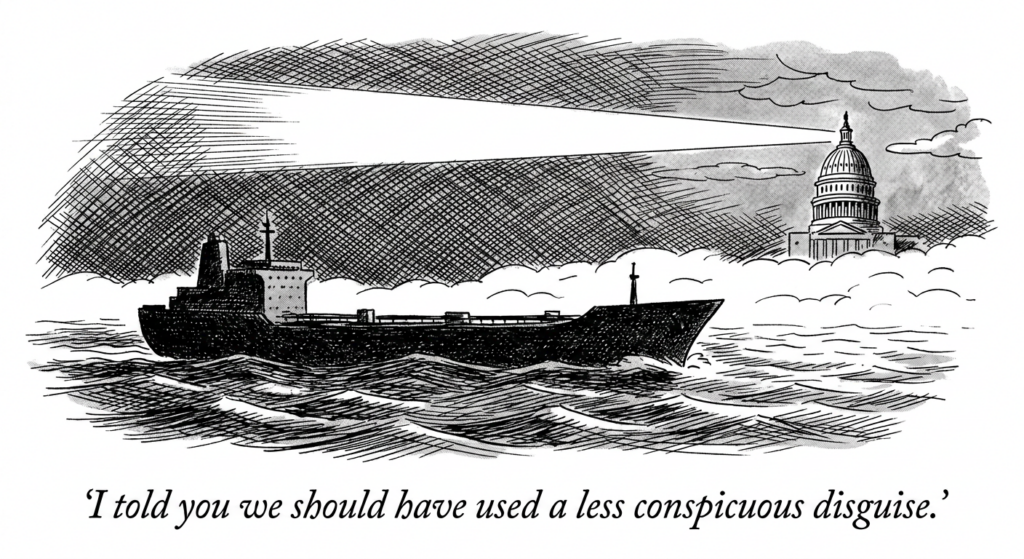
Hong Kong’s tariff identity
Hong Kong importers spent February 2025 processing news that their goods would be taxed as if they came from Shenzhen. Eighteen months and two legal U-turns later, the fiction that Hong Kong still has a customs identity separate from China is harder to sustain, and a Russia sanctions bill now awaiting the president’s signature gives Washington a third, sturdier tool to keep erasing it. Shippers routing through the territory are no longer arguing about whether they will be treated as part of China. They are trying to work out how many overlapping regimes now apply to them at once, and whether the newest one reaches Hong Kong even though it never says the name.
How the legal ground shifted twice
The chain starts in February 2026, when the Supreme Court ruled in Learning Resources v. Trump that the International Emergency Economic Powers Act does not authorize tariffs at all, striking down the reciprocal and fentanyl-related duties that had applied to Hong Kong since the year before. The administration pivoted within hours to Section 122 of the Trade Act of 1974, a Nixon-era provision that caps emergency surcharges at 150 days absent a congressional extension. Congress did not extend it. When the clock ran out on July 24, the U.S. Trade Representative had a replacement ready, a Section 301 action against 60 economies found to have failed to prohibit or enforce a ban on goods made with forced labor, built on an investigation USTR had quietly run since March. Hong Kong landed in the 12.5 percent tier alongside Brazil, Israel, and Singapore, and the tariff took effect the moment Section 122 expired, leaving no gap for compliance teams to exploit.
What makes that consequential specifically for Hong Kong is the layering underneath it. The city lost its separate customs status under a February 2025 order that folded Hong Kong-origin goods into the China tariff schedule, citing the erosion of autonomy under the national security law. China’s own goods carry a 25 percent Section 301 tariff stacked with the new 12.5 percent forced labor duty, for an aggregate USTR has confirmed at 37.5 percent. Whether Hong Kong-origin goods, already reclassified as China-origin for tariff purposes, inherit that same stack or are assessed the 12.5 percent rate on its own is not resolved in the guidance CBP has issued so far. A body of law built to punish specific national security conduct in Beijing is being applied, without a dedicated finding, to a customs territory whose legal system, currency, and port authority remain formally distinct from the mainland’s. The forced labor investigation made findings about Hong Kong’s enforcement regime, not about whether Hong Kong is China. The tariff code answered that second question anyway, by default, back in 2025.
A new authority that doesn’t need a court’s permission
Every tariff Hong Kong absorbed through July rested on a president’s own reading of his emergency or investigatory powers, and every one of those readings has eventually been narrowed or fought over in court. The bill that passed the House on September 16 breaks that pattern in a meaningful way. The Lindsey O. Graham Sanctioning Russia and Iran Act cleared 262 to 159, with 53 Democrats crossing over despite leadership’s objections, and now sits on the president’s desk. This is Congress writing tariff triggers directly into statute rather than the executive branch stretching an existing one, which puts it on firmer footing than Section 122 or Section 301, though it is worth noting that 301 is also a congressional delegation dating to 1974. The difference is one of design rather than category: 301 requires a discretionary agency investigation and finding, while this bill’s triggers are closer to self-executing once the underlying facts, who is buying Russian energy, who is moving shadow fleet cargo, are established.
The bill’s tariff section allows duties as high as 500 percent on Russian-origin imports directly and up to 100 percent on the five largest purchasers of Russian crude oil or natural gas, a bracket China occupies without much competition. A separate clause reaches beyond direct buyers to anyone facilitating a transaction involving a shadow fleet vessel carrying sanctioned Russian oil, language broad enough to cover the banks, brokers, and port operators that move the cargo rather than the buyers who take title to it. The legislation folds in the SHADOW Fleet Sanctions Act, which requires the executive branch to produce a strategy specifically addressing China’s role in helping Russian oil evade sanctions, and which authorizes sanctions against any foreign person operating a port in the People’s Republic of China or India that accepts oil from vessels violating the price cap. None of this depends on a national emergency declaration or a forced labor finding.
Why Hong Kong shows up in the fine print even though it isn’t named
Hong Kong appears nowhere in the bill’s text, and that absence is itself the thing worth flagging. Congressional investigators, including the House Select Committee on the CCP in its “Crude Intentions” report, have already documented Hong Kong alongside Singapore, Dubai, and Malaysia as a clearing point where the ownership chains behind sanctioned oil cargo get obscured. The U.S.-China Economic and Security Review Commission has separately traced the payment side of that trade through an opaque network of intermediaries that routes through Hong Kong banks. The shadow fleet port provision names the People’s Republic of China. Whether Treasury reads that phrase to include Hong Kong, a jurisdiction the administration has spent eighteen months insisting has no meaningful separation from the mainland for every other regulatory purpose, is an interpretive question nobody has answered yet. The same government that erased Hong Kong’s customs distinction to justify tariffing it as China has every incentive to erase the distinction again here, and comparatively little incentive to suddenly rediscover Hong Kong’s autonomy the one time it might work in the territory’s favor.
What this means at the terminal
For freight forwarders and NVOCCs moving Hong Kong-origin cargo, the operational reality is simple even where the legal one is not: file it, budget it, and stop expecting country-of-origin flexibility to do any work. The de minimis exemption that once let low-value Hong Kong shipments avoid the conversation entirely is gone. Compliance teams that maintained separate documentation trails for Hong Kong versus mainland sourcing, on the theory that the distinction still mattered somewhere, should treat that theory as retired. Port operators and terminal handlers with Hong Kong exposure should assume they are one flagged designation away from secondary sanctions liability if a shadow fleet vessel discharges anywhere near their operation, regardless of what paperwork the cargo carries. Correspondent banks clearing Hong Kong-originated payments for energy-adjacent trade should expect harder questions from compliance, since the bill’s facilitation language does not require the bank to have known the oil was sanctioned, only that it processed the transaction. Any forwarder still modeling China-origin exposure off the 37.5 percent aggregate Section 301 rate from July should treat that as a floor, not a ceiling, once Treasury starts counting Russian energy buyers.
Where this goes next
The bill still needs the president’s signature, though nothing in the House vote suggests he will withhold it. Even after signing, both the direct tariff and the port sanctions are discretionary tools the executive branch has to choose to use, so the document to watch is the Section 164 strategy report on Chinese sanctions evasion, due on a statutory clock once the bill becomes law. That report is the first place the administration will have to say, on paper, whether Hong Kong counts as China for this purpose too. Congress has shown no appetite to intervene on either the tariff or the sanctions side, having declined to extend Section 122 and equally declined to repeal it. The more durable pattern, across IEEPA, Section 122, Section 301, and now this bill, is structural. Every fallback authority the administration has reached for since February has treated Hong Kong as an extension of Beijing rather than a jurisdiction with its own facts. Shippers routing through the territory should plan for that treatment to outlast whichever statute happens to be doing the work at the time.