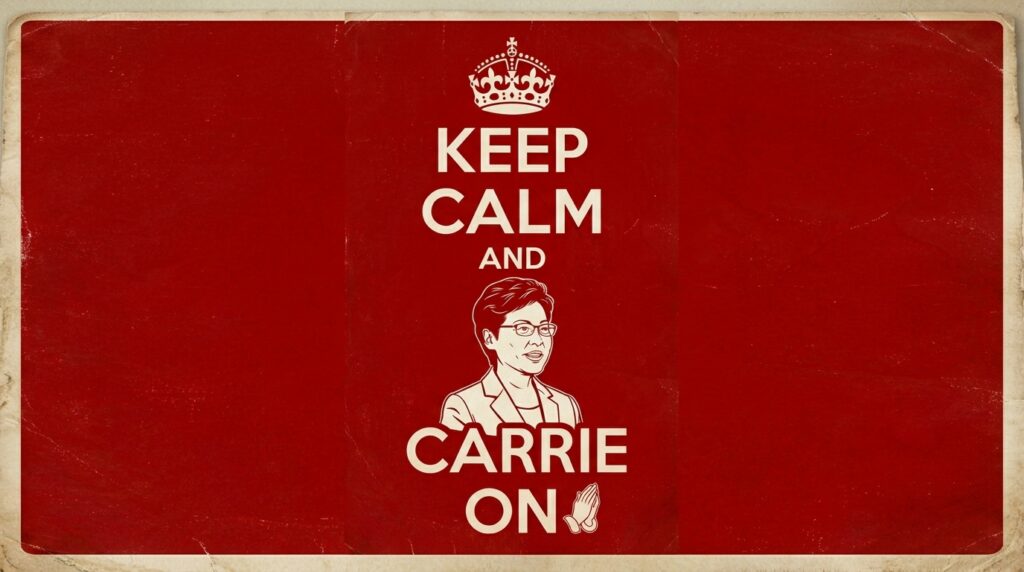
Britain printed a poster about keeping calm. Hong Kong just kept going, and never got around to putting it on a mug.
There’s a poster you’ve seen even if you don’t know you’ve seen it. Red background, crown at the top, white lettering: KEEP CALM AND CARRY ON. It was printed in 1939, about two and a half million copies of it, commissioned by the British government to steady the nation for a German invasion that, in the end, never came to the shores where the posters were hung. Almost none of them were actually displayed. Most were pulped for wartime paper scrap. One surviving copy turned up in a secondhand bookshop in Northumberland in 2000, and from that single rediscovered poster came the entire modern industry of stiff-upper-lip merchandise, the tea towels, the tote bags, the mugs in every airport gift shop from Heathrow to Hong Kong International. Britain built a national identity around resilience it printed but, for the most part, never had to spend.
I live in a city that spent it. Repeatedly. For a hundred and eighty years. And as far as I can tell, nobody here has ever felt the need to put it on a mug.
Start at the beginning, because the beginning is ugly. Hong Kong exists as a political entity because the British Empire wanted to keep selling opium to China and went to war twice to make sure it could. The First Opium War ended with Hong Kong Island ceded to Britain in 1842, not as a prize the local population asked for, but as the spoils of a conflict fought over a drug trade that devastated Chinese communities up and down the coast. The stiff upper lip, in this founding chapter, belonged entirely to the people doing the colonizing. The people who actually lived through it, the fishing communities and Hakka villagers who found themselves suddenly administered by a foreign crown, don’t get remembered as stoic. They just get remembered as conquered. That’s usually how it works when the history is written by the side holding the gunboats.
Fast-forward a century, and the city is rubble. But before it was rubble, it was a killing field, and it happened practically in the shadow of the racecourse.
On the 19th of December 1941, the single bloodiest day of the entire battle for Hong Kong played out at Wong Nai Chung Gap, the pass that separates the north and south sides of the island, a few hundred meters from where the horses run at Happy Valley today. A couple of hundred defenders, many of them Canadian troops who had arrived in the colony barely three weeks earlier, held the position for sixteen hours against a Japanese assault before being overrun. More than half of them died there. Survivors who told their stories afterward described being bayoneted on the road when they couldn’t keep pace on the forced march to the POW camps, wounded men left for dead because a bullet was considered wasted on someone who was going to die anyway.
Down the hill, at the Salesian Mission House that had been requisitioned as a medical store, Japanese troops entered a building full of doctors, orderlies, and the wounded they were treating, and killed the medical personnel where they stood. It was serious enough, specific enough, that a military court tried a Japanese commanding officer for it after the war, on charges that name the mission by address.
None of this is folklore. It’s on a war crimes docket, it’s in the veterans’ oral histories recorded decades later by men who watched their friends die on that hillside, and it’s walkable today as a heritage trail with numbered plaques, ten stations between Jardine’s Lookout and the tennis courts, marking the exact spots where a defense collapsed and a massacre began. Six days after the Gap fell, the governor surrendered at the Peninsula Hotel across the harbor, and the occupation that followed lasted three years and eight months.
By 1945, when the occupation finally ended, the city’s per capita income sat below much of what was then called Africa. No natural resources, no farmland to speak of, a population that had been starved and displaced and was now returning to a harbor full of wreckage. Nobody was issuing propaganda posters about carrying on. There was no state apparatus left to print one. People just did it, because the alternative was not doing it, and not doing it meant not eating.
Then came the refugees, and this is the part of the story that actually built the city that exists today. Hong Kong’s population in 1945 was somewhere around half a million. By the time the territory returned to Chinese sovereignty in 1997, it had grown to well over six million, and it sits above seven million now. That growth wasn’t gentle demographic drift. It was wave after wave of people fleeing something, civil war on the mainland in the late 1940s, the chaos of the Great Leap Forward and its famine in the early 1960s, the Cultural Revolution later that decade, arriving with nothing, sleeping on rooftops and in squatter camps on hillsides that would later become some of the most expensive real estate on earth. They built garment workshops in the spaces between buildings. They ran plastic flower factories out of tenement flats. Within a generation they had turned refugee poverty into a manufacturing base that fed half the world’s toy shelves and clothing racks.
In 1967, the strain that comes with packing that many displaced, underpaid, overworked people into a colony with no political voice finally broke into open violence. Leftist riots, inspired by and coordinated with the Cultural Revolution across the border, spread through the territory for the better part of a year. There were real bombs, some of them fake, planted in the streets to terrorize a population that had no idea which ones to avoid. Fifty-one people died. And when it ended, the colonial government, frightened into reform, actually started building the social infrastructure, public housing, labor protections, a police force people could trust more than the one that had just been shooting at them, that Hong Kong still runs on today. The stiff upper lip didn’t produce that outcome. Fear and pressure and, eventually, people simply refusing to let the city stay broken did.
A decade later, Hong Kong absorbed something like two hundred thousand Vietnamese boat people, refugees fleeing the aftermath of a war a few hundred miles south, housed in camps that stretched the territory’s resources and patience for the better part of two decades. Then came the countdown to 1997 and the handover itself, an entire population watching the clock run out on the only political system most of them had ever known, capital fleeing, families splitting themselves across continents as insurance against a future nobody could predict with any confidence. And still the city didn’t stop. It built the airport on a reclaimed island. It built the harbor tunnels. It kept becoming, somehow, richer.
Then 1997 delivered its own gut punch anyway, just a financial one instead of a political one. The Asian Financial Crisis hammered property values and currencies across the region, and Hong Kong’s dollar peg came under direct, sustained speculative attack. The government intervened in the stock market itself, an almost unthinkable move for a place that had built its entire identity around not intervening, and it worked, but the recession that followed was brutal and personal. Families who had bought apartments at the top of the market watched their mortgages exceed the value of the homes they were paying for, and a lot of them kept paying anyway, quietly, for years, because that’s simply what you did.
Barely five years later, SARS arrived. Severe acute respiratory syndrome tore through the city in the spring of 2003, killing close to three hundred people, hollowing out a housing estate called Amoy Gardens so completely that it became a case study in how a virus moves through plumbing, and emptying every restaurant, every mall, every street in a city built on density and proximity. People wore masks two decades before the rest of the world learned how. The economy that had just clawed its way back from the Asian crisis went straight back into free fall. And then, within the year, it didn’t. Tourists came back. Restaurants reopened. The city that had just watched hundreds of its own die from a disease nobody understood picked itself back up with what looked, from the outside, like no ceremony at all.
Five years after that, the Global Financial Crisis hit everyone, but it hit a trade and finance hub like Hong Kong especially hard, and the city absorbed it too, the way it had absorbed everything else, without much fanfare.
And then, more recently than any of that, came 2019. Months of protests that split friendships and families down political lines that hadn’t existed, or hadn’t been spoken aloud, a year earlier. I’ve walked streets here that were tear-gassed eighteen months before I stood on them, streets that today sell bubble tea and school uniforms and look like nothing happened at all. Then COVID arrived almost immediately after, closing borders for the better part of three years, gutting a tourism and hospitality sector that had barely finished patching itself up from the last disruption. Hotel occupancy in this city has only recently climbed back to where it stood before any of that started.
You don’t have to go looking for the spirit of this place in a museum or a war memorial. It’s on the street corner outside your building, most evenings, bent at the waist, pulling a cart twice her own body weight.
Hong Kong has an unofficial workforce of elderly women, and a handful of elderly men, who collect flattened cardboard from the backs of restaurants and convenience stores and drag it, stacked chest-high on homemade trolleys welded from shopping carts and rope, to recycling depots that pay a few Hong Kong dollars per kilo. People here call them the cardboard grannies, poh poh che, and there are thousands of them, women in their seventies and eighties who should, by any reasonable accounting of a life, be resting. Instead they’re out past dark in July heat that makes standing still unpleasant, wearing every layer they own against the sun rather than the cold, because a kilo of flattened boxes barely clears a couple of dollars and volume is the only lever they have. I’ve watched one of them, a woman who could not have weighed more than her own cargo, work a stack of cardboard down a loading ramp at a pace that would have had me sitting on the curb, and then straighten up, wipe her face, and keep walking.
Nobody assigned them this. There’s no ministry of cardboard, no union, no scheme that put them on that corner. Most of them are doing it because the alternative, living entirely on the elderly welfare allowance or leaning on children who have their own rent to pay, doesn’t stretch far enough in a city this expensive, and pride and arithmetic arrived at the same answer independently. They are, depending on which framing you prefer, a quiet indictment of how thin the safety net is under Hong Kong’s wealth, or the single clearest illustration of the thing this entire city was built on: nobody’s coming to carry your cart for you, so you find a cart and you carry it. Both readings are true, and I don’t think the women pulling the trolleys are especially interested in which one you pick.
They are not unique in this, just the most visible version of it. The city runs on people like them. The butchers in Kowloon’s wet markets, breaking down whole pigs before dawn on wooden blocks worn concave by decades of the same cleaver falling in the same spot. The police officers who worked twelve-hour shifts through 2019 and came home to families who, depending on the week, saw them as protectors or as the other side, and then showed up for the next shift regardless. The warehouse workers out past the airport, loading pallets through the night so that the freight the city’s entire economy depends on clears customs by morning, work nobody sees and everybody relies on. The minibus drivers navigating hairpin turns on Hong Kong Island roads that were laid out for rickshaws. The construction crews on bamboo scaffolding forty stories up, lashing poles together with nylon strip the way builders here have done it for a century, on buildings that will outlast every one of them. The noodle shop owner who lost half a year of revenue during the protests and then lost most of what remained during COVID and reopened anyway, because the alternative was not reopening, and the lease didn’t care what kind of year it had been.
None of them would call themselves resilient. It’s not a word that comes up over a bowl of wonton noodles, or a shift change at a police station, or the back of a delivery truck at four in the morning. They would call it an average day in Hong Kong.
I think about the poster sometimes, the crown, the red background, the slogan that a country printed and then largely failed to need. Britain has its stiff upper lip as a cultural export, a punchline, something you buy on a fridge magnet at Heathrow before your flight home. It’s a lovely piece of branding built, if you actually look at the history, on very little sustained catastrophe by comparison. Hong Kong has never marketed its resilience, because resilience isn’t the kind of thing you package when you’re still busy practicing it. There’s no equivalent tea towel here. There’s no gift shop version of surviving the opium wars, or feeding a population that quintupled on refugees, or burying the dead from riots and a virus and then reopening the noodle shop the following week, because the rent was due regardless of what the week had been like.
The stiff upper lip was always a story the British told about themselves. Hong Kong never had the luxury of telling itself a story. It just kept opening the shop.