Everyone in Hong Kong has stroked the paw of a bronze lion for luck. Almost nobody asks why the lion is there, or what happened to it once.
There are two bronze lions outside the HSBC headquarters on Queen’s Road Central, and if you’ve spent any time in this city you’ve probably rubbed one of their noses without thinking about it, the way you’d knock on wood. Their names are Stephen and Stitt, after two long-dead bank managers, and they’ve been guarding that entrance since 1935. Stephen is roaring. Stitt is calm. Insiders at the time said the two poses summed up the personalities of the men they were modeled on, which is the kind of detail that only a bank obsessed with its own mythology would bother preserving for ninety years.
Here’s the detail that doesn’t get told as often. In December 1941, when the Japanese army took Hong Kong Island, the lions were pulled from their plinths and shipped toward Japan to be melted down for the war effort, alongside plenty of other bronze the empire needed for shells and gun barrels. The war ended before the furnace got to them. An American serviceman stumbled across the pair sitting in a Japanese scrapyard, recognized what they were, and had them sent home. They went back up outside the same doors, bullet holes and all, and they’re still there now, close to a century after they were cast, still getting stroked for luck by people heading into the building to open an account or ask about a mortgage.
I think about those lions every time I read another headline about Hong Kong reclaiming the global IPO crown, because the story underneath the story is basically the same one. This is a market, and a bank, that has been declared finished more than once, packed up for scrap more than once, and has kept coming back to stand outside the same doors.
Start with the market itself, because the numbers this year are hard to overstate. Hong Kong’s exchange has spent 2026 at or near the top of the global IPO league tables, something it hasn’t managed with this kind of margin in years. The first half of the year alone raised close to HK$210 billion across dozens of new listings, the strongest opening six months the city has had in half a decade, and forecasters at the big accounting firms are now penciling in something in the region of HK$350 billion for the full year. More than three hundred companies currently have listing applications sitting with the exchange. The mix driving it is telling: a wave of mainland Chinese companies doing dual “A+H” listings, taking shares that already trade in Shanghai or Shenzhen and cross-listing them in Hong Kong, plus a genuine rush of specialist technology and biotech names that didn’t exist as a listing category here a few years ago. Put together, those two categories now account for more than seventy percent of everything raised.
None of this happened by accident, and none of it happened quickly. Hong Kong spent the years after 2019 and through COVID watching its IPO pipeline dry up while global capital found reasons to look elsewhere, New York for the mega-caps, Singapore for the family offices nervous about geography. The exchange spent that period quietly rewriting its own rulebook, weighted voting structures for founder-led tech companies, faster secondary listing pathways for firms already trading somewhere else, lower thresholds for the kind of pre-revenue biotech names that used to have nowhere to list except Nasdaq. When mainland demand for international capital access came roaring back this year, the plumbing was already in place to catch it.
Which brings us to HSBC, a bank that has spent the last several years looking less like the roaring lion out front and more like the quiet one.
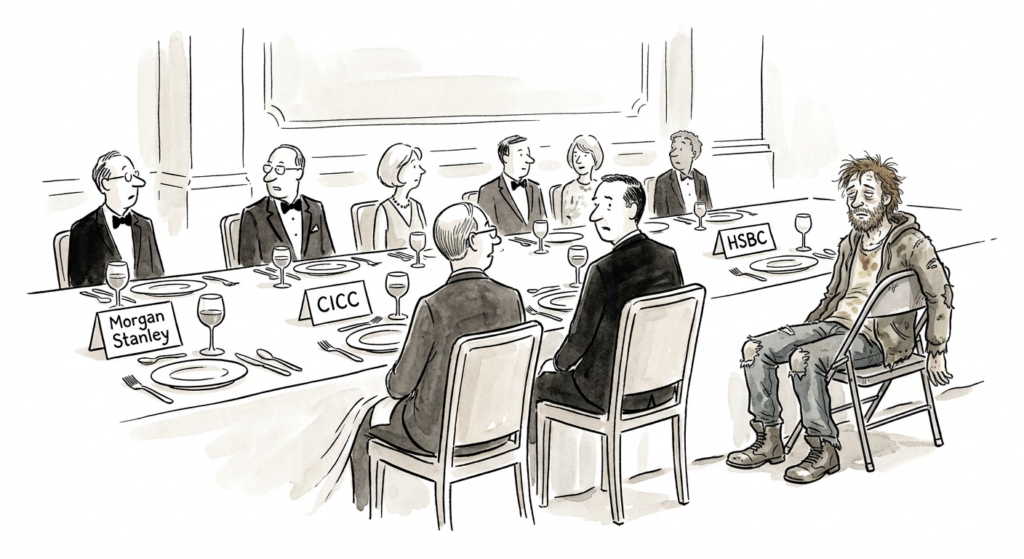
The numbers on this side of the story are almost embarrassing by comparison. Going into this year, HSBC’s investment bank had been through a serious restructuring, senior bankers had walked, and the firm found itself sitting around twelfth in Hong Kong’s share-sale league tables, well behind Morgan Stanley and China International Capital Corporation, the two houses currently running the table. This is a bank whose name is literally the Hongkong and Shanghai Banking Corporation, a bank that opened its doors on this same street in 1865 specifically to bring order to the chaotic tangle of Mexican silver dollars and British shillings that Hong Kong merchants were then using to trade with each other, a bank that has issued the territory’s banknotes for a century and a half and still prints most of the cash in your wallet if you live here. And on the single biggest capital markets opportunity Hong Kong has produced in years, it was showing up in twelfth place.
To its credit, the bank noticed. Under chief executive Georges Elhedery, HSBC has spent the past year rebuilding its China and Hong Kong dealmaking operation from something close to scratch, hiring more than a dozen senior bankers away from rivals, with Elhedery himself reportedly recording personal video messages to major Greater China clients rather than leaving the relationship-building entirely to the deal teams. The names behind that dozen tell you where the market currently thinks the talent sits: Karen Chen came over from JPMorgan to lead consumer investment banking coverage, Yuan Shuai arrived from Goldman Sachs’ equity capital markets desk, Shawn Wang joined from JPMorgan to cover general industrials, and Xihong Ai is expected in from Bank of America later this year. This is what a rebuild looks like when it’s actually happening rather than being announced in a press release, four specific people with four specific rolodexes, poached one desk at a time from the banks currently ahead of HSBC in the league tables.
It cuts both ways, which is the part that doesn’t make it into the comeback headlines. In roughly the same window HSBC was recruiting Chen and Yuan and Wang, Jefferies hired one of HSBC’s own top industrials bankers in Hong Kong away, and Barclays pulled Joseph Lee out of HSBC entirely to run its high-touch equity sales trading desk for Asia-Pacific. Every bank in this city is simultaneously a buyer and a seller of talent right now, which is really just what an actual boom looks like from the inside, less a single institution’s tidy turnaround story and more a citywide game of musical chairs with fee pools as the prize, and nobody, HSBC included, gets to keep every seat they’re sitting in. It’s working, at least by volume. The bank went from working on five Hong Kong IPOs in the whole of 2025 to roughly forty in progress this year, and across Asia more broadly it now has something like seventy mandates on its books, everything from a possible half-billion-dollar listing for Club Med to a Chinese robotics startup weighing its own offering. It’s still chasing, not leading, missing the lead role on marquee deals like the dual London-Hong Kong listing being planned by A.S. Watson, a mandate that went instead to Goldman and UBS. But the trajectory, forty mandates instead of five, is the trajectory of an institution that decided being twelfth in its own namesake city was not an acceptable resting place.
There’s something almost too on the nose about a bank called the Hongkong and Shanghai Banking Corporation having to claw its way back into relevance in Hong Kong’s own capital markets, in the same year the market itself came roaring back from years of being written off. But it’s worth remembering that this isn’t the first time HSBC has had to rebuild its standing here from a low point, and it’s worth remembering what it did the last time, because the last time is arguably the more interesting story.
After the war, with the lions back on their plinths and the bank itself reopening a head office that had spent the occupation shut, HSBC’s local managers developed a lending style that became, almost by accident, one of the quiet engines of Hong Kong’s postwar transformation. Refugees pouring in from the mainland had no collateral, no credit history, nothing a conventional underwriting model would recognize. HSBC’s branch managers lent to a lot of them anyway, on character, on a handshake, on a manager’s own read of whether the man standing in front of him asking for capital to buy a few sewing machines was going to pay it back. A meaningful slice of the garment workshops and plastic flower factories that turned refugee poverty into a manufacturing economy got their first working capital that way, from a bank willing to bet on people the balance sheet said nothing about. It’s a very different kind of financing than underwriting a biotech IPO, but it’s the same underlying instinct: a bank deciding that being embedded in this particular city’s fortunes, for better and for worse, was the whole point of existing.
That’s the tension sitting underneath every HSBC headline this year. The bank moved its global headquarters to London in 1991, formally becoming a British institution with an Asian subsidiary rather than the other way around, and it has spent the decades since being pulled in two directions by shareholders who want it to look more like a London-listed global bank and a Hong Kong market that would very much like it to keep behaving like the local bank whose lions everyone still rubs for luck on the way to work. The 2026 IPO boom is forcing that tension into the open again. Hong Kong doesn’t need HSBC’s participation to have a record year, the exchange is proving that with or without any single bank leading the tables. But HSBC needs Hong Kong, needs to be credibly good at Hong Kong, in a way that goes beyond quarterly earnings, because the alternative is a namesake bank that has quietly become a tourist in its own founding city.
I walked past the HSBC building a few weeks ago, and there was a queue of people waiting to get into Statue Square, tourists mostly, taking turns photographing each other with a hand on the lion’s paw. Nobody in that queue was thinking about league tables or dual listings or which bank missed which mandate this quarter. They were thinking about luck, the uncomplicated kind, the kind you can get from touching bronze that has survived a war and come home.
Ruth, my wife, who grew up here and banked with HSBC before she ever banked with anyone else, has stroked that lion’s paw more times than she can count and has never once, in all the years I’ve known her, mentioned the bank’s IPO league table ranking. When I told her about this piece, about the bank scrambling to rebuild a franchise it used to dominate in its own namesake city, she just shrugged and said her local branch manager still knows her by name, which as far as she’s concerned is the only ranking that has ever mattered. She’s not wrong that this is a strange thing for outsiders to get worked up about, a bank’s standing in a fee pool most people will never see a cent of. But the bank standing behind those lions is, this year, trying to prove something slightly more specific: that survival isn’t the same as relevance, and that a hundred and sixty years of being here doesn’t automatically earn you a seat at the table when the market you helped build finally, after everything, starts roaring again too.