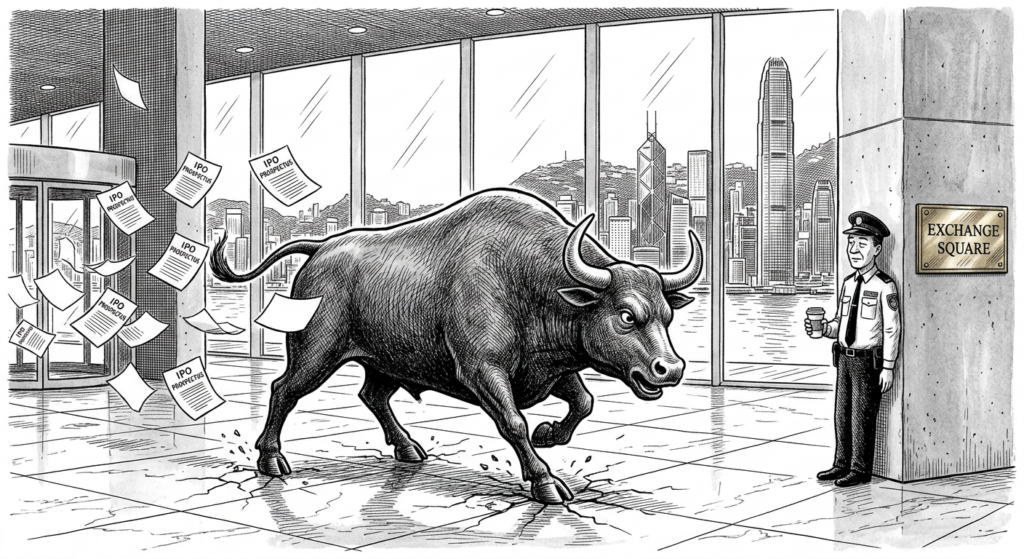
Four companies filed to list in Hong Kong today. All four will begin trading on September 29. Between them, they are raising HK$14.4 billion, about $1.8 billion, in a single wave of offerings dropped on a Monday afternoon like somebody scheduling four dentist appointments at once and hoping nobody would notice.
The biggest is RoboTechnik Intelligent Technology, already listed in Shenzhen, where its shares have surged 168 percent this year. The company makes automation equipment and testing systems for solar panel factories and the silicon photonics industry, the kind of components used in data centers, cloud networks and high-performance computing. It’s offering 11.9 million H shares at up to HK$436 each, targeting about HK$5.18 billion, with an upsize option of up to 15 percent on top. Then there’s Shenzhen Kinwong Electronic, a printed circuit board maker with 2.5 percent of the global market, going for up to HK$5.10 billion. Red Avenue New Materials, a chemical products manufacturer already listed in Shanghai, is targeting HK$3 billion. And Direct Drive Tech, a robotics technology company, is raising HK$1.08 billion in a straight IPO.
None of these names will appear in most Western newspapers tomorrow. Four companies you probably haven’t heard of, in industries that sound like the back half of a supply chain PowerPoint, all choosing the same exchange, in the same week, in a city that a considerable number of opinion columnists have spent the past five years declaring financially deceased.
Through the first eight months of 2026, IPOs in Hong Kong raised the equivalent of $43.65 billion, more than doubling from the same period last year, according to HKEX data. By early August, HKEX chief executive Bonnie Chan told an event in Kuala Lumpur that proceeds had already surpassed the full-year 2025 total. PwC expects the full year to reach HK$380 billion, roughly $48 billion. Goldman Sachs put the figure at $60 billion.
The deals powering the surge are not small. In late August, Alibaba raised HK$80 billion, about $10.2 billion, in the largest primary follow-on offering ever completed by a Hong Kong-listed company. It sold 710 million shares at HK$112.70 each, every dollar earmarked for AI infrastructure. The stock dropped 8.5 percent on dilution fears, and then Chairman Joseph Tsai and CEO Eddie Wu both walked into the market and bought shares with their own money. In mid-September, Z.AI, the Beijing-based AI company formerly known as Zhipu AI, raised $5 billion through a combined share placement of about $2 billion and a $3 billion zero-coupon convertible bond sale. Z.AI had already raised $4 billion in a follow-on in July. It listed in Hong Kong in January.
For context, Hong Kong was the number one IPO market on the planet in 2025, the first time since 2019. KPMG’s review put the year’s total at HK$272.1 billion across 100 listings, a 210 percent increase from 2024, when the exchange raised HK$88 billion. It beat the New York Stock Exchange, which raised $20.3 billion, and NASDAQ, which raised $19.2 billion. In the first half of 2026, NASDAQ leapfrogged Hong Kong to take the top global spot, but only because SpaceX completed the largest IPO in history at $86.3 billion, a single deal that accounted for 45 percent of all global IPO proceeds in the period. Remove SpaceX, and Hong Kong is still leading the world.
Underneath the headline numbers is a quieter, stranger fact. According to an EY report, two Chinese companies completed listings in the United States in the first half of 2026, raising a combined $59.5 million. That was the lowest in five years for both deal volume and offering size. In the same period of 2025, dozens of Chinese companies raised hundreds of millions on American exchanges. That is not a decline. That is a door closing. And the capital that used to walk through it is now walking through a different one, in a city seven thousand miles from the New York Stock Exchange.
I’ve lived in Hong Kong long enough to have heard the eulogy more times than I’ve heard the one for any actual person I’ve known. Hong Kong is over. Hong Kong is a shell. Capital is fleeing. Nobody will list here again. The National Security Law killed the financial centre. You could fill a library with the columns. You could fill a second library with the columns that cited the first library’s columns as evidence. At a certain point the consensus became so settled that questioning it felt less like analysis and more like bad manners at a funeral everybody had already paid for.
The consensus was wrong. Not slightly wrong, not arguably wrong, not wrong-with-caveats. The numbers are what they are. More than $43 billion raised in eight months. Number one globally in 2025. Number two in the first half of 2026, and only because a single American rocket company distorted the entire global picture. Alibaba choosing Hong Kong for the largest capital raise of its kind in history. AI companies lining up. Four more filings dropped today. And somewhere in a newsroom, somebody is probably writing another column about how the city’s financial future is behind it, which is a sentence I would enjoy more if I hadn’t already read it forty times while the market did the opposite.
I don’t know whether RoboTechnik’s H shares will trade well on September 29. I don’t know whether Kinwong’s PCB margins will hold. I don’t know whether the AI-linked demand currently powering this market will sustain itself through whatever correction eventually comes, because one always does, and anyone who tells you otherwise is selling something you shouldn’t buy.
What I do know is that a city does not raise $43 billion in eight months by being dead. It does not lead the world in IPO fundraising two years running by being irrelevant. It does not attract four new listings in a single Monday filing while the companies that used to list in New York simply stop going there.
Ruth appeared in the doorway while I was finishing this, the way she does when she can tell I’ve been writing about something that makes me sit up straighter. She looked at the screen for a few seconds, which in Ruth’s case is the equivalent of a standing ovation. Then she said: “The people who said it was over. Do they know it isn’t?”
I told her I thought they probably did.
She poured her coffee. “That’s worse,” she said.
She’s right. It is.
Comments