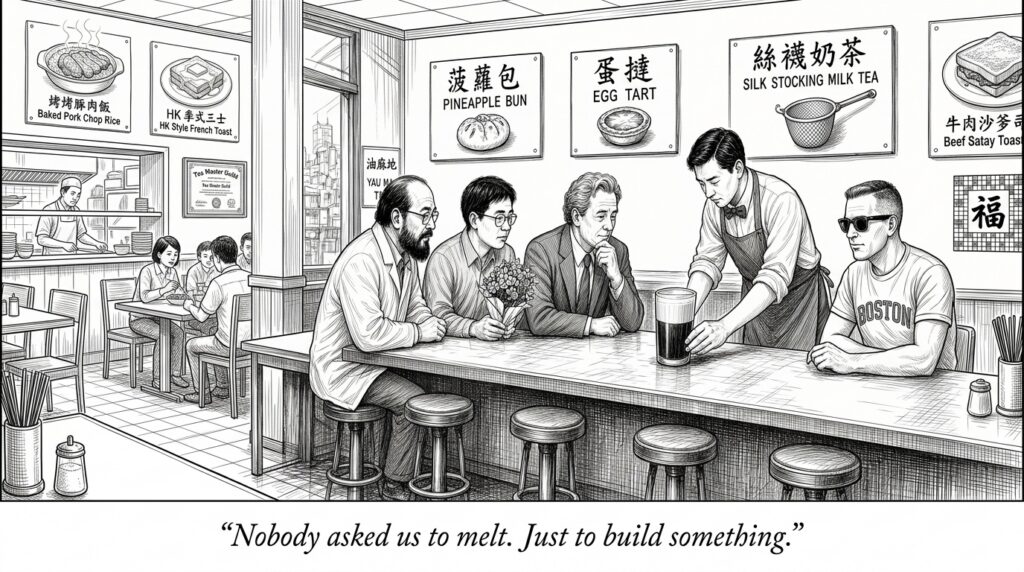
Order a yuenyeung at Lan Fong Yuen on Gage Street, the dai pai dong that’s been running the same eight-step brewing technique since 1952, and you’ll get a cup that’s half coffee, half milk tea, poured together and never fully agreeing with each other. The name means mandarin ducks, a bird that shows up constantly in Chinese art and literature as the symbol of devotion, because they’re almost always seen swimming in pairs, two distinct birds, never blended into one, paired for life without ever becoming a single creature. Ruth ordered one on her first visit, took a sip, and said, “This tastes like an argument that ended in a draw.” I haven’t heard a better description of the drink since, or of the city that invented it.
I grew up reciting a different metaphor for the same idea, and it took standing in that queue on Gage Street to notice how badly the two metaphors disagree. The melting pot comes from a 1908 play by a British writer named Israel Zangwill, in which a Jewish immigrant character announces that America is “God’s Crucible, the great Melting Pot where all the races of Europe are melting and reforming.” I recited some version of that line in a Massachusetts classroom with a laminated Statue of Liberty on the wall behind the teacher’s desk, and nobody ever mentioned that melting is a one-way process. Once the metal’s in the pot, it doesn’t get its shape back.
The mandarin ducks never had that problem. They just sit next to each other in the same cup, permanently, refusing to resolve into a single flavor, and somehow that’s the drink people queue for.
Milk tea itself tells the same story before you even reach the yuenyeung. Under British rule, English tea was something served in hotels and high-end Western restaurants, out of reach for most working Hongkongers. After the war, cooks who’d learned the English method in those kitchens started making their own version for the street, cheaper black tea filtered again and again through a cloth bag until it turned the color of a stocking, cut with evaporated milk because fresh milk was expensive and often unavailable. Locals still call it silk-stocking tea for exactly that reason. Nobody was trying to become British by drinking it, they took the one part of the colonizer’s culture worth keeping, stripped out everything else, and rebuilt it as something recognizably their own.
In 2017 the government put the brewing technique on Hong Kong’s official list of intangible cultural heritage, alongside the pineapple bun, which has never contained pineapple, and the egg tart, which came partly by way of Macau and Portugal and ended up tasting like neither. The cha chaan teng exists because Hong Kong wanted Western food without becoming the West, and built an entire cuisine to solve that one problem.
That’s what a real melting pot actually is. Not a place that dissolves people into a single alloy, but a place that hands anyone who shows up the same offer: build something, keep whoever you already are while you build it, and the city takes what you make without asking you to become someone else first. Hong Kong has been running that offer for a hundred and sixty years, usually without bothering to name it.
Walk a few blocks from Lan Fong Yuen on a Sunday and you’ll see the same offer working at street level, and if you’re paying attention with your stomach rather than just your eyes, you can taste your way through the census. Central and Causeway Bay belong on Sundays to the roughly 200,000 Filipino and 140,000 Indonesian domestic workers who take their one day off and turn the pavement into a picnic, flattened cardboard boxes laid out in rows under the HSBC building’s stilts, the smell of adobo and rendang competing with the bank’s air conditioning leaking through the vents.
Head north to Kowloon City and the smell changes entirely, into lemongrass and fish sauce. A third of Hong Kong’s Thai community, descended from Thai women who came here with Chaozhou husbands back in the 1970s, settled in that one district and never left. Everyone just calls it Little Thailand now. Walk into Chungking Mansions or the curry houses scattered through Yau Ma Tei and you’re tasting the roughly 42,000 Indians, 30,000 Nepalese, and 24,000 Pakistanis who built Hong Kong’s other great culinary import, curry so thoroughly localized that curry fish balls are sold from carts on nearly every commercial street in the city, a Punjabi spice blend married to a Cantonese dim sum staple by people who never asked permission to do it.
Add the Japanese izakayas filling basements in Causeway Bay, the roughly 2,000 West Africans running small restaurants in Yuen Long, and the nearly 62,000 Western residents keeping half of Wan Chai’s brunch menus in business, and you can eat your way through six or seven countries without leaving a five-kilometer radius. None of it curated, none of it a festival. Just Tuesday.
What surprised me most, once I started digging into who actually built that bank, is how often Hong Kong’s most iconic institutions were built by the newest arrivals in the room. HSBC exists because of a committee formed in 1864 that included Parsi merchant houses and the Bombay-based, Baghdadi Jewish firm David Sassoon & Company, communities that numbered in the low hundreds in a colony of a few hundred thousand people. The Star Ferry, the single most photographed, most sentimentally Hong Kong thing in the city, was founded by a Parsi immigrant named Dorabjee Naorojee Mithaiwala. The University of Hong Kong exists because its largest founding donor was another Parsi, Hormusjee Naorojee Mody, whose bronze bust sits in a stairwell most students walk past without slowing down.
None of these men were trying to become something else in order to build these things. They stayed exactly who they were and handed the city a bank, a ferry, and a university anyway.
That pattern never stopped, it just changed industries. Li Ka-shing arrived in Hong Kong in 1940, a twelve-year-old refugee fleeing a bombed-out Chaozhou, in a family that would lose its father to tuberculosis within three years. He left school at fourteen to work sixteen-hour days in a plastics factory. At twenty-two he started a company making plastic flowers, because he’d read they were popular in Italy. That company became Cheung Kong, now a conglomerate touching ports, telecoms, retail, and energy on nearly every continent, with a foundation that has funded a university in his home province and health and education programs well beyond Hong Kong’s borders. Ask people here what the Hong Kong Dream actually looks like, and a fair number will just point at him.
Allan Zeman is the same story running the opposite direction. Born in Germany to Jewish parents who’d survived the Holocaust, he was raised by his widowed mother in Montreal, where she worked in a hospital. He started working at ten delivering newspapers, and by nineteen had made his first million importing clothes from Hong Kong, before he’d ever set foot in the city. When he finally moved here in 1975, he later said it felt like a place where “you can have a dream that night, wake up the next morning, and make that dream a reality.” In 1983 he opened a restaurant on a narrow, half-forgotten street called Lan Kwai Fong, then gradually bought up most of the block. Decades later, holding a Hong Kong passport, he’s still the man locals call the Father of Lan Kwai Fong, a nickname that in most other cities would belong to someone who was born there.
None of these people, the Parsi ferryman, the Jewish banker’s grandson, the Teochew refugee, the Holocaust survivor’s son, arrived with anything resembling an inside track. What they found instead was a city with one consistent habit: it never much cared where you started, only whether you’d actually build the thing you said you would.
I didn’t come here to build a bank or a nightlife district, but I recognize the pattern well enough to know I’m standing inside it. I arrived an American with a law degree and not much else, spent more than a decade as a partner at a firm in Central, and somewhere in the middle of it, married a Hong Konger. Nobody ever asked me to trade the American part in for the Hong Kong part. I still say “trash” instead of “rubbish” and still don’t understand cricket, and none of that ever once got in the way of building an actual life here, a career, a home, a business.
Ruth didn’t marry an idea of an American, and I didn’t marry an idea of a Hong Konger. We’re not a merger. We’re closer to the drink, two things that never fully agree, sharing a cup anyway, on purpose, permanently.
I still believe in the melting pot as an ideal, genuinely, not ironically. I’ve just stopped thinking my own country invented the thing it named, or got the metaphor right in the first place. A Parsi ferryman, a Teochew factory boy, a Holocaust survivor’s son, and, on a much smaller scale, a lawyer from Massachusetts who never planned on staying this long, Hong Kong built the same thing over and over without ever calling it anything, and left the recipe sitting in a teacup the whole time.
Two things, permanently distinct, poured into the same cup anyway. Ruth still orders one every time we’re near Gage Street. I’ve never once seen her finish the coffee and the tea in the same sip, and I don’t think that’s the point.
Comments