On Netflix, nostalgia, and the difference between a movie that haunts you and a movie you forget before the credits roll.
A bad film can still open an old door
I watched The Last House on Netflix last night. Greta Lee, Wagner Moura, a family trapped inside their home by some kind of invisible force while rain falls and creatures move through the storm outside. PG-13. A hundred and ten minutes. Twenty-eight percent on Rotten Tomatoes, which felt generous. It hit number one globally in under forty-eight hours, which tells you everything you need to know about the gap between what people watch and what stays with them after.
It wasn’t scary. It wasn’t tense. It wasn’t anything. The first half of the film is the family dancing around the house, having a blast during forced quarantine, as if someone in a boardroom said “make it relatable” and nobody in the room had the courage to say that relatable is the enemy of horror. The second half tries to become a creature feature and fails. The ending is nonsensical in the specific way that endings are nonsensical when no one in the writers’ room was willing to commit to a single idea.
I watched the whole thing. I watched it the way you eat a meal that isn’t good but is in front of you, because you’re already sitting down and the alternative is standing up.
When it ended I sat there in the dark of the living room, not because it lingered, but because its absence lingered, the way silence lingers after a song you expected to be beautiful turns out to be nothing.
It made me think of my father. Which is not what Netflix intended, but Netflix doesn’t get to decide what I think about.
Cape Cod, 1975
The summer of 1975. I was five years old. My father, who was at that point in his life what people used to call a functioning alcoholic, which is a phrase that does a lot of work and obscures more than it reveals, took the family on vacation to Cape Cod. The family was him, my mother, my sister, and me. My father’s relationship with vacations was the relationship of a man who understood that vacations were expected of him and who had figured out that the location didn’t matter much as long as there was a cottage and the cottage had shade and the shade had a chair and the chair had proximity to a glass of gin and tonic that could be refilled without anyone noticing how many times it had been refilled. Cape Cod met these requirements. Cape Cod was perfect.
The first night, we went to a drive-in.
I don’t remember which one. The Wellfleet, maybe. Or the one in Dennis. I remember the speakers on the poles. I remember the smell of the car, that specific summer-night smell of vinyl seats and bug spray and the lingering cigarette smoke that lived in the upholstery of every car in the 1970s the way ghosts live in old houses. I remember my sister beside me in the back seat. I remember the screen, enormous, white, the size of the world when you’re five.
I did not know what Jaws was. I did not know that it was about to become the biggest movie anyone had ever seen. I did not know that it was about a shark. I did not know what a shark could do to a person. I did not know any of this because I was five and my father had not previewed the film, because my father’s parenting style could be described as benign inattention punctuated by occasional moments of accidental brilliance, and taking a five-year-old to see Jaws at a drive-in on Cape Cod, a place surrounded by the same ocean that contained the same theoretical shark, was either an act of profound negligence or the single greatest piece of parenting he ever performed, because it worked. My God, it worked.
I did not go near the ocean for the rest of that trip.
Not the next day. Not any day. My mother tried. I imagine my sister went in. I would not. The water had something in it now. Something that had not been there before we drove to that theater and parked under the stars and I watched a woman get pulled beneath the surface of the world in the first three minutes of a film that no one had warned me about. The ocean was no longer the ocean. The ocean was a mouth. The ocean was a thing with teeth and intent and patience, and it was right there, right outside the cottage, and everyone else walked toward it every morning as though they had not seen what I had seen, as though the knowledge hadn’t changed anything, and I could not understand how they did that, how they knew what was down there and went in anyway.
My father did not care that I wouldn’t swim. My father was content. He had the cottage and the shade and the chair and the gin and the quiet that descends on a man when every member of his family is accounted for and none of them require anything from him. If I wanted to sit on the sand and not go in the water, that was fine. That was one less thing. He could see me from the chair. He could see me from the glass.
I think about him there. Not with anger. With the kind of tenderness that comes decades later, when you are old enough to understand that a man can love his children and fail them in the same afternoon, in the same gesture, that taking your five-year-old to see Jaws is both a gift and a wound and that sometimes those are the same thing and you carry them both, forever, unable to separate one from the other.
What horror used to do
Decades later, I still think about that film when I swim in open water. Not every time. But enough. Enough to know that something happened in that drive-in that never fully unhappened. That a movie can change the architecture of a person, can add a room to your mind that wasn’t there before, a room you never asked for, a room you cannot renovate or sell, a room with a door that opens without your permission when the water is dark and your feet can’t touch the bottom.
That is what horror is supposed to do.
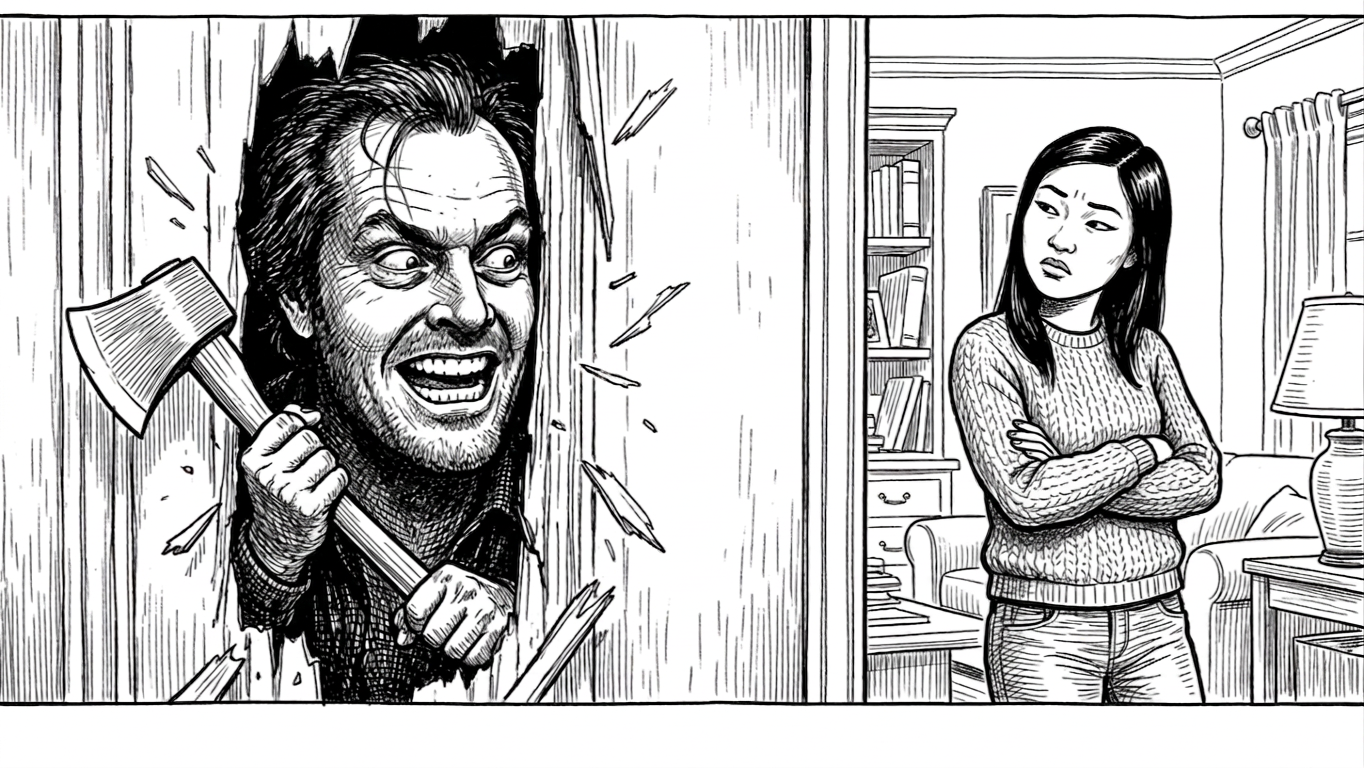
Years later, early in my relationship with Ruth, before we were married, before Hong Kong, before any of the life that came after, I showed her The Shining. The Kubrick one. The Jack Nicholson one. It was a Sunday morning. The light was coming through the windows and I said let’s watch something and she said okay and I put on a film about a man who loses his mind in a hotel and tries to kill his family with an axe.
I don’t know why I did this. I don’t know what I thought would happen. I suppose I wanted to share something that had lived in me, the way you want to share music that matters to you, or a place that changed you, the impulse to say here, this is mine, this shaped me, take it, carry it, know me better because you’ve seen it.
Ruth is Cantonese. Ruth is tough in ways that have nothing to do with horror movies. Ruth grew up in Hong Kong, navigated systems I can barely pronounce, handled things that would have broken me before lunch on a Tuesday. Ruth does not scare easily. Ruth does not scare.
She has not recovered from The Shining.
I’m not sure she’s forgiven me. Every now and then, years later, married, living in Mei Foo, a life built between us that has survived champagne corks and monkeys and MLM companies and a thousand smaller indignities, she’ll see a hotel corridor, a long one, with identical doors on both sides, or she’ll hear a certain kind of silence, the specific silence of a large empty building, and she’ll look at me. Not angry. Not scared. Something else. Something between accusation and acknowledgment.
“That movie,” she’ll say.
Not the title. Not the director. Just: that movie. As if naming it might invite it back. As if the words themselves have weight, have teeth, the way the ocean had teeth after my father took me to that drive-in.
That is what great horror does. It doesn’t just scare you for two hours and release you. It moves in. It becomes part of the furniture of your mind. You rearrange your life around it without noticing. You avoid certain hallways. You think twice about certain sounds. It colonizes your imagination and never leaves and never pays rent and never apologizes.
The Last House did none of this. It will colonize nothing. It will haunt no one. By tomorrow I will not remember the characters’ names. By next week I will not remember watching it. It passed through me the way light passes through glass, no resistance, no residue, no room added, no architecture altered, nothing.
Art versus content
And I don’t think it’s just this film. I think the genre is dying. I think modern horror, with a handful of exceptions I could count without using all my fingers, has become a thing designed by committee to offend no one, linger nowhere, and change nothing. It is PG-13 because someone in a boardroom calculated that PG-13 maximizes the addressable audience. It is a hundred and ten minutes because the algorithm says attention drops after that. It is set in a house because houses are cheap to shoot in. It has a twist ending because twist endings generate social media posts. Every creative choice is a business decision wearing a costume. The soul has been extracted and replaced with content, which is a word we invented so we wouldn’t have to admit that we turned art into a commodity and sold it by the pound.
Spielberg did not make content in 1975. He made a movie about a shark that was so mechanically broken it barely worked on set, so he had to suggest the horror instead of showing it, and that constraint, that accident of a malfunctioning prop, produced something that still lives in my nervous system half a century later. That still makes me hesitate when the water is dark. That still has me, at fifty-six years old, checking beneath the surface before I go all the way in.
Kubrick did not make content in 1980. He made a movie so committed to unsettling you that my wife, who watched it thirty years after its release on a sunny morning in a safe flat, still flinches at long hallways. Still says “that movie” in a voice that carries something I can only describe as respect for an enemy.
They cared whether you remembered. They cared whether the room they built in your mind would last.
Those men did not care whether you were comfortable. They did not care whether you would recommend the film to a friend or share it on social media or generate engagement metrics for a platform that measures success in hours watched rather than lives changed. They cared whether you remembered. They cared whether, decades later, you would still feel the cold water closing over your head or the silence of a hotel corridor stretching into infinity.
I think about my father at that drive-in. I think he probably didn’t think much of it. It was a movie. It was something to do on the first night of vacation before going back to the cottage and the gin and the slow, quiet work of being a man who loved his family and could not stop drinking and did both of those things simultaneously, with equal commitment, for years. He didn’t know he was giving me something that night. He didn’t know that the fear would outlive the vacation, would outlive the marriage, would outlive him. He didn’t know that five decades later his son would be sitting in an flat in Hong Kong thinking about that drive-in because he’d just watched a bad movie on Netflix and felt the absence of what movies used to do to him.
But he gave it to me. Without trying. Without knowing. A movie that scared me so badly I wouldn’t touch the ocean, and in the scaring, taught me that stories are not decorations. They are not content. They are not two hours you spend before bed so a streaming platform can report that you are engaged. Stories are construction. They build rooms in you that weren’t there before. They change the shape of what you’re afraid of, and in changing the shape of your fear, they change the shape of you.
Ruth asked me this morning what I watched last night. I said a horror movie. She said was it scary. I said no. She said then why do you look sad.
Because I remember when they used to be. Because I remember a drive-in and a five-year-old who wouldn’t go in the water. Because I remember the look on your face after The Shining. Because those things mattered, and this didn’t, and the distance between mattered and didn’t is the distance between art and content, and I’m watching that distance grow wider every year, and I don’t know how to stop it, and I’m not sure anyone’s trying.
She looked at me the way she looks at me when I’ve said too many words about a feeling that could be said in fewer.
“Watch The Shining again,” she said.
I said I didn’t want to put her through that.
She said, “I didn’t say watch it with me.”
Fair enough.