The ritual has steps.
Everyone who has ever lived in a small town in Massachusetts has stood behind that woman at the convenience store.
You know her. You’ve always known her. She is ahead of you in line at a Store 24, or a Cumberland Farms, or a place that has no name but sells coffee and dusty bags of Funyuns and has a neon Keno sign in the window that hasn’t been fully lit since 2004. You have one item. Coffee. Maybe a Gatorade. You are nine minutes late for something. You were seven minutes late when you walked in, and now you are nine, and in forty seconds you will be ten, because the woman ahead of you is not here to make a purchase. She is here to perform a ritual.
First: cigarettes.
A pack of Parliaments. The ones in the box, not the soft pack, this distinction matters to her, and the cashier already knows this, because the cashier has performed this ceremony with this woman every morning since I was a teenager, but she specifies anyway, in a voice like gravel being dragged across asphalt, because the ritual has steps and you do not skip steps. “The box,” she says, and the word comes from somewhere deep in her chest, somewhere decades of Parliaments have carved out and made permanent.
Second: the scratch tickets.
This is where time ceases to function as a linear concept. She wants a $5 Electric 7s. No, not that one. The Hot 7s. No, the other 7s, the Electric. And two $2 Bingos, but not from that roll because that roll hasn’t hit yet, she’s been watching, she knows. And a $1 Silver Strike, dealer’s choice, whatever, it doesn’t matter, it’s just a dollar, except obviously it does matter because she changes her mind and asks for the Win All instead and the cashier has already torn the first one off and now there’s a conversation about whether that counts. Her voice carries no urgency. It carries the weight of a woman who has been making these decisions for longer than you’ve been alive and does not recognize your schedule as a factor in her morning.
Third: payment.
She reaches into a jacket pocket and produces a ziplock bag. The ziplock bag contains coins. Not a normal amount of coins. A geological quantity of coins. She counts them out on the counter with the focus and precision of a jeweler appraising diamonds. She is three quarters short and begins searching other pockets. You watch this woman pat herself down like she’s going through TSA and you look at the clock on the wall and you are now twelve minutes late, and the coffee in your hand has a price tag of $1.50 but is costing you whatever your boss’s patience is worth at this point.
She finds the quarters. She always finds the quarters.
The cashier bags nothing, because nothing requires a bag. Parliaments go into the breast pocket. Tickets go into the jacket pocket. Coins go back in the ziplock. She leaves. She will be back at 4pm.
What they were buying
I grew up in this. I grew up in a town where Keno was a lifestyle. Where certain bars, and by bars I mean places that technically served food but the food was a legal formality, contained people who arrived at 11am and stayed until close, watching numbers appear on a screen every four minutes with the quiet intensity of air traffic controllers monitoring a storm system. Mostly older. Mostly retired, or close enough to retired that the distinction no longer mattered. Men and women both, perched on stools they’d claimed years ago, nursing coffees that went cold three draws back, filling out slips with the casual fluency of people signing their own name.
At AJ’s, the Keno regulars had stools. Not assigned stools. Understood stools. The difference is significant. No one assigned them. No sign existed. But if you sat in Dot’s spot, Dot would appear behind you within four minutes, four minutes, the interval between Keno draws was the clock by which these people measured all of existence, and she would stand there, not saying anything, just radiating a frequency that made the stool suddenly uncomfortable in a way you couldn’t explain. You moved. Dot sat down. The numbers came. The universe was in order.
What I didn’t understand, at twenty, standing behind these people at the register or watching them from across the bar, was what they were actually purchasing. I thought it was the ticket. I thought it was the chance. I was wrong.
What they were buying was the afternoon.
Not the four minutes between the draw and the result. The hours before that. The slow Thursday where you sit with your coffee and your slip and you think about what happens if the numbers come in. Not “think about” in the way a financial planner means it. Think about it the way a novelist means it. You build the scene. You furnish the rooms. You walk through the whole thing, start to finish.
You tell your boss. Not angrily, that’s amateur hour. You’re calm. You’re magnanimous. You’re the kind of person who wins money and handles it well, because you’ve rehearsed this, because you rehearse it every Tuesday and Thursday between 11am and 6pm. You tell your boss you’re done, and he says something, and it doesn’t matter what he says because you don’t work here anymore and his opinion has been demoted from “determines whether I eat” to “background noise.” You’re already somewhere else. You’re paying off the house. You’re paying off your daughter’s house. You’re somewhere warm and the money is in the bank and no one can tell you what to do on a Tuesday ever again.
That’s not four minutes of hope. That’s an entire architecture. That’s a world you build and inhabit and walk around in, and it costs two dollars, and it lasts all day, and when the numbers don’t come in, the building doesn’t collapse. You just start building it again. New slip. New numbers. Same blueprints.
Dot’s blueprints, as best I could tell from years of proximity, involved her sister in South Carolina and a car she didn’t have to share with anyone. That was it. That was the building. Not a mansion. Not a yacht. A visit and a car. She built that afternoon a thousand times on that stool at AJ’s, four minutes at a time, and I don’t know if she ever got there, but I know she spent years living in a version of the world where she could.
Then I met Mark Six
Then I moved to Hong Kong, and I met Mark Six.
Mark Six is the Hong Kong lottery. It is run by the Hong Kong Jockey Club, which in this city is not merely a horse racing organization but a quasi-governmental institution that funds hospitals, parks, and community centers with the money it extracts from the population’s compulsive need to place bets on things.
Mark Six is drawn twice a week. You pick six numbers from 1 to 49. You buy them at fluorescent-lit storefronts scattered across the city. The branches smell like old newspapers and Pak Fah Yeow, and the fluorescent light makes everyone look like they’ve been standing there too long. In Massachusetts, your numbers are your numbers because they’re your numbers. Maybe it’s a birthday. Maybe it’s a jersey number. The reasoning, if it exists at all, is personal and private.
In Hong Kong, numbers are a belief system. Eight is good, sounds like wealth. Four is bad, sounds like death. Buildings skip the fourth floor, the fourteenth, the twenty-fourth. You take an elevator and the button above 12 says 15 and everyone is fine with this. So when a Hong Kong person picks Mark Six numbers, they are consulting systems. A feng shui master may be involved. The ticket is a philosophical position.
When the jackpot snowballs
Most days, Mark Six is a quiet ritual. But when the jackpot snowballs, the ritual becomes something else entirely.
When the jackpot rolls over without a winner, the prize fund grows. When it rolls over again, it grows more. And when it crosses a certain threshold, somewhere around a hundred million, the city loses its mind in a way that is orderly and polite and completely unhinged.
The Jockey Club has a branch on Stanley Street in Central that is, by reputation, the luckiest betting outlet in Hong Kong. On a normal draw day, it is a fluorescent room where people fill out slips and leave. On a snowball day, the queue starts before the branch opens and extends down the block and around the corner and into the kind of territory where you need a staff member holding a sign to show you where the line ends. People wait forty-five minutes. Tourists join because the queue itself is the attraction, which is, if you think about it, the entire financial structure of a lottery in miniature.
On a normal day, the turnover might be sixty million. On a snowball draw, it can hit four hundred million. That is not an increase. That is a different phenomenon wearing the same name. Office groups pool money on WhatsApp, strangers organize collective buys online, treating a ten-dollar lottery ticket like a crowdfunded investment round. Self-appointed experts surface on social media with theories about tail numbers and pattern analysis, and the Jockey Club issues polite reminders that the draw is random, which no one reads, because no one who is standing in a forty-five-minute queue to buy a lottery ticket is interested in statistical disclaimers.
What happens during a snowball is that the building gets bigger. Everyone’s building. The quiet architecture that my mother-in-law maintains twice a week, the modest rooms she walks through in her mind, suddenly has to accommodate a number so large it doesn’t fit in the original blueprints. A hundred million is not a different flat and a trip to Canada. A hundred million is a different life. The building expands. New wings appear. Rooms you never furnished suddenly have furniture. And the city fills with seven million people all walking through their own buildings at the same time, all afternoon, and for one day the collective daydream is so dense you can almost feel it on the MTR, a kind of low hum, everyone smiling at nothing, everyone somewhere else.
Then the numbers come. Four winners split it, or five, or sometimes none and it rolls again and the hum gets louder. The buildings, all of them, go dark at once. And then, within minutes, the slips come back out. New numbers. Same blueprints. The hum starts again.
The Dragon Method
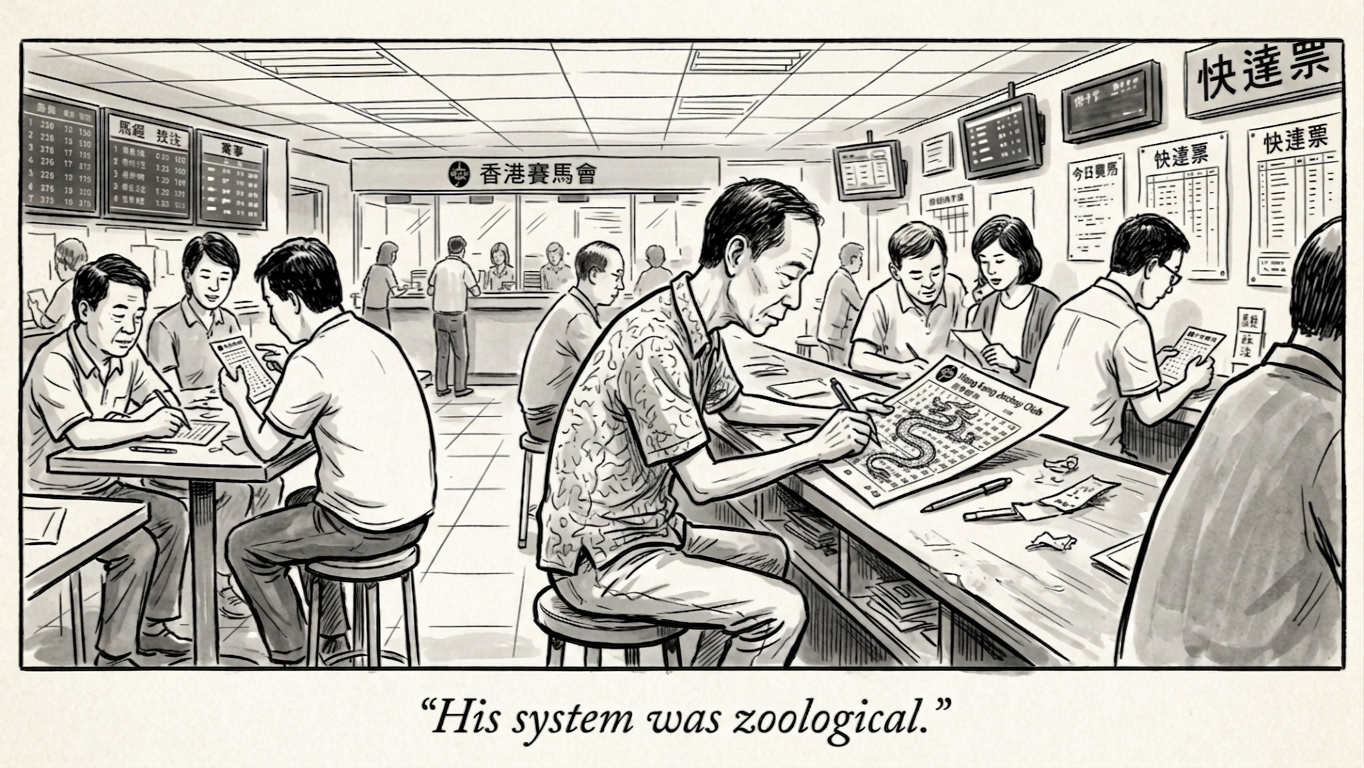
I watched a man at a Jockey Club branch once, on a normal weekday, no snowball. He was not filling out a playslip. He was drawing on it. He traced the outline of a dragon across the grid of numbers, then a fish, then something I couldn’t identify but he clearly could, connecting the numbers that formed the silhouette of a creature. His system was not mathematical. It was not numerological. It was zoological. He was betting on the spiritual resonance of an animal he had drawn with a ballpoint pen in a fluorescent room that smelled like Pak Fah Yeow, and he was doing it with absolute conviction. I have never in my life been that certain about anything.
My mother-in-law plays Mark Six with the same numbers every draw. She has played these numbers since before I met her daughter. She will play them until the earth reclaims her. These numbers are as fixed and non-negotiable as her opinions about how I load the dishwasher, which is to say: completely, permanently, and with a certainty that makes arguing pointless. I once asked what the numbers meant. My wife said, “Don’t.” I didn’t.
Her architecture is specific. I know because my wife has heard it her entire life. The flat, not a bigger flat, a different flat, a specific flat in a specific building she has walked past for fifteen years. The trip to Canada to visit her sister in autumn. Not a vacation, a long trip. A month. Maybe two. The kind of trip you can only take when the concept of “time off” no longer applies to you. She walks around inside this building twice a week, Tuesday and Thursday, and it costs ten dollars per draw, and she’s been building it for twenty years, and it is as real to her as anything in her actual apartment.
I know this because I do it too.
Every time I go home, home home, Adans, Massachusetts home, I stop at the Oasis and buy a few nips and a scratch ticket. Not a ritual I decided to have. A ritual that happened to me. I stand at the counter, pick one, no system, I am an amateur, pay, take it to the car. I sit there in the parking lot with a coin in my hand. I do not scratch it immediately.
I wait. Not long. Maybe a minute. But in that minute I am not in a parking lot in Massachusetts. I am in the building. My building. The one I’ve been furnishing for years without admitting it. There is a window in this building, a particular window, the one in the room where I would write, facing east, the morning light coming through it before anyone else is awake. That window is the main feature. Not the house. Not the money. The light through that window, and the time to sit in it. The money is just the mechanism that buys the time, and the time is vast, and I fill it with everything I can’t fit into the life that exists on the other side of the scratch ticket.
Then I scratch it. Three dollars, once. Twenty dollars, another time. Never the building. Never that window.
The building doesn’t collapse when the ticket loses. I knew that. I’ve always known that. What I didn’t know, what I didn’t want to know, is that the building is also never finished. You can live in it for a minute, maybe two. Then you’re back in the parking lot, and the window is gone, and you have to buy another ticket to see it again. That’s why I keep buying tickets. That’s why Dot kept her stool. That’s why my mother-in-law will play the same numbers until she dies.
We buy the ticket anyway, because the ticket isn’t the point.
The afternoon is the point
The afternoon is the point. The afternoon is never enough.