On the people who packed it, the company it built, and the ones being told to pack their own.
In 1969, in a city where the fog rolls through the Golden Gate and the waterfront smells of salt and diesel and cargo that has somewhere to be, a young man named Larry Hillblom had an idea so simple it was almost embarrassing. Ships were arriving in Honolulu carrying freight from San Francisco, and the freight was sitting on the dock for days, sometimes weeks, because the customs paperwork had been mailed by regular post and had not yet arrived. The cargo was there. The documentation was not. And in the gap between the two, money rotted the way produce rots, silently, expensively, and on someone else’s clock.
Hillblom’s idea was to fly the paperwork. Put the bills of lading in a suitcase, buy a plane ticket, carry the documents across the Pacific before the ship arrived, hand them to customs, and have the cargo cleared before the hull touched the dock. It was not a technology. It was not a platform. It was a suitcase and a seat on a commercial flight and the willingness of a twenty-six-year-old law student at Berkeley’s Boalt Hall to fund the venture with a portion of his student loans, because he had spent his evenings running courier duty between airports for an insurance company and the rhythm of the airports and the urgency of the documents and the gap between where something was and where it needed to be had settled into his bones.
He brought in two partners. Adrian Dalsey was a salesman, born in 1914, the oldest of the three, the one who understood that for a business to trust a stranger with its most important legal documents, the stranger had to look like he knew what he was doing. Robert Lynn was the operational anchor, born in 1920, the one who made sure the bills got paid. Together the three of them shared a Plymouth Duster that they drove around San Francisco, picking up documents, then rushing to the airport to book flights using another relatively new invention, the corporate credit card. They named the company after their initials. D, H, L. Dalsey, Hillblom, Lynn. The name was not a brand. It was an abbreviation. It was three men in a car with a suitcase, trying to outrun a ship.
Their first hires were Max and Blanche Kroll, whose apartment in Hawaii became a flophouse for their couriers. The couriers slept on the Krolls’ floor because there was no budget for hotels and the next flight left at dawn and the documents had to be there when the ship was still at sea, because the whole point, the entire business, the reason for the company’s existence, was that the paper had to beat the cargo. If the paper arrived after the ship, DHL was just another delivery service. If the paper arrived before the ship, DHL was the company that saved you a week of port fees and a warehouse full of spoiling freight.
The paper beat the ship. The company grew. By 1972, DHL had offices in Japan, Hong Kong, Singapore, and the Philippines. By 1976, the Middle East and Latin America. By 1983, it was the first express courier in the Eastern Bloc. By 1988, the company operated in 170 countries with 16,000 employees. Three men with a Plymouth Duster and a suitcase had built the largest international courier network on earth.
And then the founders left, one by one, though not all of them left willingly and not all of them left alive.
Adrian Dalsey died in 1994. He was seventy-nine. He knew that trust was the only real currency. If you said a package would arrive at ten in the morning and it arrived at five past, you had failed.
Larry Hillblom disappeared on May 21, 1995. He was fifty-two. His seaplane crashed on a flight from Pagan Island to Saipan. The pilot’s body was recovered. A business partner’s body was recovered. Hillblom’s body was never found. The man who founded DHL with his student loans vanished into the Pacific Ocean, and what followed was one of the most grotesque legal battles in corporate history: lawsuits from children fathered across Southeast Asia, a will that left everything to the University of California, and a settlement of $360 million paid to four children whose father had dissolved into the sea.
Robert Lynn died in 1998. He was seventy-eight. He was the last of the three to go. None of them were in the room when what happened next began.
Because in 1998, the year Lynn died, Deutsche Post, the privatized successor to Germany’s state postal service, began acquiring shares in DHL International. Deutsche Post itself had been formed on January 2, 1995, when the Federal Republic of Germany converted its national postal service into a joint-stock company. In November 2000, Deutsche Post went public on the Frankfurt Stock Exchange. And then it went shopping. Danzas, the Swiss freight forwarder. Air Express International. DHL International, in stages, from 1998 to 2002. By December 2002, Deutsche Post owned every outstanding share of DHL.
The company that three Americans had built with student loans and suitcases and a Plymouth Duster was now a wholly owned subsidiary of a German state enterprise. The initials D, H, and L no longer stood for the people who created the company. They stood for a brand, owned by a holding company, governed by a supervisory board, traded on the exchange, and headquartered not in San Francisco but in Bonn, a city that Dalsey and Hillblom and Lynn had almost certainly never visited when they were stuffing documents into luggage at SFO.
In 2005, Deutsche Post acquired the British contract logistics company Exel for approximately 5.5 billion euros, growing the workforce past 285,000. The organism was expanding, swallowing companies and integrating their people and their systems and their customer relationships. DHL was no longer three men trying to outrun a ship. DHL was a global logistics conglomerate, and the suitcase that started it was an artifact in a corporate archive, and the men who carried it were dead or dissolved.
The suitcase is now a museum piece. The company that grew from it employs approximately 584,000 people in more than 220 countries and territories. Its annual revenue is 82.9 billion euros. It is one of the largest logistics companies in the world, and it has won, year after year, the title of Great Place to Work. DHL Express has been ranked the number one Best Workplace in Hong Kong for the second consecutive year. The company has been certified as a Top Employer in 50 countries. The Chief Human Resources Officer, Thomas Ogilvie, has said that committed and motivated employees are the foundation for excellent service quality. The company’s Strategy 2030 declares, among its four strategic dimensions, the ambition to be an Employer of Choice.
Employer of Choice. The phrase receives the same weight in the investor presentation as the other three dimensions. It means, according to the company’s own materials, creating a safe and positive work environment, competitive benefits, and fostering employee development and inclusion.
Eight thousand positions are being eliminated.
I need to tell you about the suitcase, because the suitcase is doing different work now.
In March 2025, CEO Tobias Meyer announced the Fit for Growth program. Designed, in the language of the press release, to structurally improve DHL Group’s cost base by more than one billion euros, with the full impact expected in 2027. At Post and Parcel Germany, approximately 8,000 positions will be reduced. The division employs approximately 190,000 people. Eight thousand is roughly four percent of that workforce. It is the largest domestic workforce reduction at DHL in at least two decades. Meyer emphasized that the cuts would occur through natural attrition rather than forced layoffs.
Natural attrition. The phrase recurs in this series the way a particular phrase recurs in a liturgy, repeated until it loses meaning, until it becomes not a description but a spell designed to transform a thing into something other than what it is. At Expeditors, the mechanism was a locked email that said attrition alone would not suffice. At J.B. Hunt, the mechanism was a return-to-office mandate calibrated to a commute radius someone calculated would be intolerable. At C.H. Robinson, there were no headcount KPIs, the CEO said, while the headcount dropped 31 percent. At DHL, the mechanism is natural attrition, which means the company will not fire you. It will simply not replace the person who sat next to you when they leave, and the person across from you when they retire, and the person down the hall when they decide the workload is no longer sustainable, until the desk is empty and the work that four people did is being done by three, and the three people remaining understand that the company’s commitment to being a Great Place to Work is measured not in the people it retains but in the positions it declines to fill.
The stock surged 12.3 percent on the day of the announcement. The highest single-day jump in over a year. The market does not metabolize human consequences. The market metabolizes cost reductions, and a cost reduction of one billion euros is, in the market’s framework, excellent news.
Now let me tell you who is holding the saw.
Tobias Meyer spent twelve years at McKinsey and Company, becoming a partner in 2010, before joining DHL in 2013 as Executive Vice President of Corporate Development. He holds a doctorate in mechanical engineering from the Technical University of Darmstadt. He became CEO in May 2023, succeeding Frank Appel, who had led the company for ten years. In March 2026, the supervisory board extended his contract until 2031.
McKinsey. The name arrives in these stories with the regularity of a diagnosis. At FedEx, McKinsey was brought in to engineer the DRIVE program, the four billion dollar cost-cutting initiative that closed over 475 stations while Fred Smith was still alive to see his philosophy dismantled. At DHL, McKinsey did not need to be brought in. McKinsey was already there. The CEO is McKinsey. The HR Director, Thomas Ogilvie, is McKinsey. Both moved to DHL from McKinsey. The methodology does not arrive as a consultant’s recommendation. It arrives as the management itself, pre-installed, already running, the way an operating system runs beneath the applications that the user sees.
Meyer is not an outsider in the way Dave Bozeman was an outsider at C.H. Robinson, parachuted in from Amazon and Ford with no experience in freight brokerage. Meyer has been at DHL for over a decade. He ran Global Forwarding as COO. He ran Post and Parcel Germany. He knows the business. But his formation, the twelve years before he arrived, the years that shaped the way he sees a problem and defines a solution, those years were spent in a firm whose methodology is cost reduction, whose deliverable is efficiency, and whose definition of improvement is the distance between what a process costs and what it could cost if the people were removed.
I want to be fair. The postal business in Germany is dying. Letter volumes declined 20.3 percent between 2022 and 2024. Cumulative inflation during the same period reached 15.8 percent. The German Federal Network Agency permitted DHL to raise stamp prices by an average of only 4.6 percent over the same span. The math is brutal and it is not Meyer’s fault: the volume is falling, the costs are rising, and the regulator will not let the company charge enough to close the gap. The recently concluded wage agreement with the Verdi labor union adds another 360 million euros in structural costs by the end of 2026. Something had to give. The case for restructuring is not frivolous.
The question is what gave, and who bore the cost, and whether the people who bore it were told the truth about why.
Here is what the truth looks like from the boardroom.
Full-year 2025 EBIT rose 3.7 percent to 6.1 billion euros, exceeding guidance. Earnings per share improved 8.1 percent to 3.09 euros. Net profit reached 3.5 billion euros. The company is not starving. The company is pruning. And now, in the second quarter of 2026, the organism is surging. Revenue increased more than 10 percent year over year. EBIT reached approximately 1.85 billion euros, up 29 percent. On July 7, 2026, management raised its full-year EBIT guidance to exceed 6.5 billion euros, up from the prior forecast of 6.2 billion. DHL Express alone posted EBIT of 1.2 billion euros in the quarter, up 64 percent, supported by a return to volume growth and 150 million euros in gains from air freight capacity constraints.
The Fit for Growth program, DHL said, “continued to have a positive effect across the group, leading to Q2 earnings rising more strongly than market expectations.”
The analysts nodded. The stock climbed. The reduced cost base, the one created by eliminating 8,000 positions, was producing its designed effect: more profit from fewer people. The people were the cost. Their absence is the margin. Their departure is the earnings beat.
The company proposed a dividend of 1.90 euros per share for fiscal year 2025, a 2.7 percent increase. The total payout: approximately 2.2 billion euros. The share buyback program, increased in 2025 to up to 6 billion euros, had already returned 4.5 billion to shareholders by year-end, with 1.5 billion left to execute in 2026. Meyer told investors that dividend continuity and shareholder returns are a high priority for us.
Read those numbers again. Over two billion euros in annual dividends. Up to six billion euros in share buybacks. And the cost of the new wage agreement that was cited as justification for the 8,000 job cuts: 360 million euros. Less than one-fifth of the annual dividend payout. Less than one-sixth of the buyback program.
The wage increase is the pretext. The dividend is the priority. And the 8,000 people are the variable that connects the two, the thing the company adjusts so that the first number does not disturb the second.
Here is what the truth looks like from the mail center.
The Verdi union was not consulted about the cuts. Over 54 percent of Verdi members opposed the new collective wage agreement in a survey conducted in March 2025. Despite majority opposition, the Verdi leadership accepted the deal. Two days later, the 8,000 job cuts were announced. The union agreed to a wage increase. Two days later, the company announced that the cost of the wage increase would be offset, in part, by eliminating 8,000 of the positions that the increase was supposed to benefit. The raise was real. The people who were supposed to receive it were not.
A postal worker named Silke, working the night shift in a mail center in Hesse, described the arithmetic. The collective agreement is not just bad, she said. We struck for more. But it also goes hand in hand with 8,000 job cuts. There are already too few of us before these job cuts. She had assumed that colleagues who had previously left would be brought back. Not that even more people would be forced out.
A delivery driver from Saarland cited the threat of job cuts as the reason he voted no.
Both of them are still working. Both of them are wondering whether their position is one of the 8,000. Both of them were told, by the company’s own certifications, that DHL is an Employer of Choice and a Great Place to Work. Both of them saw the stock surge 12.3 percent on the morning the cuts were announced, and the surge meant that the market valued the elimination of their colleagues more highly than any service their colleagues had ever performed.
And beneath all of this, the German government. The state development bank KfW holds a 16.99 percent stake in DHL Group, making the German state a material shareholder. The people who are losing their jobs at Post and Parcel Germany are losing them at a company that is, in part, owned by the government of the country they deliver mail in. The state privatized the postal service. The state sold shares to the market. The market demanded efficiency. Efficiency meant cutting 8,000 positions. And the state, which still collects its dividend, watched.
The government delivered its own postal workers to the market, and the market is delivering them to the parking lot, and the government is cashing the check.
Meanwhile, in the United States, a different kind of reckoning. In March 2026, thousands of Teamsters at DHL Express voted by a 96 percent margin to authorize a strike if the company failed to present a fair contract by March 31. The workers, roughly 6,000 drivers and warehouse employees across 26 locals in 16 states, were demanding pay increases, stronger working conditions, and protection against the very thing that the corporate strategy was designed to produce: the replacement of human labor with automated systems. It was not the first time. In 2023, more than 1,100 Teamsters at DHL’s global air hub at Cincinnati/Northern Kentucky International Airport had gone on strike for eleven days over unfair labor practices, and picket lines had spread across the country.
This time, the threat worked. Less than 24 hours before the contract expired, the Teamsters national negotiating committee reached a tentative agreement. In May, the workers ratified a new four-year contract by a 92 percent margin. A 20 percent wage increase. Higher health and welfare contributions. Critical job protections. The Teamsters General President said the leverage delivered serious wage increases, locked in strong job protections, and made it clear that Teamsters will not allow technology to undermine our rights or livelihoods.
Note the language. Will not allow technology to undermine our rights or livelihoods. The workers who had the power to stop the saw, stopped the saw. The workers who did not, the 8,000 postal workers in Germany represented by a Verdi leadership that overrode its own members’ vote, did not.
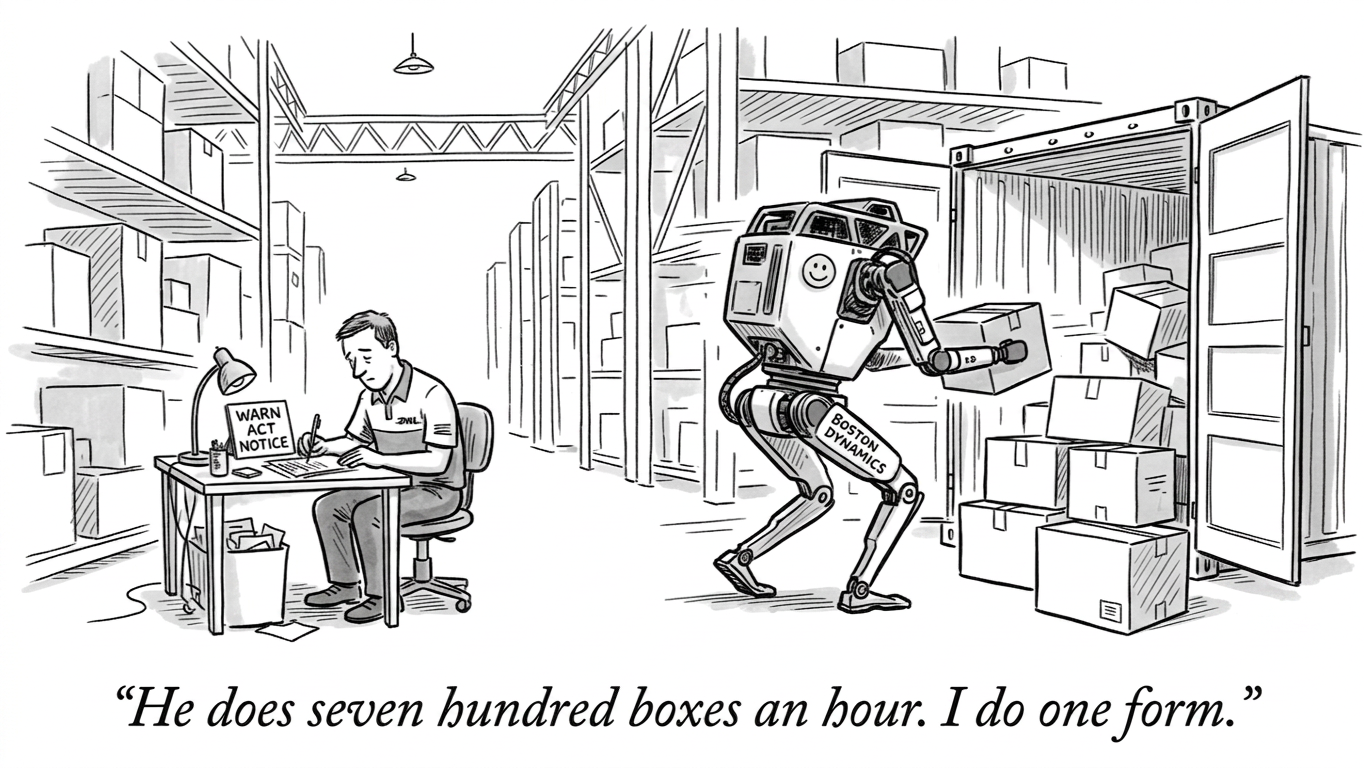
The pattern is not limited to Germany. In the United States, DHL Supply Chain has filed 33 WARN Act notices affecting 4,319 workers across 12 states from 2018 to 2026. Across all DHL entities, the company has been involved in 97 WARN notices affecting 9,865 workers from 2003 through April 2026. A warehouse in Tracy, California. Facilities in Sugar Land and Missouri City, Texas. A distribution center in Canal Winchester, Ohio, 173 workers. A warehouse in Ontario, California, 346 workers, closing this summer because a customer relocated its operations. An IKEA fulfillment center in Lakeland, Florida, 203 workers. The WARN notices capture only the cuts large enough and concentrated enough to trigger the filing threshold. The smaller cuts, the ones that happen one warehouse at a time, one contract loss at a time, one non-replacement at a time, those appear on state filings and kitchen tables and nowhere else.
On Glassdoor, a DHL Supply Chain employee wrote that executives communicate the bare minimum, that they were never told layoffs were happening at a warehouse, that management is tightening their belts even though the company is in a good financial position. Another noted that DHL Global Forwarding conducts small-scale layoffs nearly every year.
And on the same platform, from DHL Express, a different reviewer wrote: great company to grow for long-term commitment, job security, compensation and benefits is really good, no layoff concept. The company’s own Glassdoor response called DHL a people-centric company and thanked the reviewer for being part of our big DHL family.
No layoff concept. The phrase sits on the screen beside the WARN notices the way a billboard for a family restaurant sits beside an empty parking lot.
And while the positions were disappearing, the company was replacing them. Not with people. With machines. In May 2025, DHL signed a strategic agreement with Boston Dynamics to deploy over 1,000 additional Stretch robots across its global warehouse network. The robots automate container unloading, achieving rates of up to 700 cases per hour, and DHL is expanding their use into case picking, which the company itself identifies as the most labor-intensive activity within DHL Supply Chain. DHL has invested over one billion euros in automation in its contract logistics division in the past three years alone. It now uses more than 7,500 robots globally, more than 200,000 smart handheld devices, and nearly 800,000 IoT sensors. Over 90 percent of its warehouses have at least one automation solution. The company’s CIO called it a fundamental shift that’s reshaping how we operate.
A fundamental shift. That is the phrase. The shift is from people to robots, from salaries to software, from the worker who carries the cargo to the machine that replaces the worker who carries the cargo. And the savings from the fundamental shift flow through the income statement into the dividends and from the dividends into the buyback and from the buyback into the share price, and the share price is going up, and the headcount is going down, and the company is being renamed DHL AG, and the fundamental shift is fundamentally a shift in who matters.
In late May 2026, DHL eCommerce announced a new exclusive multi-year contract with the United States Postal Service valued at well over $10 billion. The agreement was described as unprecedented in the 25-year relationship between the two organizations. DHL handles nationwide pickup, sortation across its 19 fully automated hubs, and linehaul, before handing off to USPS for last-mile delivery to 170 million addresses. Nineteen fully automated hubs. The word “automated” is doing the work that the word “staffed” used to do.
CEO Meyer’s compensation is capped at 10.5 million euros under the new remuneration system approved for 2026 onward, with a base salary rising to 1.75 million euros from May 2026. His total compensation is modest by the standards of American executive pay, roughly average for the German DAX. I will concede this. Meyer is not collecting 28 million dollars like Bozeman at Robinson or 12 million like Subramaniam at FedEx. The German model constrains extraction in ways the American model does not.
But the German model also contains something the American model does not: a supervisory board on which half the seats belong to employee representatives, a co-determination structure designed to give workers a formal voice in the decisions that affect them. And the voice of the workers, as expressed through the Verdi membership vote, said no. Over 54 percent said no. The union leadership overrode them and accepted the deal. Two days later, 8,000 of their colleagues were told their positions were being structurally improved.
The workers voted. The leadership overrode the vote. The company announced the cuts. The stock rose. That is what co-determination looks like when the determination is being made by people who are not being co-determined upon.
And the Verdi deputy chairwoman who accepted the deal? Andrea Kocsis has been the chief negotiator for 18 years. She is also deputy chair of the DHL supervisory board. She received 364,000 euros in compensation in 2024 for her services on that board. The person negotiating on behalf of the postal workers sits on the board that oversees the management cutting the postal workers. The fox is not guarding the henhouse. The fox is negotiating the terms under which the henhouse is disassembled, and the fox is being paid by both the hens and the farmer, and the hens voted no, and the fox said yes.
I want to return to the suitcase.
In 1969, Larry Hillblom packed a suitcase with bills of lading and flew them from San Francisco to Honolulu because the paper had to beat the ship. That was the whole of it. That was the company. A man with a student loan and a suitcase and the conviction that the space between a problem and its solution was exactly the width of a plane ticket. He slept on a stranger’s floor in Hawaii because there was no hotel budget. His partners drove a Plymouth Duster because there was no fleet. Their office was the backseat. Their filing system was a bag. And the thing inside the bag, the documents, the bills of lading, the paperwork that cleared the cargo and freed the ship and made the port work and kept the supply chain moving, that thing was worth more than the bag that held it, and the men who carried it knew that, and the knowing was the business.
Every one of the 584,000 employees who now work under the DHL name is a descendant of that suitcase, a person who carries something from where it is to where it needs to be, who fills the gap between a shipper and a dock, between a sender and a recipient, between a warehouse in Bonn and a doorstep in Brisbane.
And now the company is asking 8,000 of those people to pack a different kind of suitcase. Not the kind that carries documents. The kind that carries belongings. The kind you pack when the job you thought was permanent turns out to be a position, and the position turns out to be a line item, and the line item turns out to be one of the costs that the Fit for Growth program was designed to structurally improve.
Hillblom’s body was never recovered from the Pacific. Dalsey died four years before the company was sold. Lynn died the year the selling began.
None of them were in the room when Deutsche Post signed the acquisition papers. None of them were in the room when McKinsey’s methodology was installed in the CEO suite. None of them were in the room when Fit for Growth was announced and the stock rose 12.3 percent and 8,000 people in Germany learned that the company that calls itself an Employer of Choice had chosen differently. None of them were in the room two weeks ago when the company raised its earnings guidance to 6.5 billion euros and the analysts nodded and the CFO said efficiency improvements and growth markets are paying off, and the word “efficiency,” as it always does in these rooms, meant the people who are no longer in the building.
The paper used to beat the ship.
Now the spreadsheet beats the people. And the suitcase, the same suitcase, carries whatever is left.