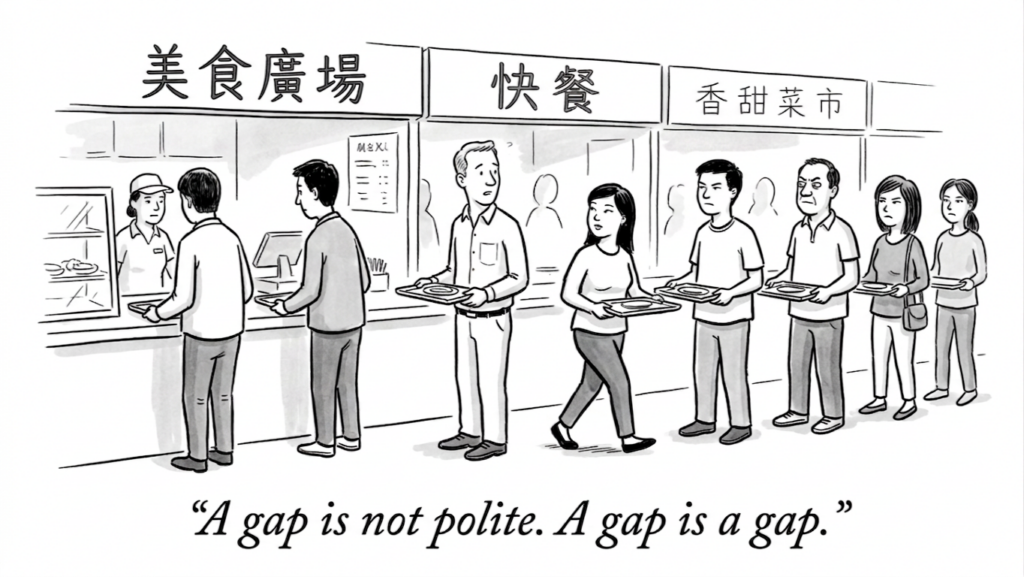
On lines, waiting, and the quiet agreement that other people exist.
In Adams, Massachusetts, where I am from, where the population hovers around eight thousand depending on who has recently died and who has recently been born, we do not queue. We have never queued. The word “queue” did not exist in my vocabulary until I was forty years old and standing in a post office in Wan Chai being corrected by a woman who weighed less than my briefcase. “You must join the queue,” she said. I looked around. There was no queue. There were people. They were standing. They appeared to be standing in a pattern, but the pattern was invisible to me in the way that dark matter is invisible to the human eye but apparently holds the universe together. I did not join the queue. I stood somewhere. It was the wrong somewhere. I know this because of the Stare.
But I am getting ahead of myself.
The word “queue” arrived in my life the same way the Octopus card arrived, the same way the tea charge arrived, the same way the discovery that you are expected to pour tea for other people before yourself arrived: uninvited, unexplained, and carrying the quiet implication that I had been doing something wrong for decades. In Adams, a queue is either a pigtail on a Qing dynasty official in the history textbook you weren’t reading, a pool cue spelled wrong, or a word you’ve genuinely never heard spoken aloud by a human person in a non-academic context. You wait in line. You stand in line. You get in line. The word “line” is honest. A line is a geometric concept. You can see it. It goes from here to there. A queue is five letters long and four of them are unnecessary and this, I have come to believe, is the most British thing about Hong Kong: the city kept the word with the silent letters.
Hong Kong has mastered the queue the way certain Renaissance cities mastered the fresco. It is a civic religion. The congregation is seven million strong, and they worship multiple times a day with a devotion that would make a Jesuit weep.
There are no ropes. There are no signs that say “line forms here.” There are no helpful arrows on the floor, no numbered tickets, no bored teenager in a uniform telling you where to stand. There is simply a place where the queue begins, and everyone knows where it is, and no one told them, and if you ask how they know they will look at you the way you might look at someone who asked how you know which direction is down.
They queue for buses with the geometric precision of a military formation, single file, along the curb. They queue for dim sum at restaurants where the wait is forty-five minutes and the meal is twenty minutes and no one has ever questioned this ratio. They queue for the MTR in two orderly lines on either side of the doors, leaving a gap in the middle for exiting passengers, and they do this without markings, without instruction, and they have been doing it so consistently that when the MTR eventually painted the lines on the platform, the paint merely confirmed what the people already knew. The infrastructure followed the behavior. Not the other way around.
They queue for limited-edition sneakers. They queue for a restaurant in Sham Shui Po that serves nothing but toast. Toast. Not artisanal toast. Toast. And the queue is thirty people long at 8 AM on a Tuesday and everyone in it is patient and silent and not one of them is questioning whether toast is worth this. The queue has already answered that question. The queue is the answer.
Cut a queue in Hong Kong. I dare you.
Cut a queue and you will be stared at with a level of contempt normally reserved for war criminals and people who talk on speakerphone in elevators. You will feel the Stare on the back of your neck like a physical weight. You will carry it for the rest of the day. You will feel it in bed that night, thinking about the twenty-three people whose morning you disrupted by believing, incorrectly and catastrophically, that your time was more valuable than theirs.
In Adams, you don’t wait in lines too often. It’s a town of eight thousand people. There aren’t enough of you to form a proper line most of the time. But when you do, at the post office before Christmas, at the deli counter at Adams Hometown Market, which replaced the Big Y, which replaced the original Adams Supermarket, because nothing in Adams dies, it just becomes a different version of itself, when you do find yourself in proximity to other people who want the same thing, what happens is not a line.
It’s a social negotiation conducted in physical space by people who went to high school together or whose parents went to high school together or who, at minimum, recognize each other from the Hometown Market and have enough shared context to conduct the negotiation without a manual.
You arrive. Someone else is already there. You stand near them. Not behind them. Near them. The geometry is approximate. You nod. The nod means: I see you. I know you were here first. But I am not going to stand directly behind you in a rigid single-file formation because this is not a war and there are only four of us and Donna at the register has been working here since 1987 and she knows who was here first because she knows everything because this is Adams and eight thousand people cannot hide from each other.
- And then the thing happens. The thing that does not happen in Hong Kong. Someone says: “You go ahead.”
- And the other person says: “No, no. You were here first.”
- And the first person says: “I’m in no rush.”
- And the second person says: “Neither am I.”
And this goes on for a duration precisely calibrated to the relationship between the two parties and the number of items they’re holding and whether the person behind them is starting to shift their weight. Eventually, someone goes. No one knows exactly why. The system is opaque. The system is organic. The line is not a system. It’s a conversation. It’s the town talking to itself about itself, confirming, at the post office and the pharmacy and the deli counter, that we are people who see each other.
Ruth came to Adams after we had been dating for some time. We went to the post office. There were five people in the lobby. They were arranged in a shape that a geometer would call “nothing” and a topologist would call “a loose cluster with no discernible orientation.” Ruth stood by the door. She looked at the five people. She looked at the counter. She looked at me.
“Where is the queue?” she said.
“There isn’t one,” I said.
“There are people. And there is a counter. So there must be a queue.”
“It’s more of a vibe,” I said.
Ruth does not like answers that contain the word “vibe.” Ruth believes that systems should be legible and that if a system is not legible it is not a system, it is chaos wearing a polite expression.
“Just stand behind someone,” I said.
She looked at the five people. She looked at me. And she said something I have thought about at least once a week for twenty years:
“There is no behind someone. There is only the idea of someone, and the idea is approximate.”
She was right. In Adams, you do not stand behind someone. You stand in their general orbit. You stand in a location that implies deference without committing to geometry. And Ruth, who had spent her entire life in a city where the queue is a religion and your position relative to the person in front of you is a statement of moral character, could not compute this. She stood there, next to a bin of priority mail envelopes, and waited for a system to emerge. The system did not emerge. What emerged was Donna, who said, “You all set, hon?” and Ruth looked at me and I said “She’s next” even though she was not next in any way that a reasonable person could identify because there was no next, there was only proximity and the vague consensus of five people who had all silently agreed on an order through a process entirely invisible to my wife, a woman who navigates one of the most complex transit systems on earth without hesitation but who could not, on this day, figure out how to mail a package in a town with one traffic light.
The inverse happened. Of course it happened.
A Tuesday in Mong Kok. The food court at Langham Place. I wanted chicken rice. The stall had a queue. I had learned, by then, to identify a queue by its characteristics: orderly, silent, single file, phones out, patience infinite. I walked to the back. I stood behind the last person. I waited. This was correct. I was, for once, in the right.
The person in front of me collected their tray and left and there was now a gap, and I did not immediately close it because somewhere in the reptilian core of my Massachusetts brain, in the part of me that is still standing in the Adams post office watching my father do the “no, you” dance with a man named Gerald, a voice said: leave a little space. Don’t crowd. Be easy.
A woman materialized in the gap. She did not cut. She simply occupied the space that I had, through cultural incompetence, donated to the universe, and the universe, being Hong Kong, had immediately filled it. Hong Kong does not believe in empty space. Hong Kong believes that if there is a gap, the gap is an invitation, and if you did not intend to issue an invitation you should not have left a gap.
I got my chicken rice a few minutes later than I would have if I had simply closed the gap like a person who understood the system he was living in.
Ruth looked up when I returned.
“You lost your place,” she said. Not a question.
“I left a gap,” I said.
“Why would you leave a gap?”
“Because I’m from a place where a gap is polite.”
“A gap is not polite,” she said. “A gap is a gap.”
The queue is not about efficiency. If it were about efficiency, Hong Kong would have eliminated it. Hong Kong eliminates inefficiency the way other cities eliminate pigeons: relentlessly, structurally, without sentimentality. The queue survives because the queue is about trust. The queue is the agreement, made fresh every morning on every platform and every bus stop in a city of seven million people who mostly do not know each other, that other people matter. That their time matters. That the fact that they arrived before you means something, and that what it means is: they go first. And you wait. And if you don’t wait, the Stare.
In Adams, the line works, when a line is needed, which is rarely, because everyone knows each other. The “you go ahead” dance is performed between people with shared history, people who will see each other tomorrow. The trust in Adams is the trust of familiarity. The trust in Hong Kong is the trust of strangers. I do not know which is more impressive, but I know which one is harder to build, and I know which one is more fragile, and I know which one I think about when I’m standing on a platform watching two million people a day honor a system that no one enforces and no one explains and that works because everyone agrees to let it work.
The queue is the social contract made visible. You don’t notice it until you’re somewhere that doesn’t have one.
I am standing on the platform at Admiralty, 8:47 AM, Tuesday. The train is arriving. I am in the left-hand line. There is a corresponding line on the right. Between us is the gap, for the people about to exit. The doors open. People begin to exit through the gap. And then, before the last person is even through, the lines collapse inward. Someone surges forward. Then another. The gap, which held for perhaps three seconds, is gone. The queue, so orderly in its waiting, dissolves at the moment of entry into something closer to fluid dynamics. I am carried forward in the press of bodies. The beautiful system I thought I understood has revealed its limit: the queue governs the wait, but not the boarding. The boarding belongs to something older. Something that does not negotiate.
And I think about Adams. About the post office. About Donna saying “you all set, hon?” About my father saying “go ahead” to Gerald and Gerald saying “no, you” and the beautiful, inefficient, human negotiation that takes place in a town where everyone knows the order because everyone knows everyone.
A man behind me shifts forward. Six inches from my back. In Adams, this would be a provocation. In Hong Kong, this is the queue breathing. I hold my position. I maintain the geometry. Six inches from the person in front of me and six inches from the person behind me. We are strangers and we are in agreement and the agreement is silent and total.
The train arrives. I queue onto it. I do not say “you go ahead.” I do not perform the dance. I file in, in my correct position, one of seven million people who have agreed, today, to trust each other.