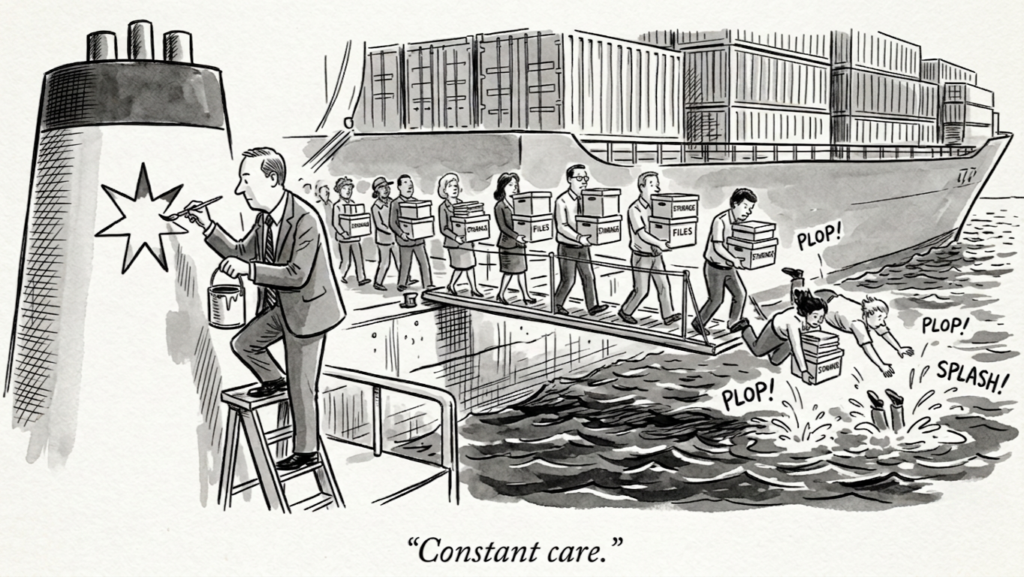
On the constant care of a captain’s prayer, the company it built, and the cost of what was saved.
In December 1883, off the west coast of Scotland, a barque named Valkyrien wrecked in rough weather on a voyage from Newport to Glasgow. Her captain, Peter Maersk Moller, survived. His livelihood did not. He was forty-seven years old. He had a wife, Anna, and ten children. He had first gone to sea as a cabin boy in 1850 and spent the next three decades learning what the ocean does to men who are not careful and what it rewards in men who are. The Valkyrien had been his ship and now the Valkyrien was gone, and the question a man faces when the sea takes everything is whether it has also taken his future or merely cleared the deck for a different one.
It was both the necessity of providing for his family and a conviction that steamships would be the future that led Peter Maersk Moller to acquire a small steamship and establish the Steamship Company Laura in 1886. On the funnel of that steamer, he painted a white seven-pointed star against a light blue background. In a letter to his wife, he explained: the star was a reminder of the evening he had prayed for her, dejectedly and anxiously, asking for a sign, and had seen one through the grey, overcast sky. Anna had suffered from a serious illness while accompanying him on a voyage years earlier. She recovered. The star became a symbol of their good fortune.
That is the star. The one that now sits on the funnels of more than seven hundred vessels, on the uniforms of more than a hundred thousand employees, on the sides of containers stacked in ports from Rotterdam to Singapore to Elizabeth, New Jersey. It began not as a brand or a trademark but as a prayer by a man whose ship had sunk, whose wife had been sick, and who painted a star on a funnel because he believed the sky had answered him.
In 1904, Peter Maersk Moller and his son Arnold Peter Moller founded the Steamship Company Svendborg with a capital of 150,000 Danish kroner. The father was sixty-eight. The son was twenty-seven. Their first ship was a second-hand British-built steamer of 2,200 deadweight tons, which they named Svendborg after the small town on the island of Funen where the family lived. The company was not a vision statement or a disruption thesis. It was a family business, launched with pooled savings and borrowed capital, built on the conviction that a careful man could make a living moving cargo by sea if he watched over every detail with what A.P. Moller would later call constant care.
No loss should hit us which can be avoided with constant care.
The phrase became the company’s spine. A.P. Moller said it, wrote it, lived it. The idea was not complex. Take care of today. Prepare for tomorrow. Watch the cargo. Watch the weather. Watch the books. Watch the people. The people especially. Because a ship that sails is only as reliable as the crew that mans it, and a company that endures is only as strong as the loyalty it earns from the people who show up every morning and do the work that no quarterly report can quantify.
The First World War was lucrative for the shipping business, and A.P. Moller took full advantage. After the war, his company was the fourth biggest shipping company in Denmark. It grew steadily in the interwar years and was the largest in Denmark at the outbreak of the Second World War.
And then came the test. On April 8, 1940, A.P. Moller issued Permanent Special Instruction One to the 36 Maersk ships on the high seas. Should Denmark become involved in war, all ships were to report directly to the New York office and follow its instructions. No orders from Copenhagen were to be followed if not approved by New York. The next morning, April 9, Germany invaded Denmark. The instruction had been issued one day before the invasion arrived. A.P. Moller’s son, Maersk Mc-Kinney Moller, traveled to the United States to manage the company’s international operations from the New York office throughout the war. A total of 25 Maersk ships were wrecked during the war, and 150 seafarers lost their lives. At the end of the conflict, the fleet was reduced to just 21 ships, only seven of which were under Danish control. The company survived because the founder had been careful enough to plan for catastrophe and brave enough to act on the plan.
A.P. Moller died on June 12, 1965. His son became CEO and held the post until 1993. Beginning in 1965, Maersk Mc-Kinney Moller also served as company chairman and did not relinquish the position until December 2003, when he was ninety years old. Under his leadership, the group transformed from a Danish shipping concern into one of the largest industrial conglomerates on earth: container ships, tankers, oil and gas exploration, shipbuilding, supermarkets, an airline. And through all of it, the values. Before stepping down, Maersk Mc-Kinney Moller carefully refined the family values into five core concepts: Constant Care, Humbleness, Uprightness, Our Employees, Our Name.
Our Employees. That was the fourth value. Not Our Shareholders. Not Our Margins. Not Our Efficiency Metrics.
The right environment for the right people. Attracting and retaining the right people, building the right team. Providing opportunities for continual development.
And Our Name. The fifth value. The sum of all the others. Ane Maersk Mc-Kinney Uggla, Maersk Mc-Kinney Moller’s daughter, who became chair of the family foundations when her father died on April 16, 2012, said of the values: this is what the family, together with our leaders and employees, have built. And it is what we must not destroy: Our Name.
The name. The star. The prayer on the funnel. All of it held together by a Danish phrase that resists easy translation: nyttig virksomhed. It centers on ensuring that the company serves a purpose for society and stakeholders, beyond purely commercial aims. A.P. Moller wrote it into the deed of the Foundation he established in 1953 to ensure his family’s long-term control of the company. Businesses should be developed to have a positive impact on society, while also being financially sound and profitable. Useful enterprise. Enterprise that serves. Not enterprise that extracts.
That was the architecture. Five values, one foundation, one family, one star. The structure was designed by a man who survived a shipwreck and a world war and who understood that the thing you build must outlast the storms you cannot foresee, and the only way to ensure that is to take constant care of the people who stand on the deck when the weather turns.
The weather has turned.
In November 2023, Vincent Clerc, the man who became CEO of A.P. Moller-Maersk on January 1, 2023, told the market: this is not a diet, this is a reset of the baseline. The total reduction would be approximately 10,000 positions, bringing global headcount down nine percent.
Ten thousand people. The number deserves a pause before the analysis begins.
By the end of Q3 2023, the company had already reduced its workforce from 110,000 employees to 103,500 since the beginning of the year. Another 2,500 jobs would be eliminated in the coming months, with the remaining cuts extending into 2024. The goal was to bring total headcount below 100,000. The savings: $600 million annually.
Clerc is not an outsider. The distinction matters, because the essay you are reading sits alongside stories of companies where the man with the saw was imported from a factory or a fulfillment center and never understood the business he was cutting. Clerc has been with Maersk since the late 1990s, more than twenty-five years. He rose through the ranks, from the commercial side to Chief Commercial Officer to CEO of Ocean and Logistics to the top job. He knows the trade lanes. He knows the customers. He knows how a container ship loads in Tanjung Pelepas and where the documentation jams in Lagos. He is the insider who knows exactly what he is cutting, and cuts anyway, because the man who grew up in the house understands the load-bearing walls and has decided that some of them are no longer necessary.
That is what makes this story different from C.H. Robinson’s. Dave Bozeman arrived from Amazon and Ford and had never brokered a load. Clerc has been moving freight for a quarter century. The defense that ignorance provides, the consolation that perhaps he did not understand what he was destroying, is not available here.
He was right about the market. The pandemic had produced record profits that were never going to last. Revenue for Q3 2023 was $12.1 billion compared to $22.8 billion in Q3 2022. Underlying EBITDA dropped to $1.9 billion in the third quarter from $10.9 billion a year earlier. The boom had ended the way booms end, and the fleet was oversized, and the cost base was bloated, and someone had to act.
I concede all of this. New vessels ordered during the pandemic were flooding the market with capacity. The 2M alliance with MSC was dissolving. The company was navigating the Houthi attacks in the Red Sea that forced every vessel on the Asia-Europe trade around the Cape of Good Hope, adding weeks and cost to every voyage. The case for cost reduction is not frivolous. The company was burning through the reserves of a boom that had already become a memory, and the future was overcapacity and rate pressure and the particular arithmetic that confronts every shipping company when supply exceeds demand and the only variable within management’s control is cost.
The question is what kind of cost. And at what price.
Then, in February 2026, another round. Maersk announced it would cut roughly 15 percent of its corporate jobs, approximately 1,000 positions out of 6,000, reducing corporate costs across headquarters, regions, and countries by $180 million annually. Full-year 2025 EBIT had been $3.5 billion and net profit $2.9 billion. Not a crisis, but a decline from the heights, and sufficient, in the calculus of the modern corporation, to justify another round of eliminations.
From the inside, the cuts look like this. One employee described constant layoffs from the moment they joined and an overall everlasting sense of insecurity. Every decision and every policy was covered by a smoke of secrecy. No transparency at any point whatsoever. The employee described being told repeatedly that no layoffs would take place in the near future. You can guess, the employee wrote, what actually happened.
Another described entire teams that were recently expanded or rebranded as “future core” being suddenly dissolved. Some employees received long notice periods, others very short, with no transparent criteria. Leadership kept announcing big themes, AI-first, digital transformation, creating stability, while basic operational and data-quality issues remained unresolved. The gap between what is said and what is done, the employee wrote, becomes very obvious on the ground.
The gap between what is said and what is done. That is the fracture line running through every company in this series.
From Robinson to Expeditors to DSV to Kuehne+Nagel to FedEx, the podium says one thing. The pay stub says another. The values page says Our Employees. The restructuring notice says your position has been eliminated.
At Maersk, the gap has a particular texture, because the values are not boilerplate. They were not drafted by a consultant or approved by a committee. They were written by a man who ran the company for nearly four decades, who inherited them from a father who ran it for six decades before that, who inherited them from a grandfather who painted a star on a funnel because the sky answered a prayer. The values are genealogical. They are the spiritual inheritance of a family that has controlled the company for more than 120 years, through a foundation structure that ensures the family controls more than 50 percent of voting rights. This is not a company where values were imposed by a board or demanded by an activist investor. This is a company where the values are the family, and the family is the control, and the control is the structure, and the structure is the fortress that keeps the outside world from dictating what happens inside.
And inside the fortress, 10,000 people were told to leave.
The employee reviews are not uniform. Some are positive. Many describe a good culture, Scandinavian decency, a genuine effort to treat people well. One reviewer noted that the company tries to follow the Scandinavian culture of kindness and respect at work, that yelling at employees and disrespect are not tolerated, that HR takes complaints seriously. But the same reviewer added: layoffs are the last resort for the company, that’s the way things have been. Don’t know if the AI age will challenge all that.
Don’t know if the AI age will challenge all that.
The sentence has the quality of a letter found after a flood, written before the water rose.
It has arrived. Another employee described frequent reorganizations, salaries not even keeping up with inflation, additional responsibilities for no additional compensation, frequent layoffs and offshoring. When layoffs occur, there are always several positions and responsibilities that are not backfilled and no longer owned by anyone. The result: employees no longer trust the leadership, there is no stability, there is no incentive to do great work.
The common refrain across platforms: AI transformation and no job security.
I must now address the structure that sits above the cuts, because the structure is unlike anything else in this series, and it determines the answer to a question that cannot be asked at any of the other companies: who benefits?
At C.H. Robinson, the beneficiary is the activist investor Ancora and the stock price and the CEO’s $28 million compensation package. At DSV, the beneficiary is the stock market and the conversion ratio. At Kuehne+Nagel, it is Klaus-Michael Kuhne’s fifty-five-percent stake and his $37 billion net worth. At FedEx, it is the $12.3 million CEO and the D.E. Shaw hedge fund.
At Maersk, the beneficiary is the A.P. Moller Foundation. The Foundation was established by A.P. Moller and his wife Chastine Mc-Kinney Moller in 1953 to safeguard the long-term viability of the A.P. Moller Group and to invest in and build businesses with a positive impact on society. The Foundation donates proceeds to various societal endeavors every year. It funds hospitals, universities, cultural institutions, climate research. The Maersk Mc-Kinney Moller Center for Zero Carbon Shipping. The Copenhagen Opera House. The donations are real. The impact is real. The structure was designed not to enrich a family but to perpetuate a mission, and the mission is nyttig virksomhed, useful enterprise, enterprise that serves.
And yet.
The structure also means that every cost reduction, every headcount eliminated, every $600 million in savings extracted from the workforce flows through the income statement into the dividends and from the dividends into the Foundation and from the Foundation into the family’s control of the company. The family does not extract the way an American CEO extracts, through stock options and eight-figure compensation. The family extracts through perpetuation. Through the quiet accumulation of control across generations. Through a foundation that owns a holding company that owns a majority stake that controls a board that appoints a CEO that cuts 10,000 people to save $600 million that flows into dividends that fund the foundation that the family chairs.
The circle is not vicious. It is not even, by most measures, unjust. It is Danish. It is quiet. It is designed for centuries, not quarters. And the people inside it, the ones who lose their jobs, lose them in service of a structure that was built by a man who believed in constant care and whose granddaughter says it is what we must not destroy.
The CEO pay ratio tells part of this story. In 2024, the ratio was 215 to 1, up from 205 the prior year. Vincent Clerc’s total compensation is modest by American standards, approximately $7 million, but the ratio is not modest. Two hundred and fifteen to one means the CEO earns in less than two days what the median employee earns in a year. And the ratio has been rising, not falling, during the period of the cuts.
I should note, because fairness requires it, that the Maersk story contains something the other stories in this series do not. It contains a genuine strategic transformation, not merely a cost reduction dressed in strategic language. Under Soren Skou, who served as CEO from 2016 to the end of 2022, Maersk divested its oil and gas business, sold its tanker operations, shed its drilling company, exited retail, closed its shipyard, and refocused the entire conglomerate on a single mission: to become what the company calls the Global Integrator, an end-to-end logistics provider connecting ocean shipping with landside logistics, warehousing, customs brokerage, and air freight. That is not a euphemism for cost-cutting. That is a fundamental redefinition of what the company is, and it required building capabilities the company did not have, acquiring companies, and constructing a technology platform that could manage supply chains from factory to shelf.
Clerc inherited that transformation and accelerated it. The Gemini Cooperation between Maersk and Hapag-Lloyd launched on February 1, 2025, and within months was recording schedule reliability above 90 percent, a number that would have been considered impossible a few years earlier, when the industry average hovered closer to 55 percent. Maersk is not merely shrinking. It is reshaping itself around a different business model, one that promises reliability as a premium product in an industry that has historically treated reliability as optional.
But the reshaping requires fewer people. That is the transaction.
The Global Integrator needs technology platforms, not phone rooms. It needs algorithms that optimize container placement, not dispatchers who remember which crane operator at which terminal needs the paperwork formatted a particular way. The transformation is real. The vision is coherent. The strategy may even be correct. And the cost of correctness is 10,000 people who were told they were no longer necessary, not because they had failed, but because the company had decided to become something that did not require them.
And then there is the matter of the IT team. The story that tells you everything you need to know about the distance between what the company says and what it does. In June 2017, the NotPetya ransomware attack hit Maersk and brought the company to its knees. The company reinstalled more than 4,000 servers, 45,000 PCs, and 2,500 applications over the course of ten days. The chairman, Jim Hagemann Snabe, called the recovery “a heroic effort.” The estimated cost exceeded $300 million. The recovery was largely directed from Maersk’s command-and-control center in Maidenhead, England, where staff worked around the clock to rebuild the company’s entire infrastructure from scratch.
In early 2020, Maersk prepared to make approximately 150 job cuts at that same Maidenhead center, outsourcing the work to India. The people who saved the company were let go. Their work was sent offshore. Constant care.
Constant Care. Humbleness. Uprightness. Our Employees. Our Name.
The values are still printed on the website. They are still cited in annual reports. They are still invoked by the family that controls the foundation that controls the holding company that controls the board. Ane Maersk Mc-Kinney Uggla called the values the load-bearing pillars of the company. Load-bearing. The metaphor is architectural. Remove the pillar and the building comes down.
Ten thousand people were removed. The building is still standing.
The analysts are still nodding. The Gemini Cooperation is still achieving 90 percent schedule reliability. The share price reflects what the market considers to be discipline. And somewhere in Copenhagen, on Esplanaden, the portraits of five generations of Mollers look down from the walls of a headquarters that still calls itself by their name and still prints their values on every page and still asks every employee to live by the constant care that the founder practiced when he painted a star on a funnel because the sky answered a prayer.
The star is still there. On every funnel. On every container. In every port on earth. It was painted by a man who had lost his ship and asked the heavens for a sign and received one. He painted it as a reminder that prayers are answered, that care is constant, that the distance between a man and his ruin is measured in the attentiveness he brings to every detail of the work.
The work, today, is cutting 15 percent of corporate positions. The work is saving $180 million annually. The work is resetting the baseline. The work is delivering what the CEO calls strong performance and what the employee on Glassdoor calls an everlasting sense of insecurity.
Peter Maersk Moller prayed for a star and saw one through the clouds and painted it on his ship. Arnold Peter Moller built a company around that star and asked everyone in it to exercise constant care. Maersk Mc-Kinney Moller codified the values and ran the company for half a century and told every employee that they were one of five pillars.
Our Employees is still the fourth value.
It is printed in the same font as the other four. It receives the same weight in the corporate literature. It means, according to the company’s own definition, the right environment for the right people.
Ten thousand of those people were told they were no longer the right people. Not because they had failed. Because the environment changed. Because the freight rates fell. Because the pandemic ended and the capacity came and the baseline had to be reset. Because the Global Integrator needs fewer bodies and more algorithms and the conversion from the old company to the new one is measured not in people retained but in costs removed.
The star does not know their names. It never did. It was painted for a woman who was sick on a ship in 1886, by a man who asked the sky for mercy and received it. The company that carries the star now spans more than 130 countries and employs more than 100,000 people, a number that was 110,000 two years ago and is, by design, still falling. The star does not fall. The star is a trademark now. Maersk blue, registered, protected, monetized, reproduced on every surface the company touches. It means, to the market, reliability. It means, to the customer, 90 percent schedule adherence. It means, to the Foundation, nyttig virksomhed.
It meant, to the man who painted it, that the Lord hears our prayers.
The question the star cannot answer, the question no logo has ever answered, is whether the Lord also hears the prayers of the people who carry the cargo that moves under the star, who staff the offices that coordinate the shipments the star represents, who built the systems the star depends on and were then told their systems had been outsourced and their positions eliminated and their constant care was no longer required.
Five values. Five generations. Five pillars. And the fourth pillar, Our Employees, is thinner now than it was when the man who wrote it was alive, thinner by exactly the number of people who were told this is not a diet, this is a reset of the baseline, while the star on the funnel kept shining, as stars do, indifferent to the darkness it was painted to answer.
The star still shines. The prayer still echoes. The values are still printed. The people are still leaving.
And the constant care, the thing the founder said should prevent every avoidable loss, has become, in the hands of the company he built, the instrument by which the losses are administered: carefully, methodically, with Scandinavian decency and proper consultation processes and $180 million in annual savings and a CEO pay ratio of 215 to 1, in an organization that still prints the words Our Employees on its values page and means, by those words, the ones who remain.