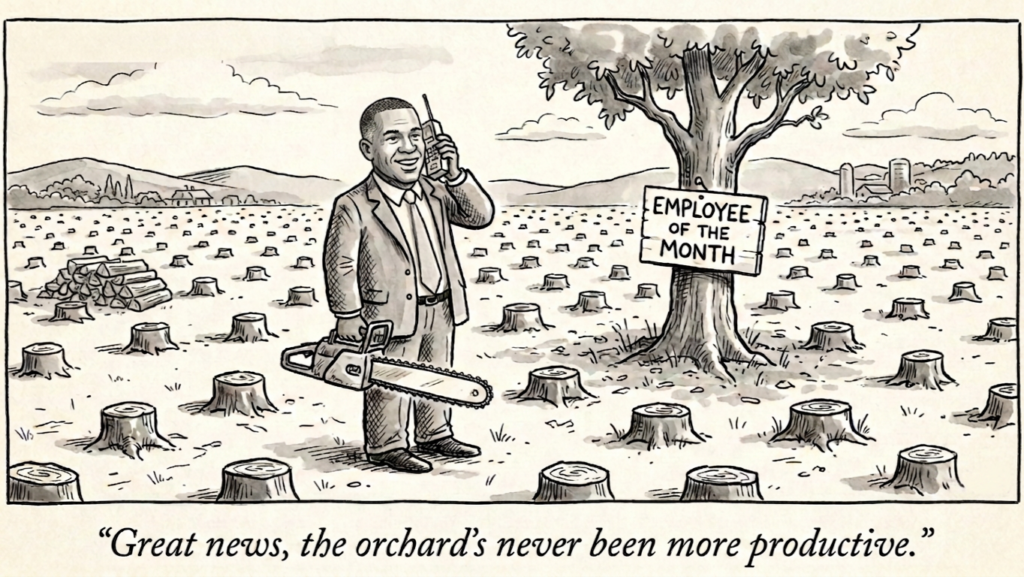
Fortune published a piece this week calling C.H. Robinson an AI success story, which can be found here: https://archive.ph/jEKby. The headline said the company achieved a 45% productivity gain with AI agents and promised to reveal the secrets of its success. I read it the way you read a realtor’s listing for a house where someone died. Everything is technically accurate. The floors are original hardwood. The light is natural. The previous occupants are not mentioned.
I wrote about C.H. Robinson earlier this year. The piece was called “C.H. Robinson’s Orchard.” It told the story of a company founded in 1905 by a produce broker in the Red River Valley, a company that became 100% employee-owned in 1976 and went public in 1997, a company that for most of its history understood that its asset was not a warehouse or a truck or a software platform but the person who picked up the phone and knew the customer’s name. It told the story of what happened when an activist investor named Ancora Holdings put two directors on the board, forced out a company lifer CEO, and installed David Bozeman, a man who had spent thirty years at Harley-Davidson, Caterpillar, Amazon, and Ford, and zero years in freight brokerage, and zero years owning a P&L. It told the story of more than 5,500 people who lost their jobs, many of them meeting or exceeding their targets, some of them fired on the floor in front of their colleagues, while the CEO collected approximately $28 million in total compensation in fiscal 2023, a figure inflated by a $5 million signing bonus and initial equity grants, and told CNBC he was building a new culture and getting the company’s swagger back.
The Fortune piece does not mention any of this. Not the layoffs. Not the 5,500. Not the sales representatives terminated despite meeting their numbers. Not the Glassdoor reviews. Not the employee who wrote that fear is what keeps most people in IT in place. Not the person on TheLayoff.com who said all that remains are twenty-somethings who don’t know better and lifers trying to survive to retirement. None of it. The house has original hardwood floors and the light is natural and the 5,500 former occupants are not mentioned because they would interfere with the staging.
What the Fortune piece does mention is this: the company’s use of AI has resulted in a 45% productivity gain since the end of 2022.
It mentions that the company now deploys hundreds of AI agents across different aspects of its business and that Bozeman is a believer in Lean management. It mentions that agents now deliver quotes to customers, a process that once took human specialists 20 minutes, in just 31 seconds. It mentions that Bozeman is at pains to say his company’s embrace of AI is not about replacing human workers and that the company has been moving specialists into higher-value work. And then, in the paragraph that does the load-bearing work of the entire article, it concedes that there has been “some labor savings” and that Bozeman characterizes this as natural attrition: the business has a turnover rate of 11% to 14% each year, and the AI agents mean the company simply does not have to hire replacements for the people who leave.
Some labor savings. That is what 5,500 people looks like when you hold it at the correct angle and tilt your head.
Some labor savings. Not mass layoffs. Not the deliberate elimination of over half the enterprise sales team in a single day. Not rounds of cuts in November 2022, May 2023, July 2024, and again after that. Some labor savings that happen naturally, the way leaves fall in autumn, the way the wind carries things away, the way you don’t have to fire anyone if you simply make the conditions unlivable enough that they fire themselves and then don’t replace them and call the difference attrition.
The Fortune piece reports that Bozeman says the company is “getting hundreds of millions of dollars of benefit with a token cost of less than $2 million” and that he calls this “a deep, wide moat.”
I believe him. It is a moat. You build a moat by digging a trench around a castle, and the trench is the empty space where something used to be. Five thousand five hundred people used to be there. Now there is a moat. The moat is very wide. It is also very deep. And the people who dug it are on the other side.
“Think about it as ‘supply chain in a box,’” he tells Fortune.
Think about that for a moment. Supply chain in a box. The company that was built on human relationships, on the particular knowledge that a person accumulates over twenty years of calling the same dock managers and knowing which carriers are reliable in January and which ones lie about their reefer units, the company that was once 100% owned by the people who did that work, that company now wants to be a box. A product. A thing you buy off a shelf. The relationships are inside the box, presumably, automated, compressed, and stripped of the names and the handshakes and the trust that took decades to build. The box does not know your name. The box does not ask about your daughter’s soccer tournament. The box delivers a quote in thirty-one seconds and calls the difference a competitive advantage.
Fortune reports that in both the high-value supply chain consulting work and the servicing of more small and midsize businesses, Robinson is hiring more employees, according to Bozeman.
Those workers have AI assistants helping them surface the insights their customers need. This is presented without irony. The company that eliminated more than 5,500 positions is hiring. The company that fired over half its enterprise sales force in a single day is growing. The trick, and it is a trick, is that the people being hired are not the people who were fired. They are new people, cheaper people, people who have never smelled a rotting pallet of produce and do not need to because the AI assistant will surface the insights for them. The institutional knowledge that walked out the door, the twenty years of relationships that a large language model cannot replicate, that knowledge is not being replaced. It is being declared unnecessary. The new hires will rely on the box. The box will rely on the data. The data was generated by the people who were fired. And when the data runs out, when the relationships that fed it decay because no one is tending them, when the customer who used to get a phone call from someone who knew their name starts getting a quote in thirty-one seconds from a system that does not know they exist, the moat will still be there. It will just be on the wrong side.
The company has built almost all of its AI agents in-house using its own models or open-source models.
It employs some 450 engineers, most of whom are steeped in the shipping industry. Four hundred and fifty engineers. Steeped in the shipping industry. Building the tools that replace the people who were steeped in the shipping industry before the engineers were. The engineers are valued because they build the machines. The machines are valued because they replace the people. The people are not valued. That is the sequence. That is the secret of its success. It was always the secret. The Fortune piece just says it out loud, in a room with good lighting, and calls it a case study.
He does not believe in looking at headcount as a measure of performance.
The headcount went from 17,399 to 11,855, a decline of 32% according to the company’s own 10-K filing. He does not issue directives to cut staff. He deployed a methodology. The methodology did the cutting. The methodology is blameless. The methodology is Lean. And Lean, as Bozeman has said, is not just for the manufacturing floor. It is a continuous improvement process that applies to anything. Including, apparently, the number of human beings who are employed.
And what of the people who remained?
According to employees posting on Glassdoor and TheLayoff.com, merit raises were frozen, bonuses were cut, and benefits were diminished while workloads expanded. One employee wrote that Bozeman “picked up a $20 million package and told every employee we cannot receive our earned bonuses.” Multiple posts reference the elimination of annual raises. And the CEO-to-median-employee pay ratio, as disclosed in the company’s 2025 proxy statement for fiscal year 2024, stood at 149 to 1, based on Bozeman’s approximately $8.78 million in total compensation that year. The man who collected $28 million in his first partial year and $8.78 million in his first full year canceled the raises of the people who do the work. The alignment that once ran from the warehouse floor to the shareholder register now runs from the C-suite to the stock price and nowhere else.
I do not blame Fortune for writing the piece. Fortune writes about business, and Bozeman is running a business, and the business metrics are, by the business metrics’ own standards, good. The stock has risen. The margins have expanded. The productivity line goes up and to the right. If you are an analyst at Deutsche Bank or a fund manager at First Eagle, this is what a success story looks like. The inputs were optimized. The waste was eliminated. The moat was dug. The returns were returned.
But I am not an analyst at Deutsche Bank. I am a person who talked to the people on the other side of the moat. And the secret of its success is not AI agents or Lean methodology or open-source models built in-house at a token cost of less than $2 million. The secret of its success is that 5,500 people did the work for twenty or thirty years, built the relationships that generated the data that trained the models that now replace them, and then were removed from the system with the same mechanical efficiency that the system was designed to produce. The AI learned from their labor. The company profited from their absence. And Fortune wrote it up as a case study in getting ROI from artificial intelligence without ever asking the question that sits at the center of the whole arrangement like a stone in a peach:
ROI for whom?
The orchard is still producing fruit. It will produce fruit for a while. The soil remembers what it was fed, even after the roots are gone. But the third season is coming. It is always coming. And when it arrives, Fortune will write a different kind of article, and it will not mention this one, and the secrets of its success will look, in retrospect, like the secrets of a very efficient and very well-documented harvest of a living thing that was mistaken for a machine because the people who were paid to describe it had never been close enough to tell the difference.