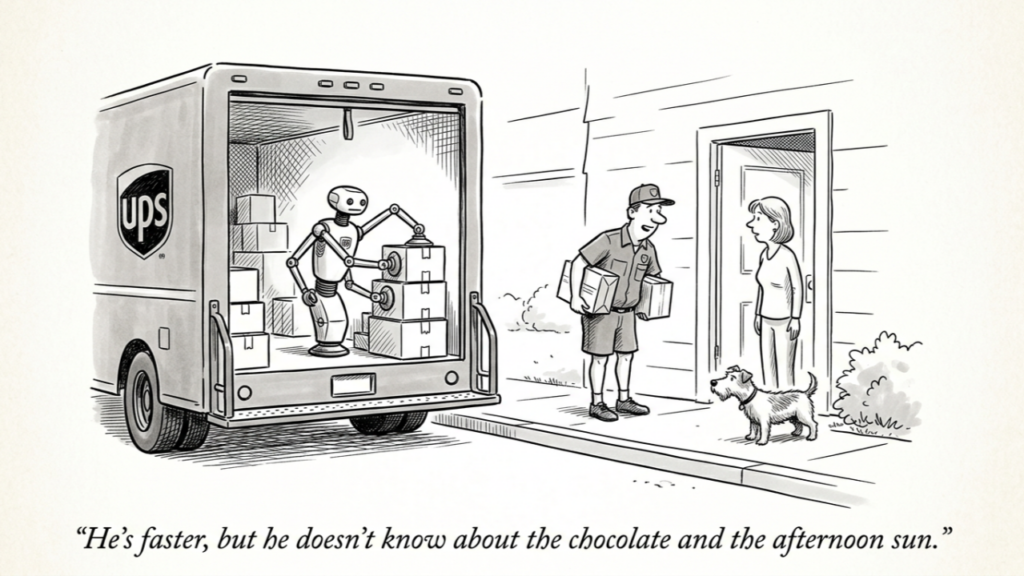
On ownership, belonging, and what happens when the company Jim Casey built measures its future in the people it no longer needs.
On August 28, 1907, in a six-foot by seventeen-foot basement office below a Seattle saloon, a nineteen-year-old son of Irish immigrants borrowed a hundred dollars and started delivering messages. James Emmett Casey had been working since he was eleven. His father, Henry, had come from County Galway, prospected for silver in the Nevada desert, contracted a miner’s lung disease, and died when Jim was fourteen, leaving him as the man of the house. His mother, Annie, held the family together. Jim never forgot that. He and his siblings, George, Harry, and Marguerite, named their foundation after her.
He and Claude Ryan hired six boys. They had two telephones, two bicycles, and nine competitors. They charged fifteen to sixty-five cents per message, depending on distance. His motto, adopted before he had employees enough to fill a room, was simple and has never been improved upon: never promise more than you can deliver, and always deliver what you promise.
He was not a visionary in the way the word is used now, which is to say loudly, with a stage and a slide deck and the performative certainty of a man who has confused conviction with volume. Casey was the opposite. He was shy. He was observant. He disliked personal praise. His office was a small, stark room with a metal desk, several chairs, and a coat tree. He pursued what one biographer called a Spartan business philosophy that emphasized military discipline, drab uniforms, and reliability over flash. In 1916, a new associate named Charlie Soderstrom suggested painting the company’s vehicles brown, a shade modeled after the Pullman rail cars that symbolized class and elegance, a color that also hid dirt. Casey approved. He assigned the same driver to the same route every day so customers could know their driver by name. He believed that seconds saved become minutes over the day and a few minutes each day mean big dollars. He was meticulous about the small things because he understood that the business of delivering packages is nothing but small things, repeated at scale, by people who care enough to do them correctly.
And then he did the thing that made UPS different from every other delivery company in America. He gave his company away.
In 1927, Casey offered stock in UPS at fifteen dollars a share to fifty-two key employees. All but three accepted. The stock could be sold back to the company at a price set quarterly by the board, prices that would consistently rise over the years. This was not a perk. It was not a retention tool. It was the whole philosophy, compressed into a financial instrument. Casey believed, with the particular clarity of a man who had started with nothing and built something through the labor of people he knew by name, that the people who did the work should own the company they were building.
He said it plainly: “The basic principle which I believe has contributed more than any other to the building of our business as it is today, is the ownership of our company by the people employed in it.”
He said it again, in different words, over the decades that followed, because the principle did not change and Casey did not tire of stating it: “Good management is taking a sincere interest in the welfare of the people you work with. It is the ability to make individuals feel that you and they are the company, not merely employees of it.”
You and they are the company. Not merely employees of it. That sentence is the foundation. Everything else, the brown trucks, the global network, the hub-and-spoke system, the airline, the logistics empire that now spans more than two hundred countries, all of it was built on top of that sentence, by people who believed it, because for seventy-two years the sentence was true.
UPS was employee-owned from 1927 until 1999. For seventy-two years, every share of stock in the company was held by founders, their families, employees, and retirees. It became the largest employee-owned company in America. The employee-owner concept was not a line in a corporate brochure. It was the company’s competitive advantage, the thing that made UPS drivers legendary for their discipline and their care, the thing that made loaders show up at two in the morning and sort packages with an intensity that competitors could not replicate, because the competitors’ workers were employees and UPS’s workers were owners, and the distance between those two words is measured in effort, in loyalty, in the particular ferocity that comes when the success of the company is not someone else’s success. It is yours.
The employee-owners could wait. When UPS lost nearly a billion dollars building its European network in the early 1990s, the patient, confident employee-stockholders backed the investment because they were not quarterly traders. They were people who loaded trucks and drove routes and understood that you sometimes lose money for a decade before you make money for a century. FedEx, publicly traded and accountable to impatient shareholders, pulled out of the European market in the 1990s with over a billion dollars in losses. UPS, privately held and accountable to its own people, stayed. The people who owned the company decided the company’s future. That was the whole point.
Casey led UPS for fifty-five years. He continued as the chief executive officer until 1962, when he handed over the reins at age seventy-four. He remained on the board of directors and a leader and inspiration for UPS almost until his death at the age of ninety-five in 1983. He died on June 6, 1983, in a hospital-nursing home in Seattle. He left three legacies: UPS, the Annie E. Casey Foundation, and Casey Family Programs. He had no children. The children he cared about were other people’s children, the foster kids his foundation supported, and the workers he had made into owners.
Sixteen years after Casey died, the company went public.
On November 10, 1999, UPS offered 109,400,000 shares of newly created Class B stock on the New York Stock Exchange at fifty dollars per share, raising $5.47 billion in what was then the largest IPO in American history. The Class A shares, which carried ten votes per share compared to one vote for Class B, remained in the hands of employees and retirees. The architecture was designed to preserve the employee-owner culture even in the public market. The dual-class structure was Casey’s ghost, standing at the door of the stock exchange, trying to keep the speculators out.
It was not enough.
By the time of the IPO, employees and retirees owned approximately two-thirds of outstanding shares. Today, institutional investors hold approximately seventy-two percent. Vanguard is the largest single shareholder. BlackRock is second. Individual insiders, including executives, hold less than one-tenth of one percent. As of December 31, 2025, Class A shares represented only 12.5 percent of outstanding shares. The employee-owner culture that Casey called the most important thing he ever did has been diluted to a rounding error. The people who load the trucks and drive the routes do not own the company in any meaningful sense. Vanguard owns the company. BlackRock owns the company. The index funds own the company. And the index funds do not sort packages at two in the morning.
The company knows this. Or at least, some part of the company remembers. A group calling itself the Casey Way Coalition has formed, uniting Class A shareholders and legacy stakeholders around what it describes as the principles that built United Parcel Service. Its website reads like an elegy: “Service before speculation. Stewardship before short-termism. Ownership as responsibility.” It invokes Casey’s words and asks the company to remember that the people who move the packages and manage the hubs are not separate interests from the people who hold the shares. They are one enterprise. They are supposed to be one enterprise.
The company’s official strategy, as articulated by its current CEO, has a different vocabulary. The strategy is called “Customer First, People Led, Innovation Driven.” The slogan that Tomé herself introduced is “You Belong at UPS.”
You belong at UPS.
The company launched that slogan during Tomé’s tenure. In 2025, it eliminated forty-eight thousand jobs.
Enter Carol Tomé.
Tomé was born Carol Louise Buchenroth in Jackson, Wyoming, on January 8, 1957. She grew up in rural Wyoming, learning to hunt, fish, cook, sew, and live off the land. Her father was a community banker. She studied communication at the University of Wyoming and earned a master’s degree in finance from the University of Denver. She began her career as a commercial lender at United Bank of Denver and spent twenty-four years at The Home Depot, rising to executive vice president and chief financial officer. She retired in 2019. She was on her 550-acre north Georgia farm with her husband, serving on corporate boards, when the UPS board came calling.
She had been a UPS board member since 2003. She was not, in the narrow sense, an outsider. But she was, in every sense that matters, the first non-lifer to lead the company in its history. Every previous CEO had started at UPS and risen through the ranks. Every previous CEO had loaded trucks or driven routes or sorted packages or done the unglamorous ground-level work that Casey insisted his leaders understand from the inside. Tomé had never loaded a truck. She had never driven a route. She had been a CFO at a home improvement retailer and a board member who, by her own admission, dropped into the company four or five times a year and heard what management wanted to tell her.
She told an interviewer she was worried about being rejected, “like a transplant being rejected by the body.” She told another she took the job because the stock price had been flat for about six years and “I think I could get in there and swizzle the business model a little bit and create some value.” She added: “I like to make money. I have a pretty good track record at it.”
Jim Casey’s office was a metal desk and a coat tree. His philosophy was that employee ownership contributed more than any other thing to the success of the company. Carol Tomé’s stated motivation for coming out of retirement was that she could swizzle the business model and create some value. She likes to make money. She has a pretty good track record at it.
I want to be precise about what happened next, because the scale of it deserves precision.
UPS employed approximately 543,000 people at the end of 2020. By the end of 2024, that number had fallen to approximately 490,000. In 2024 alone, the company announced 12,000 job cuts, concentrated in management roles, producing a billion dollars in savings. Then came 2025.
In 2025, UPS eliminated roughly 48,000 jobs, the largest workforce reduction in the company’s 118-year history. Of those, approximately 34,000 were operational positions and 14,000 were management roles. The company closed daily operations at 93 facilities. It increased automation in 57 others. The restructuring saved $3.5 billion.
Then came 2026. UPS announced it would eliminate up to 30,000 additional operational positions, close at least 24 more buildings in the first half of the year, and offer a second voluntary separation program for full-time drivers. The 2026 cuts are projected to save another $3 billion.
The total: approximately 78,000 jobs eliminated in two years. Nearly two hundred facilities closed or slated for closure. Six and a half billion dollars in savings. The company calls it “Network Reconfiguration and Efficiency Reimagined.” It calls it “Network of the Future.”
The network of the future has fewer people in it. That is the point. That is the entire point.
The catalyst, the company will tell you, is Amazon. UPS is reducing the volume of packages it delivers for Amazon by more than fifty percent by mid-2026, because Amazon is not its most profitable customer. Amazon has built its own delivery network that handled 6.3 billion packages in the United States in 2024, surpassing both UPS and FedEx. The volume that Amazon once gave UPS, and that UPS staffed up to handle, is leaving. The people who were hired to handle that volume are leaving with it. This is arithmetic, not cruelty. When the volume goes, the headcount follows. The alternative is paying people to sort packages that are no longer arriving, which is not a strategy. It is a subsidy.
That explanation is true. It is also incomplete. Because the volume reduction accounts for some of the cuts, but the automation accounts for the rest. UPS has committed $9 billion to automation projects across more than sixty facilities, with plans to triple the number of automated buildings to four hundred by 2028. The company is investing $120 million in four hundred robots from Pickle Robot Co., autonomous machines that drive into shipping containers, lift boxes using suction, and place them on conveyor belts. A single robot can unload a typical truck in approximately two hours, replacing a task that traditionally requires four or more workers.
The volume-per-resource ratio, average daily volume divided by U.S. employees, was fifty-one in 2023. UPS wants it to reach fifty-nine by 2026. The denominator is the employee. The way to improve the ratio is to either increase the numerator or decrease the denominator. UPS is doing both: growing volume in higher-margin sectors like healthcare while reducing the number of people required to move it. The robot does not join the Teamsters. The robot does not have a pension. The robot does not need a route that accommodates a school pickup at 3:15. The robot is efficient. The robot is also, in any meaningful sense, a replacement for a human being whose labor Casey said was the foundation of everything.
One employee observed that since Tomé took over, there have been layoffs each year and no growth, and that most managers are not allowed to backfill positions if someone leaves. That is the friction model. You do not fire someone. You make their departure permanent. You close the position behind them like a door that locks from the outside. The work they did is absorbed by the people who remain. The workload is never measured in human terms. It is measured in cost terms. And on the cost ledger, a departure without a backfill is not a loss. It is a saving.
There is a manager somewhere in the UPS network, right now, who is not allowed to interview the people who will work on his dock. They are hired by AI. The algorithm does not know the applicant’s name. It does not know if the applicant will show up early and stay late and care whether the package makes it on time. It knows resume keywords and a willingness to accept the posted wage. Jim Casey used to walk the streets of Seattle and talk to his own drivers to assess the company’s delivery operations. He believed that the manager’s relationship with the worker was the company. The algorithm does not have relationships. It has inputs.
And while the positions were evaporating and the facilities were closing, Carol Tomé’s total compensation for fiscal year 2024 was $24.1 million, representing a CEO-to-median-worker pay ratio of 436 to one. In 2023, her compensation was $23.4 million. The median UPS worker earned approximately $55,000.
Jim Casey’s office was a metal desk and a coat tree. He pursued a Spartan philosophy. He was known for his frugality and minimalism. He gave his wealth to foster children and his stock to his employees. His CEO earned 436 times what his median worker earned. That ratio did not exist in Casey’s time, because Casey’s time was a time when the CEO was an owner among owners, not an executive above employees. The ratio exists now because the company is no longer what Casey built. It is what Casey’s company became after it stopped being owned by the people who built it.
UPS will survive this transformation. It is a company with the most extensive integrated ground and air network in the world. The Network of the Future will be leaner, faster, more automated, more profitable per package, more efficient per dollar of labor. The savings are real. The stock market will approve, because the stock market approves of savings the way an organism approves of nutrition. The savings are the nutrition. The people are the cost.
But there is a coalition of shareholders and retirees in a corner of the internet, people who still hold Class A shares, people who remember what it meant to own the company you worked for, who are trying to remind anyone who will listen that UPS was not built by algorithms and robots and a CFO from a home improvement retailer. It was built by determined men, working together, in a basement below a saloon, with a hundred borrowed dollars and a philosophy that the people who do the work should own the company they are building. The coalition’s name is the Casey Way. Its principles are service before speculation, stewardship before short-termism, ownership as responsibility. It exists because the people who remember the old UPS can see what the new UPS is becoming, and they are trying, with the ten-to-one voting power of shares that represent 12.5 percent of the company, to hold the line.
They are holding the line against a $9 billion automation program. They are holding the line against a CEO who likes to make money. They are holding the line against the index funds that own seventy-two percent of the shares and have never sorted a package in their lives. They are holding the line against 78,000 eliminated positions and 200 closed facilities and 400 robots that can unload a truck in two hours without a pension, without a union card, without the knowledge that the customer on Elm Street needs the package left by the side door because the front porch gets afternoon sun and the chocolate melts.
That knowledge lives in a driver. It has always lived in a driver. Jim Casey knew this because Jim Casey started as a driver. He delivered messages on foot and on bicycle in a city he knew by name, every nook and cranny, every customer and every block. He built a company on the understanding that the person making the delivery was not a cost to be optimized. The person making the delivery was the company. The person was the product. The person’s reliability and care and knowledge of the route was the entire competitive advantage, the thing that made UPS different from every other delivery service, the thing that made a brown truck pulling up to your house mean something.
“You Belong at UPS,” the slogan says. Seventy-eight thousand people have been shown what belonging looks like when the network is being reconfigured and the efficiency is being reimagined and the robots are being deployed and the CEO’s compensation is 436 times what yours was before you updated your LinkedIn profile.
Jim Casey borrowed a hundred dollars and started a messenger service in a basement below a saloon. He hired six boys. He gave them stock. He gave them ownership. He gave them the belief that they were not merely employees of the company but that they were the company, and the company was them, and the distance between those two ideas was zero, because Casey had made it zero, deliberately, as a matter of principle, because he understood something that the spreadsheet has never captured and the algorithm will never learn:
That a company owned by its workers will be defended by its workers. That a company that belongs to its people will have people who belong to it. That the hundred-dollar loan is repaid not in cash but in decades of devotion from people who showed up before dawn and stayed past dark because the company was theirs, and they would no more let it fail than they would let their own house burn.
The house is not burning. The house is being renovated. The renovation is called Network of the Future, and it costs $9 billion, and it replaces people with machines, and the machines are more efficient, and the efficiency is measured in savings, and the savings are measured in billions, and the billions flow to shareholders who have never loaded a truck, never driven a route, never sorted a package at two in the morning while Seattle slept.
The basement is still there. A small park was built on the site where Casey started the American Messenger Company. It has a twenty-two-foot waterfall. The park was completed and dedicated in 1978, when Casey was ninety years old.
The company that grew from that basement now employs roughly 460,000 people, a number that is, by design, declining. The robots are arriving. The facilities are closing. The routes are being consolidated. The drivers are being offered $150,000 to walk away, and the Teamsters are contesting the buyouts, and the buildings are going dark one by one, and in Atlanta, the city where Casey’s company moved its headquarters after he died, a woman from Wyoming is swizzling the business model and creating some value.
Determined men, working together, can do anything. That was the sentence. A banker said the first half, and Casey added the rest, because Casey understood that the working together was the part that mattered. Not the determination alone. Not the individual genius. The togetherness. The ownership. The shared stake in a shared enterprise.
Seventy-eight thousand determined men and women have been separated from the togetherness. Their positions have been eliminated. Their facilities have been closed. Their work has been absorbed by the people who remain, or by machines that do not know their names, or by algorithms that do not know their routes, or by a network that is being reconfigured to be more nimble, quicker, automated, and consolidated.
The network does not know their names.
The basement does not know their names.
And the robots, arriving by the hundred, unloading trucks with suction and silence, do not know that there was ever a time when the people who did the work owned the company they were building, and the company, in turn, belonged to them.