I’ve been circling these questions for a while now. I’ve written about life in Hong Kong as a lawyer who can read the Basic Law aloud, talk openly about democracy, and go on with his day. I responded to Professor Stephen Roach after he cited my argument alongside Hong Kong’s Deputy Financial Secretary and said it made him rethink his thesis. I also wrote a book, Hong Kong Belongs to Hongkongers, about how foreign narratives distort this city, what the maximalists actually did, and who benefited from the destruction. Some of you have read those pieces. Some of you disagreed. Some of you asked better questions than I was ready for.
One question keeps coming back. People want to understand the mechanism. They want to know what the nominating committee actually is, who sits on it, what was actually offered in 2014 and why it was rejected. They want to know why I call the 2019 protests anti-democracy protests when every headline they have ever read says the opposite. They want the details that the Western press left out because the details complicate a simple story and simple stories perform better.
So here are the details.
I am going to tell you something about the 2019 protests that almost nobody in the Western press has ever explained, because explaining it would ruin the story they spent years selling you. The story they sold you is simple. Brave young people wanted democracy. Evil authoritarian government crushed them. Roll credits.
Here is what they left out. The people who claimed to be fighting for democracy are the ones who destroyed Hong Kong’s only real chance at achieving it. And they did it deliberately, unanimously, on camera, in the Legislative Council chamber, on June 18, 2015. Every single one of them voted no.
Let me tell you what they voted against, and let me start with something the Western press has never once made clear.
The Chief Executive of Hong Kong is not the head of a country. Hong Kong is a city. The Chief Executive is, functionally, a mayor. The Western press covered this story as though Hong Kong were electing a president, as though the stakes were national sovereignty and the levers of a nuclear state. They are not. This is a city of seven million people choosing its chief municipal officer. And in the United States, the largest city operating under a council-manager system is Phoenix, Arizona, the fifth-largest city in the country. The person who actually runs Phoenix on a day-to-day basis is not the elected mayor. It is the city manager, an unelected professional appointed by the council. Over 40 percent of American municipalities operate this way. The chief executive of the city is hired, not elected. Nobody calls it tyranny. Nobody writes outraged op-eds about Phoenix’s democratic deficit. Nobody sanctions Arizona. It is simply how that city chooses to be governed, and it works fine. Keep that in mind as you evaluate the hysteria that surrounded Hong Kong’s proposed electoral system.
The nominating committee was not Beijing’s invention in 2014. It was not sprung on anyone. It was not a last-minute bait and switch. It was written into the Basic Law in 1990, seven years before the handover, negotiated between Britain and China, published for the world to read. Article 45 says it plainly. The Chief Executive shall be selected by universal suffrage “upon nomination by a broadly representative nominating committee in accordance with democratic procedures.” Those are the words. They have been there since 1990. Everyone who has ever claimed to care about Hong Kong’s constitution has had thirty-six years to read that sentence.
The Basic Law did not promise unlimited candidacy followed by a popular vote. It never said that. It said universal suffrage upon nomination by a broadly representative committee. The mechanism was always part of the design. The 2014 proposal did not violate the Basic Law. It implemented it. It did exactly what the document always said it would do. And the pan-democrats, the people who wrapped themselves in the language of constitutional rights, rejected the constitution’s own mechanism while claiming to defend it.
In August 2014, the Standing Committee of the National People’s Congress issued a decision on electoral reform. The proposal was straightforward. For the first time in the city’s history, not the first time since 1997, the first time ever, the Chief Executive would be elected by universal suffrage. Five million people would vote. Every eligible resident would cast a ballot. The candidates would first be vetted by the nominating committee of 1,200 members that the Basic Law had always specified, drawn from four sectors: industrial and financial interests, the professions, labor and social services and religious organizations, and political representatives including legislators and Hong Kong delegates to national bodies. That committee would nominate two or three candidates. Then the public would choose.
That is what was on the table. A real vote, for a real leader, by millions of real people, through the exact mechanism the Basic Law had described since before the handover occurred. A vote for a mayor, through a process more transparent than the one Phoenix uses to hire the person who actually runs their city.
Now let me tell you what people do not understand about nominating committees, because Western commentators talk about this system as though it were some alien authoritarian invention, as though no democracy on earth filters candidates before the public gets to vote.
Every democracy on earth filters candidates before the public gets to vote. And there are very good reasons for this.
Think about what unlimited universal suffrage actually means if you take it literally. It means anyone can run. No threshold. No signatures. No party endorsement. No nominating mechanism of any kind. A city of seven million people, and anyone who wants to be on the ballot is on the ballot. You would have dozens of candidates, possibly hundreds. The ballot paper becomes a phone book. Voters cannot research them all. Media cannot cover them all. Debates become impossible. Fringe candidates with extreme positions and small but fanatical followings win pluralities of eight or nine percent in a fragmented field. Spoiler candidacies become a weapon. Well-funded extremists flood the ballot to split the vote of their opponents. Foreign-backed candidates enter the race specifically to destabilize. Joke candidates delegitimize the process. The winner governs with a mandate so thin it barely constitutes consent.
This is not theoretical. This is why every functioning democracy in the world has developed filtering mechanisms. Not because they hate freedom. Because unlimited candidacy does not produce good governance. It produces chaos, and chaos produces either paralysis or authoritarianism, usually the latter.
In France, you cannot run for president unless you collect 500 signatures from elected officials spread across at least 30 departments. That is not a popular threshold. That is a gatekeeping mechanism controlled by the political class. If the mayors and council members of France decide you are not a serious person, you do not appear on the ballot. Period.
In the United States, the filtering is even more aggressive, it is just hidden behind a curtain of money. Before a single primary ballot is cast, before a single debate is held, candidates must raise hundreds of millions of dollars. That money comes from a donor class concentrated in Manhattan and Greenwich, Connecticut and Silicon Valley, from people whose names the public never learns, who hold private fundraisers in rooms the public never enters, who expect returns on their investment and receive them regardless of which party wins. If you cannot secure that money, you do not exist. You do not get media coverage. You do not make the debate stage. You do not appear on the ballot in any meaningful sense. The American primary system is a nominating committee. It just does not call itself one.
In the United Kingdom, you vote for whoever your local party lets you vote for. Candidate selection happens inside party machinery the public does not control and largely does not see. The whip system determines who speaks and how. The party leader is chosen by internal processes that vary by party and change when convenient. The public’s role is to ratify choices already made by people in rooms.
In Germany, parties control ballot access through internal nomination. In Japan, faction politics within the ruling party determines who leads the country, and the public votes for the party. In Israel, party lists are assembled by leadership and the voter chooses among pre-assembled slates.
No country in the world has unlimited universal suffrage in the sense that any person can simply declare themselves a candidate and appear before the electorate with no filtering whatsoever. It does not exist. It has never existed. And it has never existed because it would not work. The question in every democracy is not whether candidates are filtered. The question is how, by whom, and whether the filtering is visible or hidden.
Hong Kong’s Basic Law answered that question in 1990. It said the filtering would be done by a broadly representative nominating committee. The 2014 proposal implemented that answer. It named the committee. It defined the sectors. It published the membership. It put the mechanism in the open where anyone could see it and criticize it and push for its reform over time. That is more transparent than what happens in the United States, where the filtering operates through private money in private rooms with no public accountability whatsoever.
The pan-democrats called it fake democracy. They said a vote among vetted candidates was not a real vote.
By that standard, no country on earth has real democracy. By that standard, France is fake because the mayors filter candidates. America is fake because the billionaires filter candidates. Britain is fake because the parties filter candidates. If the mere existence of a nominating mechanism renders an election illegitimate, then every election that has ever been held in any country at any time in human history is illegitimate, because all of them involved some form of filtering. And if the specific mechanism written into your own constitution renders the election illegitimate, then you are not a constitutionalist. You are a revolutionary who has decided the constitution is wrong. Which is fine, but do not pretend you are defending the Basic Law while rejecting the very mechanism the Basic Law prescribes.
Twenty-seven pan-democratic legislators voted against that proposal. Not a single one broke ranks. Not a single one said, this is imperfect but it is a start, let us establish the practice of popular voting and build pressure for further reform over time. Not one. The unanimity was absolute. The movement that claimed to speak for democracy could not tolerate internal democratic debate about its own strategy.
I know the counterarguments. I have heard them for years. Let me go through them honestly.
The first and most common is that the nominating committee would never have allowed a genuine opposition candidate through. The threshold required a candidate to receive majority support from the committee, and the committee’s composition leaned pro-Beijing, so the argument goes that the public would be choosing between two or three candidates who were all, functionally, Beijing’s picks. A menu with no real choices. That is the strongest version of the objection and I take it seriously.
But here is what it ignores. The committee had 1,200 members across four sectors. It was not a rubber stamp of seven people in a back room. Getting a majority of 1,200 people to coalesce around a candidate requires coalition building, negotiation, public pressure.
And here is the part nobody ever tells you. The committee was not appointed by Beijing. The overwhelming majority of its members, over a thousand of the 1,200, were elected. Thirty-five of the 38 subsectors returned their members through elections with registered voters. Over 230,000 eligible voters participated in those subsector elections. Only 60 seats were filled by nomination (the religious subsector) and 106 were ex officio. The rest were contested. Pan-democrats ran in those elections. They won. In 2016 they took 325 seats, a record quarter of the entire committee, including clean sweeps in the legal, education, higher education, health services, IT, and social welfare subsectors. Benny Tai himself, the Occupy Central co-founder, led a slate that won all 30 higher education seats. The man who organized the movement to reject the nominating committee won election to the committee. The people who told you this was a rubber stamp were sitting on it. They competed for seats on it, they won seats on it, and then they told the world it was an illegitimate body that could never allow a genuine candidate through. That is not principle. That is strategy dressed as principle.
The professional sector included lawyers, academics, doctors, accountants, people with reputations and constituencies of their own. The assumption that no moderate, no centrist, no figure acceptable to both the committee and the public could ever emerge requires you to believe that 1,200 people from different walks of life would vote in perfect lockstep forever with no internal disagreement and no responsiveness to public opinion. That is not how committees of that size behave anywhere in the world. It is a projection of what might happen, treated as a certainty, used to justify rejecting the entire system before it was tried even once.
And there is something else. The composition of the nominating committee was not fixed by divine law. It was set by local legislation, subject to future reform. You fight for a better committee after you establish the principle of universal suffrage. You do not reject universal suffrage because the committee is imperfect in its first iteration. That is backwards. That is burning the house because you do not like the curtains.
The second argument is the ceiling theory. Accept this offer and it becomes permanent. Beijing will point to it and say, you have universal suffrage, what more do you want. There will never be another reform because the pressure disappears the moment people start voting.
This is a reasonable fear. It is also unprovable and ahistorical. Democratic expansion has never worked that way anywhere. Once people vote, they do not become passive. They become more demanding. The franchise in Britain expanded over a century, each expansion creating pressure for the next. American suffrage expanded from white male landowners to all adults over 150 years of incremental change, each step building momentum rather than killing it. The idea that voting makes people complacent is refuted by the entire history of democratic development. Voting is a muscle. The more you use it, the stronger it gets. The more people participate, the more they expect their participation to matter, the harder they push for it to matter more.
And consider the alternative. They rejected the offer. Did that create more pressure for reform? Did standing firm produce a better proposal? The answer is in front of you. The answer is the 2021 electoral overhaul, which made the system more restrictive than anything that existed before 2014. The ceiling theory says accepting a flawed offer locks you in forever. Reality says rejecting a flawed offer can lock you out entirely. Which happened? We do not need to theorize. We have the data.
The third argument is legitimacy. A vote among pre-filtered candidates gives Beijing democratic legitimacy it does not deserve. The world would look at Hong Kong and say, see, they vote, they are free, and the conversation about genuine self-determination would end.
This argument treats the people of Hong Kong as props in someone else’s narrative rather than as citizens with agency. Five million people voting is not a propaganda exercise. It is five million people making a choice. The choice might be constrained. The options might be limited. But the act of voting, of standing in a line and marking a ballot and having that ballot counted, is not nothing. It is not theater. Ask anyone who has never been allowed to do it. Ask anyone who risked their life to do it. The pan-democrats looked at five million people and said, your vote would only serve Beijing’s narrative, so we will not let you cast it. They treated the public as instruments of a messaging strategy rather than as people with a right to participate in governance however imperfectly.
And there is a deeper irony. The people making the legitimacy argument were themselves elected under an imperfect system. The Legislative Council that voted no in 2015 was itself the product of a partially democratic arrangement, with functional constituencies and geographic constituencies and a structure no one would design from scratch. Those twenty-seven legislators held power through a system they considered flawed. They did not resign their seats in protest. They used the flawed system to block the public from getting any system at all.
And here is what happened next. The 2017 Chief Executive election proceeded under the old system, selection by the 1,200-member Election Committee with no popular vote at all. The thing they rejected was not replaced by something better. It was replaced by nothing. And then it was replaced by something worse, because after 2019, Beijing restructured the entire electoral system in ways that make the 2014 proposal look like a dream of radical freedom by comparison.
The maximalists demanded everything. They received nothing. Then they received less than nothing. That is the legacy of the anti-democracy protests.
I wrote about this in Hong Kong Belongs to Hongkongers at length. I traced the sequence year by year. The rejection in 2015. The oath-taking crisis of 2016, when elected legislators used their swearing-in ceremony to display banners reading “Hong Kong is not China” and insert obscenities into their oaths. The foreign trips. Joshua Wong in Washington in September 2019, flanked by American flags, with Marco Rubio presiding, asking a rival superpower to sanction his own city. The airport shutdowns. The petrol bombs, over a thousand of them. The storming of the Legislative Council. And then the National Security Law in 2020, the one Hong Kong was constitutionally required to pass itself under Article 23 and never did for seventeen years.
That is not a timeline of unprovoked aggression. That is a timeline of escalation with identifiable decision points where different choices would have produced different outcomes. I have written about this before. I am not going to rehash every detail here. But I want to focus on something I have not fully explained in prior pieces, because it is the thing that makes the whole Western narrative collapse.
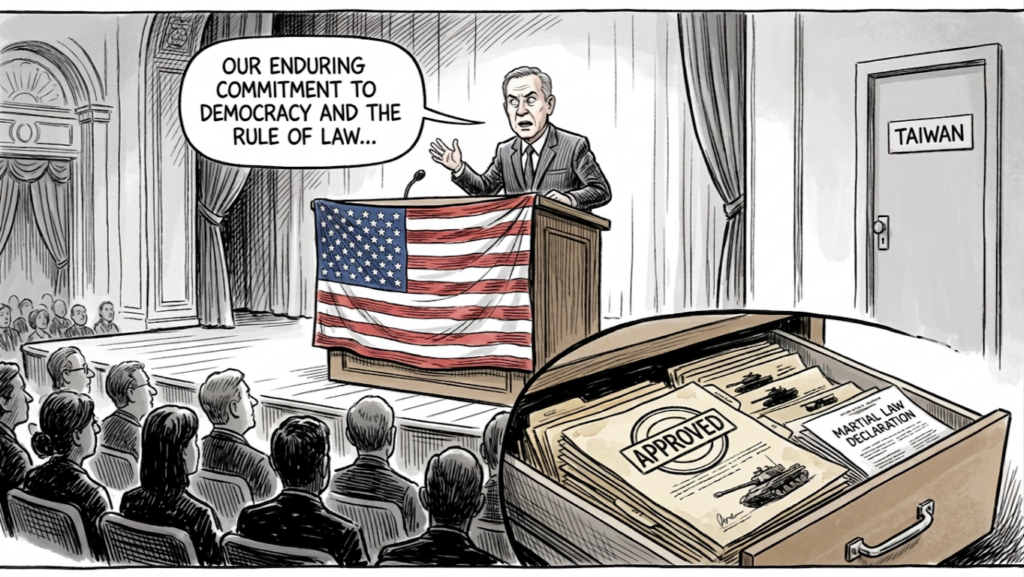
Now let me tell you something about Taiwan, because this is where the hypocrisy becomes so thick you could choke on it.
Taiwan was a military dictatorship until 1987. Martial law was declared in 1949 and maintained for 38 years, one of the longest periods of martial law in modern history. During that time, the Kuomintang government ran what is known as the White Terror. Estimates vary, but thousands were executed. Tens of thousands were imprisoned. Political dissent was crushed. Opposition parties were banned. The press was controlled. People disappeared.
The February 28 Incident of 1947 saw government troops massacre thousands of Taiwanese civilians, estimates range from 18,000 to 28,000 dead, and the repression that followed continued for decades. Intellectuals, lawyers, students, journalists, anyone suspected of disloyalty to the regime faced imprisonment or death.
And during all of this, every single year of it, the United States was fine with it.
Not just fine. The US signed a Mutual Defense Treaty with Taiwan in 1954, right in the middle of the White Terror. American military aid flowed. American economic support poured in. American diplomatic recognition continued. The same country that now lectures Hong Kong about democracy spent decades propping up a military dictatorship in Taiwan that was executing its own citizens for political speech, and it did so happily, because that dictatorship was anti-Communist and therefore useful.
Taiwan did not hold a direct presidential election until 1996. That is not ancient history. That is within the lifetime of anyone reading this over the age of thirty. The United States supported Taiwan through nearly five decades of authoritarian one-party rule, and during none of those decades did Washington express the kind of outrage about Taiwan’s lack of democracy that it now expresses about Hong Kong.
The concern arrived at the exact moment Beijing became involved. That is not a coincidence.
Hong Kong under British rule never had democracy. Not once in 156 years. The Governor was appointed by London. The Legislative Council was appointed by the Governor. When Britain ratified the International Covenant on Civil and Political Rights in 1976, it entered a specific reservation for Hong Kong, carving this city out of the article guaranteeing the right to vote in genuine elections by universal suffrage. Britain looked at a treaty that said all people have the right to choose their government and said yes, we agree, except those people over there.
Taiwan under the KMT never had democracy. For 38 years of martial law, there were no free elections, no opposition parties, no freedom of speech, no due process for political dissidents.
And the United States was fine with both. For decades. Without complaint.
The outrage about Hong Kong’s democratic shortcomings appeared the moment Beijing entered the picture. The outrage about Taiwan’s democratic shortcomings never appeared at all, because the dictator was Washington’s friend.
I am not saying these histories excuse anything happening today. I am saying that the people who lecture Hong Kong about democracy have a credibility problem so vast it could swallow the Pacific Ocean. I am saying that the moral authority they claim does not exist. I am saying that when American politicians sit in congressional hearing rooms and talk about Hong Kong’s freedom as though it were a sacred cause, they are speaking from a country that backed a White Terror for four decades and called it an ally.
And while we are on the subject of what the Western narrative leaves out about China, let me tell you something else that never makes it into the story. Because the story requires a cartoon villain, and cartoon villains are not allowed to have accomplishments.
Over the past forty years, China has lifted close to 800 million people out of extreme poverty. That is not my number. That is the World Bank’s number, published repeatedly, verified by an institution nobody accuses of being a mouthpiece for Beijing. Eight hundred million people who were living on less than two dollars a day now are not. China accounted for roughly three quarters of all global poverty reduction during that period. Three quarters. The single greatest reduction in human misery in recorded history, accomplished by a government that Western commentators describe as though its only function is oppression.
China built a universal medical insurance system that now covers approximately 95 percent of its population, over 1.3 billion people. Twenty years ago, coverage was around 13 percent. They went from one in ten to nearly everyone in two decades. The system is not perfect, out-of-pocket costs remain a problem in some areas, rural coverage is thinner than urban coverage, but the trajectory is unmistakable. A bulk drug procurement program launched in 2018 has cut pharmaceutical prices by more than half on average. Inpatient reimbursement rates within the policy scope sit at around 70 percent. Compare that to the United States, where medical debt is the leading cause of personal bankruptcy, where insulin prices became a political crisis, where tens of millions went uninsured for decades and millions still do, where a single ambulance ride can cost more than a month’s rent.
China’s labor law caps the standard workweek at 40 hours. Overtime is limited to 36 hours per month, with mandatory premium pay at 150 percent on regular days, 200 percent on rest days, and 300 percent on statutory holidays. In 2025, regulators launched a public enforcement campaign against the old 996 culture, nine to nine, six days a week. Major companies including Tencent and Midea responded by setting hard departure times for employees. Are these protections perfectly enforced everywhere? No. Enterprise employees still averaged close to 49 hours per week in 2024. But the legal framework exists, it is being actively enforced, and over 1.6 million labor arbitration cases were accepted in 2024 alone, which tells you the system has teeth and workers know how to use it. Compare that to the United States, where there is no federal cap on weekly hours for salaried workers, where overtime protections have been gutted for white-collar employees, where the phrase “exempt employee” means your employer can work you seventy hours a week with no additional compensation and call it legal.
And then there is housing. Rent in China is roughly 74 percent cheaper than in the United States. A one-bedroom apartment in a Chinese city center averages around 400 dollars a month. In an American city center, the same apartment averages over 1,600 dollars. In Beijing, China’s capital, a city center one-bedroom runs between 870 and 2,100 dollars. In San Francisco, it is 3,400 dollars. In Los Angeles, the citywide median is over 2,000 dollars. China treats housing as infrastructure. They build it directly, at scale, with government involvement. Construction that takes three to four years in America gets done in twelve to eighteen months in China because less time means less financing cost and less financing cost means lower rent. The United States treats housing as an investment vehicle first and shelter second. The results speak for themselves.
China also operates what is now the largest social security system in the world. It has a two-tier pension structure covering both urban workers and rural residents. The system expanded dramatically between 2009 and 2013, tripling the number of people covered, and by 2020 it had achieved functionally universal coverage of its first-tier basic insurance schemes. Employers contribute up to 16 percent of earnings toward the basic pension. Employees contribute 8 percent to individual accounts. In 2024, China raised its statutory retirement age for the first time, phasing in gradual increases, a reform that reflects the system’s maturity rather than its absence. Is the system fully funded to provide generous benefits? Not yet. The rural pension remains modest. But it exists, it covers over a billion people, and it was built from nearly nothing in under three decades. Compare that to the United States, where Social Security’s trust fund faces projected shortfalls, where private retirement savings are a luxury half the workforce cannot afford, where the median retirement account balance for working-age Americans would not cover six months of expenses.
None of this means China is perfect. It is not. None of this means there are no legitimate criticisms of how the country is governed. There are. But the Western narrative requires you to believe that 1.4 billion people live under a government that does nothing for them, that offers them nothing, that exists solely to restrict and punish. That narrative is not just incomplete. It is delusional. A government that lifts 800 million people out of poverty, insures 95 percent of its population, caps working hours, builds affordable housing at scale, and constructs a pension system covering a billion people in three decades is a government that, whatever else you say about it, is delivering material improvements to the lives of its citizens at a pace and scale that the United States has not matched in living memory. And when American politicians lecture China about governance while presiding over a country where medical bills bankrupt families, where housing costs consume half of take-home pay, where retirement is a fantasy for the working class, and where life expectancy is actually declining, the credibility gap is not subtle. It is a canyon.
That is context the Western press never provides, because providing it would complicate the story. And the story must remain simple. Good versus evil. Freedom versus tyranny. Us versus them. No room for a government that does terrible things and extraordinary things simultaneously, because that describes every government that has ever existed including the ones telling you to be outraged.
The 2014 proposal was not perfect. The nominating committee was weighted toward pro-Beijing interests. Critics were right about that. But the vote would have been real. Five million people choosing their mayor, for the first time in Hong Kong’s history, for the first time in any configuration of governance this city has ever known. A foundation to build on. A democratic practice to establish. A foot in the door that could have been widened over successive cycles, the way it has been widened in every country where democracy actually took root.
Instead, twenty-seven legislators decided that imperfect democracy was worse than no democracy at all. They made that choice for five million people. They did not hold a referendum. They did not ask the public. They decided, in a bloc, unanimously, that the people of Hong Kong should not be allowed to vote for their leader because the mechanism was not pure enough for their standards.
Think about the irony of that for a moment. The democracy advocates denied the public a vote because the vote did not meet their definition of democratic. They disenfranchised five million people in the name of enfranchisement. They blocked universal suffrage in the name of demanding universal suffrage. And then they called themselves the pro-democracy camp.
I do not believe Beijing has given up on democracy for Hong Kong.
I know how that sounds. I know the Western press has told you the opposite for years. I know the narrative says it is over, finished, that the promise was always hollow and now it has been formally abandoned. But I am a lawyer, and I read documents, and the document that governs this city has not changed on this point.
The Basic Law says the ultimate aim is universal suffrage. It also says the path toward that aim shall proceed “in light of the actual situation” and through “gradual and orderly progress.” Those are the words. Gradual. Orderly. In light of the actual situation.
The actual situation in 2014 was a city being offered its first popular vote. The actual situation in 2019 was a city on fire, with petrol bombs in the streets, foreign flags in the legislature, and its most prominent activists in Washington asking a rival superpower to impose sanctions on their own home. The actual situation in 2020 was a city that had never passed the national security legislation it was constitutionally required to pass under Article 23, after seventeen years of delay. The actual situation changed. And when the actual situation changes, the timeline adjusts. That is what “gradual and orderly” means. It means the pace depends on conditions. It means if you burn the conditions down, the pace slows.
The British had 156 years. They did not try once. Not a single proposal for universal suffrage in a century and a half of colonial rule. Not a whisper, not a white paper, not a consultation exercise. Zero. When they finally introduced limited electoral reforms under Chris Patten in 1992, the handover was already five years away. They had waited until it was someone else’s problem.
Beijing tried within seventeen years of the handover. Seventeen years, and there was a concrete proposal on the table, with a mechanism, a timeline, a specific election date in 2017. Say what you want about the nominating committee, say it was imperfect, say it favored pro-Beijing interests, all of that is fair. But Beijing put universal suffrage on the table within seventeen years. Britain did not put it on the table in 156 years. If you want to know who was more serious about democracy for Hong Kong, look at the timeline. The timeline does not lie.
And I believe they will try again. Not tomorrow. Not next year. Maybe not this decade. But the incentive has not disappeared. It has only been complicated by the people who rejected the last offer and then set the city on fire.
Here is why Beijing still wants this. It is not charity. It is not ideology. It is strategy, and it is good strategy.
Hong Kong is Beijing’s bridge to Western capital markets. It is the only city under Chinese sovereignty that operates a fully convertible currency, an independent common law judiciary, and a regulatory framework that global investors trust. Billions flow through Hong Kong every year because international finance trusts the system. That trust rests on the perception of autonomy. The perception of autonomy rests on One Country, Two Systems actually meaning something. A democratic Hong Kong, one where leaders are chosen by popular vote within a framework Beijing can live with, strengthens that perception enormously. It tells the world that this city governs itself, that its institutions are real, that your money is safe here because the people who run this place answer to the people who live here.
A Hong Kong that is perceived as just another mainland city loses that function. The money moves to Singapore. The arbitration moves to London. The listings move elsewhere. Beijing knows this. Beijing is not stupid.
But there is something bigger than capital markets. There is Taiwan.
I wrote about this in Hong Kong Belongs to Hongkongers and in the Roach response, and I will say it again because it is the single most important geopolitical point that Western coverage consistently ignores. Beijing’s single most important long-term objective is reunification with Taiwan. The only peaceful path to that objective runs directly through Hong Kong. If One Country, Two Systems produces a genuinely autonomous, prosperous city with meaningful democratic participation, Taiwan has a model. Taiwan has proof that sovereignty can coexist with local self-governance. Taiwan has evidence that Beijing keeps its word. That is not a military argument. It is not a threat. It is an advertisement, and it is the most powerful advertisement Beijing could possibly make, because it is a living, breathing, functioning example that twenty-three million Taiwanese can observe in real time.
A democratic Hong Kong is not a threat to Beijing. It is one of the most strategically valuable things Beijing could possess. Every year that Hong Kong functions well under this formula, the case for peaceful reunification strengthens. Every year that Taiwan watches Hong Kong thrive, the independence argument weakens. Beijing does not need to invade Taiwan if it can persuade Taiwan. And the most persuasive thing it could ever do is demonstrate, through Hong Kong, that the deal works.
The maximalists destroyed that demonstration. They rejected the vote. They escalated until Beijing responded with exactly the heavy hand that proves the independence movement’s point. They handed Taiwan’s separatists their best argument on a silver platter. They set back the cause of peaceful reunification by a generation. And they set back democracy in Hong Kong by God knows how long, because the conditions for “gradual and orderly progress” now look nothing like they looked in 2014.
The Western media sold Hong Kong a bill of goods. They told young people that maximalism was principle. They told them that rejecting an imperfect offer was brave rather than catastrophic. They told them that the world was watching and would protect them from consequences, and then the world watched the consequences arrive and moved on to the next story. The journalists who cheered the protests from the safety of foreign bureaus kept their jobs. The politicians who passed resolutions of support kept their seats. The think tank fellows who advocated confrontation published new papers about Taiwan. The activists who testified before Congress are serving prison sentences or living in exile.
The media did not pay the price. Hong Kong paid the price. And the price was democracy itself, set back by the very people who were selling you the story that they were fighting for it.
I believe it will come back. I believe the Basic Law means what it says. I believe Beijing’s strategic interests still point toward a more democratic Hong Kong, eventually, when the conditions allow, when the actual situation permits gradual and orderly progress to resume. I believe this because I read the document, because I understand the incentives, and because I have watched enough history to know that timelines bend but constitutional commitments do not simply vanish.
But it will take longer now. It will take longer because of the people who were supposed to be fighting for it. And it will take longer because Western media told a generation of Hong Kong’s brightest young people that burning things down was the path to freedom, and those young people believed them, and now some of them are in prison and some of them are in London and the city they left behind is picking up the pieces.
That is what the Western press did to Hong Kong. They did not fight for democracy here. They set democracy back. And they did it while telling you they were helping.
The Basic Law has not been amended. Articles 45 and 68 still say what they have always said. The promise of universal suffrage remains in the text. The path is longer now. The people who made it longer are the ones who told you they were clearing the way.
Twenty-seven legislators voted no.
Five million people never got to vote at all.
That is the legacy. Everything else is commentary.
— Author’s Note —
I do not usually plug my services as a lawyer, my writings as a Lodestar Premium columnist, or my books. But if this subject interests you, if you have been reading the mainstream version of this story for years and something never quite added up, you would like Hong Kong Belongs to Hongkongers. It offers a view you will not find anywhere else, not because the facts are hidden, but because nobody with a Western platform had any incentive to assemble them in this order. I wrote it for the people who suspect the story they were told was too simple but never had someone walk them through exactly where it broke down. It is not a comfortable book. It does not let anyone off the hook, not Beijing, not London, not Washington, and not the maximalists who claimed to speak for a city they helped destroy.