On alphabets, tempo, and the particular arrogance of fixing something that was never broken.
I heard the song wrong.
Not wrong in the way you hear a song wrong when you mishear a lyric and spend twenty years believing the line is something it isn’t, which is a private wrong, a wrong that lives inside you like a benign cyst until someone punctures it at a dinner party and you have to sit there, forty-three years old, absorbing the fact that you have been singing the wrong words since Reagan was president and nobody loved you enough to say so. Not that kind of wrong.
I heard it wrong because it was wrong.
I heard it wrong because it was wrong. Because someone had changed it. Because a man named Matt, a single person, one man with a YouTube channel called Dream English Kids, had decided in 2012 that the alphabet song, the one that every English-speaking child on earth has been singing since 1835, needed to be fixed. Not a curriculum board. Not a committee. Not a team of developmental psychologists in a windowless room with a federal grant and a whiteboard. One man. Named Matt. Who made a video.
I was in a café in Wan Chai. Not a cha chaan teng. One of the newer places, the kind with exposed concrete and a menu that lists the origin country of each coffee bean as though the bean’s passport is part of the experience. A woman at the next table was on a video call with a child. The child was singing the alphabet.
I was not listening. But the alphabet song is one of those pieces of music that bypasses the conscious brain entirely. You don’t decide to listen to it. It enters you the way a siren enters you, or a car alarm. The alphabet song is not a song you hear. It is a song you have. It has lived in you since you were four years old, sitting on a carpet in a room that smelled like paste and apple juice, singing it with thirty other children who also didn’t know what the letters meant but who knew, with absolute certainty, how fast the middle part went.
The middle part. LMNOP. Elemenopee.
The middle part. LMNOP. Elemenopee. The part that was not four letters but one word, one glorious, indivisible, runaway word that you sang at full speed because the melody demanded it, because the song accelerated there the way a rollercoaster accelerates at the drop, and you held on and you got through it and you landed on Q with the relief of a person who has survived something. And you had. You had survived elemenopee. It was the first thing you ever survived, and it mattered.
The child in the café did not sing elemenopee.
The child sang L. M. N. O. P.
The child sang L. M. N. O. P. Five separate letters. Five separate beats. Each one given its own small, tidy room in the song, as though the letters were being onboarded individually, each one welcomed and oriented and shown where the bathroom is before the next one arrives. The whole second half of the alphabet had been flattened, the tempo equalized, the peaks and valleys ironed out until the song was less a song and more a list, a spoken-word inventory of twenty-six items delivered at the pace of a man reading license plate numbers to a police dispatcher.
I went home. I told Ruth.
“They slowed it down,” I said. “The alphabet song. The LMNOP part. Each letter is separate now.”
“Why?”
“Because children were confused. They couldn’t distinguish the individual letters.”
Ruth considered this the way a structural engineer considers a load-bearing wall.
“Were you confused?” she asked.
“No.”
“Was anyone confused?”
“Every child on earth was confused. For about six months. And then they weren’t. That was the whole point.”
So they fixed something that fixes itself.
“So they fixed something that fixes itself.”
Ruth went back to her phone. The conversation was over. She was right. She is always right. That is the problem with being married to a woman who is always right in a city that agrees with her. I have no allies. I have a laptop and no allies and a song that no longer sounds like the song I learned.
Here is what Matt did.
He slowed down the LMNOP. He gave each letter its own beat, its own visual moment on screen, so that no child would ever again believe that elemenopee was a single letter, which, according to Matt, was a thing that was happening. Children were watching the letters fly past and concluding that the five fastest letters in the song were, in fact, one letter, a super-letter, an elemenopee, and Matt decided this was a problem. He also removed the word “and” between Y and Z, because apparently “Y and Z” sounded too much like “Y, N, Z,” which added a phantom twenty-seventh letter to the alphabet that did not exist and was confusing children who were already, per Matt’s diagnosis, confused enough.
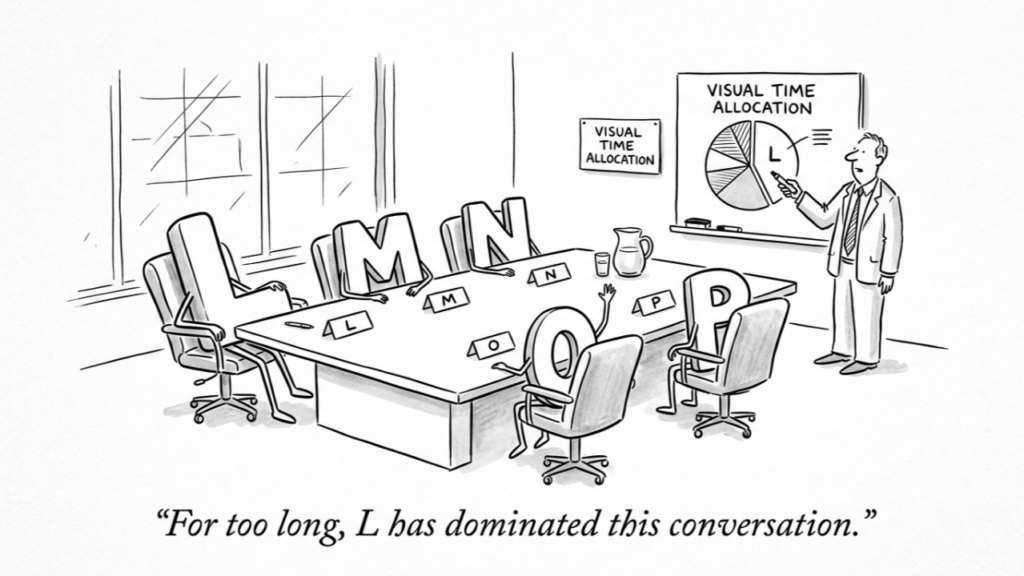
He said he just wanted each letter to have equal visual time.
He said he just wanted each letter to have equal visual time. Equal visual time. As though the letters were employees and the song was a meeting and L had been dominating the conversation while O sat in the corner, unseen, unheard, its contributions buried in the blur of elemenopee. Matt gave O its moment. Matt gave every letter its moment. And in doing so, Matt destroyed the only moment in the song that mattered, which was the moment when all five letters stopped being individual and became something bigger, something faster, something that a four-year-old could not control but could survive.
The video sat on YouTube for seven years. Nobody noticed. Nobody cared. And then, in 2019, it went viral, because someone found it and shared it and the internet, which has strong opinions about things that do not matter and no opinions about things that do, lost its collective mind. Matt received so much hate mail that when NPR interviewed him, he asked them not to use his last name. NPR granted him anonymity. Anonymity. For changing the alphabet song. A man went into something resembling witness protection because he adjusted the tempo of a song for preschoolers. This is either the most disproportionate response in the history of human communication or exactly the right response, and I have not yet decided which, and I am not sure I need to.
Then it happened again in 2024. A first-grade teacher posted herself singing the new version on Instagram. The video got more than ten million views. The comments were not kind. The debate, such as it was, had not been resolved in the five years since the internet first discovered the change, because this is not a debate that resolves. This is a debate about something people carry in their bodies, in their muscle memory, in the place where rhythm lives and where rhythm, once learned, does not accept amendments.
Ms. Corrigan taught first grade at Hoosac Street School in Adams, Massachusetts, in a classroom that had a piano and a carpet where twenty-two children sat every morning and sang. She did not slow the song down. She never explained why the middle part was fast. She didn’t need to. The song explained itself. You sang it. You hit the fast part. You stumbled. You tried again. You got it.
And when you got it, you had done something. Not something large. Not something anyone would celebrate or document or scan with a QR code. But something. You had navigated a small, fast, confusing thing, and you had come out the other side knowing the letters, yes, but also knowing something else, something that no curriculum committee and no man named Matt has ever put on a whiteboard: that some things in life come at you faster than you’re ready for and you just have to open your mouth and go.
Elemenopee was the first time the world didn’t slow down for you.
Elemenopee was the first time the world didn’t slow down for you. And you handled it. You were four, and you handled it.
Now the song waits for you, patiently, the way a moving walkway waits for you, the way an automated checkout explains each step as though you have never before encountered the concept of placing an item in a bag. The song has been made accessible, clear, easy. And in the making of it easy, something has been taken from it that I am not sure Matt understands he took, because it was not on his screen. His screen had metrics. Letters per second. Visual time per character. A child confused N with M. The confusion was a problem. The problem required a solution. At no point did anyone stand up and say: the confusion is the lesson.
I think about this because I live in Hong Kong, a city that is, in almost every respect, an elemenopee. A city that comes at you fast and does not slow down and does not wait for you to distinguish the individual letters. A city where the MTR doors close on time whether you’re through them or not. A city where the cha chaan teng auntie has moved on to the next table before you’ve finished your order, not because she didn’t hear you but because she heard enough. This city is LMNOP. This city has always been LMNOP. And the people who live here learned to sing it fast or they learned to be hungry.
In Adams, when I was growing up, the school system didn’t change the song. The school system operated on the principle that things that had been working would continue to work until someone proved otherwise, and proving otherwise required more than a theory. It required a fire truck. It required my grandmother’s question: if you change this, what breaks? And if no one could answer that question, the thing did not change, because changing things that work in order to solve problems that don’t exist is not improvement. It is vandalism with a grant proposal.
The song worked. It worked for a hundred and eighty years. It worked in Adams and it worked in Kowloon Tong and it worked in every English-speaking classroom on every continent. It carried children through a fast, confusing, wonderful thing, and on the other side they knew the alphabet and they also knew, without being told, that they were capable of moving fast when the world required it.
Matt changed it. Not because it was broken.
Matt changed it. Not because it was broken. Not because children were failing to learn the alphabet. Not because Ms. Corrigan’s method had produced a generation of adults who couldn’t locate M in a dictionary. He changed it because he saw a problem that fixed itself and decided to fix it first. He wanted equal visual time. He wanted clarity. He wanted each letter to arrive on screen at a pace that allowed a child to see it, absorb it, and move on to the next one in an orderly fashion, and what he got was a song that sounds like an attendance roll being read at a government office, and ten million angry comments, and anonymity, and the particular loneliness of a man who improved something that nobody asked him to improve and discovered that the improvement was the crime.
I sang it last night. The old way. The real way. In the apartment, while Chu-B sat on my chest and Mimi watched from the foot of the bed with the expression of a cat who has been asked to evaluate a performance and has found it wanting. I sang LMNOP the way it was meant to be sung, as one word, one glorious, chaotic, indivisible word that generations of children have shouted into classrooms and living rooms and bathtubs, the word that is not a word but a feeling, the feeling of going fast and not falling, the feeling of being four and being capable.
Ruth called from the other room.
“What are you doing?”
“Singing.”
“Why?”
“Because they changed it.”
A pause. The pause Ruth deploys when she is deciding whether to engage with whatever I am doing or simply let it exist, the way she lets the sound system exist, the way she lets my opinions about restaurant QR codes exist, as features of the apartment that are occasionally activated and never fully understood.
“One man changed it,” she said. “In 2012.”
“I know.”
“You can’t change it back by singing in bed.”
“I know.”
“Goodnight.”
“Goodnight.”
Chu-B adjusted herself on my chest. Mimi closed her eyes. The apartment was quiet. The building was not. Somewhere above us, someone was dragging furniture. Somewhere below us, a fruit basket was decomposing. Somewhere across the harbor, a child was learning the alphabet slowly, carefully, each letter given its own room, its own equal visual time, and the child would learn the letters and the child would be fine and the child would never know that the song once went fast in the middle, that there was once a word called elemenopee that was not a word but a test, the first test, the smallest test, a test that every child who ever took it passed.
They’ll never know what they missed.
They’ll never know what they missed. That is the particular cruelty of fixing something that worked. Not that it breaks. It doesn’t break. It just becomes ordinary. And the ordinary version functions perfectly well, and the metrics improve, and no one notices that the song doesn’t feel like anything anymore, because no one remembers that it used to.
Ms. Corrigan is retired now. The piano is probably gone. The carpet is probably gone. But somewhere, in the muscle memory of every adult who sat on that carpet and sang the song the way it was supposed to be sung, elemenopee is still there. Still fast. Still one word. Still the first thing we ever survived.
Matt can slow the song down. He can’t slow it down in us.
Matt can slow the song down. He can’t slow it down in us.