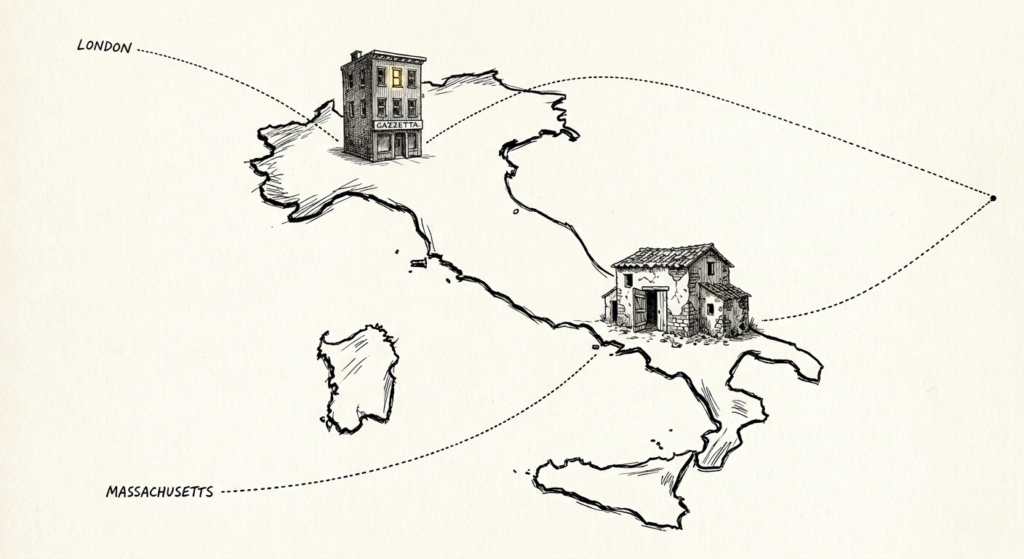
On Alessandro Pasetti, the man who handed me a platform, and the fact that Italians cannot help themselves.
There are two kinds of Italians. There are the Italians from the south, who leave because the land is steep and the work is hard and the reasons for leaving are older than the people who leave, and there are the Italians from the north, who leave because they have looked at the situation clearly and determined that a larger situation exists elsewhere, and they intend to be in it. My family, the Pitaniellos, are the first kind. Alessandro Pasetti is the second kind. We ended up in the same place anyway, which is the whole point of this story, and of Italy, and possibly of the entire human condition: it does not matter why you leave. It matters that you left.
I met Alessandro because of a lawsuit. This is not the way most people meet the person who will reshape their professional life, but most people are not litigating against Expeditors International from a jurisdiction on the other side of the world from the courthouse they expected to be standing in when they imagined their career. I was in Hong Kong. I was a lawyer. I was doing what lawyers do, which is reading documents with the specific intent of finding the sentence someone wishes they had not written. I found enough of them. The case was the case and the work was the work, and at some point during or after the Expeditors matter a door opened that had not been there before.
The door was Alessandro. Or more precisely, the door was Loadstar Premium, which is his, which he built, which did not exist before he decided it should exist, and which now lands every morning in the inboxes of over a thousand executives, investors, and analysts in global logistics who pay real money to read what he and his people write before the market opens. The door was a contribution gig. Write something. See if it works. See if the voice translates. See if a lawyer from Adams, Massachusetts, who ended up in Hong Kong because he followed a Cantonese girl across the Pacific, has anything to say to the people who move physical goods across the surface of the earth for a living.
I had something to say. I had several things to say. I had a column’s worth of things to say, and then another, and then I was a columnist, which is not a thing I expected to be when I was reading Expeditors’ internal correspondence looking for the sentence they wished they hadn’t written. A columnist at Loadstar Premium, because an Italian from Brescia looked at my work and said yes. The yes was not tentative. It did not come with a ninety-day probationary period during which I would be evaluated against metrics. It was the yes of a man who decides things quickly and does not reconsider them slowly, which is the exact quality that Steven Telford identified in a reference letter he wrote nearly twenty years ago, when Alessandro was still new to London and had not yet built anything except a reputation for being unkillable.
I have read the reference letter. Telford, once a research economist at Queen Mary University of London, wrote: “He arrived a stranger in this country, with just a backpack, some CVs, and an unshakable will to succeed.” He wrote: “No challenge is fit to daunt him.” He compared him to Cassius Clay. He said that when there is nobody left for Alessandro to challenge, he will, with no reduction of rigor, challenge himself. He said that Alessandro is not a good man but a great man, and that it is a privilege to call himself a friend of his.
This was written before Loadstar Premium existed. Before Premium existed. Before the subscriber base. Before the daily morning briefing that moves money. Telford saw the blueprint when the building was still a man with a backpack standing in London trying to figure out which direction to walk. And the blueprint was clear: this person will not stop. You can put him in a country that is not his, in a language that was not his first, in an industry he has not yet entered, and he will build something real on whatever ground he finds himself standing on.
I know what that looks like because I watched my family do it for a hundred years without knowing the details until I found them in a newspaper clipping from 1927. My great-grandfather Pasquale Pitaniello left Cervinara, Campania, and built a twenty-five-room roadhouse on top of a mountain in western Massachusetts and made it glow at night. Someone dynamited it. The family kept going. That is what Italians do. Not because we are brave. Because we do not understand the alternative. The alternative is something other people do when they run out of energy, and we do not run out of energy, we just get more tired while continuing at the same speed, and the continuing is what makes us recognizable to each other across regions and generations and oceans.
Alessandro started in Brescia. The north. Lombardy. The part of Italy that looks at the south the way Boston looks at Alabama, with a polite, firm belief that the two places share a flag but not a temperament. And it is true, they are different. Brescia and Cervinara are different the way a Swiss watch is different from a Neapolitan argument, one is precise and the other is loud, and both keep working long after you expected them to stop. But the underlying machinery is the same. Show up. Build. Refuse the premise that the thing cannot be built, because the premise is wrong, and the people who believe it are the people who stayed home.
He does not like AI. Alessandro Pasetti, the man who runs the newsroom covering an industry being reshaped by artificial intelligence, who publishes daily stories about AI agents and AI platforms and AI tools paying dividends for the companies his readers own stock in, does not want it near the core of what he does. The core is a man reading documents and making phone calls and knowing people and understanding numbers and writing sentences that move money because the sentences are true and the man who wrote them has earned his sources over twenty years, one conversation at a time, not one prompt at a time.
“I love pressure,” he told me. “The harder it gets, if it’s something that doesn’t require divine intervention, the better I feel. Don’t know why.”
I know why. Pressure is the evidence that the work is real. Take away the pressure and you are just maintaining something. Maintaining is not building. Alessandro builds. Every morning, five days a week, for years now, he builds the briefing that his subscribers open before they open anything else, and the reason they open it is that they trust it, and the reason they trust it is that a man from Brescia put his name on it and his name has meant accuracy and sourcing and a refusal to publish what he cannot verify for two decades running, and no algorithm replicates that, and he knows it, and he is right.
He built Loadstar Premium as a family operation. The Dow Jones press release from 2009 identifies him as among the best-sourced writers on the syndicated loan market in EMEA. He went from there to the Wall Street Journal in London, then built his own thing. The trajectory is clear: learn the room, master the room, leave the room, build a better room. His wife runs the business side. I do not know her well, but I know she is there the way I know my great-grandmother Maria was there, her name on the deed while Pasquale ran the house, because no Italian man builds something this size without the person next to him holding the part that does not make the news.
Now. Ruth.
Ruth went to Italy recently. A business trip, nothing to do with my family’s Campanian ancestry, nothing to do with the Pitaniello origin story, though I will admit the thought of a Cervinara detour crossed my mind and I kept it to myself because suggesting a side trip to an ancestral village during someone’s work schedule is the kind of thing Ruth would entertain for exactly two seconds before returning to her laptop. She was there for work. She was in his country. And Alessandro, a man she knows because he knows me because of Expeditors because of Hong Kong because of her because of Miami because of a mountain that is not in Florida, was on call.
All day. All night. Anything she needed. Restaurants. Transit logistics between cities. What to do if something went sideways, what to do if nothing went sideways but she wanted it to go better. Not because anyone asked him. Not because there was a professional obligation or a favor being exchanged. Because that is who he is. Because Telford wrote, nearly twenty years ago, that a metaphorical IOU from Alessandro is as good as hard currency, and the currency has only appreciated since.
Ruth came home and said he was incredibly helpful. She said it plainly, without decoration, because Ruth does not decorate statements. He answered every question she had about a country that is his the way it is mine, differently but completely, and he did it because she is connected to me and I am connected to him and the connection, once made, is not something Alessandro treats as casual. You are in or you are not. If you are in, your wife going to Italy is his concern. Not formally. Not transactionally. But actually, in the way that matters, in the way a man from the north understands loyalty, which is not as a debt ledger but as a standing offer with no expiration.
My contacts list looks different now than it did before him. Before, I was a lawyer in Hong Kong who had litigated a case against a logistics company. Now my name appears in the same publication read every morning by the people who run the industry. The names in my phone are names that move freight across oceans, that sign contracts worth hundreds of millions, that decide which ships go where and which warehouses get built. These are not Adams, Massachusetts people. These are not my people by background. But they are my people now, because Alessandro opened a door and I walked through it, and on the other side was a room full of titans who take my calls because my byline sits in a publication they trust, and they trust the publication because they trust the man who built it, and he trusts me. That is the chain.
He handed me a platform. Not literally. But he gave me a place to build on, a spot where the work could be seen. Pasquale had to find his own mountain. I was given mine. By a different Italian, from the other end of the peninsula, who would probably find it mildly offensive to be compared to a southern Italian bootlegger who got his roadhouse dynamited by persons unknown. I am comparing them anyway because the thing they share does not respect regional boundaries. It is Italian, full stop. North, south, Brescia, Cervinara, London, Massachusetts. Show up. Build something. And when someone connected to you needs something, give it without keeping score.
We have never met in person. I should say that. This entire relationship, the contribution gig, the column, the trust, the phone call availability, Ruth in Italy, all of it has happened across screens and time zones and the particular intimacy of working alongside someone whose standards you absorb without ever having sat across a table from them. I am looking forward to the day he comes to Hong Kong, or I find myself wherever he is, and we sit down and I buy him dinner and we talk about nothing important for a while before talking about everything important, the way Italians do when they finally meet the person they have been building alongside. It will happen. I am in no rush. The work is ongoing and the connection is not going anywhere, and when it happens it will be like meeting a relative you have somehow known your whole life without having been in the same room. Which, given that we are two Italians who left Italy and ended up adjacent to each other through a chain of events involving Expeditors International and a Cantonese woman and a mountain in Massachusetts, is probably exactly right.
Alessandro will not like this piece. He does not do the public praise, the biographical examination, the being-written-about instead of the writing. He is the man behind the newsroom, not in front of it. He would prefer that I write about DSV’s acquisition strategy or margin compression at Kuehne+Nagel or whatever is moving in the container markets this week. He would prefer that I do my job.
But my great-grandfather built a glowing pyramid on a mountain where nobody asked him to build anything, and somebody blew it up, and the family did not stop. I am not going to stop either. And part of not stopping is acknowledging the man who gave me the ground to build on. So here it is. The acknowledgment. From one Italian to another, across the length of a peninsula neither of us lives in anymore, in a publication he built from nothing, on a platform he gave me without hesitation: thank you. The lights are on. They are visible from the road. And I intend to keep them there.