Cetus Maritime is in talks to absorb 13 vessels from Hong Kong-listed Seacon Shipping ahead of its own overseas listing. It would be the fourth merger or acquisition in four years for a company built almost entirely by buying rivals.
On Aug. 28, Seacon Shipping Group Holdings disclosed to the Hong Kong exchange that it is negotiating the sale of subsidiaries holding interests in 13 vessels to Cetus Maritime Holdings, a Cayman-incorporated entity tied to the Hong Kong dry bulk operator.
Seacon has not named the ships or their value, and the company says the deal may not proceed. But the structure is telling: around 30% of the price would be paid in cash, and the remaining 70% in Cetus shares issued just before Cetus’s own intended IPO on an overseas exchange, according to Splash247’s reporting on the filing.
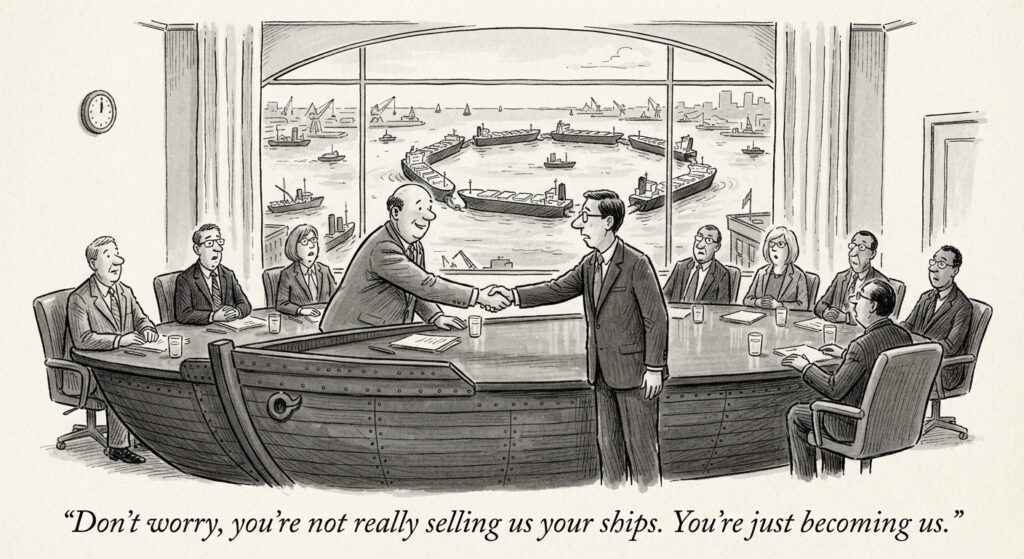
That structure turns Seacon, a Qingdao-based owner that runs a fleet of 48 vessels through its own operations and joint ventures, according to the company’s own disclosures, into a shareholder in the company buying its ships.
It is an unusual way to sell a fleet, and it only makes sense if Seacon’s board believes Cetus is headed somewhere worth owning a piece of.
A company built by acquisition
Cetus did not exist three years ago. It was formed in early 2023 when Hong Kong-based Asia Maritime Pacific merged with Germany’s Hamburg Bulk Carriers, combining roughly 40 owned and 25 chartered vessels under AMP chief executive Mark Young, according to contemporaneous reporting on the deal.
A year later, Cetus absorbed Chile’s Nachipa Corp, adding a modern, Japanese-built fleet that the outlet reported pushed the eco-vessel share of Cetus’s tonnage to 75%. It then folded in Australia’s Rhumb Maritime. Today Cetus describes itself as running more than 40 Handysize ships, ranging from 8,500 to 45,000 dwt, with around 1.3 million dwt of owned capacity.
The Seacon talks would be Cetus’s fourth major fleet transaction overall, after the founding AMP-HBC merger, the Nachipa merger and the Rhumb Maritime acquisition, and the first of the four structured as a partial share swap tied to an exit rather than an outright purchase. If it closes, Cetus would be buying scale from a public company just as it prepares to go public itself, a sequence that lets Seacon’s shareholders convert a fleet disposal into equity in the buyer rather than simply cash.
Why Hong Kong dry bulk keeps consolidating
Handysize and small-Panamax owners have spent the past several years absorbing each other for the reasons that drive consolidation everywhere: scale lowers the cost of chartering, bunkering and compliance with tightening vessel emissions rules, and a bigger fleet gives an owner more routes to fill a ship that would otherwise sail in ballast. Cetus’s own numbers illustrate the logic. A platform assembled from four mergers has more chartering relationships and more operating offices, in Hong Kong, Singapore, Shanghai and Hamburg, than any of its component companies had alone.
What is less obvious is why Seacon, itself only listed on the Hong Kong exchange since March 2023 and ranked among the world’s top ten ship managers for three straight years by its own account, would rather hold Cetus shares than continue operating a diversified fleet that includes Capesize and Panamax tonnage alongside its dry bulk and tanker business. One reading is that Seacon’s board sees more upside in a pre-IPO stake in a pure-play Handysize consolidator than in continuing to run vessel classes further from its core. Another is that this is simply a capital-raising move dressed up as strategy, a way to book a gain on aging tonnage while keeping optionality through the Cetus shares. Neither has been confirmed by either company, and the deal is not binding.
What to watch
Two things will determine whether this becomes more than a stock exchange filing. First, whether Cetus and Seacon identify the actual vessels and agree a valuation, since 13 unnamed ships is not yet a transaction. Second, timing against Cetus’s own IPO, since a private company issuing shares to a seller just before going public invites the kind of scrutiny that public markets bring to related-party-style transactions, even when, as here, the companies are unrelated.
Hong Kong’s dry bulk sector has spent three years consolidating quietly, outside the headlines that container shipping and terminal disputes attract. A Handysize platform built from four mergers, now paying for its next one partly in its own soon-to-be-public stock, is the kind of deal that usually only gets noticed after it is done.
Comments