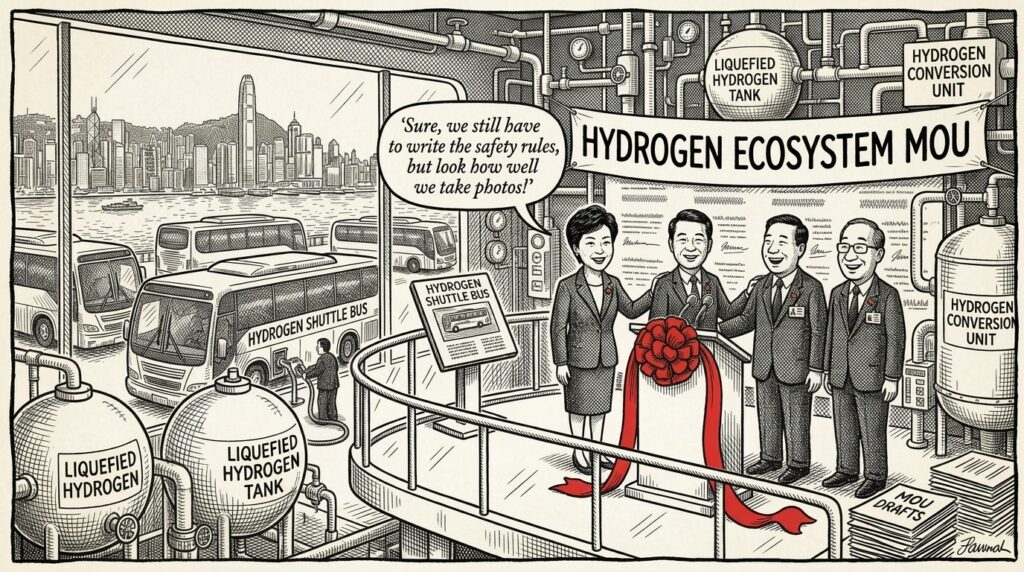
Nine companies signed a hydrogen ecosystem MOU in Hong Kong on May 18, but the officials who witnessed it, including the department that will eventually write the safety rules, signed nothing.
On May 18, Hong Kong’s hydrogen bet paid off when nine companies, led by Hyundai Motor Group, signed a memorandum of understanding to build a hydrogen ecosystem, targeting full operation by the end of 2030. Bonnie Ho, Senior Vice President for Transport, Logistics and Industrials at Invest Hong Kong, appears in the event’s official photo lineup alongside InvestHK’s Director-General Alpha Lau and Hyundai’s regional hydrogen policy chief. The deal covers landfill-gas-to-hydrogen conversion, liquefied hydrogen refueling stations, and fuel cell commercial vehicles, including tour and airport shuttle buses. For an industry that moves freight and passengers on fixed routes and fixed schedules, that last detail is the one worth reading closely.
The regulator who watched, but didn’t sign
A memorandum of understanding is not a license, and it is not a safety code. Despite Hong Kong officials witnessing the ceremony, the nine signatories are private companies, not the government. Deputy Minister Jeong Eui-kyung of Korea’s Ministry of Land, Infrastructure and Transport, Hong Kong’s Acting Secretary for Environment and Ecology Diane Wong, the Director of Electrical and Mechanical Services Poon Kwok-ying, and InvestHK’s Alpha Lau all officiated the signing. None of them signed it. That distinction matters more than it looks. Liquefied hydrogen refueling infrastructure is the kind of thing regulators usually spend years writing rules for before anyone builds it, and the Electrical and Mechanical Services Department, whose director stood at the ceremony without putting his name on the document, is the body that will eventually have to write those operating rules. Fleet operators watching this space should not read “targeted to be fully operational by the end of 2030” as a delivery date. It is a policy aspiration sitting on top of a certification regime that does not exist yet, for vehicles, for refueling stations, and for the workers who will handle liquefied hydrogen at street level in one of the most densely built cities on earth. Anyone planning a fleet transition on the strength of this MOU is planning around rules that a different government department, one that didn’t sign anything, will eventually write.
Why InvestHK’s presence matters more than the technology
Hong Kong has run this playbook before. InvestHK’s Director-General, Alpha Lau, said the agency has spent three years bringing hydrogen enterprises into the city, several of which have since listed on the Hong Kong Stock Exchange and raised more than 2.5 billion US dollars between them, according to InvestHK’s own announcement of the signing. That is not a hydrogen story so much as a capital markets story wearing a hydrogen costume, and it tells you what this MOU is actually for. InvestHK’s Transport, Logistics and Industrials division exists to make Hong Kong attractive to exactly this kind of enterprise, and by that measure its job was done the moment the signing photo went out. The harder work, certification standards, fuel cell vehicle type approvals, liability if a refueling station fails, sits with agencies that showed up to witness the deal but signed nothing themselves. That gap, an investment agency’s job finishing where a regulator’s job begins, is a recurring feature of Hong Kong’s green economy announcements, and it is worth watching whether the certification work moves at the same pace as the press releases.
What this means for logistics operators
For carriers and airport ground handlers eyeing the tour and shuttle bus angle specifically, the practical takeaway is patience dressed as opportunity. Hong Kong’s government has already committed, in the Chief Executive’s 2025 Policy Address, to building public hydrogen filling stations on Hong Kong Island and in Kowloon and to a cross-border hydrogen corridor with Guangdong under the Greater Bay Area plan. A corridor spanning two jurisdictions means Hong Kong and mainland regulators will need to agree on fuel purity standards, station safety codes, and vehicle certification before a single fuel cell truck can cross it without stopping to prove its tank satisfies both sets of rules. Operators who wait for that alignment to finish before committing fleet capital risk falling behind the nine companies already inside this MOU. Operators who commit now are betting on a regulatory timeline that none of the nine signatories controls.
One number in InvestHK’s own release doesn’t quite add up. The announcement calls this a “nine pioneering companies” deal, but its own partner list names Hyundai Motor Company and Hyundai Engineering & Construction as separate entries alongside eight other firms, ten names for a headline that says nine. Whether that’s a rounding of the two Hyundai entities into one or a simple miscount, it’s the agency’s inconsistency to explain, not this piece’s to resolve.
What to watch next
The next concrete signal will not be another MOU. It will be the Electrical and Mechanical Services Department publishing an actual liquefied hydrogen refueling code, or Hong Kong and mainland authorities issuing a joint technical standard for the Greater Bay Area corridor. Until one of those appears, this remains an investment promotion win dressed as an infrastructure win, and operators would do well to remember InvestHK wrote the press release, not the rulebook.
Comments