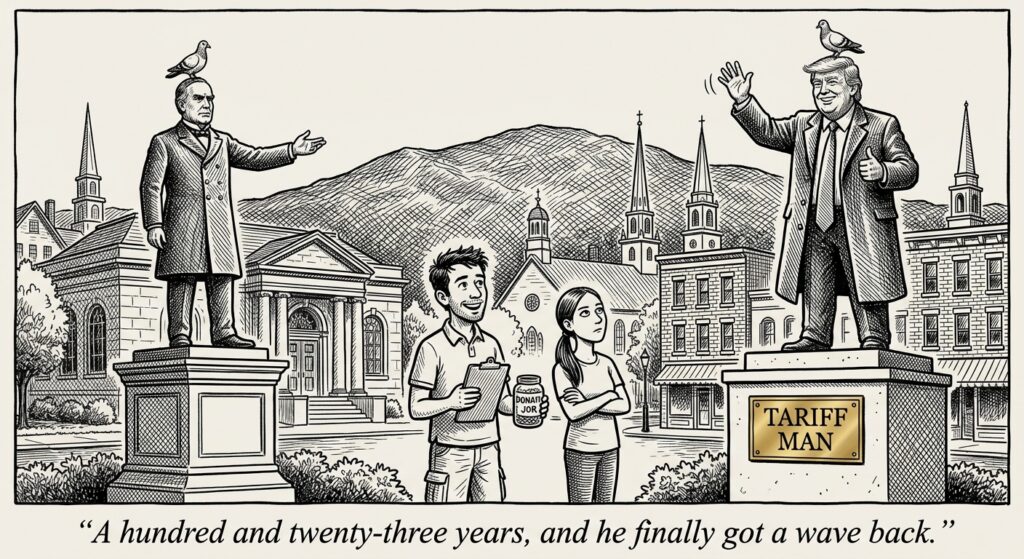
There is a bronze man in the middle of my hometown with his left arm stuck out, and it is easy to assume he is waving. He is William McKinley, eight feet tall on a block of Stony Creek granite beside the Adams Free Library, and according to local historians he isn’t waving at all. The arm is meant to show him on the floor of Congress, pushing through a tariff bill. Adams, a mill town in the northern Berkshires, put up a monument to a trade policy, and for more than a century people have driven past it thinking it was saying hello.
So here is my proposal, and I’d ask you to hold your objections for one paragraph. Adams should commission a Donald Trump statue, stand it next to McKinley, and rededicate the Free Library in his name. Best library you’ve ever seen, folks. Tremendous circulation numbers.
The reason this is less insane than it sounds is that we have done it before, and it worked, for somebody. In November 1888, Benjamin Harrison won the presidency on a Republican platform promising protective tariffs, and when he was sworn in the following March, his party held the White House and both houses of Congress for the first time since 1875. That same year, 1889, the brothers William and Charles Plunkett founded the Berkshire Cotton Manufacturing Company on the Adams site where their father had been making textiles since the 1830s. Did they know the tariff was coming? Of course they did. Everyone did. The winning party had printed it.
So let me spell out what the Plunketts actually did, because it is the whole point of this essay. They didn’t need a secret. They read the platform, believed it, and bet the family business on it before a single rate had been written. Then, once the tariff passed and the orders came in, they made very sure the man who wrote it knew who had believed him first. They gave him their cornerstones to lay, their house to sleep in, and eventually their statue. None of it was hidden. It happened on Park Street in front of thousands of people, with a band. That is the playbook: bet publicly on a president’s promise, then flatter him until he treats your town like family. It worked well enough that by 1900 the Plunketts had built three more mills.
The tariff arrived on schedule. On October 1, 1890, the McKinley Tariff pushed the average duty on imports from about 38 percent to 49.5 percent, one of the highest walls in American history. The country hated it. In the elections a month later, House Republicans were cut from 171 seats to 88, and McKinley lost his own seat, helped along by a hostile redistricting. The nation punished the tariff almost immediately. Adams got rich on it.
McKinley kept coming back to see the results. In October 1892, as governor of Ohio, he laid the cornerstone of Mill No. 2 in front of about three thousand people. In 1897, now president and the same year he signed another tariff into law, he rolled into town in a private rail car that parked in front of the Plunkett mansion to a 21-gun salute, and he laid the cornerstone of the library. In 1899 he returned for the cornerstone of Mill No. 4 and cut the visit short when his wife fell ill. After he was shot in Buffalo in 1901, the Plunketts started a fund, and in October 1903 the arm went up on Park Street.
The plaque leaves out what McKinley did with the rest of his presidency. He never set foot in the Philippines. He ran them from Washington. After Spain lost the war of 1898, his negotiators in Paris were first told to ask for Luzon, Guam and Puerto Rico, and the demand grew into the entire archipelago, for which Spain accepted $20 million. The Senate ratified the treaty by one vote more than it needed, with Massachusetts on both sides of the aisle: Henry Cabot Lodge led the fight for it and George Hoar led the fight against. On December 21, 1898, McKinley had described America’s mission in the islands as “benevolent assimilation.” Filipinos who had just finished fighting Spain for their independence disagreed, and the war that followed killed more than 4,200 American and about 20,000 Filipino soldiers. The State Department’s own historians put Filipino civilian deaths at as many as 200,000, from violence, famine and disease. McKinley governed all of it by appointment, sending William Howard Taft to take over as civilian governor in 1901.
He also changed his mind about tariffs. On September 5, 1901, at the Pan-American Exposition in Buffalo, he gave what turned out to be his last speech. “The period of exclusiveness is past,” he said. “Commercial wars are unprofitable.” He wanted reciprocity treaties instead of retaliation. The next day he was shot. The statue in Adams commemorates the McKinley of 1890. The man who died in 1901 had moved on.
Adams moved on more slowly. Berkshire Cotton merged in 1929 into Berkshire Fine Spinning Associates, which at its 1948 peak employed 11,000 people at eleven mills, and in 1955 it merged with Hathaway Manufacturing of New Bedford to form Berkshire Hathaway. By then Washington had spent twenty years negotiating tariffs down, and when cheap Japanese cotton goods began arriving in the mid-1950s, the textile lobby did what the Plunketts would have done and went to Washington. It worked. The Eisenhower administration leaned on Tokyo until Japan agreed to limit its own exports, and the 1956 quota came to less than 1.5 percent of American cotton cloth production. The wall was back, more or less. In May 1958, Berkshire Hathaway closed Mill No. 4 anyway. It was the last cotton mill in Berkshire County, and a thousand jobs went with it. The company’s president, Seabury Stanton, didn’t blame Japan. He called Adams “a high cost mill” and blamed the washing machine: housewives wanted wash-and-wear, and the fine goods Adams made didn’t survive the spin cycle. The industry had been moving South for cheaper labor and weaker unions, and no tariff has ever stopped a mill from moving to Georgia.
The town has been shrinking ever since. Adams had 13,026 people in 1910 and 12,391 in 1960. The 2020 census counted 8,166, fewer than lived here in 1890, the year McKinley’s tariff passed. Four years after the closing, a young investor named Warren Buffett began buying Berkshire Hathaway stock, and he later called it “the dumbest stock I ever bought.”
Now consider the man we would be flattering. In his inaugural address on January 20, 2025, Donald Trump said McKinley “made our country very rich through tariffs and through talent,” and that afternoon he signed an order renaming North America’s highest peak Mount McKinley. The order praised McKinley for winning the Spanish-American War and for “an expansion of territorial gains for the Nation.” In April 2025 Trump announced tariffs on nearly every country on earth. In February 2026 the Supreme Court ruled 6 to 3 that the emergency law he used gave him no power to impose them, and within hours he had a 10 percent global tariff in place under a different statute. When that one expired at 12:01 a.m. on July 24, new duties of 10 or 12.5 percent on sixty economies took effect the same minute. The arm never comes down.
The Plunkett playbook is running again, and it has moved into the Oval Office. On August 6, 2025, Apple’s chief executive Tim Cook stood beside the president, presented him with a disc of Corning glass on a 24-karat gold base made in Utah, and announced another $100 billion in American investment. In the same appearance Trump announced a 100 percent tariff on imported chips and explained that for companies building in the United States, there’s no charge. Cook didn’t need a secret either. He bet publicly on the president’s policy, then made sure the president knew who had believed him. The cornerstone has become a plaque. Four months earlier, at 9:37 on the morning of April 9, Trump had posted “THIS IS A GREAT TIME TO BUY!!! DJT.” DJT is his initials and also the ticker of Trump Media, in which he holds a majority stake. Less than four hours later he paused most of his tariffs, and the S&P 500 rose 9.5 percent. Nobody has shown that anyone traded on inside information, and I’m not alleging it. I am only noting the timestamps.
Then there is the territory. On January 3, 2026, American forces took Venezuela’s president, Nicolás Maduro, and his wife out of Caracas in an overnight raid. That morning at Mar-a-Lago, Trump said the United States was “going to run the country” until a proper transition, and that American companies would be selling its oil. Two months earlier, his advisers had told lawmakers they had no plans to change Venezuela’s government. McKinley at least put his treaty to a Senate vote. Trump skipped that step, and he skipped the flag too. Washington now works through Maduro’s former vice president, who has signed an agreement giving the United States preferential access to Venezuela’s oil fields. If you want the McKinley precedent for that, it isn’t the Philippines. It’s Cuba, which McKinley took in the same war, occupied until 1902 and then kept as a protectorate until 1934. Control without annexation turned out to be the more durable model.
Which brings me back to the traffic island on Park Street, and to what a second statue might actually get us. Adams already has two Opportunity Zone tracts under Trump’s own 2017 tax law, and they haven’t brought back a mill. Last year Congress made the program permanent, and Massachusetts is choosing its new map right now, 103 tracts out of 410 eligible, for the decade starting in January. A statue is unlikely to move Governor Healey. But the federal government has also discovered a sudden appetite for bronze. The National Endowment for the Arts gave fifty grants last December, $25,000 apiece, for 2026 projects honoring the people on Trump’s list of American heroes, and that list includes Susan B. Anthony, who was born in Adams in 1820. So we have the birthplace of an approved hero and the country’s oldest shrine to the tariff king’s favorite president, on the same traffic island, one plinth short of a set.
So I am proposing that Adams run the Plunkett playbook one more time, openly, the way they did. Bet on the president’s policy in public. Build him the monument, and build it big, because we know our audience: taller than McKinley, the tallest bronze in Berkshire County, people driving in from three states, grown men crying, nobody has ever seen a statue like it. Rename the library. Tremendous books, some of the best books ever written, many of them about him. Then invite him up and give him the full McKinley treatment. Coffee at the Daily Grind, the best grind, nobody grinds like Adams, believe me. Lunch at the McDonald’s, where we let him work the fry station, which he did at a McDonald’s in Pennsylvania in 2024 and which he said requires great expertise. Afterward we drive him to the foot of Mount Greylock, the highest point in Massachusetts, and let him look at it for a while. He has renamed one mountain already, and Greylock is, frankly, a very sad name. McKinley came to Adams three times. We only need Trump to come once. Maybe he cuts the ribbon, maybe we get a post, and maybe somebody in Washington decides a tariff-loyal town in the Berkshires deserves a Federal Redevelopment Zone. I don’t know what a Federal Redevelopment Zone is. Neither does anyone in Adams. That has never stopped us from applying for something.
All of which is, you will have gathered, a joke. Mostly. I don’t believe a bronze president fixes a town, and the history above is a fair argument that it doesn’t. The McKinley statue never brought the mills back, and neither did the protection Adams won in the 1950s. Flattery pays the flatterer first, and the people who worked the Plunketts’ looms got their notice in the North Adams Transcript in May 1958.
Having said all that, here is where I actually land. Adams has fewer people today than it did the year McKinley’s tariff passed. It has tried being charming and tried being artsy, and it has spent sixty-eight years waiting for the next thing. A statue is a strange bet, but it is a cheap one next to what the town has already lost, and it is the only play in Adams history that verifiably got a sitting president off a train. The downside is small. At worst, the town ends up with an odd piece of public art, some busloads of people who drove up to argue with it, and a story every paper in the country will want to tell. At best, someone in Washington finally remembers where we are.
So, seriously: I think it’s worth a shot, and I’ll put money behind that. If the town of Adams identifies the land and sets up a fundraiser for the statue, I will match every dollar raised, up to $25,000. And honestly, I bet the president himself would kick in the rest, or better yet, just cut Adams a federal check directly. Tremendous check. Nobody writes a check like this administration, believe me. It would be yuge. Bigger than the mills ever were. Ruth, who was cutting a pomelo when I told her the figure, asked whether that included the gold base. McKinley has had his arm out on Park Street for a hundred and twenty-three years. It seems rude to leave him standing there alone.
Comments