The alert showed up on my phone the way these things always do in Hong Kong, forwarded into three different group chats within an hour, each one adding its own layer of alarm on top of the last. One of the chats was mostly other lawyers, which meant the forwarding came with commentary, and lawyers forwarding a legal notice is its own genre of chaos, four people who bill by the six-minute increment all typing at once, nobody agreeing on what the document says, everybody agreeing it’s bad. By the time it reached me the US Consulate General’s actual notice had grown a second, angrier notice stapled to the front of it. Hong Kong police could now legally demand the password to your phone, the message said, and refusing was a criminal offense. Every outlet that covers this city ran some version of the same headline that week, and every version led with the same word, sweeping, before it got anywhere near what the rule actually says.
I have spent most of my career being the person other people forward this kind of thing to, which is a less glamorous specialty than it sounds. Nobody invites the guy who reads the statute to the fun part of the dinner party. I am a dual-qualified solicitor in the United States and Hong Kong, which mostly means I got to spend a decade as a partner at a firm in Central reading laws for clients who were too busy or too frightened to read them themselves, and the habit does not turn off just because I am now reading one for myself, on my own kitchen counter, at eleven at night, in the same posture I used to bill at three hundred dollars an hour and now perform for free, for an audience of one very tired man in pajama shorts.
What the amendment actually says took longer to find than it should have, buried under three separate summaries that all led with the penalty before the process, because fear travels faster than Schedule 1 of anything. Police need reasonable grounds to suspect a device holds evidence of a national security offense, and they need a magistrate to sign off before they can ask you for anything. Only after that warrant exists can they legally demand a password. Refuse at that point and you’re looking at up to a year in prison and a HK$100,000 fine, which is real and worth being afraid of, but it’s a year that starts after a magistrate has already looked at the evidence and agreed there’s a case. That detail ran, when it ran at all, somewhere around paragraph nine, which in journalism is roughly where facts go to retire.
I read this as both halves of what I am, which is a phrase I would strike from a client’s brief for being pretentious, and I’m leaving it in here anyway. As an American citizen, the alert was a warning from my own government about a foreign law. As a Hong Kong permanent resident married to a Hong Konger, it was a warning about the actual legal system I live inside, the one that governs my wife more directly than it governs me, since nobody has ever been fully sure how the National Security Law treats a foreign-born solicitor versus a citizen born here, a question I have billed exactly zero hours researching because the honest answer is probably “let’s not find out.”
The American half of me went back, uninvited, to a constitutional law class at Boston University sometime in the mid-1990s, the kind of class where a professor spends forty minutes making you feel very good about the Fourth Amendment and then five minutes taking it away again. The border, it turns out, does not work like the rest of the country. At the actual line, or its functional equivalent, an airport, a mail facility, anywhere customs treats as the door, the government can search you and your belongings with no warrant, no probable cause, no suspicion of any kind, a power that traces back to a customs statute from 1789 and has survived every modern challenge since. Then there is the zone around the border, defined by federal regulation, since the 1950s, as a “reasonable distance,” 100 air miles. Inside that zone, which by the Border Patrol’s own math contains something like two-thirds of the entire American population, New York, Los Angeles, Chicago, agents can stop you at a fixed checkpoint and ask about your citizenship without needing any individualized suspicion at all, a rule the Supreme Court upheld in 1976. Move the same stop off the checkpoint and onto a roving patrol, and technically the standard rises to reasonable suspicion, the same phrase Hong Kong’s own police need before they can even request a warrant. Technically is doing a lot of work in that sentence, and I remember thinking so at the time, in a lecture hall in Boston, decades before I had any reason to apply it to myself.
Hong Kong has nothing resembling the 100-mile zone. It has a line, and checkpoints on the line, Lo Wu, Lok Ma Chau, the high-speed rail terminus at West Kowloon, and the search power lives at the checkpoint, not on a highway a hundred miles from it. Say what you want about a magistrate’s warrant standing between you and a password request, and I have, at length, at my own kitchen counter. At least the government asking has to still be standing at the door when it asks.
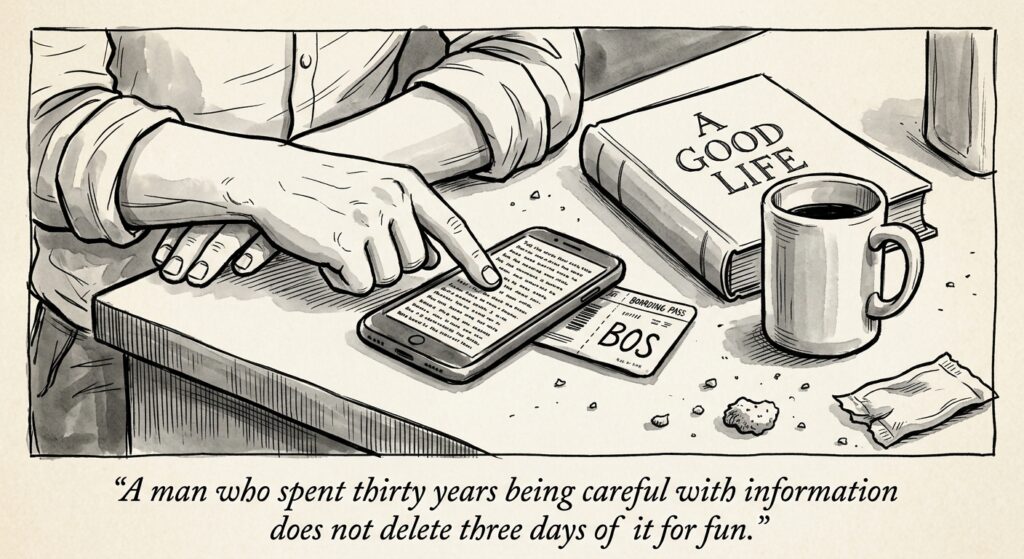
I was still turning this over when I read that Wang Xiangwei, who ran the newsroom at the South China Morning Post for three years and has spent more than thirty covering China, spent the better part of three days scrubbing his phone before a flight. Not a flight into the mainland. A flight to Boston, for a year as a visiting scholar at Harvard’s Kennedy School, a ten minute walk from a law school I sat in thirty years ago on the other side of the Charles, back when the only password I worried about forgetting was the one for a dial-up email account, and the only threat model that account faced was my own inability to type it correctly after a night out. Old emails, screenshots, WeChat threads that might read the wrong way, all deleted, on advice he said now circulates routinely among Chinese travelers heading to the United States, carry a clean phone, or better yet, a burner. He was careful to say he wasn’t being paranoid.
The story of his career I like best isn’t a scoop, though I’m sure he has a few. It’s the one he told about himself when he finally left the Post in 2022 after twenty-six years, in a column that kept circling back to A Good Life, the title Ben Bradlee gave his own memoir, a book Wang clearly reveres and the closest phrase he could find for summing up his own life’s work. He took over as the paper’s China editor in 2000, the same year Beijing was closing in on joining the World Trade Organization, and he spent the next two decades pushing the Post’s China coverage until it became, by his own account, something closer to what he wanted it to be, a platform where readers could get authoritative, independent reporting on a country that does not make independent reporting easy. That’s the kind of pride that doesn’t need a headline. It just needs twenty-six years and the right sentence to land it. A man who spent that long building a case for careful, independent information does not scrub three days of phone history out of superstition.
I believed him immediately, and then I remembered why. In January 2025, an Atlanta activist named Samuel Tunick came home through Hartsfield-Jackson after a vacation in the Dominican Republic. CBP pulled him into secondary inspection and told him they could go through his phone, no warrant needed, on the government’s own stated theory that a citizen who hasn’t yet been waved through the line isn’t legally on US soil yet, a legal fiction that would be funny if it weren’t the actual argument in an actual federal filing, the idea that a man standing in an airport on American concrete, breathing American air, drinking the same eleven dollar airport beer as everyone else, is nonetheless constitutionally still somewhere over the Atlantic. According to his lawyers’ court filing, he said early on that he didn’t want to keep talking without a lawyer, and the officers kept going anyway. It’s the same request I have made on behalf of clients more times than I can count, always assuming the asking itself was the easy part. Prosecutors say he then gave the agents a password, the one built into his phone’s security software to erase everything the moment it’s entered under duress, and the screen went dark. A federal grand jury indicted him in November 2025 under a destruction of evidence statute. He has pleaded not guilty, and the final briefs on his motion to throw out the search are due in late October.
So here is the comparison nobody ran in paragraph one, the one I kept circling back to at my own kitchen counter, long after the pajama shorts had lost any claim to dignity. In Hong Kong, a magistrate has to agree there’s a real national security case before police can even ask you for a password. At the American border, a citizen can ask for a lawyer, be ignored, and have his phone searched on a hunch with no warrant at all, and if the phone in his pocket defends itself the way it was built to, he can be the one who ends up facing prison, charged, more or less, with the crime of owning a phone that did exactly what he told it to do. I have spent a career telling clients that the process matters as much as the outcome, that a government asking permission first is not a small thing. I did not expect to end up making that argument on my own country’s behalf against my own country, at midnight, in my kitchen, to nobody.
Ruth found me still at the counter, phone in one hand, the actual text of Schedule 1 open in a browser tab I’d clearly been rereading like it might resolve into a different statute on the fourth pass. She didn’t ask what I was doing. She has lived with this long enough to recognize the specific stillness of a lawyer who has stopped trusting a headline. “You’re going to give yourself the exact panic they’re trying to sell you,” she said, and took the phone out of my hand to check the dinner reservation. “Also delete the group chat. Nobody in it has read past paragraph one either.”
I let her keep the phone a while longer than I needed to.
Comments