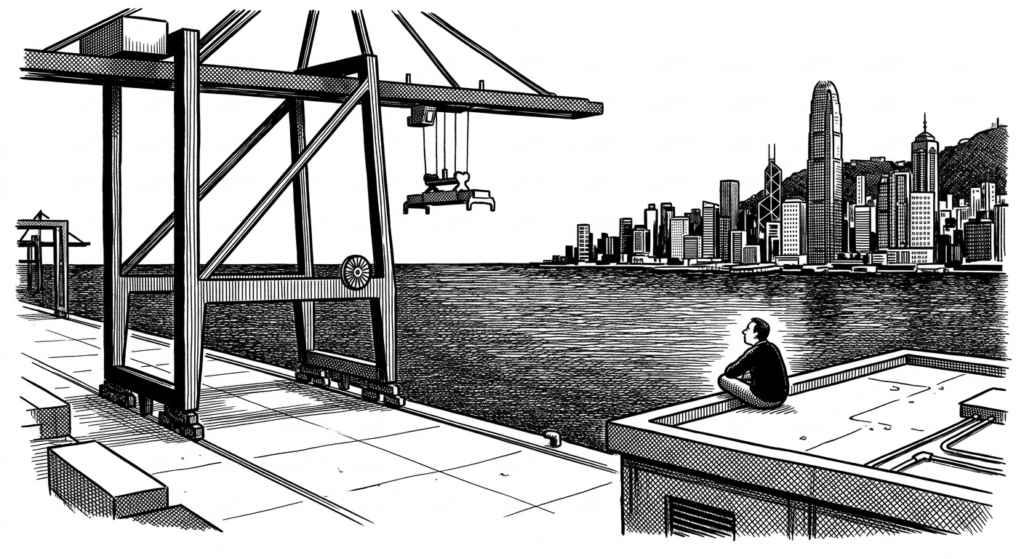
There is a crane at Kwai Tsing that I can see from the rooftop of my building in Mei Foo. I have been looking at it for years. It used to move. Not constantly, not every time I looked, but often enough that the movement was part of the view the way the harbor ferries are part of the view, something you stop noticing because it is always there. Lately it has not been moving. I noticed this the way you notice a shop has closed on your street, not because you went looking for the information but because the absence made a sound you could not quite identify until you turned your head.
In the first nine months of 2025, outward port cargo from Hong Kong discharged in the United States fell 41.6 percent year-on-year to just 703,000 tonnes. The decline accelerated each quarter: down 31.9 percent in Q1, 45.1 percent in Q2, and 48.8 percent in Q3. By the time Washington imposed a fresh 12.5 percent tariff on Hong Kong goods last month, citing inadequate enforcement of forced-labor import prohibitions, the lane was already gone. The tariff did not kill it. The tariff showed up to the funeral, highlighting the Hong Kong US Cargo Collapse.
Hong Kong’s trade statistics are unusual in a way that matters here. The territory’s “outward port cargo by country of discharge” captures total tonnage leaving the port for a given country, encompassing both goods made here and cargo transshipping through on its way somewhere else. In a city where 99 percent of exports are re-exports, according to the Census and Statistics Department, the transshipment component dominates. The 42 percent collapse does not merely describe fewer Hong Kong-made goods heading to America. It describes a collapse in the routing logic that justified Hong Kong’s role as a supply chain node for US-bound freight. The city was not making things for America. The city was holding things for America, briefly, on their way from somewhere else. And now even that function is gone.
I walk past the container port on the way to the bus sometimes. The scale of it is the kind of thing that stops impressing you once you have lived here long enough, but it impressed me when I arrived, all those stacked boxes in colors no one chose for aesthetic reasons, the yellow of Maersk, the grey of Evergreen, the red of Hamburg Süd before they repainted it. I liked looking at it the way you like looking at a working thing. A machine doing what it was built to do. Lately the stacks are lower. The colors are fewer. The bus still runs the same route, but the view has thinned.
No single cause explains a drop this violent, but the contributing factors feed each other and none of them are reversible by announcement. China’s share of US merchandise imports fell from roughly 13 percent at the end of 2024 to approximately 9 percent by late 2025, a level not seen since China joined the WTO in 2001, per analysis from Alfaro and Chor published via VoxEU in January 2026. As Chinese-origin goods destined for America declined, so did the transshipment cargo that once flowed through Hong Kong en route. Port competition within the Greater Bay Area compounded the damage. Shenzhen’s Yantian terminal captured outbound European volume. Nansha and Guangzhou absorbed intra-Asian transshipment. Ocean Alliance reduced direct port calls at Hong Kong from eleven to six for 2025, and removed the port from its Pacific South West and Pacific North West services entirely. Hong Kong handled just 12.995 million TEU in 2025, well below its 2007 peak of 24 million and down 5.1 percent year-on-year. The port now sits outside the world’s top ten.
I remember when they used to say Hong Kong was the busiest port in the world. They said it the way they said the Peak Tram was the steepest funicular in Asia, with the quiet satisfaction of a city that believed its infrastructure was its identity. The port was not just a port. It was proof that the city worked, that the location mattered, that geography was destiny. Twenty-four million TEU in 2007. That number lived in every government brochure and every real estate pitch and every taxi driver’s sense of civic pride. The number is thirteen million now. Nobody puts it in brochures.
Then there was the de minimis elimination. The suspension of duty-free treatment for sub-$800 shipments into the US, effective August 2025, throttled the direct-to-consumer air parcel model that had been generating significant small-package volumes through Hong Kong International Airport. The airport’s total cargo remained strong at 5.07 million tonnes in 2025, but the US-bound e-commerce component contracted sharply. When you remove the economic rationale for a routing decision, people stop making that routing decision. Nobody takes the long way home because the long way used to be shorter.
On July 24, 2026, the USTR’s Section 301 forced-labor action imposed a 12.5 percent tariff on all goods originating in Hong Kong, alongside 59 other economies. The investigation found Hong Kong had “failed to impose and effectively enforce a forced labor import prohibition” and that this failure burdened US commerce. For a territory whose entire trade proposition rests on free-port status, the language is damaging in a way that transcends the rate itself. Hong Kong’s effective US tariff rate was approximately 0.99 percent in 2024. By early 2026, prior Section 122 duties had pushed it to around 10 percent. It now sits at 12.5 percent, stacking on standard duty rates for most product categories.
The practical impact may be less dramatic than the headline suggests, precisely because the trade flow was already so diminished. US Census Bureau data shows total American goods imports from Hong Kong fell to $5.15 billion in 2025, down 13.7 percent from 2024. Monthly figures outside an anomalous January spike, likely precious metals, rarely exceeded $375 million. You cannot kill what is already mostly dead. But you can make sure it stays that way.
Here is what makes this strange. I wrote last week about Hong Kong’s capital markets, about HSBC poaching bankers from JPMorgan and Goldman, about over a hundred companies listing on the Exchange in the first half of this year and forty billion dollars raised and the sandwich shop in Admiralty with a line at noon. That is real. That is happening right now, in the same city, in the same year, measured in the same currency. Financial Hong Kong is hiring. Freight Hong Kong is emptying. The parking lot in Central is full. The container yard at Kwai Tsing is not. Same harbor, two different stories depending on which direction you look from the ferry.
The city is splitting into two economies. The one that moves money is booming. The one that moves boxes is hollowing out. The bankers and the crane operators live in the same city and ride the same MTR and eat at the same cha chaan tengs, and one of them is having the best year in a decade while the other is watching the work leave, container by container, call by call, until the schedule thins and the yard goes quiet and the only sound is the bus passing on its way to somewhere that still has freight.
The Hong Kong government continues to invest in partner port strategies, green corridors, and intermodal links to China’s interior. The airport expansion and UPS’s forthcoming million-tonne hub bet on air cargo’s continued growth. These are reasonable bets if Hong Kong’s future is as an intra-Asian and mainland-facing distribution node, a high-value niche built on cold chain and premium air freight. They are not reasonable bets if anyone still believes this city will recover its role as a waypoint for American-bound ocean cargo. That role is structurally gone. It left the way a tenant leaves a flat they can no longer afford, quietly, without ceremony, and the landlord only notices when the rent stops arriving.
I asked Ruth at dinner whether she thought the US lane could come back. She had her chopsticks in the air, mid-reach for something in the claypot. She did not put them down.
“Come back to what?” she said. Then she picked up the piece of tofu she had been reaching for and went back to eating.
That was the whole answer. She did not elaborate. She did not need to.
The lane is not dead in the absolute sense. Cargo still moves. But for planning purposes, it is structurally diminished, and the new tariff ensures it will not recover on inertia alone. If you are still building rate models or origin strategies around a Hong Kong-to-US routing assumption, you are building on ground that has already given way beneath you.
The crane at Kwai Tsing is still visible from my roof. It is still there. It may move tomorrow. It may move next week. I will keep watching it. Not because watching changes anything. Because I live here, and this is my view, and I remember when it moved.
Comments
One response to “Hong Kong US Cargo Collapse: 42 Percent Drop Before the Tariff Even Hit”
Thank you for sharing your thoughts, opinion, wisdom and life experiences via writing, it is insightful and at times humurous. I have enjoyed reading every piece of it.
Please continue writing. *while offering a cup of hot tea to Ruth*