How Hong Kong’s Most Essential Workers Are Never Allowed to Belong
I have written before about the space between the wall and the stove. 攝灶罅. The gap where things go to be forgotten. Where dust collects. Where you put the woman who is too old to marry but too young to give up on entirely. The daughter who makes too much money and has too many opinions and does not know how to smile at the right time.
I thought I understood the phrase, that it was merely a commentary on marriage, a quiet archive for women left on the shelf. I thought it was about the pressure to settle, the fear of being alone, the quiet desperation of a city that measures women by their marital status. Those women wanted a better life too. They wanted children, a home that was theirs, a future shaped by choice rather than obligation. They wanted out of the gap.
I was not wrong about the phrase. I was not wrong enough.
Because the space between the wall and the stove is not just about marriage. It is about all the women who live in the gap between usefulness and belonging. And no one lives in that gap more visibly, more permanently, more structurally, than the foreign domestic helpers of Hong Kong. The left-on-the-shelf women are fighting for recognition inside a system that at least acknowledges their citizenship. The helpers are fighting for survival inside a system that has made their exclusion a matter of law.
There are over 370,000 foreign domestic workers in Hong Kong. Most are from the Philippines and Indonesia. They live in their employers’ homes, not by choice, but by legal mandate. They work six days a week. They earn HK$5,100 per month, a wage that most residents could not imagine surviving on. Barely over US$650. In a city where a single dinner can cost a hundred dollars, it is a figure that makes the mind reel.
But before we talk about what they earn, we should talk about what they do. Because the number is incomprehensible without the context of the labor, and the labor is staggering.
They raise Hong Kong’s children. Not in the helpful-auntie sense. In the waking-at-six, preparing-the-school-uniform, packing-the-lunch-box, walking-to-the-bus-stop, picking-up-at-three, helping-with-homework, bathing, feeding, soothing-after-nightmares sense. In many households, the helper is the primary caregiver. She is the one who knows the child is afraid of thunder. She is the one who knows which classmate is being cruel. She is the one the toddler reaches for when he falls. She is there for the first word, the first step, the first fever at two in the morning when both parents are asleep and the child is crying and someone has to be the one who gets up. That someone is almost always her.
They cook. Not reheating, not assembling, but cooking. Three meals a day, seven days minus one, tailored to the preferences of every member of the household. Grandma needs soft food. The son will not eat vegetables unless they are hidden in dumplings. The husband wants soup every night. The wife is on a diet this month, off it next month, back on it the month after. The helper remembers all of it. She goes to the wet market at seven in the morning and comes back with fish so fresh it is still twitching in the bag, vegetables she selected by hand, cuts of meat she negotiated for in Cantonese she taught herself because no one else was going to teach her. She plans the week’s meals in her head. She adjusts when guests come unannounced. She produces a full dinner for six on thirty minutes’ notice and makes it look effortless.
They care for the elderly. This is the part that no one talks about, because it is the least glamorous and the most grueling. Hong Kong is aging rapidly, and the burden of elder care falls almost entirely on domestic helpers. They lift seventy-year-old women out of bed. They change adult diapers. They administer medication on schedule. They push wheelchairs through the park. They sit for hours in hospital waiting rooms. They monitor blood pressure, blood sugar, mobility, mood. They do the work of a home nurse at the wage of a household servant, and they do it with a patience that borders on saintly, because the alternative, for most families, is an institutional care home that costs ten times the helper’s salary and offers a fraction of the attention.
They make dual-income households possible. This is not a small thing in a city where a one-bedroom flat costs five million dollars and a two-bedroom costs eight. Without helpers, one parent stays home. In practice, that means the mother stays home, because this is still how the math gets done in most families here. The entire professional class of Hong Kong women, the bankers, the lawyers, the doctors, the architects, the executives, they exist in their careers because someone else is doing the work at home. The helper is not a luxury. She is the condition upon which modern Hong Kong’s economy is built. Remove her and the whole thing collapses in a week.
But here is what we do not talk about enough. Here is the other side of the ledger.
That HK$5,100 a month is more than many of these women could earn in a year back home. It is a university education for a daughter. It is a son who becomes an engineer instead of a farmer. It is a concrete floor where there was once dirt. It is a roof that does not leak in the monsoon. It is a small shop in East Java that sells rice and soap and employs two people from the village. It is an entire extended family, parents, siblings, cousins, nieces, nephews, who eat because one woman has consented to vanish into someone else’s kitchen.
The remittances sent home by foreign domestic workers are not a footnote to this story. They are the story. In the Philippines alone, remittances from overseas workers account for nearly ten percent of the country’s entire GDP. These women are not just cleaning houses in Hong Kong. They are building schools in Pangasinan. They are funding hospitals in Cebu. They are the largest source of foreign currency their countries have. They are, in a very real sense, the economic backbone of nations.
So when I say that domestic helpers are the invisible infrastructure of Hong Kong’s economy, I am only telling half the story. They are also the invisible infrastructure of their own countries’ economies. They are the reason professional women in Hong Kong can have careers. And they are the reason their own daughters can become professional women too. They are doing double duty, in two places at once, and neither place fully sees them.
Consider the geometry of the arrangement. In Hong Kong, a helper sleeps in what is euphemistically called a “helper’s room,” which in most flats is a converted storage closet, a windowless box barely large enough for a single bed and a shelf. Seven nights a week she folds herself into this space. Back in Leyte or Surabaya, the house she is building with her wages grows room by room, year by year. A second floor goes up. A kitchen with a proper stove. A garden where her mother hangs laundry in the sun. The physical confinement of her life in Hong Kong is in direct proportion to the spatial expansion of the life she is building back home. She shrinks here so that everything there can grow.
And the government has made this shrinking mandatory. Under Hong Kong’s immigration policy, domestic helpers are admitted specifically to live in their employers’ homes. The courts have upheld this as a legitimate condition of their immigration status, noting that helpers “are admitted to Hong Kong for the purpose of provision of live-in domestic service.” Think about what this means in the language of 攝灶罅. The government has legislated the gap. It has written into law that these women must live inside the space between the wall and the stove, inside the employer’s home, inside the narrow opening where they are useful but never permanent. And then, to complete the architecture, it has passed a second law ensuring they can never claim permanent residency, no matter how many years they spend here, no matter how many generations of a family’s children they raise. They must live in the gap, and they can never leave the gap by growing into something more. The stove will not move. The wall will not move. The woman stays between.
I know this because I have lived on the other side of it.
For the first five years I lived in Hong Kong, Ruth and I did not have a helper. I was reluctant. The whole arrangement made me uneasy, something about having another person live in your home and clean up after you that I could not square with how I was raised. It felt exploitative, even if everyone around me insisted it was normal, beneficial, mutual. Ruth understood my hesitation, though she had grown up differently. Her family always had helpers, all from the same extended family back in the Philippines, one generation after another. It was not what I pictured when I heard the word “domestic helper.”
After five years, we hired Liza.
Liza was from the Philippines, and she was, without exaggeration, one of the finest cooks I have ever encountered. I am not being sentimental. I am telling you that I ate like a king every day. Carbonara with guanciale she tracked down in a wet market basement. Rack of lamb with a rosemary crust. Eggs Benedict with home fries. Pan-seared sea bass with ginger and spring onion. Risotto she stirred for forty minutes without complaint. Beef rendang that took her all day. She could have held a Michelin star. She was already running her own YouTube cooking channel, a popular one, monetized, with a following that grew every week. The camera loved her, and she loved the camera back, and somewhere in the background of every video was our kitchen, which she had turned into a studio without asking permission because she did not need to ask.
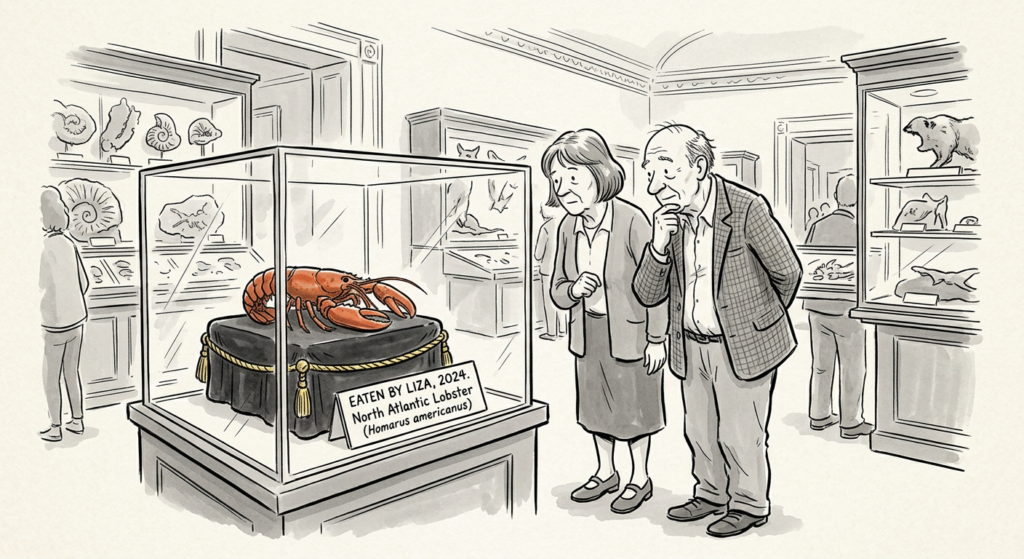
The lobster is the story I tell at dinner parties. Liza served us lobster one night, presented beautifully on the plate, shell intact, legs arranged, the whole animal looking like it had simply decided to lie down and offer itself. She sat with us. We ate. We pulled it apart the way most people do, getting the tail, the claws, the obvious meat, and leaving the rest as wreckage on the platter. Liza ate differently. She dismantled the thing with a surgeon’s focus, cracking every leg, every joint, every fold of cartilage I would never have thought to bother with, extracting threads of meat from places I did not know meat existed. By the time she was done, her plate held a hollow shell reassembled like a jigsaw puzzle, cleaned so thoroughly it looked taxidermied. The rest of us had left half the animal on the bone. She had left nothing. She looked up and shrugged. “Sayang,” she said. Waste.
Her one weakness was adobo, which is roughly the equivalent of an Italian grandmother who cannot make tomato sauce. It was edible. It was fine. It was not what a Filipina of her caliber should have been producing, and she knew it, and she would change the subject when you brought it up, which only made it funnier.
Ruth, who is a good cook and will want me to say that publicly, stopped cooking entirely within a month. She did not fight it. She sat down at the table with the rest of us and said nothing, which is the closest Ruth gets to admitting defeat.
Liza spent years with us. She saved. She was deliberate about it, careful, building toward something with a patience that never wavered. And then she went back to the Philippines and started a gas station and a tire shop, and had a baby girl. We stay in touch. Her daughter is growing up in a house Liza built. We now have her sister-in-law working with us, and the arrangement continues, one family to another, the way Ruth always described it.
None of it would have been possible without an employer in Hong Kong. That is the uncomfortable truth at the center of this story. The system that confined Liza to a helper’s room is also the system that gave her access to a wage she could never have earned at home, in a currency that multiplied when it crossed the ocean. The employer who benefited from her labor also provided the platform from which she launched everything that came after. You cannot separate the opportunity from the constraint. They are the same door, viewed from different sides.
I tell you this not because it resolves anything. It does not. Liza’s story is a success story, and success stories are dangerous because they let systems off the hook. But Liza was also a person who made a calculation, who executed it brilliantly, who used the gap as a bridge. The gap did not define her. She passed through it.
Not everyone passes through.
The prohibition on permanent residency ensures that no one ever fully arrives. Domestic workers in Hong Kong are specifically excluded from the normal seven-year residency pathway to permanent status. No matter how long they work, no matter how integrated they become, they can never belong. They are permanently temporary. Permanently between the wall and the stove.
The invisibility compounds it. A recent study from Hong Kong Baptist University describes the experience of domestic workers as “invisible violence” that occurs behind closed doors. The live-in requirement creates the conditions for abuse. The worker is always there, always available, always under the employer’s authority, always in the space where privacy ends and ownership begins. The vast majority of Hong Kong employers treat their helpers with fairness and respect. Some families, like Ruth’s, hire successive generations from the same village, weaving the helper into the fabric of their lives. But the system does not require this. The system is built on a foundation of power that is absolute, and a worker’s dignity should not depend on an employer’s character.
The endless hours are part of it. There is no standard working hour for domestic helpers. Their contracts stipulate a minimum wage, but no maximum hours. A helper’s day often begins before the family wakes and ends after they sleep. She is the first to rise and the last to rest, her labor punctuated by the demands of a household that never stops needing something.
The debt trap is part of it too. Domestic workers are subjected to unregulated lending that exploits their vulnerability. Some borrow from multiple lenders, accumulating debts they cannot repay, leaving employers to face harassment from debt collectors. The problem has become so severe that advocacy groups and lawmakers are pushing for a centralized loan database and lending caps. A cycle of precarity that feeds on the very precarity the system created.
But then Sunday comes.
If you have never been in Central on a Sunday, you have not seen Hong Kong. I have written about this before, the transformation that happens when the workweek ends and the city’s most invisible population becomes, for a few hours, its most visible. The elevated walkways that on Monday morning carry bankers and lawyers in pressed suits to their glass towers become, for one day, the living rooms and kitchens and beauty parlors and trade schools of tens of thousands of women. They lay out cardboard and blankets and sit in groups that spill across every available surface. The corridors beneath HSBC’s headquarters, where Norman Foster’s architectural monument to capital becomes a picnic ground. Statue Square, built to celebrate colonial governors, becomes a Filipina village market. The geography of Sunday Hong Kong maps almost perfectly onto national lines, Filipinas in Central, Indonesians in Causeway Bay and Victoria Park, an informal partition that no one organized but everyone understands.
And in places you would never think to look, they are building futures. I have seen, in a hidden corridor beneath a housing estate, women running portable sewing machines plugged into power strips of questionable legality, cutting fabric from patterns, assembling garments for sale or to send home. Around the corner from them, rows of women seated on plastic stools practicing hairstyling on mannequin heads propped on overturned buckets, an older woman moving between them with the quiet authority of someone who ran a salon back home and is running one again on her one free day. No permits. No signage. No certificates at the end. Just skill transferred hand to hand, one braid at a time, every single one of them building something for a life that will come after this one. A salon in Surabaya. A shop outside Bandung. Something of their own.
They are spending their only day off working, because the system does not give them enough time or money to do otherwise, and because they are not the kind of women who wait for systems to provide.
I struggle with this. I want to write a clean indictment. I want to say that the live-in requirement is a form of servitude, that the exclusion from permanent residency is a moral failure, that the wage is an insult. And all of that is true. But it is not the whole truth. Because the women who live this life are not simply victims of it. They are agents inside it. They made a choice. It may have been a choice made from limited options, but it was a choice nonetheless. They left their own children to raise other people’s children, not because they wanted to, but because they calculated that this sacrifice would buy their children a better life.
And the calculation was often correct.
Go to the provinces in the Philippines. Go to the villages in Indonesia. You will see the houses these women built. You will see the children they sent to school, now grown, now working in Manila or Jakarta or Singapore. You will see the grandparents who lived longer because there was money for medicine. You will see the siblings who started businesses because their sister in Hong Kong sent seed capital every month for years. You will see entire communities transformed by the wages of women who spent their days in other people’s kitchens.
This does not erase the hardship. It does not make the live-in requirement just, or the exclusion from permanent residency humane, or the endless hours acceptable. But it complicates the story in ways that resist clean moral conclusions. It forces us to hold two truths at once: the system is exploitative, and the system is also, for many, a path out of poverty. Both things are true at the same time, in the same woman, in the same kitchen, in the same moment.
I brought this up at dinner. Ruth was eating, chopsticks moving steadily between the plate and her mouth, half-listening in the way she does when she already knows where I am going.
“So they get to do the work,” I said. “The most essential work. They raise our children and care for our dying. They know our most private moments. And they never get to stay.”
Ruth did not look up. She did not have an answer.
Maybe it is just the price of everything.
When I wrote about the left-on-the-shelf women, I wrote about a crisis of expectation. A crisis of privilege, even. Those women had careers, money, options, even if the options were not what their mothers wanted. Their struggle was for recognition within the structures of family and society. The helper’s struggle is different. It exists in the space between two homes, two families, two selves. She is a mother who does not mother her own children. A daughter who cannot bury her parents. A woman who builds a life in a city that will never build a place for her.
And still she comes. And still she stays. And still she sends the money home.
I do not know if this makes her a victim or a survivor. I do not know if the system that exploits her is also the system that saves her. I do not know if I am looking at an injustice or an arrangement, a tragedy or a transaction, a moral failure or a simple fact of how the world is organized when some countries are rich and others are not.
I only know that every Sunday, when the women on the flyovers lay out their cardboard and their plastic bags full of parcels, when they build their temporary walls and share rice and laugh at jokes in languages I will never understand, I am looking at something that defies easy judgment. Something that is, perhaps, the truest reflection of this city I have ever seen. A place that runs on the labor of people it refuses to keep.
The space between the wall and the stove is not empty. It is full. Full of women who are not quite here and not quite there. Full of love that travels across oceans in remittance slips. Full of grief that has no grave to visit. Full of work that is seen and workers who are not. It is a space that should not exist, and yet it does, and yet it must, because without it, nothing else would work.
The women will go back to their employers’ homes tonight. Tomorrow they will wake before the sun. They will cook breakfast for children who are not their own. They will wipe down the counters and fold the laundry and answer to a name that is easier for the family to pronounce.
And in a few years, some will go home to houses they built with their own sacrifice. They will hold grandchildren who know them only from video calls. They will walk through doors their wages paid for. They will sit in kitchens that are finally their own.
Some will stay. Some will return. Some will never see Hong Kong again.
And the city will continue. And the gap will remain.
The only thing I know for certain is this: the next time you walk past a group of women on a Sunday, sitting on cardboard in the shadow of the banks, laughing and talking and being fully alive in a city that refuses to fully admit them, do not look away. Do not call them heroes, because that is too easy, and it lets you off the hook. Do not call them victims, because that is also too easy, and it erases their power. Just look at them. Really look. And ask yourself the question I have been asking myself since I began this essay:
What would I have done, if I were her?
And what would she have done, if she were me?