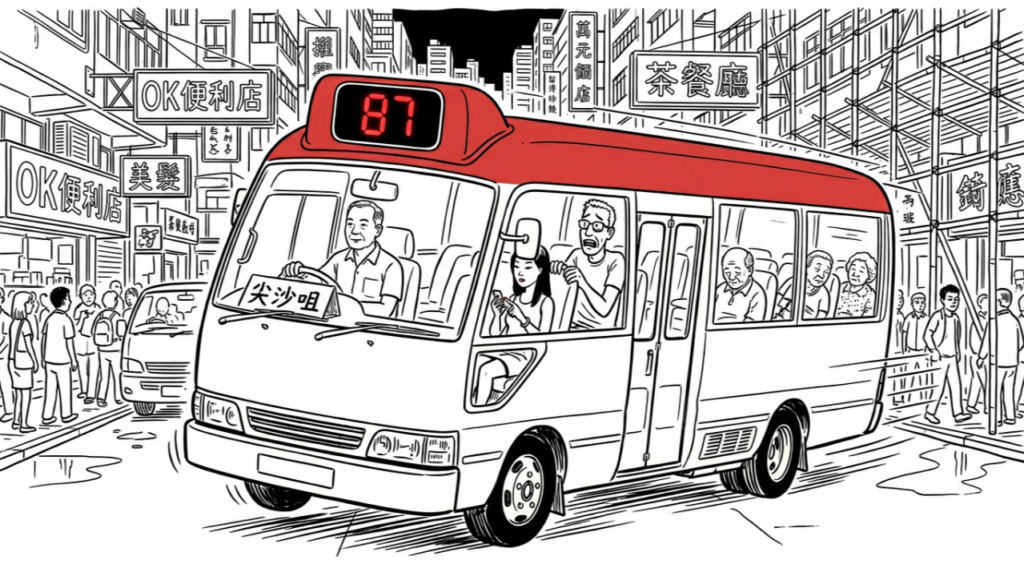
Hong Kong’s public transport is world-class. And then there’s the red minibus.
Hong Kong has, by almost any measure, one of the greatest public transportation systems on earth. The MTR runs with Swiss precision, clean, air-conditioned, and so punctual you could set your watch by it. The buses are frequent and reliable. The trams are a charming throwback. The ferries connect the harbor with the efficiency of a well-oiled machine. The Octopus card lets you glide through it all with a tap, moving seamlessly from train to bus to 7-Eleven without ever reaching for your wallet.
This is a city that looked at a mountain and said, “Let’s build an escalator.”
The Central–Mid-Levels escalator system stretches over half a mile, climbing more than 440 feet up the steep hillside from Central to the residential neighborhoods above. It’s the longest outdoor covered escalator system in the world, a series of moving walkways and escalators that carry you effortlessly up terrain that would otherwise leave you drenched in sweat and questioning your life choices. It even changes direction based on the time of day: downhill during the morning rush to carry residents to work, uphill in the evening to carry them home.
Only in Hong Kong would this exist. Only here would someone look at the problem of a steep hill and decide the solution was to simply mechanize the entire commute. It’s pragmatic, ambitious, and slightly insane, which is to say, it’s perfectly Hong Kong.
I thought I understood this city’s relationship with transit. I was a confident navigator, a man who had mastered the system, who had ridden an escalator up a mountain and found it completely normal.
Then I took my first red minibus.
The red minibus is not part of the system. The red minibus exists adjacent to the system, tolerated, necessary, and operating by a set of rules that no guidebook will ever adequately explain. The green minibuses, with their fixed routes and designated stops, are the respectable cousins. The red minibus is the uncle who shows up to family gatherings uninvited, slightly drunk, but somehow always knows a shortcut.
I didn’t understand what I was getting into when I climbed aboard. I just knew it was going vaguely where I needed to go, and the fare was reasonable, and my wife was with me, so how bad could it be?
The first thing I noticed was the display at the front, large numbers, prominently mounted, updating in real time. I assumed it was some kind of route information. A stop countdown, maybe. An estimated arrival time.
“What are those numbers?” I asked my wife.
“That’s the speed.”
“Why would they display the speed?”
“So the driver knows when he’s speeding.”
Before I could process this, why would you need a display to tell you you’re speeding? Wouldn’t you just… know?—the beeping started.
It was loud. Insistent. The kind of beeping that, in any other vehicle, would indicate that something had gone catastrophically wrong. A door ajar. A seatbelt unfastened. An engine about to explode.
“What’s that sound?” I asked, gripping the seat in front of me.
“The speeding warning.”
“Shouldn’t he slow down?”
My wife looked at me with the patience of someone who had married a foreigner and accepted certain ongoing educational responsibilities.
“It beeps the whole time,” she said.
She was right. It beeped when we accelerated. It beeped when we took corners at angles that seemed to defy physics. It beeped as we threaded through gaps in traffic that I would not have attempted on a bicycle. The beeping was not a warning, I came to realize. The beeping was the soundtrack. The driver had made peace with the beeping. The beeping and the driver had an understanding.
Then came the stops.
There are no buttons on a red minibus. No pleasant automated announcements. No digital display marking your progress toward a destination. When you want to get off, you yell.
The Cantonese phrase, I’ve since learned, is “有落” (yau lok), literally “have drop,” meaning someone wants to be dropped off. But that first ride, I didn’t know any phrases. I just watched in amazement as passengers shouted seemingly random syllables at the driver, who would screech to a halt at locations that bore no obvious relationship to anything resembling a bus stop.
The system, if you can call it that, requires local knowledge I did not possess. The regulars knew their landmarks, a particular building, a specific intersection, a shop that probably closed in 2014 but still serves as a navigational reference. They called out, and the driver understood, and the minibus lurched to the curb, and passengers tumbled out, and we accelerated back into traffic before they’d fully cleared the door.
The beeping resumed.
I should have been terrified. Part of me was terrified. But somewhere between the third near-miss and the fifth inexplicable stop, something shifted. I started to see it.
This was Hong Kong. Not the polished, efficient, world-class-infrastructure Hong Kong of the tourism brochures. The other Hong Kong. The one that runs on informal systems and collective understanding, on drivers who know every shortcut and passengers who know exactly where “after the second traffic light, near the old pharmacy” means.
The red minibus doesn’t pretend to be anything it isn’t. It’s fast because people need to get places. It’s chaotic because the city is chaotic. It’s human-operated in an age of automation, requiring actual communication between driver and passenger, demanding that you pay attention, stay alert, and speak up when you need something.
You can’t ride a red minibus while staring at your phone. I mean, you can, but you’ll end up in Yuen Long wondering where you went wrong.
The escalator and the minibus represent two visions of the same city.
The escalator is Hong Kong at its most engineered, a problem identified, a solution implemented, the entire system running so smoothly you barely notice you’re being transported up a mountain. It’s the same impulse that built the MTR, the Airport Express, the seamless network of pedestrian bridges that let you walk from Central to Admiralty without ever touching a street. Infrastructure as solved problem.
The red minibus is Hong Kong at its most alive. Nothing about it is optimized. The routes are suggestions. The stops are negotiations. The speed limit is a dare. And yet it works, has worked for decades, because the people who use it understand it, and the people who drive it know the city in a way that no algorithm could replicate.
There’s a version of Hong Kong that’s being slowly polished into smoothness. The MTR apps that tell you which car to board for the fastest exit. The QR code menus that eliminate the need to speak to a server. The delivery apps that mean you never have to leave your apartment. All of it convenient. All of it frictionless. All of it slowly sanding away the edges that make this city what it is.
The red minibus is a hold-out. A remnant. Proof that efficiency isn’t everything, that sometimes the point is the chaos, the negotiation, the beeping that never stops because the driver has places to be and so do you.
I take the MTR most days. It’s clean and fast and I can read on my phone and emerge exactly where I need to be. Sometimes I take the escalator, gliding up the hillside past noodle shops, modernity cutting through history without disturbing it.
But sometimes I take the red minibus. Not because it’s faster. Not because it’s cheaper. Because it reminds me why I moved here in the first place, to live somewhere that still demands participation, that hasn’t been fully tamed, that asks something of you beyond a tap of your Octopus card.
The beeping, I’ve come to realize, is the sound of a city that refuses to slow down.