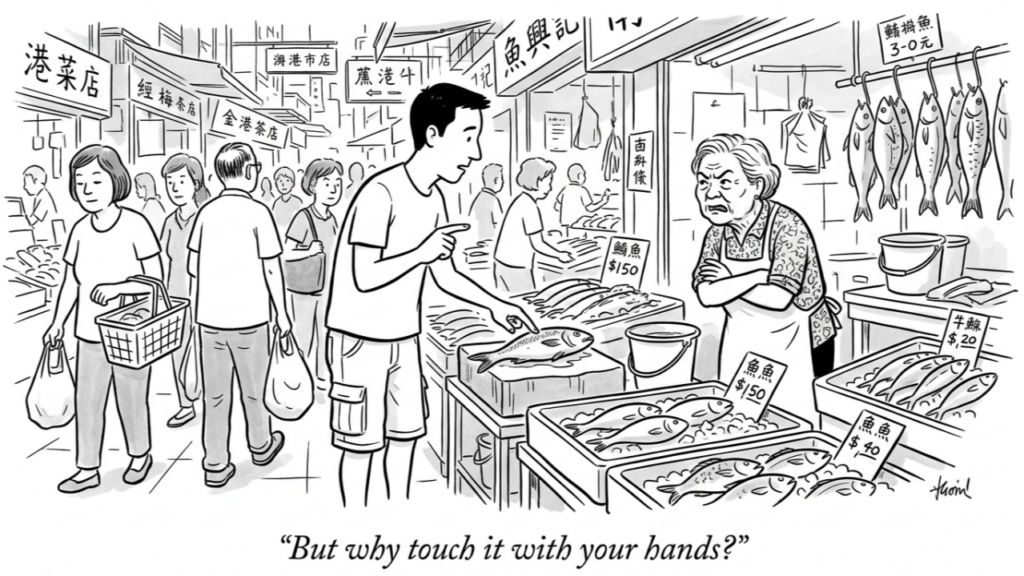
I have lived in Hong Kong for close to two decades. I still do not understand Hong Kong’s rules.
Not the laws. The laws are fine. The laws are written down. I mean the other rules, the ones that are not written anywhere, the ones that every single person in this city knows except me, the ones I am apparently supposed to have absorbed through the humidity.
I still mess up the wet market. There is a system. I do not know the system. There is an order in which you approach the stalls, a way you point at the fish, a volume at which you speak, a degree of eye contact that communicates seriousness without aggression. I do none of this correctly. I point at the wrong fish. I speak at the wrong volume. I once picked something up with my hands and the woman behind the counter looked at me the way a librarian looks at someone tearing pages out of a book. I do not know what I did. I still do not know what I did. I have not been back to that stall in four years, and I take a longer route now to avoid walking past it.
The thing about not knowing the rules is that it makes you a child. Not in a cute way. In the real way. In the way where you are a grown man with a career and a mortgage and a wife and you are standing in a cha chaan teng not knowing whether to sit down or wait, not knowing if the table is yours or shared, not knowing whether to move the newspaper or leave it, and the answer is always that you should already know, and you don’t, and the gap between should and don’t is where your dignity used to be.
I still make eye contact on the MTR. In America, eye contact is a social courtesy. It says, I see you, we are both here, we are sharing this space as humans. In Hong Kong, eye contact on the MTR says something else entirely. I am not sure what it says, because no one has explained it to me, but based on the reactions I get, it says something closer to, I am about to ask you for money, or, I am unstable and I have chosen you specifically. People look away. People shift. I have made grown adults change cars. I was just being friendly. I was being friendly in the wrong language.
That is the thing no one tells you about living abroad. You do not lose your old language. You just speak it in a place where it does not work, and every day is a small translation failure, and after enough of them you start to wonder if the problem is the language or the person speaking it.
I still apologize when I bump into people. This is the one that gives me away every time. In Adams, Massachusetts, where I grew up, if you bumped into someone, you said sorry. If they bumped into you, you also said sorry. If no one bumped into anyone but you were both reaching for the same door, you said sorry. It was not an apology. It was a sound. It was the sound that people made to acknowledge that two bodies had occupied nearby space.
In Hong Kong, bumping into someone is not a social event. It is physics. Two masses in motion, limited sidewalk, brief contact, continued trajectory. No one stops. No one turns. No one says sorry because there is nothing to be sorry about. You were walking. They were walking. Space is limited. Contact happened. This is not a moment. This is an average day.
But I say sorry. Every time. I say it in English, which makes it worse, because now I am not just the man who apologized for a collision, I am the foreigner who apologized for a collision, and the distinction matters, because one is strange and the other is expected, and being an expected kind of strange is its own category here, a category I have been in for almost two decades and will be in for the rest of my life.
I do not know how to wash my utensils at a restaurant. I mean I know now. I have watched it a thousand times. The hot water comes and you rinse the chopsticks, the bowl, the spoon, and you pour the water into the little bowl and discard it. I know the steps. But I do them the way someone plays a song they memorized but cannot hear, technically correct, rhythmically wrong, and the people at the table can tell, and they say nothing, which is worse than if they said something, because silence in Hong Kong is its own commentary.
There are rules about elevators. I do not know all of them. There are rules about how you hail a minibus, how you signal your stop, how you pay, how you exit. I have learned these, mostly, through a process that looked less like education and more like repeated public humiliation. There are rules about where you stand on the escalator, which I actually know, but I know them the way a tourist knows them, consciously, with effort, which means I am always one distracted moment away from standing on the wrong side and becoming an obstruction and a cautionary tale.
There are rules about typhoons. Which number means what. When you leave, when you stay, when the city shuts down and when it pretends nothing is happening even though the rain is horizontal. I love typhoons, actually. Typhoons are the one time Hong Kong admits that something is happening that is beyond anyone’s control, and for a man who never knows the rules, a day when the rules are suspended feels like a holiday.
There are rules about gifts. What you give. What you do not give. What colors mean what. What numbers mean what. I once gave someone a clock and Ruth looked at me the way you look at a man who has just detonated something without knowing he was holding it. I did not know. How would I know. I grew up in a place where a clock was a clock, not a message, not a symbol, just a thing that told you the time, and now I live in a place where a clock can end a friendship and I am supposed to just carry that information and not make mistakes, and I make mistakes, I make them constantly, and every mistake is a reminder that I am a guest in my own life.
Ruth used to correct me. In the beginning, she would lean over and whisper, not like that, or, don’t do that here, or simply, no. She was patient. She was thorough. She corrected my Cantonese, my posture, my ordering, my walking speed, my volume. She told me when I was too polite and when I was not polite enough and when I was being polite in a way that was technically correct but culturally strange, which is its own punishment.
She has stopped. She stopped years ago. I do not know exactly when she stopped, but at some point the corrections ended and what replaced them was silence, and the silence was not angry, it was not frustrated, it was something else. It was the silence of love that has made its peace. She married a man who will never fully assimilate. She knows this. I know this. We do not talk about it anymore because there is nothing left to say. I am me. I will always say sorry when I bump into someone. I will always make eye contact on the train. I will always be the man at the wet market who pointed at the wrong fish in 2014 and has been taking the long way around ever since.
She does not explain the rules anymore because the rules were never the problem. The problem is that I come from a place where the rules were different, and I have been here long enough to learn new rules but not long enough to forget old ones, and I am carrying both sets at all times, and they contradict each other constantly, and I just pick whichever one feels right in the moment, and it is almost always the wrong one.
As many of you know, I got lost in my own building once. Not the neighborhood. Not the district. My building. The lobby. I had lived there for years. I called Ruth. I told her I was lost. She asked where I was. I said the lobby. She hung up. She did not come down.
I found my way eventually. I always do. That is the other thing about Hong Kong. You figure it out, not because someone helps you, not because the rules suddenly make sense, but because you have been here long enough that even your confusion has a routine.
I think about Adams sometimes. Not with longing. Not the way people think about the places they left. I think about it the way you think about a language you used to dream in. I knew every rule in Adams. I knew how to greet people and when to wave and how long to stand in a doorway talking before it was time to leave. I knew what a clock was. Just a clock. I knew that sorry meant nothing and everything at the same time, and everyone around me knew it too, and no one ever had to explain it.
I left that place. I chose this one. I chose a city where I will never stop being slightly wrong, where I will never fully pass, where my instincts will betray me in small ways every single day. I chose it many years ago, and I choose it again every morning when I walk out into the heat and the noise and the density of eight million people who know things I will never know.
There is something honest about staying in a place that will not meet you halfway. It asks you a question every day, the same question, and the question is not do you belong here. The question is, does it matter.
I do not understand this city. I have never understood this city. I will probably die in this city not understanding this city. But I am still here, still saying sorry to strangers who do not want to hear it, still fumbling through the wet market like it is my first week, still married to a woman who hung up on me when I was lost in my own lobby and did not come down, because she knew I would figure it out, because she has always known that about me, even when I did not know it about myself.
I would not live anywhere else.