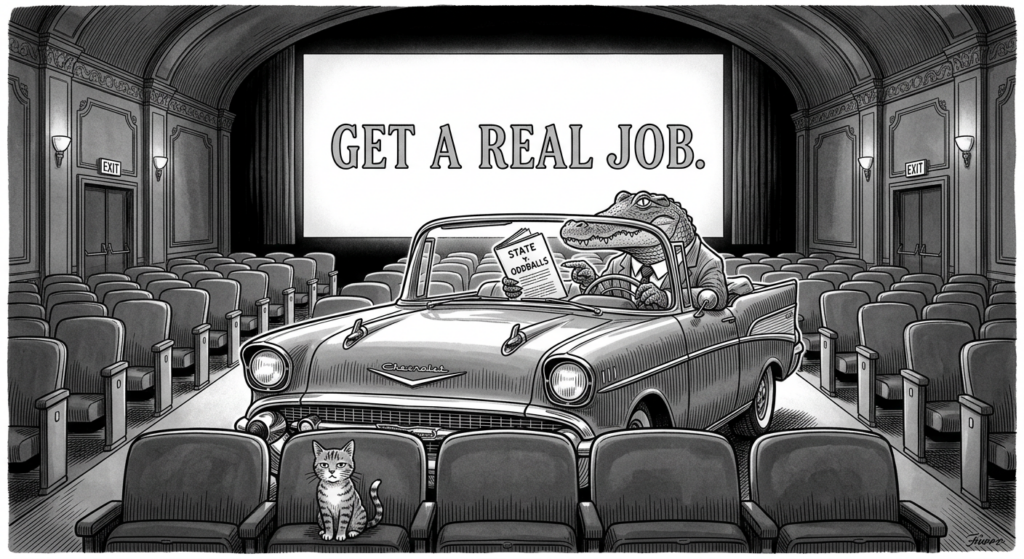
Ruth told me I need a real job.
She said it the way she says most things, which is to say while reading something on her phone. She did not look up. She did not need to. Ruth has perfected the art of delivering a life-altering sentence without moving any part of her face. I have seen her do it to waiters. I have seen her do it to Kevin, the poor guy who had the misfortune of renting me a Hyundai. I have seen her do it to building management. I have seen her do it to me so many times that I have developed a physical response to the sound of her unlocking her phone, which is a slight tightening in my chest, because the phone means she is about to read something, and when she reads something, she thinks of something, and when she thinks of something, she says it, and when she says it, it is always true, and the truth from Ruth has never once been something I wanted to hear.
“I have a real job,” I said.
“You have nine books and a LinkedIn profile.”
“That is not a job?”
“That is a hobby with a tax return.”
She said this without looking up. She was scrolling through something. I do not know what. I have never known what Ruth reads on her phone. It could be the news. It could be property listings. It could be a group chat where she and her friends discuss me in Cantonese. I will never know, and she will never tell me, and the not knowing is one of the load-bearing walls of our marriage.
I thought about this for a moment. I was standing at the window with my coffee, watching the city do what it does at eight in the morning, which is move in every direction at once. A man on the street below was pushing a cart of fish so fast that the Styrofoam boxes were vibrating. A woman in a visor was power-walking with her arms bent at exactly ninety degrees, which is the correct angle for a Hong Kong auntie in motion, and which I believe is taught in a class I have never been invited to. Two construction workers were sharing a cigarette on a scaffolding that looked like it had been assembled by someone who had seen a picture of scaffolding once and decided to improvise. The coffee contained chicory, which tastes like New Orleans, which is not where I am from and not where I live, but which is the taste I borrowed from someone else and never gave back. That is the whole story of my life in one cup. I take what I like from other places and make it mine. Ruth would say I also take what nobody else wants and make that mine too, and she would be right, and she would not look up when she said it.
But Ruth was not really talking about the books. She was talking about the past five years or so. The years where I did not do what lawyers do. The years where I did something else entirely. The years where, if you asked me what I did for a living, I would give you an answer that took eleven minutes and left you less certain than when you started.
Here is what happened.
In 2023, I represented a former Expeditors employee in a dispute with the company. The company had a no-layoff policy. They told a federal judge it never existed. They told the employee who believed it that she was unreasonable for doing so. I wrote about it. I wrote about the distance between what the CEO said in an earnings release and what his lawyers said in court. The piece got read by thousands of Expeditors employees. The CEO at the time was Jeff Musser. Musser joined Expeditors at sixteen and worked there for forty-two years. In February 2025, the company announced he was retiring, effective March 31. Six weeks’ notice, after forty-two years. Dan “the Desecrator” Wall took over on April 1.
I am not saying I got Jeff Musser fired. I am saying I wrote the thing that made the contradiction impossible to ignore, and then the contradiction did what contradictions do. Ruth, when I told her this, said, “So you got a man fired and you still do not have a real job.”
In 2025, I took on a private prosecution in Hong Kong. A journalist named Selina Cheng had been fired by Dow Jones, the publisher of the Wall Street Journal, after she was elected chair of the Hong Kong Journalists Association. The Labour Department declined to prosecute. So she brought a private prosecution, and I was her instructing solicitor. We convicted Dow Jones on the charge of deterring her from exercising her union rights. It was the first conviction of its kind in Hong Kong. The verdict was covered by Reuters, CNN, the Associated Press, and every outlet in between.
I represented Universal Entertainment Corporation in a casino dispute in Hong Kong. Universal is the Japanese gaming giant founded by Kazuo Okada, the man who made his fortune in pachinko and was once ranked among the richest people in Japan. Okada was not just Universal’s founder; he was also Steve Wynn’s business partner. The two men built Wynn Resorts together in 2002, and Okada’s Universal held a 20 percent stake in the Las Vegas casino empire. When the partnership soured and Okada was removed from the Wynn board in 2012, Universal and Wynn fought a long legal battle that ended with Wynn paying Okada $2.6 billion.
By then, Okada had turned his attention to the Philippines. Through Universal and its Hong Kong subsidiary, Tiger Resort Asia Limited, he was developing Okada Manila, a $2.4 billion integrated casino and resort complex on 44 hectares of Manila Bay. It was to be the largest casino resort in the Philippines, with nearly a thousand hotel rooms, over 500 gaming tables, and more than 3,000 electronic gaming machines.
The problem was the cost. The project had an approved budget of US$2.43 billion. By September 2019, the costs had exceeded that budget by roughly US$620 million. Universal and Tiger Resort came to Hong Kong, where Okada held substantial assets, and sued him for breach of director’s duties, seeking to recover over half a billion dollars. We sought a Mareva injunction to freeze his Hong Kong assets, including his stake in Okada Holdings, which was valued at the time at approximately US$330 million.
Here is the part that still surprises me. Before any of this, before the lawsuits, before the partnership with Wynn, before the pachinko empire, Universal made arcade games. In 1981, they released Lady Bug, a maze game where you played a ladybug navigating a maze of flowers and doors, eating dots and avoiding predators. I played it when I was a kid. I did not know who made it. I did not know what a Universal Entertainment was. I just knew the game, and the game was good. I was eleven years old in Adams, Massachusetts, feeding quarters into a machine in an arcade that smelled like burnt cheese and floor cleaner, steering a ladybug through a maze, and I could not have told you what pachinko was, or what a Mareva injunction was, or where Hong Kong was on a map. Decades later, I was sitting in a Hong Kong courtroom, representing the company that made it. I told Ruth this once. She said, “You were bad at the game too, right?” I was. The ladybug died constantly. I was not going to give her the satisfaction.
Then there was the money laundering case.
In early 2024, Hong Kong Customs announced the largest money laundering case in the city’s history. HK$14 billion. A family-owned syndicate, shell companies, cross-border trade fraud. Seven people arrested. I represented two brothers who were caught up in it. It was the kind of case that makes the news, and I made the news again, this time in a video that ran with the coverage, standing outside with one of my clients, looking like a man who had been called at three in the morning and had not been to bed since.
Then there was Yvette.
Yvette Digan was a twenty-two-year-old law student from Hong Kong, studying at City University, on a summer exchange at Boston University. In May 2025, she was at a fraternity party at Worcester Polytechnic Institute when someone poured Everclear, a 190-proof grain alcohol, 95 percent ethanol, onto an open fire. The result was a fireball that engulfed her. She suffered second and third-degree burns over more than thirty percent of her body, including her legs, neck, chest, and left hand. She required multiple surgeries, skin grafts, physical therapy, and counseling. Her medical bills reached into the hundreds of thousands.
I filed a lawsuit against Luxco, the Missouri-based company that makes Everclear. The claim was that Luxco had quietly removed the prominent safety warning labels from its bottles starting in 2018, warnings that had said, in large red letters, “CAUTION: DO NOT APPLY TO OPEN FLAME. CONTENTS MAY IGNITE OR EXPLODE,” and had begun marketing Everclear for culinary and household uses, including cooking near gas stoves and fondue pots with open candle flames. We alleged that the product had been involved in serious burn injuries across the country for years, and that Luxco knew it and kept selling it anyway. The lawsuit sought $70 million in damages and an emergency order banning Everclear sales in Massachusetts.
The case became the opening chapter of my book, Profit Before People: When Corporations Knew It Was Dangerous and Sold It Anyway. I appeared on the Howie Carr Show to talk about it. For anyone outside Massachusetts, Howie Carr is the voice of Boston talk radio, a National Radio Hall of Famer, a longtime columnist for the Boston Herald, and a man who once had a murder contract put on his life by Whitey Bulger, the city’s most notorious crime boss, because of his reporting. His show is syndicated across New England and simulcast on Newsmax TV. He is not a man who softens a story. When he wanted to talk about Yvette, I said yes. The case is still ongoing. Luxco has argued that Digan lacks standing because it was another person, not the company, who poured the Everclear onto the fire.
I became a columnist for Loadstar Premium, the world’s most popular logistics news source, writing about logistics and supply chains. I wrote an op-ed that appeared in China Daily rebutting an op-ed that appeared in the New York Times. I appeared in the news in Boston, Singapore, Manila, St. Louis, Hong Kong, and India, among other places. I am reasonably sure my mother still does not understand what I do. She tells people her son is a lawyer in Hong Kong. When they ask what kind of lawyer, she says, “The sleazy kind.” This is technically accurate and entirely unhelpful, which is the family tradition.
And then Stephen Roach, the former chairman of Morgan Stanley Asia, wrote an essay saying Hong Kong was over. I wrote a response. He grouped me with Hong Kong’s Deputy Financial Secretary, called my argument “especially impressive,” and we went back and forth. A China Daily article about Roach mentioned my book Hong Kong Belongs to Hongkongers and described me as an American lawyer who has lived and practiced in Hong Kong for more than a decade, married to a local, and who writes about the city as home rather than as a lost ideal.
I was also named Author of the Month by UK Talk Radio in January 2026. Geoff Carter, who hosts the breakfast show, reviewed Hong Kong Belongs to Hongkongers on air and on the station’s website. He wrote that it stayed with him long after he closed the cover, which for him is the sign of a serious book doing honest work. He wrote that I do not shout, posture, or try to score points, and that the book dismantles neat narratives and replaces them with something messier and more human. He wrote that once a place becomes a metaphor, it stops being understood. I do not know Geoff Carter. I have never met him and never been to his studio. But he read the book the way I hoped it would be read, and he said the thing I was trying to say. Ruth read the review. She did not look up. She said, “Author of the Month.” Then she went back to her phone. I am still not sure if that was approval.
I started my own website, The Escalator. I have appeared in Dimsum Daily. I have a profile on Muck Rack, an author page on Amazon, and a LinkedIn presence with a large audience, most of whom side with Ruth for reasons I have stopped trying to understand. I also have a cat who sits on my keyboard when I am trying to finish a paragraph, and who has, on at least three occasions, published a draft before it was ready by stepping on a combination of keys I have never been able to replicate on purpose.
I left Payne Clermont Velasco. Before I did, Doyle’s Guide listed me among the leading criminal lawyers in Hong Kong in 2021 and among the leading white-collar crime, corporate crime, and regulatory investigations lawyers in 2023. The listings are based on peer feedback and market research. They are the closest thing my profession has to a report card, and I keep them in a drawer with the other things I do not look at.
After years as a partner at Payne Clermont Velasco, I became a consultant with Lee Law Firm. We are changing the name to Kim Lawyers. American solicitor. Korean firm. Hong Kong. I am not sure which part of that sentence I am supposed to explain first, and I am not sure anyone has ever asked for the full version. When I told Ruth about the name change she said, “At least they are not naming it after you.” I asked her why that would be a problem. She said, “Because then people would have to say it out loud.” I still do not know what she meant by that and I have chosen not to ask.
And through all of it, Ruth watched. She watched me get up at 3 in the morning and write. She watched me take meetings with clients who wanted to sue shipping companies and freeze the assets of Japanese billionaires. She watched me publish essays that people read and then read the comments that said Ruth is right. She watched me become, in some small way, a person who is known for the thing I do when I am not being a lawyer. She watched all of this from the other end of the couch, or from the bedroom doorway at 3 a.m. where she would appear like a ghost in an oversized t-shirt, say nothing, look at me, look at the screen, look at me again, and go back to bed. The whole performance took four seconds. It communicated more than most conversations I have had in my professional life.
And then she told me I need a real job.
She also told me something else.
She said, “I dare you to title your next article ‘Interior Crocodile Alligator. I drive a Chevrolet movie theater.’”
She said it the way she says everything. Without looking up. Without explanation. Without any indication that she expected me to actually do it. Ruth issues dares the way other people issue sighs. They are not challenges. They are observations about what she already knows you are going to do, packaged as provocation so that when you do it, she can say she told you to.
So here it is. She dared me. And this is what I did.
The past few years have been strange. I, an American, convicted a major American media company in a Hong Kong court. I sued a man who was once the richest man in Japan for half a billion dollars. I wrote a book about corporate misconduct that got cited by people who do not usually cite me. I got into a debate with a Yale economist and held my own. I did all of this while technically being a solicitor, which is a job, but not the job I was doing.
The job I was doing was the writing. The writing was the thing that made the conviction matter, that made the Expeditors piece land, that made the Roach debate happen. The writing was the thing that turned me from a lawyer with opinions into a person people wanted to hear from. The writing was also the thing that made Ruth look at me across the flat at 11 p.m. on a Wednesday and say, “Are you still typing?” Yes. I am still typing. I will always be still typing. That is the deal.
And Ruth, who has been married to me long enough to know that when I say something does not mean anything, it usually means something, told me to get a real job so the writing could be the thing I do when I am not working, instead of the thing I do instead of working. This is, I realize, a completely reasonable position. It is also the most painful kind of criticism, which is the kind that is right.
I thought about it. I thought about it for a long time. I thought about it while standing at the window drinking chicory coffee that had gone cold because I was thinking instead of drinking. I thought about it while watching the auntie on the street below rearrange her recycling cart with the precision of a chess grandmaster and the urgency of someone defusing a bomb. I thought about it while the cat sat on the windowsill and stared at a pigeon with the focus and intensity of a man who has been asked a question by his wife and is not yet sure of the answer.
Here is what I came back with.
The past few years have not been a hobby. They have been a practice. The practice of a man who chose a city that will never meet him halfway and decided to keep choosing it anyway. The practice of finding the sentences that are mine, in a language that is not mine, in a place that does not care whether I learn it.
There is a line I say to myself when the city gets too heavy. I heard it in 2008, on a loop, the way everyone heard it. Someone had cut two bars out of a freestyle by a Cleveland rapper called Chip tha Ripper and set it spinning on repeat. The whole thing was nonsense. It was a car boast, technically. Crocodile seats, screens in the headrests. But stripped of context it became pure absurdity, a sentence that meant nothing and stuck to everything. The video had a low-resolution photo of an alligator sitting in the driver’s seat of a car. That was it. That was the whole production budget. And it was perfect.
Interior crocodile alligator. I drive a Chevrolet movie theater.
I love that line because it breaks every rule of language and does not care. It does not follow a grammar. It does not build a sentence that means anything. It is a boast with no boast in it, a rhyme with no reason, and yet it works. It works because the man who wrote it decided it would work. He broke the convention and the convention had no choice but to accept it.
That is what I have been doing.
I did all of this from my couch in Mei Foo.
That is the part I want you to know. The conviction of a major American media company. The half-billion-dollar casino dispute. The book about a company that sold a product it knew would burn people. The column, the website, the LinkedIn profile with thousands of audience members, the appearances on the news in Boston, Singapore and Manila and St. Louis Hong Kong and India. I did all of it from a couch in Mei Foo, in a flat in a housing estate in the middle of a city I still do not fully understand. The couch is blue. It has a permanent indentation on the left side where I sit. The indentation is deep enough now that if I put a marble on the cushion it would roll toward my spot. Ruth has pointed this out. She did not find it charming.
There is no office. There is no corner suite. There is no receptionist. There is a couch, and a coffee table that has ring stains from every cup of chicory coffee I have failed to put on a coaster, and a cat on the windowsill who has never once been impressed by anything I have written, and Ruth reading something on her phone and telling me I need a real job.
I break convention.
I am an American solicitor, Hong Kong and US qualified, working for a Korean firm, in a Chinese city, representing a Filipina in legal proceedings in America, writing essays in English about a Cantonese fish market, with a tattoo on my arm in Chinese, and I still cannot order at a cha chaan teng without pointing at something and hoping for the best. The last time I tried to order in Cantonese, the woman behind the counter looked at me the way you would look at a dog who had just attempted to open a door by staring at the handle. She was not unkind. She was confused. These are different things, and in Hong Kong, the difference matters. I do not fit the model. I do not match the template. I am not the guy the brochure was designed for. I am the guy on the couch in Mei Foo, doing the work from the place I chose, in the way I chose to do it, because the way other people do it has never quite worked for me.
Here is what my day actually looks like. Ruth gets up at seven. She gets ready, she has her breakfast, she reads something on her phone. The breakfast is precise. It is always the same. Toast, cut into triangles, with a thin layer of peanut butter that she applies with the focus of someone restoring a painting. I get up with her, because I want to see her before she goes. I walk her to the door. I say goodbye. I kiss her or, I should say, she kisses me. I tell her to have a good day. She says something in return that I choose to interpret as affectionate, but probably is not. And then I go back to bed.
I have not been to the office in months.
She hates this. She does not say it, because she is patient, and because she has been married to me long enough to know that some battles are not worth fighting, and because she knows that the work gets done whether I am in an office or not. But she hates it. I can tell. There is a particular quality to the silence that follows the goodbye when she knows I am going back to bed. It is not anger. It is not disappointment. It is something closer to resignation. It is the sound a door makes when it closes behind someone who has already decided what they think about you but is going to let you figure it out on your own. It is the sound of a woman who married a man who does things his own way and has decided, for the most part, to let him. For the most part. The phrase is doing a lot of work in that sentence and we both know it.
After she leaves, I sleep for another hour or two. Sometimes three. I am not proud of this. The cat joins me, because the cat is also not proud of anything and we have that in common. Then I get up. Then I go to the gym.
The gym in Mei Foo is open twenty-four hours. I go in the morning, most days, usually around nine or ten. It is empty then. The equipment has that particular look of machines that were new in 2014 and have been wiped down with the same cloth ever since. The mirrors are slightly too high, which means I can only see myself from the chest up, which is the most flattering possible angle and I suspect this is not an accident. It is just me and the machines and the one guy who works the front desk and does not seem to know what to do with a foreigner who shows up at ten in the morning on a Tuesday. He nods at me. I nod at him. We have been nodding at each other for months. I do not know his name. He does not know mine. It is the most successful relationship I have in the building. If anyone is in the Mei Foo area and wants to hit the gym in the morning, hit me up. I am there. I am usually the only one there. I could use the company. The front desk guy could use a break from nodding.
The rest of the day is the fun. The writing, the calls, the emails, the essays, the columns, the books. I do it from the couch, or from the desk in the corner of the flat that Ruth calls “the desk” and I call “my office” and she calls “the desk” again, louder, to make sure I heard her the first time. Or from the coffee shop down the street when I need to be around people. The coffee shop has a woman who works the register and has memorized my order without ever having spoken to me. She sees me walk in and starts making it. This is either good customer service or evidence that I come here too often, and I suspect it is both. I do not go to the office. I do not need one. I have a laptop and a phone and a city that never stops moving outside the window, and that is enough. Ruth does not think it is enough. But Ruth also married the man on the couch, so I maintain that she knew what she was getting.
There is one more thing. I made six business trips to the United States last year. Each one was about two weeks. That is twelve weeks on the road, not counting travel days and the particular agony of a fourteen-hour flight during which I watch three movies I have already seen because I am afraid to try the ones I have not. Ruth came with me for a few of them. She survived Adams.
Adams, Massachusetts, is where I grew up. It is a small mill town in the Berkshires, population eight thousand on a generous count, and the count is always generous because people in Adams include everyone who has ever lived there, including people who left in 1987 and have not been back since, because Adams does not believe in letting go. It is the kind of place where everyone knows your family and your business and the last time you were in town and whether you have put on weight. They know this because they are standing at the gas station or the post office or the parking lot of the one grocery store, and they see you, and they tell you. “You look good,” they say, which means you have not put on weight. Or they say nothing about how you look, which means you have. Ruth, who grew up in Hong Kong, in a city of 7.4 million, in a flat that is smaller than the driveway of the house I grew up in, walked into Adams and did not blink. She ate the food. She ate the food in quantities that alarmed my mother, who responded by making more food, which Ruth also ate, and my mother decided on the spot that Ruth was the best thing I had ever done. She is.
She survived the winters. She stood in snow up to her shins wearing a coat I bought her at a store in Lee, Massachusetts, which is a town on the other side of the county, because Adams does not have a coat store, because Adams barely has a town. She did not complain, not once, not in a way I could hear. She just looked around at the mountains and the river and the empty streets where the only movement was a man walking a dog that was clearly walking him, and she said, in her Cantonese-accented English, “It’s quiet.”
Which it is. Which is the whole point. Which is why I left, and which is why I still go back, and which is why the fact that she came with me and survived it means more than I can say. I took her to the diner. I took her to the bridge over the Hoosic River where I used to sit as a kid and throw rocks into water that was going somewhere I was not. I took her to Mount Greylock, which is the highest point in Massachusetts and which she climbed without complaint and without stopping and then looked at me at the top while I was breathing like a man who had been rescued from something and said, “You grew up next to this and you are not in better shape?” She was genuinely confused. I had no answer. I still do not.
I do not know what the rules are here. I have never known. But I know the lyric. And the lyric knows me. And we have both decided that the rules are not going to be the thing that stops us.
Ruth dared me to title this “Interior Crocodile Alligator.” She did not think I would do it. She does not read these before they go up. She will find out when someone tells her, or when she sees it on her phone, which is the same thing. And when she does, she will not look up, and she will not say anything, and the silence will mean exactly what it always means, which is that she was right and I did the thing she knew I would do and she is not surprised and she is not impressed and she married me anyway.
And she will still be thinking she could have married a banker.
Interior crocodile alligator. I drive a Chevrolet movie theater.
I do not drive a Chevrolet. I do not drive anything. I take the MTR. But I do live in a movie theater of my own making, a flat in Mei Foo where the walls are lined with books I wrote and the couch has a dent shaped like my body and the cat does not care and Ruth is reading something on her phone and will not tell me what.
That is the job. That has always been the job.
She knows it. She has always known it.
She just wants me to get a real one too.