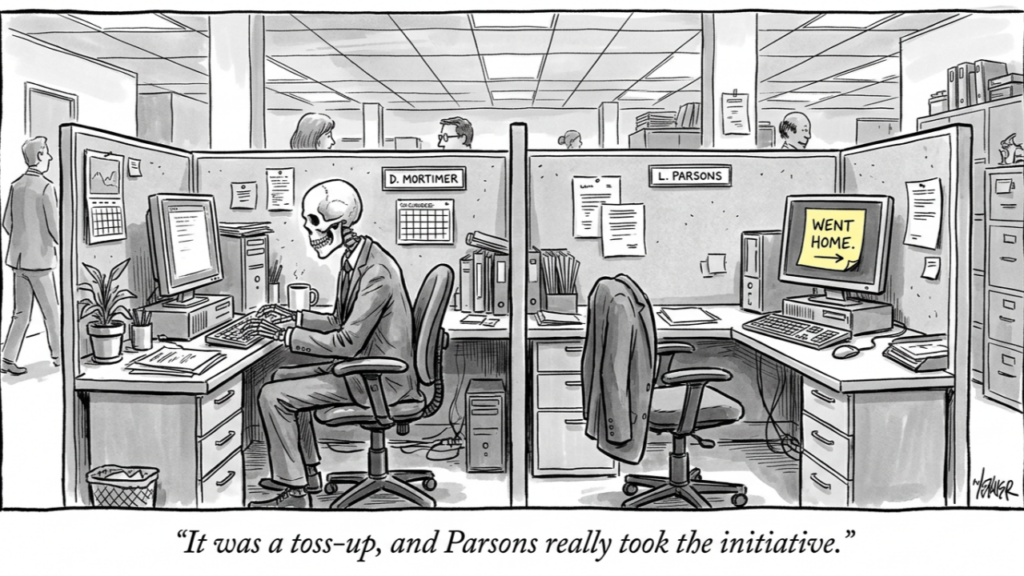
On Uncle Carmine, corporate loyalty, and the fact that nobody at your funeral is going to talk about wishing they had worked more.
My Uncle Carmine was at Pearl Harbor when it was bombed. He served in Korea. He served in Vietnam. Three wars. Three separate occasions on which the United States government asked Carmine to go to a place where people were trying to kill him, and three times Carmine went. When he came home from the third one, he did not write a memoir or launch a leadership podcast or position himself as a thought leader in the emerging field of surviving things. He came home and he lived. Quietly. Without performance metrics.
He said one thing to me that mattered more than anything I learned in law school, anything I billed for, anything I read in a brief or a boardroom or a business class lounge at Chek Lap Kok:
Nobody goes to their grave wishing they had worked more.
He did not say it with emphasis. He did not say it the way a keynote speaker says it at a conference in Orlando, lit from below, voice cracking at a rehearsed moment, while two thousand people in lanyards feel something for forty-five seconds and then check their phones. He said it the way a man says something he knows is true because the truth nearly killed him three times and he is not interested in your opinion about whether it applies to you.
It applies to you.
I grew up in Adams, Massachusetts. Eight thousand people. A mill town in the Berkshires where everyone knows your name, your mother’s name, and what happened at the Polish National Alliance bar last Saturday. I live in Hong Kong now. I practice law here and in the United States. I have spent thirty years in the machinery of professional life, and the machinery nearly killed me. Not a metaphor. My body, which had been keeping score in ways my mind refused to, sent me a message. Not an email. Not a calendar invite. The kind of message that arrives when the body has exhausted every other method of communication and decides to try the emergency broadcast system.
I was devoting everything, time, health, sleep, the hours that belonged to my wife, the hours that belonged to whatever remained of my capacity for joy, into cases and causes I believed in. And I did believe in them. The belief was not the problem. The problem was that I had confused the fact that the work mattered with the conclusion that I did not. That the parts of me that wanted to sit on a couch in Mei Foo and watch a Wong Kar-wai film with my wife, or eat dim sum on a Sunday morning, or write a story about a garden hose and four girls from Pittsfield, were luxuries. Extras. Nice-to-haves that could be deferred indefinitely while the real work consumed everything else.
The body does not defer. The body does not schedule a follow-up meeting.
So I am doing what I love. I am writing. Including, now, for Loadstar Premium, a publication read by the people who move cargo across oceans and understand, better than most, what it means to keep things in motion. Alessandro Pasetti, the Head of Loadstar Premium, took a real risk giving a platform to a man who writes about hitting gym teachers with golf balls and impersonating Sears at two in the morning. That is either courage or poor judgment, and I am grateful for both.
It costs something.
I am losing friends. I am losing family. Not in the dramatic way. In the quiet way. The way you lose people when you live eight thousand miles from the town you grew up in and the news, when it comes, comes through a screen, at a delay, in a different time zone. Pete Love, who once flew a Volkswagen off a hill on Fisk Road and faced a police cruiser alone while I ran into the darkness, died in 2023. I read it on my phone in Mei Foo. Eight thousand miles away. Thirteen time zones. Time is not renewing. Carmine knew this. He learned it in the harbor, in the fire, in the water. He learned it the hard way so he could say it the easy way, one sentence, in a kitchen, to a nephew who would not understand it for thirty years.
Now. The part you need to hear.
If you are a C-suite executive, a VP, a director, a manager, or a person in any cubicle at any level of any organization, I need to say something that no one at your company will ever say to you, not your manager, not HR, not the CEO in the town hall who tells you that you are a family:
They do not care about you.
I say this with the calm clarity of a man who has seen the machinery from both sides. Ask Jeff Musser, former CEO of Expeditors International. He joined the company at sixteen. He became just the third CEO in the company’s history, leading revenue growth from $6.1 billion to $10.6 billion. Forty-two years. His entire adult life. He notified the board in February 2025 of his plans to retire, effective March 31, 2025. Six weeks. That is what forty-two years buys you. The company praised him for cultivating “corporate culture and values, which have been the foundation of our competitive advantage since our beginning.”
The culture and values. Hold that phrase while I tell you what I found.
Ever since the days of Peter Rose, Expeditors prided itself on a “no layoffs” policy strongly embedded in its DNA. That was the promise. That was the culture. A so-called covert termination program was allegedly put in place. A detailed examination revealed Expeditors’ transformation from a “no-layoff” company to a firm that allegedly engineered systematic workforce reductions while maintaining the pretense of its founding values. Approximately two thousand positions, eliminated under the guise of performance issues. I exposed it. I published the evidence, including a smoking gun email from the CEO himself. Workers deserved transparency about business challenges instead of covert programs designed to circumvent stated policies. Shortly after, the CEO who oversaw that culture “retired” with six weeks’ notice, and the press release thanked him for the values.
The CEO. Forty-two years. If they will do it to him, what makes you think the chair you are sitting in has your name on it?
I ride the MTR at rush hour in Hong Kong. Every morning I watch the doors open and a thousand people step out with the same eyes. You know the eyes. You have had the eyes. The eyes of a person who left their apartment forty-five minutes ago and will not return for eleven hours, spending the interval doing something they do not love for someone who does not care in a building that will forget their name the day they leave. The same eyes in Hong Kong as in London, the same eyes in Singapore as on the 7:47 out of Greenwich or Rowayton, carried in the skulls of men and women in good suits with good titles who are, by every external measure, succeeding, and by every internal measure, gone.
I have seen the executive version. The first-class lounges at Heathrow and Changi with the shower suites and the champagne and the daylight lamps designed to trick your body into believing it is morning when it is nothing o’clock because you have crossed so many time zones that time has become a suggestion. The hotel rooms in Shanghai and Dubai that all look the same, same white duvet, same desk, same minibar, same view of a city you will not see because the conference starts at eight and the dinner ends at eleven and the flight is at six-thirty. The suitcase that is never fully unpacked because unpacking would suggest permanence and there is no permanence, there is only the next flight and the next room and the next handshake with someone who asks how you are and does not wait for the answer.
The answer is tired. The answer is far from home. The answer is I-haven’t-seen-my-kid’s-game-in-three-weeks. The answer is I-am-succeeding-at-everything-except-the-things-that-matter.
I have been that man. I have had those eyes. And then the body sent the message, and I had just enough sense to listen.
Here is what I am asking you to do. Not next quarter. Not after this project. Not after the kids are older or the mortgage is paid or the promotion comes through.
Go home. Go to the game. Go to the recital. Go to the dinner you keep rescheduling because something came up, and understand that something always comes up, that the something is the system telling you it needs you more than your family does, and it is lying, fluently, in the language of urgency.
Do something absurd. Write the thing you have been carrying in your head for ten years. Call someone you haven’t spoken to in years. Take your kid to a ballgame on a Wednesday. Do the thing that has no ROI, that cannot be captured on a slide, that no one at your company would understand. Do the thing that Carmine did when he came home from three wars and refused to be impressive about it and just lived.
The corporation will not do this for you. The corporation will send Jasper. The corporation will offer you miles. The corporation will tell you that your experience of not living was a personal comfort preference, and then it will process you out with a press release and a six-week notice after forty-two years, and the chair will be warm when the next person sits down.
You have to do it yourself.
The thing you want to do, the real thing, not the spreadsheet, not the email, is dying. Not dramatically. The way a plant dies in a room with no light. Slowly, silently, in the minutes you gave to the meeting that could have been an email and the email that could have been nothing. And one day you will look at the place where it was and it will be gone and you will not be able to say when it left.
Uncle Carmine survived Pearl Harbor so he could say one sentence in a kitchen in Massachusetts to a nephew who would not hear it for thirty years. I heard it. I am saying it to you now, on a professional networking platform, between the quarterly earnings analyses and the conference lanyards, in the only voice I have:
Nobody goes to their grave wishing they had worked more.
Close the spreadsheet. Open the door.
While you still can.