I have written before about the theater of hailing a Hong Kong taxi, the U-shaped hand gesture under an imaginary harbor, the window rolling down just far enough to reject you, the small miracle of the fifth driver who finally says okay. I stand by all of it. The Hong Kong taxi driver is a free agent who owes you nothing, and there is something almost bracing about a service that makes you earn it.
I did not expect to be writing, a year later, about the taxi trade the way you write about an endangered species, but that’s more or less what this has become. In 2015, a Hong Kong taxi license, the little laminated permission slip that lets you legally charge strangers for rides, sold for as much as HK$7.25 million. Today it goes for under HK$2 million, less than a quarter of peak value, and still falling. Somewhere in this city there is a man in his sixties who bought a license in the 2000s the way his father might have bought a small flat, the boring, reliable thing you hand down. He worked nights for it. He is still working nights for it. And the asset he was counting on to carry him into old age is worth a fraction of what it was, through no failure of his own, just the ordinary cruelty of a market that changed its mind about what his life’s work was worth.
The license system itself is a peculiar piece of Hong Kong engineering. The government stopped issuing new urban and New Territories taxi licenses in 1998 and never resumed, freezing supply at roughly 18,000 for nearly three decades while the city’s population, tourism, and late-night drinking habits all grew around it. Scarcity was the whole business model. A license was a small, tradable piece of a monopoly, and for fifty years it behaved like one, appreciating quietly while the men actually driving the cars often rented them by the shift and never saw a cent of that appreciation themselves. Then Uber showed up in 2014, technically illegal, practically everywhere, and the monopoly started leaking.
For most of the last decade, Hong Kong handled this the way it handles most uncomfortable questions, by not really answering it. Uber drivers operated on private car licenses that technically forbade carrying paying passengers, which made every ride a small act of civil disobedience. Police occasionally arrested drivers. Nothing structural changed. Uber kept growing anyway, and by this year it had more than 30,000 active drivers on its Hong Kong platform, nearly double the entire licensed taxi fleet, all operating in a legal condition best described as everyone knows, nobody enforces.
That ended, more or less, last October, when the Legislative Council passed a bill establishing a formal licensing regime for ride-hailing services. The government gazetted the actual rules this past May: a cap of 10,000 ride-hailing vehicle permits, chosen specifically, officials said, because it would not excessively affect taxi drivers’ income. Applications opened in early August, and the government hopes to issue the first permits in November, which is to say, essentially now, as you read this. Ten thousand permits sounds generous until you remember there are already more than 30,000 people driving for Uber in this city. Uber itself has said publicly that a cap anywhere near this level means over 20,000 current drivers lose their income, that four in ten ride requests could go unfulfilled during rush hour, and that wait times could double. The taxi trade, for its part, thinks 10,000 is still far too many and had lobbied for a cap closer to 3,600. Nobody got what they wanted, which in Hong Kong policymaking usually means the number is about right.
The taxi trade will tell you Uber is killing them, and the license price chart backs that up, but talk to the drivers themselves and the picture gets more complicated, which is usually how it goes with these things. Plenty of working taxi drivers, the men actually behind the wheel rather than the investors who bought the license, will admit the ride-hailing apps have become a second income stream, since many taxis are now bookable through the same apps that also dispatch Uber cars. It is the license owners, some of whom paid seven million dollars for a piece of paper that now trades for two, who have the most to lose. The Hong Kong Taxi and Public Light Bus Association said in May that more than three-quarters of taxi owners have fallen into debt because of ride-hailing competition, most of an industry lying awake doing math that no longer works, watching an asset they were told was as safe as property behave instead like a stock nobody wants. There is now a genuinely serious proposal, backed by industry heavyweights, that the government use public money to buy back licenses at something closer to their old value, and whatever you think of the economics, it is worth pausing on what it would mean for that number to just sit there, unaddressed, for the people living inside it. Ask an ordinary commuter what they think of spending tax dollars to bail out an asset that was always a speculative bet on artificial scarcity, and you will get the reaction you’d expect. Ask the driver’s wife what she thinks, and you will get a different answer entirely.
So the traditional taxi is being squeezed by regulation catching up to a decade of Uber operating essentially unbothered, by drivers who increasingly work both systems at once, and by a permit cap that satisfies no one but at least ends the pretending. It is not a clean story of plucky underdog crushed by Silicon Valley. It is messier than that, and more Hong Kong than that, an entrenched cartel, a foreign disruptor, and a government trying to legislate its way to a truce between the two while 90 percent of the city just wants to get home on the MTR anyway.
Here is where I confess something that complicates my own sympathies. Over the past few months I have quietly become a taxi loyalist again, not out of nostalgia for the U-shaped hand gesture and the fifty-fifty odds of rejection, but because Uber, in Hong Kong, has started doing something that makes me want to throw my phone into the harbor. It goes like this. I open the app. A driver accepts. The little car icon appears on the map, supposedly en route. And then it just sits there, not moving, parked, as far as I can tell, somewhere a comfortable distance from wherever I happen to be standing, close enough to count as assigned, far enough that actually coming to get me was apparently never the plan. Ten minutes pass. Twelve. Fifteen. Eventually I cancel, because I have somewhere to be, and the driver has, in effect, been paid in my patience for doing nothing at all.
Ruth has watched me do this enough times now that she no longer bothers looking up from her phone. The first time, she asked what was wrong. The second time, she asked if the driver was lost. By the fifth or sixth time, she had stopped asking questions entirely and simply started walking toward the taxi rank the moment my thumb hit cancel, the way you’d stop asking a dog why it barks at the mailman and just get the leash. “You could just do this part first,” she said once, not looking up, already three steps ahead of me toward a red Toyota Crown idling at the curb. I did not have a good answer for her then, and I do not have one now.
I do not think I am imagining this, either. It turns out to be a well-documented pattern outside Hong Kong too, riders around the world posting the same complaint: a driver accepts a ride, never moves, and either quietly collects a cancellation fee once the rider gives up or simply keeps the booking parked as a kind of insurance policy while working a better fare on the side. Uber’s own cancellation rules, five minutes of waiting before a no-show fee kicks in, two minutes before the rider gets charged for backing out, were clearly designed with good-faith actors on both sides in mind. They were not designed for a driver who has decided that doing nothing is more profitable than driving.
It has happened often enough, across enough different pickup spots, that I have stopped treating it as bad luck and started treating it as a business model. There is a particular flavor of helplessness in standing on a curb, watching a small blue car icon on your phone not move, minute by minute, while you do the math on whether you’ll still make dinner, your meeting, your flight. You cannot honk at it. You cannot make eye contact with it. You cannot even be certain it is real, that there is an actual person behind the wheel making an actual choice not to come, rather than some glitch you are choosing to take personally.
I have met this particular species of nothing before. I wrote, a few weeks ago, about my six-month correspondence with Cathay Pacific and Banyan Tree, a story that eventually introduced a man named Jasper, a customer service representative with no memory of anything his colleague had promised me, who offered me the exact same 18,000 miles as if six months and three departments and a written commitment had simply never happened. The blue dot that will not move is Jasper’s cousin. Neither one has to look you in the eye. Neither one has to remember you tomorrow. The taxi driver who shakes his head at Mei Foo is at least spending his own face on the rejection. The app just spends your time, and answers to no one.
The practical effect on me, one commuter among millions, has been to send me right back to the curb with my arm raised, making the little U-shape, taking my chances with a system that at least has the decency to reject me quickly rather than waste a quarter of an hour pretending to help.
And this, I think, is where the story actually lands, and it is stranger than either side’s talking points. The taxi trade is being regulated into a smaller, more permanent piece of the market, its license values gutted, its owners in debt, while the government spends a year building an elaborate permit system to formalize a competitor that, in my own recent experience, cannot always be bothered to show up. Uber will get its 10,000 permits in November, or something close to it, and will keep insisting that number is too small. The taxi trade will keep insisting it’s too large. Both of them will keep advertising reliability as their core selling point, and both of them, on a bad night in Wan Chai, will fail to deliver it in exactly the way you’d least expect.
The stars did align, eventually, for the fifth taxi in that story I wrote last year, and these days I’d rather take my chances with driver number five than watch a blue dot sit motionless on a map, quietly deciding I’m not worth the trip. Somewhere out there, that man in his sixties is still working nights, still driving the same streets, still holding a license that used to mean something more than it does now. He does not know me. He has probably never heard of Uber’s cancellation window or the algorithm that makes it profitable to sit still. He just knows the fare came, and he took it, and that has to be enough for tonight. It should be enough. I would like to live in a city where that is still enough.
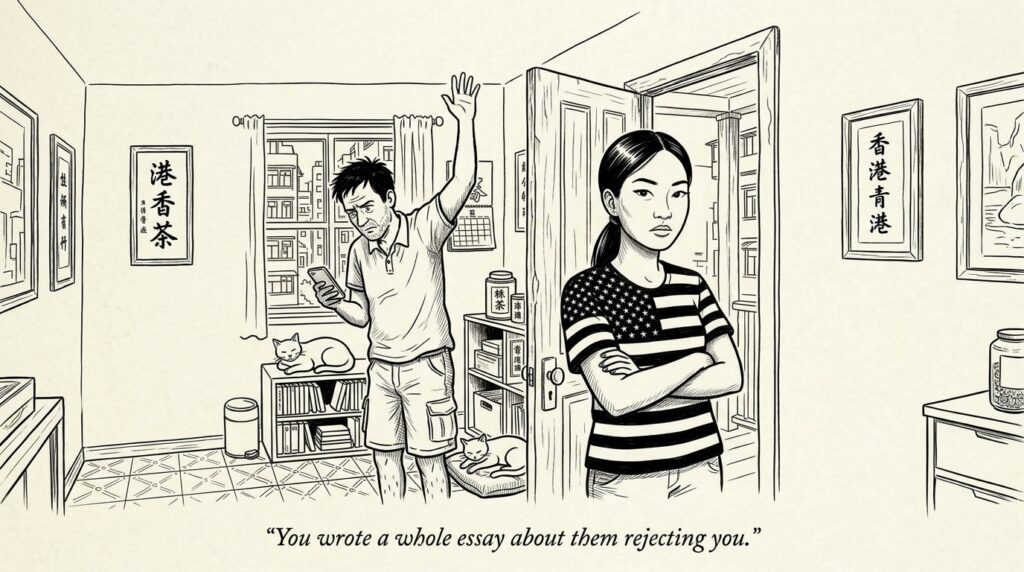
Ruth, for her part, has a simpler read on the whole affair. She just shook her head when I told her all this. “You wrote a whole essay about taxis rejecting you,” she said, “and Uber still managed to make you miss them.” That’s the part I can’t argue with.
Comments