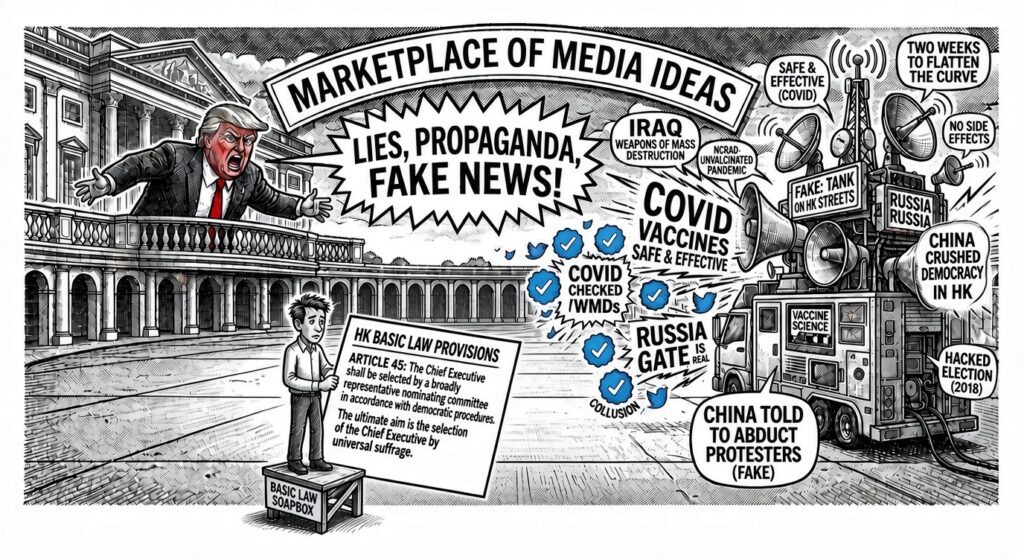
Last Friday, Trump announced on Truth Social that he was “proud” to ban CNN, MS NOW, and Politico from the White House grounds, calling their coverage “fake news.” By Saturday their credentials were deactivated. The three outlets sued Monday. A federal judge blocked the ban within days and ordered access restored.
Trump’s grievance with the press isn’t invented from nothing, and a few specific cases carry real weight. In December 2017, ABC’s Brian Ross reported that Trump had directed Michael Flynn to contact Russian officials during the campaign, a claim serious enough that the Dow dropped roughly 350 points within minutes of the broadcast. The story was wrong. Flynn’s contact came after the election, during the transition, a materially different and far less incendiary fact, and ABC suspended Ross for four weeks over a report his own network admitted “had not been fully vetted.” In January 2019, BuzzFeed reported that Trump had personally directed Michael Cohen to lie to Congress, a story so explosive it briefly raised talk of obstruction charges, only for Robert Mueller’s office to take the almost unheard-of step of publicly disputing it as “not accurate” less than 24 hours later, a rebuke special counsels essentially never issue.
And the “very fine people on both sides” line from Charlottesville, real words, said by Trump, ran for years in coverage and campaign ads with the sentence immediately after it quietly dropped, the one where he said he wasn’t talking about the neo-Nazis and white nationalists, “because they should be condemned totally.” None of this makes every complaint Trump has made about coverage accurate, and plenty of his own claims about the press don’t survive the same scrutiny. But a president who has watched a market-moving false report, a special counsel’s own team disputing a story about him, and a selectively quoted sentence all shape the public record against him has more than a persecution complex to point to when he calls the coverage unfair.
Cable news spent the week treating the ban as a uniquely Trumpian assault on a free press. I think that’s the wrong story. The right story is what kind of press we’re actually fighting to protect, and whether the reasons we protect it still apply to what it’s become.
The First Amendment’s protection of the press was never unconditional, and it was never meant to be. It rests on a specific theory: that a free exchange of ideas, left alone by government, tends toward truth, because false claims get outcompeted by better information circulating in the same open space. That theory assumed something about the incentives of the people doing the circulating. It assumed a press that made money by being trusted, because trust was the only thing that kept readers coming back to a finite number of newspapers and broadcast slots.
That trust is gone, and the collapse is not a matter of opinion. Gallup’s polling on confidence in the mass media goes back to 1972, when 68% of Americans said they trusted newspapers, television, and radio to report the news fully, accurately, and fairly. By September 2025, that number was 28%, a new low in the trend, down from 32% the year before. The partisan split is the part that should actually worry you regardless of which party you belong to: only 8% of Republicans now say they trust the media at all, against 51% of Democrats, a 43-point gap that has roughly doubled since 2020. A press that has lost four in five conservatives and half of liberals isn’t suffering a messaging problem. It has lost the one asset the marketplace-of-ideas theory assumed it would always protect, because protecting it was the whole business model.
Today’s dominant media model doesn’t run on trust. It runs on attention, harvested by algorithm, sold to advertisers, optimized second by second for whatever keeps a thumb from moving. Outrage outperforms accuracy. Division outperforms nuance. A correction, by design, is boring, and boring loses. The marketplace of ideas didn’t disappear. It just stopped selecting for truth, and started selecting for whatever the algorithm can monetize fastest, which turns out to be neither.
None of this is unprecedented in the sense of the law suddenly having no tools. What’s unprecedented is the argument, made with a straight face by media companies and platforms alike, that this new model deserves the same near-absolute protection the old one earned.
Standards have never actually been static. Congress passed the Sedition Act of 1798, criminalizing criticism of the government, within a decade of the Bill of Rights being ratified. The Espionage Act of 1917 was used to prosecute newspaper editors and imprison Eugene Debs for a speech questioning the draft, producing Schenck v. United States, the case that gave us “fire in a crowded theater,” a standard so permissive by modern measure that the Court itself abandoned it in 1969 for Brandenburg’s much narrower incitement test.
From 1949 to 1987, the FCC’s Fairness Doctrine required broadcasters to devote airtime to contrasting views on controversial public issues, upheld by the Supreme Court in Red Lion Broadcasting v. FCC on the theory that scarce spectrum was a public resource broadcasters held in trust, not a private soapbox. Time, place, and manner restrictions, content-neutral rules about when, where, and how speech happens rather than what it says, have always been permitted so long as they’re narrowly tailored and leave open other ways to speak. Even the case usually cited as the high-water mark of press freedom, the Pentagon Papers ruling in 1971, only barred prior restraint. It left the door open to punishment after the fact.
Doctrine has moved before, sometimes toward more protection, sometimes less, always in response to some claim about what the press actually was and what it was for. The claim underneath today’s version doesn’t hold up nearly as well as everyone assumes it does.
Start with the harm the current model does to the people least equipped to resist its design: children. On August 26 of this year, Meta agreed to pay roughly $18 billion to settle claims brought by 51 state attorneys general, ending a trial in Oakland where a bipartisan coalition alleged the company built Instagram and Facebook to be addictive to minors using design techniques its own internal research compared to a casino, then hid what it knew from parents. That settlement followed a bellwether jury verdict five months earlier finding Meta and YouTube had knowingly harmed a young user’s mental health, splitting a $6 million damages award between them.
Attorney General Rob Bonta’s own language from the case: Meta “designed a dangerous product for young users, knew it to be dangerous, and then lied to children, families, and the community about how dangerous it was.” Nobody’s arguing Instagram’s feed is protected political speech. But it’s the clearest available evidence that an engagement-optimized information architecture will, left to its own incentives, produce measurable harm to a population that can’t consent to the bargain. The same design logic that hooks a fourteen-year-old on an infinite scroll is the design logic deciding what a fifty-year-old sees about a war, an election, or a court verdict. We regulated one. We’ve barely touched the other.
Australia went further than a settlement. It banned social media outright for anyone under 16, the first country to try it at national scale, and the law took effect on December 10 last year. Eight months in, the country’s own internet regulator reported that more than eight in ten Australian kids aged 10 to 15 are still on the platforms the law told them to leave, with daily use barely down from before the ban. Meta says it has pulled more than 750,000 underage accounts since the law took effect, and the kids opened new ones just off camera. Call it a rare case of a government identifying the correct harm and still losing the fight to stop it. The diagnosis, that a design built to exploit an adolescent brain is a different legal animal than a design built to inform an adult one, was right. The enforcement mechanism, an age gate an app can’t verify and a teenager won’t respect, was never going to hold on its own. But the diagnosis is the part worth keeping, because almost nobody has extended it past the algorithm to the other system that spent the same years shaping the same age group: the newsroom.
There’s a related asymmetry that gets almost no attention: ordinary citizens don’t actually have equal access to the marketplace the First Amendment imagines they’re equal participants in. A cable network or a verified institutional account gets algorithmic amplification a private citizen posting a correction about their own life never will. If a story gets your name wrong, or your neighborhood wrong, or the facts of an incident involving you wrong, the outlet that got it wrong has infrastructure, reach, and search-engine authority behind the error that you, correcting it, simply don’t have. The doctrine still talks about speech as though every voice enters the same open square. The architecture has made that fiction load-bearing in a way it never used to be.
I want to include a case I’ve written about at length elsewhere, the coverage of Hong Kong’s democracy movement, because it’s one of the clearest examples I know of a story where omission did more work than any outright falsehood could have.
In 2014, Beijing offered Hong Kong direct, one-person-one-vote elections for the first time in the city’s history, through a nominating committee of 1,200 members across four sectors, on which pan-democrats held real seats and where Benny Tai’s own slate won all thirty seats in the higher-education sector. Twenty-seven legislators voted unanimously to reject it, meaning five million people never got to cast that vote at all. Most Western coverage of the years that followed treated Hong Kong’s democratic backsliding as something that simply happened to the city, rarely mentioning that its own elected representatives turned down the one concrete offer of expanded suffrage Beijing ever put on the table.
I watched the same mechanism work on individual cases years later. When a Hong Kong barrister was convicted on incitement charges this past August, wire coverage largely converged on four words: democracy activist convicted. Nothing about what the charge actually was. Nothing about her own mitigation in open court, where she called for ending one-party rule across mainland China and compared the judges hearing her case to Nazi executioners. You don’t have to fabricate anything to produce a completely different impression in a reader’s head. You just decide which four words survive and which eighteen paragraphs don’t, and that’s an editorial choice, not a neutral act of reporting, however much the format disguises it as one.
Hong Kong owes itself the same scrutiny I’ve just applied to Iraq, to COVID, to a decade of American cable news, and I don’t think it’s given that scrutiny yet. Liberal Studies became a compulsory secondary-school subject in 2009, built around a module called “Contemporary Hong Kong” that pointed students toward the live political controversies of the day. It was later blamed by pro-Beijing lawmakers for radicalizing the students who filled the streets in 2019, a charge serious enough that the subject was scrapped in 2021. I’m not asking anyone to simply accept that verdict, it came from a government with every incentive to reach it, but the underlying question is genuinely testable rather than settled: a teenager doing a mandatory research project on “political participation,” inside a media environment dominated by a handful of English-language outlets and wire services repeating the same handful of frames, was not encountering a marketplace of ideas so much as one argument wearing the costume of an assignment. Joshua Wong founded Scholarism at fifteen. “Self-determination,” a term a lot of that generation grew up repeating, was rarely defined for the fifteen-year-olds using it, and the press covering them had no real incentive to define it either, since a clean story about young people demanding freedom sells better than one that stops to explain what the Basic Law actually permits.
The honest version of this argument has to cut in Hong Kong’s direction too, not just at the foreign correspondents who got the 2014 vote wrong. If Western newsrooms deserve scrutiny for the formula that turned a complicated city into a simple morality tale, Hong Kong’s own schools, broadcasters, and civil service owe the public an honest accounting of how a generation was taught to hold a debate it was never given the full text of. That accounting shouldn’t take the form of a new enforcement power, a right-of-reply regime with teeth is only legitimate if it would bind Hong Kong’s own institutions as readily as it binds Reuters, and I haven’t seen anyone here propose that version. It should take the form Hong Kong keeps refusing to build: an independent, publicly published inquiry into what the domestic curriculum and domestic press actually taught an entire generation about a term as consequential as “self-determination,” conducted with the same willingness to find fault at home that I’m asking American readers to apply to Iraq and Facebook.
So what should Hong Kong actually do about the foreign side of this, given that suing Reuters over a headline isn’t a real option and waiting for Western newsrooms to voluntarily add context they’ve omitted for a decade isn’t a strategy? Not what Beijing’s own state media does, which is to answer selective Western coverage with equally selective coverage of its own, two propaganda systems shouting past each other while the actual record sits untouched in the middle.
The better move is the boring one: publish the primary documents themselves, in English, without commentary, and make them trivially easy to find. The 2014 nominating committee’s actual composition. The full LegCo vote record. A defendant’s full mitigation, not the wire service’s four-word summary of it. Most of what gets lost in translation and compression isn’t classified or hard to obtain, it just requires someone to post it somewhere a foreign correspondent on a deadline might actually find it before the deadline hits.
Hong Kong’s own government has been consistently bad at this, treating rebuttal as beneath it or as Beijing’s job rather than its own, which cedes the correction to people with far less credibility to make it. And it’s worth saying plainly: this isn’t a job for state media, whose credibility with exactly the audience that needs to see it is close to zero. It’s the kind of gap independent writers, historians, and lawyers who actually know where the documents live are better positioned to fill than any ministry ever will be. It’s a big part of why I keep doing it myself, one essay at a time, rather than waiting for anyone else to.
Four more case studies, relating to the U.S. this time, chosen because each cuts in a different direction and none of them lets you off the hook for cheering the others.
The run-up to the Iraq War is still the cleanest example in my lifetime of institutional failure with no clean partisan angle. Outlets with real resources amplified WMD claims from a narrow set of sources without proportional scrutiny, and the correction arrived years after the war did.
The COVID lab-leak theory is the strongest recent case for platform-level suppression of a claim that turned out to be taken seriously by the people who actually study this. Facebook explicitly banned posts claiming the virus was man-made or lab-derived starting in February 2021. Senator Tom Cotton was mocked by name in contemporaneous Washington Post and Politico coverage in February 2020 for raising the possibility at all, one outlet called it “easily debunked within three minutes.” Facebook didn’t reverse the ban until May 2021, the same month President Biden ordered US intelligence agencies to formally investigate the theory, at which point it went, in the space of weeks, from banned misinformation to a plausible hypothesis taken seriously by the same government that had spent a year treating its discussion as dangerous. Separately, internal communications later showed White House officials pressuring Facebook over content related to vaccine hesitancy.
The Trump-Russia story is messier, and worth getting precisely right rather than reaching for whichever headline fits your priors. Mueller’s report states the investigation “did not establish that members of the Trump campaign conspired or coordinated with the Russian government.” That is not the same sentence as “found no contacts,” and Mueller was careful about the distinction, the report also documents that the campaign “expected it would benefit electorally from information stolen and released through Russian efforts.” Durham’s later report criticized the FBI for opening the investigation on thin, unverified sourcing, a genuine process failure, but did not establish that the underlying Russian interference itself was fabricated. Coverage from 2016 through 2019 regularly collapsed all of this into a single word, collusion, depending on the outlet either asserted as fact or dismissed as hoax, and neither compression survives contact with what either report actually says.
Jimmy Kimmel’s suspension last September is the cleanest recent example of a regulator leaning on private broadcasters without ever issuing a formal rule. FCC Chairman Brendan Carr told a conservative podcast the network could “do this the easy way or the hard way” days after Kimmel joked about the reaction to Charlie Kirk’s assassination. Nexstar and Sinclair pulled the show from dozens of affiliates, and ABC suspended it “indefinitely” shortly after. The FCC’s own Democratic commissioner, Anna Gomez, said publicly the commission had no legal authority to threaten a license over content like Kimmel’s. The show came back, and Kimmel is up for an Emmy for it this year, but the story hasn’t actually closed. Page Six and TMZ reported this month that ABC doesn’t plan to renew his contract past May 2027, ABC calls the report “inaccurate,” and Kimmel himself has reportedly been shopping other projects around town. A federal regulator publicly threatening affiliate licenses over a comedian’s monologue doesn’t fit cleanly into “the government censored speech” or “a private company made a business call,” and current doctrine doesn’t have a clean box for the hybrid.
Republican candidates and officials haven’t just complained about this treatment, they’ve been suing over it at a pace that’s genuinely accelerating. Axios tallied 61 media and defamation lawsuits involving Trump personally, his businesses, or his administration since 2015, and the pace has nearly doubled in the last two years alone, 16 filed in 2025, 9 more already this year. That tally includes Trump’s $10 billion suit against the BBC, FBI Director Kash Patel’s $250 million suit against The Atlantic, and ABC itself suing the FCC, the sixth lawsuit between a press organization and the commission since 2025. It isn’t only the administration. Mark Robinson, North Carolina’s 2024 Republican nominee for governor, sued CNN over a report that he’d posted sexually explicit comments on a pornography site’s message board years earlier, claiming the account was hacked. Whatever the merits of any individual case, and some of these will lose, the sheer volume is itself data: a political movement that has decided litigation, not just complaint, is now a standard tool for contesting how it gets covered.
State actors are the piece of this that has nothing to do with any American political party, and it’s the strongest evidence that an unregulated information environment doesn’t just reward domestic bad actors, it’s actively exploited by hostile foreign ones. Since 2022, a Russian operation called Doppelgänger, tied to Russia’s Ministry of Defense and a GRU unit specializing in psychological operations, has run a network of typosquatted websites, washingtonpost.pm instead of washingtonpost.com, along with counterfeit versions of Fox News, Le Parisien, and Der Spiegel, seeded with pro-Kremlin content designed to look indistinguishable from the real outlets at a glance. The Justice Department seized 32 domains tied to the operation in 2024. It’s still running. Researchers were tracking over two thousand inauthentic accounts linked to it as of this summer, and it’s since expanded into Latin America.
The domestic platform version of the same asymmetry ran with the parties reversed. Twitter suppressed the New York Post’s Hunter Biden laptop story weeks before the 2020 election, a decision made under Jack Dorsey that drew relatively muted sustained coverage as a press-freedom story at the time. Once Elon Musk bought the platform and loosened moderation, the same broad coalition of outlets that had mostly shrugged at the earlier suppression began running a steady stream of pieces about X becoming a vector for misinformation. Both concerns can be true. What’s harder to defend is a framework, never stated outright, where content moderation reads as responsible stewardship under one owner and a crisis under the next, tracking who owns the platform more reliably than any stable underlying principle.
None of this gets you to “government should decide what’s true.” I don’t think it does, and the risks require real caution: the Sedition Act, wartime censorship, and every historical instance of a government handed authority to police falsehood shows how fast that authority gets captured by whoever’s holding it. Defining “press,” “commercial,” or “false” without inviting abuse is genuinely hard, possibly hard enough that it can’t be done safely at all.
What I’d actually propose is narrower than it probably sounds. Treat large portions of modern commercial journalism, outlets built around engagement metrics and advertising revenue rather than pure political advocacy, closer to the Central Hudson commercial-speech framework than to core political speech, and build transparency requirements around that category rather than around content: disclosure of funding, disclosure of algorithmic ranking criteria, a real corrections policy with something approaching reach parity to the original claim. I have set out some of my recommendations in great detail in Narrative Immunity, which was published last year and is available here.
The Meta settlement is a useful precedent here in a way nobody’s fully connected yet. It establishes, in a court-tested record, that a platform can be held to a duty of care around what its design does to a vulnerable population, without anyone arguing that violates the First Amendment. That’s the shape of doctrine that could extend further than child safety alone. Viewpoint neutrality has to be the non-negotiable design constraint, the moment a rule is built to catch “lies we dislike” it fails on both legal and legitimacy grounds. A rule built around measurable structural incentives, how a platform ranks content, who funds a story, whether a correction gets anything close to the original’s reach, has a real doctrinal foothold that content-based regulation never will.
Here is the actual ask, for readers on either side of the Pacific. If you’re American: stop treating a 28% trust number as background noise and start asking your own outlet the three questions that number implies, who funds this, how is this ranked, and what happens when you’re wrong. Demand the disclosure before you demand the ban. If you’re in Hong Kong: stop waiting for foreign newsrooms to correct themselves and start building the boring infrastructure, the primary documents, the full mitigation statements, the actual vote records, that makes correction unnecessary because the record was never hidden in the first place, and demand the same self-examination of your own classrooms and broadcasters that you’re owed from anyone else’s.
Trump’s ban on CNN, MS NOW, and Politico will probably get unwound in court, as it should. That’s not really the story. The story is a platform that could be proven in open court to have known it was hurting children and built the product anyway. A government that correctly diagnosed that harm and still watched 81 percent of the affected kids walk straight back onto the platform eight months later. A Russian intelligence unit that counterfeited the Washington Post’s own web address and ran it for four years before anyone shut it down. A democratic reform voted down by the very representatives claiming to want it, the omission barely registering a decade later. A trust number that fell from 68 to 28 while nobody in the industry it describes changed how they operate. The doctrine meant to sort all of this out hasn’t meaningfully moved since the 1960s. Everything underneath it has, and the fix starts with the boring part nobody wants to fund: publish the record, disclose the incentive, and stop asking to be trusted on reputation alone.
Comments