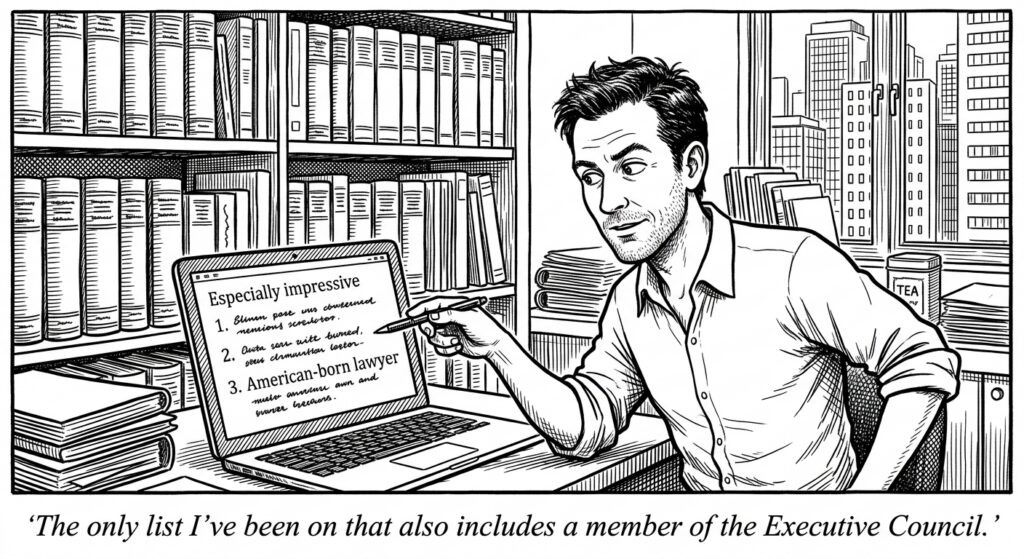
On August 2, Stephen Roach published a short list. The former chairman of Morgan Stanley Asia had argued in July that “the Hong Kong of old is, indeed, over,” and a number of readers wrote back. In a follow-up on his Substack, he singled out three rebuttals as “especially impressive”: one by Virginia Lee, a Greater Bay Area solicitor writing in China Daily; one by Michael Wong, Hong Kong’s Deputy Financial Secretary, writing in Sing Tao; and one by “an American-born lawyer living and practicing law in Hong Kong,” writing on LinkedIn.
The third one was mine. It is the only list I have been on that also includes a member of the Executive Council, and I am choosing to read it as a compliment.
Roach’s argument deserves to be stated fairly. He wrote that Beijing’s takeover after the protests of 2019 and 2020 “transformed Hong Kong into just another big Chinese city,” and that the city’s resilience “has been largely made in China, not in Hong Kong.” Some of his evidence is real. Most of the money raised in Hong Kong’s IPO revival has come from mainland companies.
Next month his thesis meets a practical test. For the first time, Hong Kong hosts the APEC Finance Ministers’ Meeting. Finance ministers and senior officials from 21 member economies are expected, along with the World Bank, the IMF and the Asian Development Bank, about 500 visitors in all. The leaders meet in Shenzhen in November. The ministers who manage the money meet here first.
Read the membership rules and the argument gets harder to sustain. APEC calls its members economies, not countries, because, in its own words, its work is “predominantly concerned with trade and economic issues.” The People’s Republic of China and Hong Kong joined in the same week in November 1991. After 1997, Hong Kong stayed on, as its Trade and Industry Department puts it, “as a separate and full member” under the name Hong Kong, China. Shenzhen, a city of enormous economic weight, has no seat. Neither does Shanghai.
That separate seat is not a courtesy. It is written into the Basic Law. Article 151 says Hong Kong “may on its own, using the name ‘Hong Kong, China’,” maintain relations and conclude agreements with foreign states and international organizations in fields that include “economic, trade, financial and monetary” matters. Article 152 lets it join international organizations “not limited to states” under the same name, which is exactly the category APEC falls into. Article 116 makes Hong Kong “a separate customs territory.” Article 111 keeps the Hong Kong dollar as legal tender. None of that applies to any other Chinese city.
Roach would answer that Beijing chose to hold the meeting here, which only proves that Hong Kong’s standing is made in China. Beijing did choose the venue. But the choice makes sense only because of what Hong Kong can do that the cities around it cannot. “Just another big Chinese city” is a claim about character. The Basic Law is a statement about capacity, and capacity is what finance ministers deal in.
The agenda shows why. The ministers will take up how governments support household incomes, how to finance digital infrastructure such as data centers and broadband, and how to widen access to finance, with papers prepared alongside the World Bank and the Asian Infrastructure Investment Bank. Financing a data center that serves several economies is, underneath, a legal problem: whose law governs the contract, where disputes are heard, and whether the judgment will be respected. Hong Kong’s courts, under Article 84, may refer to precedents from other common law jurisdictions, and Article 82 allows judges from those jurisdictions to sit on the Court of Final Appeal. That is the kind of infrastructure that doesn’t appear in an IPO league table.
Financial Secretary Paul Chan has said the meeting lets Hong Kong show its role as a “super connector.” The phrase is overused, but the law behind it is specific, and it is the part of this city that Roach’s account leaves out. Change is real. So is the legal architecture that a visiting finance minister will actually be relying on.
When the ministers take their seats, there will be a placard reading China, because China is the host. A few places away there will be another reading Hong Kong, China. Any account of this city as just another Chinese city has to explain the second placard.
The Wound That Never Closed
by Adam Clermont
A clear-eyed look at the Taiwan question—from its 1895 origins to the limits of strategic ambiguity.
Comments