I bought a pack of chewing gum at the 7-Eleven in Mei Foo on Saturday night, and nobody asked to see a doctor’s note. This is freedom I thought to myself.
Ruth watched me put it on the counter. I don’t chew gum. “Research,” I said. She picked up a bottle of Vita lemon tea, paid for both, and handed me the gum without looking at it. “You’re writing about Singapore again.”
I am, because the migration continues. Every few months another expat in a quarter-zip announces that he has finally had enough of Hong Kong and is moving his family and his fund to Singapore, where people are free. The post usually comes with a photo of Marina Bay Sands and the word “bittersweet.” Nobody in the comments asks what, specifically, he will be free to do there. So, as a public service, here is a travel advisory for anyone leaving Hong Kong’s tyranny for the Lion City.
1. Pack your gum.
Chewing it is legal. Buying it is not. Singapore banned the import and sale of chewing gum in 1992 under the Control of Manufacture Act, and selling it can cost you up to S$2,000. Since 2004 there has been an exception for therapeutic and nicotine gum, which you can get from a doctor or a registered pharmacist. So if you are a free man with a craving for spearmint, book an appointment.
In Hong Kong, the gum sits by the register, next to the Mentos and the Octopus reader. I have been told this is what the collapse of a free society looks like. It is surprisingly well stocked.
2. Bring a permit for your opinions.
Singapore’s Public Order Act requires a police permit for any public assembly that supports or opposes a view, publicizes a cause, or marks an event. The Ministry of Home Affairs spells this out on its website.
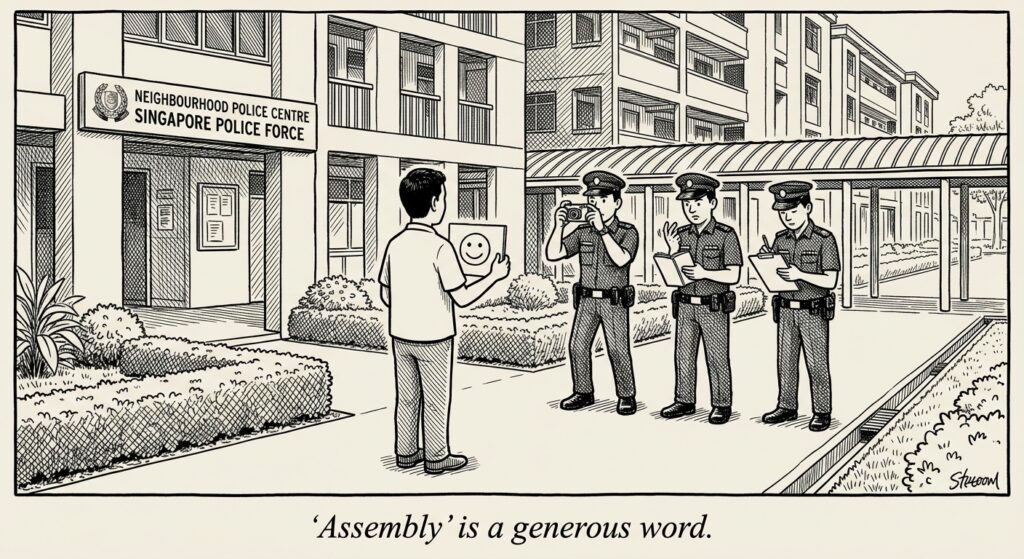
“Assembly” is a generous word. On December 13, 2018, a social worker named Jolovan Wham stood outside the State Courts holding a sheet of paper that read “Drop the charges against Terry Xu and Daniel De Costa.” He held it for less than 15 seconds, took a photo, and posted it on Facebook. The police found out from the post. He was convicted of illegal assembly in January 2022 and fined S$3,000, with 15 days in jail if he didn’t pay. After the High Court dismissed his appeal, he chose the jail. Fifteen seconds, fifteen days. The court noted that he had earlier applied for a permit for a one-person assembly at that spot and been refused.
It wasn’t his only sign. In March 2020 he stood outside the Toa Payoh police center holding a piece of cardboard with a smiley face drawn on it, in solidarity with two young climate activists the police were investigating for holding up their own signs. He was charged for that one too. The prosecution dropped the smiley face charge in February 2022, nearly two years after he smiled.
The law does not only catch activists. In 2020, Louis Ng, a member of Parliament from the governing party, visited a hawker center in Yishun and held up a placard reading “Support Them,” with a smiley face, asking the public to back hawkers during the pandemic. The police investigated him for organizing a public assembly without a permit. In October 2022 the Attorney-General’s Chambers decided to take no further action, because Mr. Ng had been exercising his duty as an MP by expressing care for the hawkers in his constituency. So there is a defense available. You just need to be elected first, and it helps to be from the right party.
Singapore does keep one place where you can protest without a permit: Speakers’ Corner in Hong Lim Park. The organizers must be citizens, and the participants must be citizens or permanent residents. If you are an expat on an employment pass, which describes nearly everyone writing the “bittersweet” posts, you can’t take part. The island’s one free speech corner is closed to you.
3. Do not invite Joshua Wong
In November 2016, Jolovan Wham organized an indoor forum called “Civil Disobedience and Social Movements.” One of the speakers was Joshua Wong, who appeared by Skype from Hong Kong. Indoor events in Singapore can go ahead without a permit if they meet certain criteria, one of which is that the speakers are Singapore citizens. Joshua Wong is not a Singapore citizen. Wham was convicted of organizing an assembly without a permit and fined S$2,000, plus S$1,200 for refusing to sign a police statement. He chose 16 days in jail over paying. He challenged the law at the Court of Appeal, which upheld it in November 2020.
So the city you are moving to for freedom jailed a man because Joshua Wong appeared on a laptop screen at his forum. The city you are leaving is the one where Joshua Wong is actually serving his sentence, and whatever you think of him (I have thoughts), his cases go through open court, with reasons anybody can read.
4. Leave the pigeons alone.
Singapore will fine you up to S$5,000 for feeding wildlife, pigeons included, and in May, Parliament voted to double that to S$10,000.
Hong Kong is worse. Since August 2024, feeding a feral pigeon here can cost you HK$100,000 and a year in prison, with a HK$5,000 fixed penalty for the casual offender. On pigeons, Hong Kong is the police state. If your definition of liberty centers on bread and birds, Singapore is the freer jurisdiction. Go with my blessing.
5. Enjoy the suspense of election night.
Singapore holds real elections on schedule. The People’s Action Party has governed since 1959. On May 3, 2025, it won 87 of 97 seats with 65.57 percent of the vote. The opposition Workers’ Party held its ground, and another opposition party lost every seat it had.
I have never seen a Western headline announce that democracy in Singapore is dead. I looked. Sixty-seven years of one party gets described as “stability.” Hong Kong’s system gets described as the end of the world. The expats moving from one to the other haven’t brought this up.
6. Mind the rope.
Singapore executed 17 people in 2025, according to Bloomberg, most of them for drug trafficking. That is the highest annual total since 2003. Singapore also canes people. An American teenager named Michael Fay received four strokes in 1994 for vandalism, after President Clinton asked for clemency and the sentence was cut from six.
Hong Kong’s last execution was on November 16, 1966. The death penalty was formally abolished in 1993. I have not seen a single “bittersweet” LinkedIn post that mentions any of this. Either the authors don’t know, or it doesn’t count as a freedom issue when the jurisdiction is on the approved list.
7. Check the scoreboard before you board.
The people making this move like to cite the rankings, so here they are.
Freedom House, in its 2026 report, gives Singapore 48 out of 100 and Hong Kong 41. Both are rated “Partly Free.” Singapore wins on political rights, 19 out of 40 to Hong Kong’s 9. On civil liberties, Hong Kong wins, 32 out of 60 to Singapore’s 29. Freedom House gives Singapore 1 out of 4 for freedom of assembly, which by now you understand.
The Fraser Institute’s 2025 Economic Freedom of the World report ranks 165 jurisdictions. Hong Kong is first. Singapore is second.
By the numbers the escapees themselves quote, they are giving up some civil liberties to gain some political rights, and giving up gum. People are entitled to prefer Singapore. The chili crab alone is a reason. Calling the move an escape to freedom is another matter.
* * *
Before anyone in Singapore forwards this to the Ministry: I love Singapore.
I love it the way you love a friend’s immaculate apartment. The trains arrive when the board says they will. The hawker centers serve the best cheap meal in Asia. The streets are clean because people keep them clean. The government is competent and honest, and it works hard at making the place run for the people who live there. Singaporeans grumble about it the way everyone grumbles about their government, and then they go to the polls and give the same party nearly two-thirds of the vote. Most of them like their country very much.
And I don’t mind the rules. Singapore gets to decide what works for Singapore. When I visit a friend’s home and the shoes are lined up by the door, I take mine off. I don’t lecture the host about my constitutional right to wear loafers on his sofa. When I land at Changi, I do the same thing. I leave the gum at home and keep my opinions about pigeons to myself.
Which is my actual point. Neither city is an authoritarian dystopia. Both are modern, safe, wealthy places where citizens have rights and freedoms, and some restrictions that come out of their own history, like every country, including the one I grew up in. Millions of people live good, free lives in both.
The difference is in the coverage. Singapore has had one governing party since 1959 and gets called a model. Hong Kong gets called finished. I don’t want anyone to start hating Singapore. I’d just like the people who write the “bittersweet” posts to give Hong Kong the same courtesy they give the city they’re moving to.
Ruth and I walked out past the minibus stop. I still had the gum in my hand, unopened.
She took it from me, unwrapped a piece, and put it in her mouth.
“Chew it here,” she said. “Take your shoes off there.”
Goodreads Book Giveaway
The Wound That Never Closed
by Adam Clermont
Giveaway ends October 2.
A clear-eyed look at the Taiwan question—from its 1895 origins to the limits of strategic ambiguity.
Comments