There is a moment, and I can tell you the exact moment, when I stopped believing that my way of doing things was the correct way of doing things. It was not a gradual enlightenment. It was not the slow, accumulating wisdom of a man who has lived in Asia for over a decade and read the right books and attended the right seminars and emerged, blinking, into the warm light of cultural sensitivity. I was in a hawker center in Singapore. A man was eating rice with his hands. And the sentence that formed in my head, the sentence that rose unbidden from the deep programming of a childhood in the Berkshires, was: that’s not how you eat rice.
That’s not how you eat rice.
I caught it. I caught it the way you catch a sneeze in public, just barely, just in time, before it becomes visible. But I heard it. I heard the voice, and the voice was not mine, not really. The voice was Adams, Massachusetts. The voice was my mother’s kitchen. The voice was a thousand meals at a table where the rules were absolute and inarguable and applied, apparently, to every human being on earth, regardless of whether they had ever been to Adams or heard of Adams or had any reason whatsoever to care what a woman in the Berkshires thought about the proper use of a fork.
The man in Singapore was not doing anything wrong. The man in Singapore was doing exactly what his mother had taught him, and his mother before that, back through however many generations of people who understood, with a certainty that does not require explanation because it does not require defense, that rice is eaten with the hand, that the hand knows the temperature and the texture and the portion in a way that a utensil never will. He was not wrong. He was normal. His normal. And in that moment, in that humid, magnificent hawker center that smelled like char kway teow and chili and the particular sweetness of pandan that I did not know existed until I was thirty-four because nothing in Adams has ever smelled like pandan, I understood something I should have understood twenty years earlier: I had been carrying a single normal around with me my entire life, and I had been measuring every other normal against it, and every other normal had been failing, not because they were wrong but because there was only one of them in my head, and one is not enough. One normal is not a perspective. One normal is a blindfold with a hole in it.
One way was never enough
In Adams, there was one way to eat. One way to greet someone. One way to behave at a table. These were not suggestions. They were physics. You sit down. You put the napkin in your lap. You do not reach. You do not serve without asking. You do not make noise. You do not place a bone on the table. You do not eat with your hands unless the food has been pre-approved for hand-eating by some invisible committee whose membership and bylaws nobody can produce but whose rulings are final. And you carry all of this forward into the world with the assumption, unexamined and total, that the we in we don’t do that is everyone. Every person. Everywhere. All of them doing it this way, because this way was the way.
I carried that assumption onto the plane. The plane that brought me to Hong Kong. The plane that deposited me into a city of seven million people who had their own physics and their own rules and absolutely no interest whatsoever in what a woman in Adams, Massachusetts, thought about table manners.
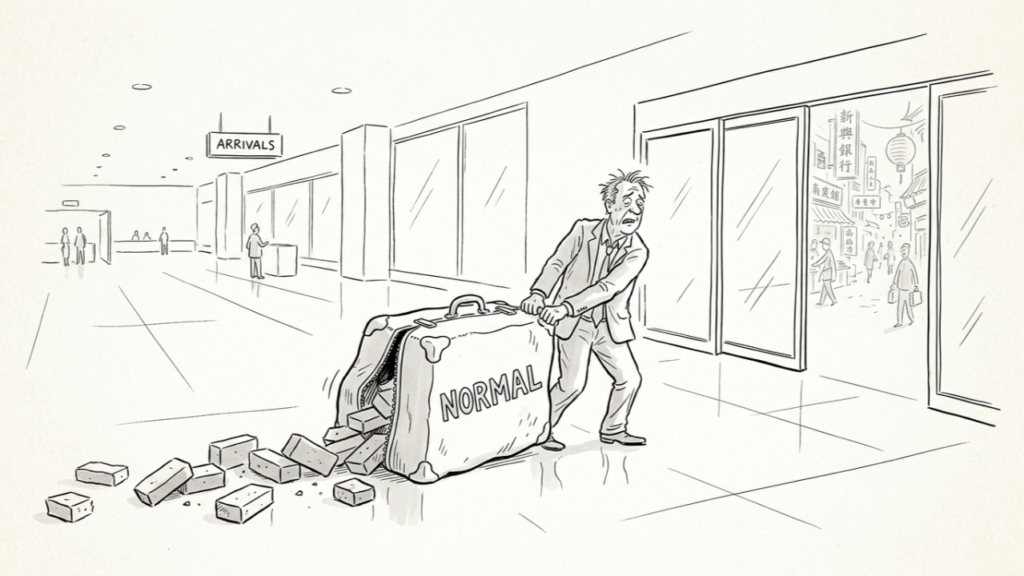
The first dinner was the hardest. Ruth’s family. A round table in Mong Kok. The table had a lazy Susan the size of a truck tire, loaded with dishes I could not identify, spinning with the aggressive purpose of a carousel that had somewhere to be. And around it, Ruth’s family, reaching, serving, chopsticking pieces of things onto each other’s plates with a speed and an intimacy that broke every rule my mother had ever installed in me. You do not reach across someone. You do not put food on someone’s plate without asking. You do not talk with your mouth full. You do not place bones on the table. They did all of it. All of it at once. Reaching, serving, talking, laughing, placing bones in a small pile beside the plate with the efficient lack of ceremony of people who understood that the bone is not the point and the plate is not the point. The people are the point. The gathering is the point. And everything else, every rule I had carried from Adams like a suitcase full of bricks, was decoration. Arbitrary nonsense that someone, somewhere, had once decided was civilized.
Ruth’s mother put a piece of char siu on my plate. She did not ask. She reached across the lazy Susan with her chopsticks and placed it there with the precision of a surgeon and the authority of a woman who had decided I was too thin and was going to fix it whether I had opinions about it or not. In Adams, this would have been a violation. You ask. You say would you like some and you wait for the answer and the answer determines whether anything moves and this is how civilization works. Ruth’s mother did not ask because asking would have been strange. Asking would have implied distance. It would have suggested that I was a guest rather than a person at the table, and a person at the table gets fed. Gets fed by the people around them. Gets fed without the performance of permission, because the permission was already given when you sat down, when you entered the family.
The people are the point.
I ate the char siu. It was extraordinary. And something in my suitcase got a little lighter.
Normals in motion
Ruth is quiet at the table. Not always. Not when it’s the two of us, or when we’re with friends whose company makes the volume rise and the bottles empty. But in certain company, at certain meals, Ruth is quiet. She listens. She eats. She observes. In Adams, someone would lean over and ask are you okay? Because silence at an American table is a symptom. Silence means something is wrong, someone is upset, and the table cannot rest until the silence has been diagnosed and the noise restored to its proper level. In Ruth’s world, silence at a table is respect. Silence in the presence of elders is what a well-raised person does. A well-raised person does not fill every gap with speech. A well-raised person is present, and presence does not require narration. I spent two years thinking something was wrong at family dinners before I understood that nothing was wrong. That the silence was the thing working correctly. That my discomfort with it was my problem, installed by a kitchen eight thousand miles away that had no jurisdiction here.
I have been in Hong Kong for over a decade now, and in that decade I have moved through the five-hour circle with a frequency that the proximity and the airport and the points make possible, and at every stop I have collected a normal that is not mine.
In Tokyo, nobody talks. I am overstating this. But in certain restaurants, the small ones, the counter seats, the places where the chef is three feet away making something with his hands that requires concentration you can feel in the air, people are quiet. They eat. They appreciate. They do not narrate the appreciation. They do not say oh my God this is amazing after every bite. I watched a man in Shinjuku eat an entire omakase in near-total silence. Twelve courses. He said itadakimasu at the beginning and gochisousama deshita at the end and between those two sentences he simply ate. With attention. With the kind of undivided presence that Americans spend thousands on meditation retreats trying to achieve, and here was this man, achieving it over mackerel, without effort, because the culture had given him permission to be silent and the silence was the highest compliment he could pay.
In Bangkok, everyone talks. The taxi driver talks to you. The woman at the street stall talks to you. The man at the next table, whom you have never met and will never meet again, talks to you. The temperature of human interaction in Bangkok is set forty degrees higher than anywhere else I’ve been, and this is not an intrusion. This is hospitality. This is a culture that has decided strangers are simply friends who haven’t spoken yet, and the not-speaking is the aberration, and if you are uncomfortable with this then Bangkok will cure you of it within eleven minutes of landing because the taxi driver wants to know where you are from and what you do and whether you have tried his cousin’s noodle place on Sukhumvit and here, he will write the address on the back of a receipt.
In Seoul, you do not pour your own drink. Someone else pours for you. You pour for them. The bottle moves around the table and the movement is the conversation, the are you good, do you need more, expressed through liquid rather than language. You hold your glass with two hands when someone senior pours. You turn away slightly when you drink in the presence of an elder. I poured my own soju at a dinner with a Korean client and the table went briefly, imperceptibly still. The same pause my mother’s kitchen would produce if someone reached without saying excuse me. The same silence that means we don’t do that. Except the we was different. And I was the one who didn’t know.
In Bali, they touch you. A hand on the shoulder when they bring the food. A gentle press on the back when they guide you to the table. Not inappropriately. Not in any way that violates anything. They touch you the way family touches you. The staff at the villa, when Ruth’s bathing suit was returned from its monkey-related adventure, handed it back with both hands and a slight bow and a touch on Ruth’s forearm, and the touch said here, it’s okay, we fixed it. The touch was the sentence.
And in Hong Kong itself, the place I have lived longest, the place that should be the most familiar and is in many ways still the most foreign: the rules multiply. The tea pouring. The tapping of two fingers on the table to say thank you when someone fills your cup, a gesture so small and so universal in this city that I did not even notice it for six months, and when I finally noticed it I had already been failing to do it for six months, and nobody had corrected me because I was a foreigner and foreigners are exempt from things that locals are not, which is its own kind of isolation, the isolation of being forgiven rather than included.
Thirteen versions of correct.
The red packets at New Year. The amount. The number. The denomination. The fact that certain numbers mean death and certain numbers mean prosperity and the wrong number in the wrong packet to the wrong person is not a faux pas but a curse, an actual symbolic assault on someone’s fortune, and the rules governing all of this are so complex, so layered with superstition and hierarchy and the accumulated weight of a thousand years of tradition, that Ruth has to brief me every January like a lawyer preparing a client for deposition. And every January I listen, and I follow instructions, and I still feel, somewhere in my chest, the faint residual absurdity of a man from Adams who grew up putting cash in a card from Hallmark and thinking that was the end of it.
I have been counting. Since I arrived in Hong Kong, since I started moving through the circle, I have sat at tables in Hong Kong, mainland China, Japan, South Korea, Taiwan, Thailand, Vietnam, Cambodia, Indonesia, Singapore, Malaysia, the Philippines, India. That’s twelve countries and one special administrative region. Thirteen versions of correct. Thirteen sets of rules that feel like physics to the people who live inside them and feel like nothing to the people who don’t. Add Adams. Add New York. The number doesn’t matter. What matters is that somewhere around the fifth or sixth, something broke. Something structural. Something that had been installed so deep I didn’t know it was there until it cracked. The thing that broke was the belief that my normal was the normal. That Adams, Massachusetts, a town of eight thousand people whose restaurants consisted of a pizza place and a Chinese takeout, was the reference point. The universal standard. The place from which all deviation was measured.
It’s absurd. It was always absurd. But I believed it in the pre-verbal, pre-conscious way that you believe the things your body learned before your brain was online, the things installed by repetition and correction and the quiet, devastating efficiency of a mother’s face. And I believed it until I had seen enough other faces, enough other tables, enough other hands holding enough other food in enough other ways, that the belief could not sustain itself against the evidence.
Travel is not the lesson
Travel doesn’t teach tolerance automatically. I want to be clear about this. The boarding pass is not the lesson. I have met people with thirty passport stamps who judge more, not less, because they traveled with their suitcase intact and never opened it. They stayed in the Marriott. They ate at the hotel restaurant. The closest they came to another normal was the breakfast buffet, which had both Western and Asian options, and they chose Western every morning and went home confirmed rather than challenged.
Travel creates the conditions for tolerance. The teaching happens when you sit down and someone puts food on your plate without asking and you feel the small sharp stab of that’s wrong rise in your chest and you catch it. You catch it and you look at it and you ask: wrong by whose rules? And the answer, every time, is: wrong by the rules of a kitchen in Adams, Massachusetts, that I left fifteen years ago and that has no jurisdiction here. No jurisdiction in Singapore. No jurisdiction in Seoul. No jurisdiction at a round table in Mong Kok where a woman with the authority of a general is placing char siu on my plate because I am too thin and she has decided to fix it.
Wrong by whose rules?
The judgment doesn’t die. I want to be honest about this. The programming doesn’t die. I still feel it. I feel it in Seoul when someone pours and I want to pour myself. I feel it in Tokyo when the silence stretches and my American wiring screams say something. I feel it in Bangkok when the driver starts talking and some small, terrible part of me wants to be left alone. But the judgment gets quieter. It gets quieter because every new normal adds weight to the other side of the scale, and after enough weight the scale tips, and what you feel is not that’s wrong but that’s different, and the distance between those two sentences is everything.
Ruth never had this problem. Or rather, Ruth had the opposite version and solved it in the opposite direction. She grew up in Hong Kong with one normal. Her normal. The normal of a Cantonese family with Cantonese rules and a mother whose face could correct from across a room. And then she married a man from Adams who talked too much at dinner and did not understand that silence was not a symptom and that food on your plate was not a violation and that the lazy Susan spins with authority, not apology.
We have been negotiating for over a decade. The negotiation has no end. The negotiation is the marriage. Her normal says silence is respect. My normal says silence is a problem. Her normal says serve without asking. My normal says ask before serving. Her normal says the elder sets the pace. My normal says the loudest voice sets the pace, and the loudest voice is mine, and it has been mine since I was six years old and could not sit still and filled every silence with speech because silence, in my family, was the thing that happened before someone got upset.
The marriage is the lesson
And the marriage has taught me more about the multiplicity of normal than every flight I’ve ever taken and every hawker center I’ve ever sat in, because you can visit a country and leave. You cannot visit a marriage and leave. You live inside another person’s normal every day, and their normal pushes against yours every day, and the pushing does not stop. The goal is not the stopping. The goal is the catching. The moment when that’s wrong becomes that’s hers and that’s hers becomes that’s fine and that’s fine becomes that’s beautiful, because the thing your wife is doing, the thing that once felt like a violation, is a kindness your programming was too narrow to recognize.
Robert Louis Stevenson wrote that there is no duty we so much underrate as the duty of being happy. I think there is a cousin duty, equally underrated: the duty of being uncertain. The duty of holding your normal lightly. The duty of arriving at a table with your hands open instead of your fists closed. The duty of saying, when the voice in your chest rises with its ancient, inherited, mother’s-kitchen certainty: I don’t know if that’s wrong. I only know it’s not mine. And not-mine is not the same as wrong. Not-mine has never been the same as wrong. I just couldn’t see the difference until I had enough tables to compare.
Not-mine is not the same as wrong.
I am not a tolerant person by nature. I am a person from Adams, Massachusetts, with a suitcase of bricks that I have been slowly, one brick at a time, setting down at tables across Asia for fifteen years. Some bricks I have set down permanently. Some I pick back up when I’m tired, when the negotiation has gone on too long and I want, just for one night, to eat dinner in the silence of my own unquestioned normal. But the suitcase is lighter. It is lighter than it was in 2011, when I landed at Chek Lap Kok with every brick intact and a certainty, unexamined and total, that my way was the way.
Twelve countries and one special administrative region. A thousand tables. A wife whose silence taught me more than anyone’s speech. A mother-in-law who put char siu on my plate without asking because she loved her daughter and decided, in that moment, with those chopsticks, to love me too. In her language. By her rules. In her normal.
The char siu was extraordinary. And I am still learning.