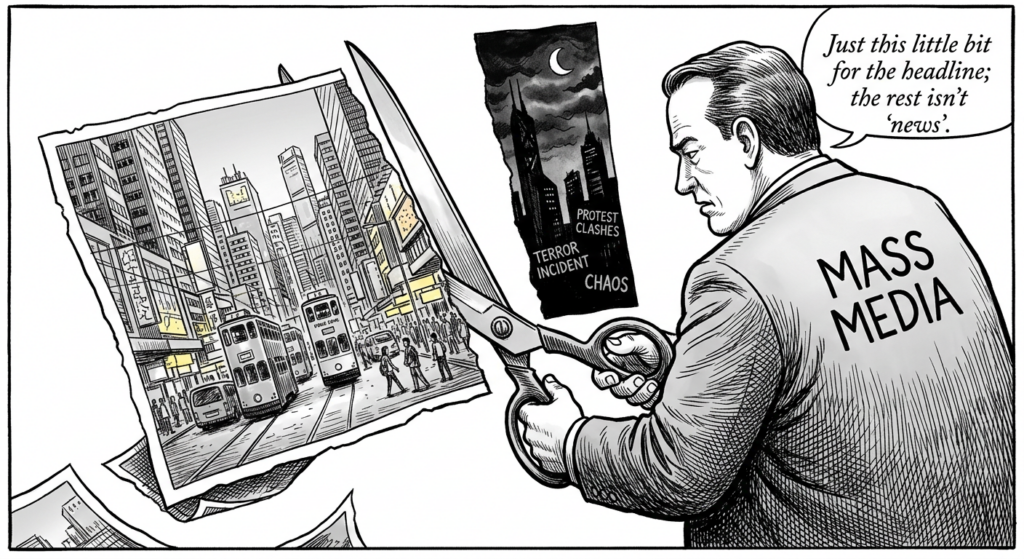
It isn’t that Western coverage of Hong Kong lies. It’s that it figured out, a long time ago, that it doesn’t have to.
I wrote a piece a short time ago about what was missing from Kanis Leung’s AP story on the bookstore arrests. The word “disappeared” doing the work of an entire paragraph. A drunk-driving charge that didn’t make the cut. I thought pointing out the holes would be enough, that the reader would see through the wall once I showed them where the bricks were missing.
It wasn’t enough. I’ve been around persuasion long enough to know why, and the honest answer made me sit with my coffee a little longer than usual that morning. Knowing the trick doesn’t stop it from working. It just lets you watch it work on you in real time, which is its own kind of unpleasant.
So let me tell you what actually happened to you while you were reading that piece. And then let me show you the equation running underneath it the whole time.
Eleven Letters
Here’s what’s strange about that reaction, once you actually check the piece. The current arrests, the ones the article opens on, aren’t described that way at all. Greenfield’s booksellers were arrested, and a few sentences later you’re told, plainly and without drama, that bail was granted. Procedural. Routine-sounding. Almost forgettable. It’s only a few paragraphs after that, when the piece reaches back to 2015, that “disappeared” appears at all, for Lam Wing-kee and four others affiliated with Causeway Bay Books.
Here’s what the word itself never tells you, and what a reader would need a separate search to find. Of those five, four eventually came home. Three of them, Lui Bo, Cheung Chi-ping, and Lee Bo, returned to Hong Kong within months and personally cancelled their own missing persons reports with police. The fourth, Lam Wing-kee, came home that same year, gave interviews contradicting the official account, reopened his bookstore, and spent the rest of his life as one of the more visible critics of the Chinese government from a stage in Taiwan, until he died this past July. Only the fifth, Gui Minhai, remains unresolved in any way that could fairly be called a disappearance today. “Disappeared” describes an accurate fact about October to December of 2015. It describes almost nothing true about the decade that followed for four of the five men it names.
Nobody wrote a sentence claiming the current arrests are the same kind of event as 2015. The piece never says that. But it doesn’t need to. “Bail was granted” and “disappeared” sit close enough together, in the same short piece, about the same category of person, booksellers, arrested by the same authorities, that your sense of one continuous story does the merging the sentences themselves never attempt. You don’t remember that the two things are legally, categorically different, an ordinary arrest with a court date on one hand, an unexplained vanishing across a border with no charge for months on the other. You remember booksellers, and you remember danger, and the piece never had to claim they were equivalent for you to end up feeling they were.
That’s not “she didn’t mention the release.” She did. It’s that mentioning it once, in flat procedural language, immediately followed by the most loaded word in the entire piece for a different case, does something a false statement never could. It leaves you with an impression neither sentence, read on its own, actually supports.
“Four booksellers were arrested and released on bail pending investigation, in a pattern unrelated to the unresolved 2015 disappearances of five Causeway Bay Books staff, four of whom returned home within the year” was also available to her. It’s accurate, and it draws the distinction instead of letting proximity draw it for you. She wrote something else.
The Girl in the Bookstore
Then came Fleming Cheng, standing in a shop, reading a biography, allegedly banned in China, the VPN scars on her browsing history, the quiet fear you could almost smell through the screen. And something else happened to you, something you definitely did not notice at the time. You stopped checking.
Here’s what checking would have told you.
Fleming Cheng traveled to Hong Kong. Nobody stopped her. She walked into Greenfield Book Store. Nobody stopped her. She stood there and read dozens of pages of a book about a pro-reform Chinese leader who fell from power for sympathizing with Tiananmen protesters. Nobody stopped her. She was a mainland Chinese student, browsing whatever she wanted, and at no point during this experience did she need the VPN the article mentions in its second sentence. The VPN was for the mainland. She was in Hong Kong. She could open Facebook on her phone. She could open X. She could pull up Kanis Leung’s own article about the death of free expression, right there on her phone, in a bookstore, while doing the exact thing the article says is under threat.
Here’s the part I don’t think anyone involved in this story expected you to know. I live in Hong Kong. I do use a VPN. But not for the reason the word made you assume. The only time I need a VPN in this city is to access Western platforms that have decided, on their own, to geofence Hong Kong out. ChatGPT. Claude. A handful of American news sites that went dark here after GDPR and never came back. The blocking isn’t coming from inside the building. It’s coming from the companies whose products and platforms sit inside the same media ecosystem that keeps telling you this city is sealed shut. Nobody in the Hong Kong government told OpenAI to cut off my access. OpenAI made a commercial decision, and now I route through Tokyo to use a chatbot, in a city where I can walk into a bookstore and read whatever I want. The VPN Leung put in her second sentence points in exactly the wrong direction, and the reason you didn’t catch it is that the word had already done its work before you had time to ask who, exactly, is blocking whom.
Leung needed you to feel the VPN before you could feel the bookstore. The VPN is constriction. The VPN is the mainland closing in. Once you’d felt it, you were inside Fleming Cheng’s anxiety, and from inside that anxiety, a bookstore that was open, where a mainland student was freely reading a politically sensitive biography on a Wednesday afternoon, looked like the last candle before the dark. It didn’t look like what it actually was. A bookstore. Open. Accessible to anyone who makes the trip.
That’s the transaction. Leung didn’t show you a city. She showed you a feeling, and the feeling was so vivid that the city behind it disappeared.
The Dates She Chose
Here’s something you can check yourself. Pull up the piece and write down the dates she gave you. 2015. 2020. 2024. Today. In that order, with nothing between them.
Now try something. Put 2018 in the middle. That’s the year the high-speed rail link opened, connecting Hong Kong to the mainland. No booksellers were kidnapped on it. Nothing happened. That’s precisely why it wasn’t included, because a year where nothing happened breaks the sequence, and the sequence is the argument.
She didn’t hand you a conspiracy. She handed you an order. Four dates, laid end to end, each one worse than the last, so that by the time you reached today you felt you were reading a trajectory, not a selection.
The Equation Underneath All of This
Here’s the part I didn’t tell you last time, because I hadn’t laid it out yet. None of what I just described is improvised. It’s formula, taught the same way to every wire reporter, applied the same way regardless of subject, closer to algebra than to instinct.
The lede is built to answer who, what, when and where in under about thirty-five words, a constraint from the teletype era that nobody ever relaxed. Notice what’s missing from that list. Why. Why gets held back, saved for the paragraphs the formula trusts you to still be reading once you’re already inside the story. Fleming Cheng is the who. Greenfield Book Store is the where. The VPN is doing the work of why, before why has technically been allowed onto the page.
The nut graf comes next, by paragraph two or three, restating the facts times a claim about their significance. This is where the frame gets welded shut. Once “disappeared” and “under threat” have done their work in the opening, every paragraph after is graded on how efficiently it supports that thesis, and a fact that complicates it, four came home, one gave a decade of interviews, has to fight for space against facts that confirm it. In a wire story built to a strict length, that fight is never close.
Then the balance requirement, one paragraph of the government’s position, positioned deliberately after the frame is already set, so that by the time Chris Tang’s food-safety comparison arrives you’re not evaluating an argument. You’re evaluating a suspect. The formula is satisfied the moment both sides appear somewhere in the piece. It says nothing about where, or how much weight either one is allowed to carry once it lands.
And the kicker, the boulder, saved for last on purpose, because every wire editor is taught that endings carry more than middles, and the single best quote gathered in the entire reporting process gets moved to the exact spot where it will be remembered longest, regardless of whether it’s the most representative thing anyone said.
This is what I mean when I say it isn’t one reporter. It’s an equation, solved the same way every time, and the equation doesn’t know or care that the variable this time was a bookstore in Mong Kok instead of a city on the other side of the world.
The Hundreds You Forgot
You left that piece thinking about four bookstores. Four names. Four storefronts. Four closing notices.
You did not leave thinking about the other bookstores in Hong Kong that nothing happened to that month, the ones that restocked, or had a slow Tuesday, or complained about rent the way bookstores everywhere complain about rent. I don’t actually have a reliable count of how many independent bookstores currently operate across this city to give you as the denominator here, and I’d rather tell you that plainly than hand you a number I can’t stand behind. What I can tell you is that the four you were shown are vivid, specific, and named, and the ones nothing happened to have no names at all, because there’s no story there. Your brain doesn’t need the missing number to fill the gap. It fills it with the four pictures it was actually given.
Where She Put the Boulder
The piece ends on an image. You know the one. The boulder rolling downhill, crushing everything growing beneath it. It’s the last thing she gave you, and now you know why: the kicker isn’t accidental placement, it’s the last step in the formula, chosen specifically because it’s what survives in memory after the specifics blur.
You didn’t lose the argument. You were walked past it so smoothly you thought you were still making up your own mind.
The Lock You Didn’t Hear Click
Once you’ve accepted that the government is the one who arrests, inspects, investigates, and raids, something happens to your ability to hear that same government explain itself. The food-safety comparison isn’t just poorly placed. It’s spoken by the wrong character. You’ve already decided what kind of character this is, and that character doesn’t get to make reasonable analogies. That character gets to be the boulder.
The Byline You Didn’t Read
Every one of Kanis Leung’s stories carries the same dateline: HONG KONG (AP).
She isn’t filing from a safe distance. She isn’t writing from New York, or London, or the Singapore bureau that the Wall Street Journal quietly moved its regional staff toward in 2024. She’s here. She lives here. She walks to the courthouses and photographs the storefronts. She interviews booksellers before and after their arrests. She files her copy from the same city her coverage describes as a place where free expression goes to die, and she does it under her own name, week after week, to a global audience of hundreds of millions of readers.
Here’s what that output looks like, just from the past year or so.
“Red lines and increasing self-censorship reshape Hong Kong’s once freewheeling press scene.“
“Plight of imprisoned Hong Kong ex-publisher Jimmy Lai evokes grief over loss of press freedoms.“
“Hong Kong booksellers are reportedly arrested over alleged sales of seditious publications.“
“Former leader of Hong Kong journalist group sent to prison for obstructing police.“
“Hong Kong court sentences 3 Tiananmen vigil organizers to prison in national security case.“
Every one of those was published from Hong Kong. Every one is still online. Every one is accessible to anyone in this city with a browser and no VPN. Nobody stopped her from filing any of them. Nobody raided the AP bureau. Nobody pulled a single story. Nobody arrested the reporter whose byline sits at the top of every piece describing a city where journalists supposedly cannot do what she is, at that exact moment, doing.
If Hong Kong were the place her body of work describes, her body of work would not exist. That’s not an opinion about the national security law or a defense of any particular prosecution. It’s a statement about what the word “silenced” means. It means you can’t speak. She speaks, from here, constantly, to the entire English-reading world, and no one stops her.
The reason you never noticed the contradiction is the same reason you never noticed any of the others. It’s structural. It sits underneath the vivid details, not inside them. Your brain doesn’t naturally compare a headline to a dateline. It reads the headline, feels the room the headline builds, and moves on. The dateline is two words in capital letters that you skip on the way to the lede. But those two words, HONG KONG, are doing more work than anything in the paragraphs below them, because they are the single piece of evidence that makes every other claim in the story testable, and they sit right there, at the top, in plain sight, every time.
What I Did to You, Too
I’d be running the same game if I let you believe my own writing sits outside all of this. It doesn’t.
The bookstores piece I published opened with a building security guard asking if I was going out. A small, warm, mundane image. I picked it because I needed you to feel safe before I started telling you things that should make you uncomfortable, and a security guard making small talk in a lobby is about as safe as prose gets. It worked. You relaxed. I know you did, because you kept reading.
I closed that piece on “the kind that is not what you were told it is.” I built that line the same way she built the boulder. I put it last because last is where things stick, and I wanted it to stick. And in the piece you’re reading now, I’ve been doing it again, right down to using the formula itself, lede, frame, balance paragraph, kicker, to explain the formula to you. None of this makes what I wrote false. But pretending I wasn’t making choices about what you’d feel, and when, and in what order, would make me exactly the thing I’m asking you to notice in someone else.
So there it is. I did it too. The difference, if there is one, is that I’m telling you I did it, which is either honest or just another, more sophisticated move. I genuinely don’t know some mornings.
The Part That Should Actually Scare You
I don’t think Kanis Leung sat down and consciously decided to exploit how your brain processes threat, or calculated where to place an image so it would overwrite a competing argument. I don’t think Li Yuan, whose New York Times piece on the Tai Po fire opened with mourning citizens versus smearing leaders in two consecutive sentences, did it on purpose either. (Note: My response which ran in the China Daily is here.)
And then there’s Matthew Brooker’s Bloomberg column from last week, “Joshua Wong’s Freedom Means More Than Cheap Chinese Cars.” Read the headline again. Before you’ve opened the piece, before you’ve seen a single fact, you’ve already been handed a choice between a human being’s freedom and a consumer product. Brooker would rather you contribute to global warming than understand that what Wong was convicted of, conspiring with foreign forces to impose hostile measures on your own country, is something every nation on earth prohibits. Nowhere in the column will you find a mention that Article 23 of the Basic Law has required Hong Kong to enact national security legislation since 1990, in a constitutional document the United Kingdom agreed to, or that Wong helped kill the only universal suffrage proposal Hong Kong has ever been offered while calling himself a democrat.
I have written about what Wong actually did to this city here. It has nothing to do with the conspiracy charge. It has to do with a vote that five million people never got to cast. The column does concede, in the same breath as its central claim, that the 2019 protests “sometimes turned violent,” before pivoting to call the national security law a tool that has been used to “criminalize peaceful political dissent.” Wong pleaded guilty to a foreign collusion charge on September 2, a detail the piece includes plainly, a few lines from where Brooker writes that the four-year delay in bringing the second case “looked calculated” to keep him in prison past his expected release date. The hedge is there, “looked,” not “was.” But by the time you reach it, the headline has already sorted you into a side, and a hedged verb four paragraphs later rarely unsorts anyone.
That’s the part that should actually scare you. None of them have to do it on purpose.
The newsroom rewards the vivid opening, the clean arc, the closing image that makes a reader’s breath catch, because the formula was built, reasonably, for a world of teletype word limits and readers with a dozen other papers to choose from. File after file, edit after edit, and eventually the writer learns what holds attention without ever needing to learn why it holds attention, or what it costs the reader to have their attention held that way. The machine doesn’t need anyone to be dishonest. It just needs everyone to be good at their jobs, and their jobs, it turns out, are optimized for exactly the parts of your brain that don’t check the math.
Which means the problem was never one reporter. It was never one outlet. It’s an equation, and the equation got very, very good at you.
Reading with the Lights On
The only thing that changes the math is a reader who notices the room the word built, who asks for the bookstores that aren’t in the article, who checks which image was saved for last, who can name the lede and the nut graf and the kicker the way you’d name the terms in an equation, and who reads the headline before deciding whether the headline already made the decision for them. On every piece, from every outlet.
Including this one.
That’s not distrust. It’s just reading with the lights on.
Comments