A practical guide, field-tested over roughly a decade, with results you can expect to replicate at your very next family dinner.
Step One: Bring a fact to a feelings fight.
Every family has a group chat that turns into a crime scene around the holidays, and mine is no exception, so let’s start there. Wait for someone to bring up Obama. When Cousin says he tripled the national debt and apologized for America on a world tour, resist the urge to simply nod along. Instead, mention that the debt thing is complicated and the apology tour never actually happened, he gave one speech in Cairo. Cousin will say he’s heard it described as an apology tour by several respected commentators. Ask which commentators. He will say “you know, the news.” Ask which news. He will say “not the fake news.” Congratulations, you’re five minutes in, nobody has produced a single verifiable date or source, and everyone at the table has strongly implied something about everyone else’s intelligence, patriotism, or gullibility. This technique also works with Trump, tariffs instead of the debt, “convicted felon” instead of “convicted apologizer,” Charlottesville deployed with the gravity of a smoking gun, “context matters” deployed with the gravity of a bomb squad. The uniforms change. The choreography never does.
For advanced practitioners, I recommend the Hong Kong variant, which I’ve spent roughly a decade perfecting and which reliably ends dinner parties faster than anything involving Trump. Mention that Beijing’s 2014 proposal offered a nominating committee of 1,200 members drawn from four sectors, publicly registered, subject to judicial review, that pan-democrats held real seats on it, that Benny Tai’s own slate won all thirty seats in the higher education sector, that the final stage was a direct one-person-one-vote ballot, the first in Hong Kong’s history, something Britain never offered in a hundred and fifty-six years of running the place, and that twenty-seven legislators voted, unanimously, to reject it, meaning five million people never got to cast that vote at all. For extra credit, add that five years later, after the extradition bill that started the 2019 movement had already been withdrawn, things escalated anyway, over a thousand petrol bombs, a man set on fire, universities turned into fortified camps, the airport shut down, the legislature stormed and its chamber smashed, an activist sitting in a Washington hearing room asking a rival superpower to sanction his own city. Deliver all of this in under ninety seconds. Watch the conversation stop being about any of it and become a conversation about what kind of person recites facts in that order. Not whether the committee had 1,200 members. Whether you’re the sort of person who’d bring up the committee at all.
That’s really the whole method, if you want it in one sentence: you will be arguing logic and facts, and your dinner companions will be arguing motives and symbols, and these are not the same argument, which is why they never resolve, no matter how long the meal runs or how many times somebody refills the wine.
Step Two: Learn to recognize your opponents, because they come in types.
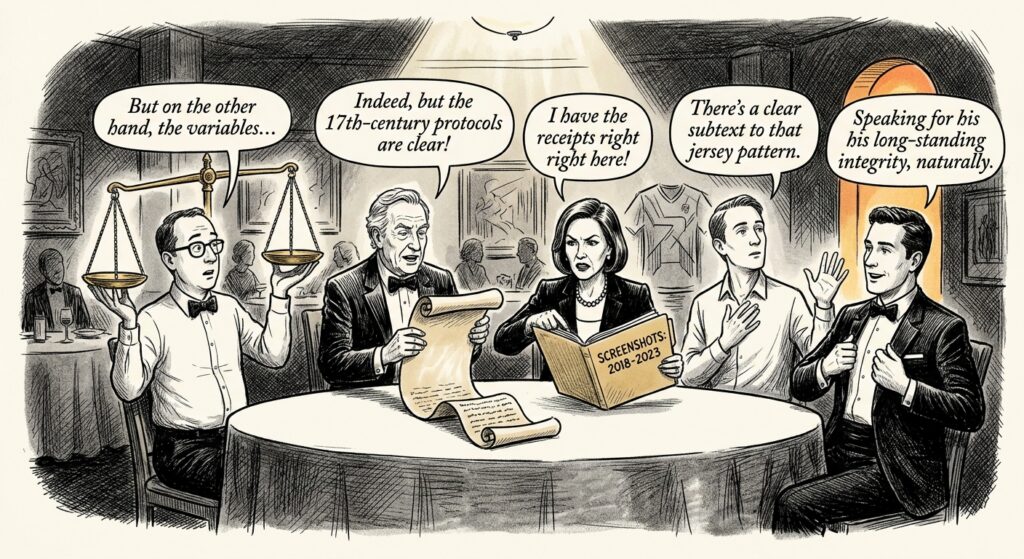
Success requires knowing your audience. In my experience the cast is small and reliably recurring, like commedia dell’arte but with worse hats. There’s the Whataboutist, who can’t let any accusation land without producing an equal and opposite accusation from the other team, as if morality were a ledger that just needs balancing. There’s the Sudden Historian, who has never once mentioned the Smoot-Hawley Tariff Act, or for that matter the Sino-British Joint Declaration, until the exact moment either becomes useful, at which point he can recite it like Torah. There’s the Screenshot Warrior, who has a folder, an actual folder, organized by year, ready to deploy at a moment’s notice, a political ammunition depot disguised as a Downloads folder. There’s the Symbol Reader, who doesn’t respond to what you said, only to what saying it signals, so that “the 2014 proposal included a direct popular vote” gets heard not as a claim about a proposal but as a confession about which team you’re on. And the Character Witness for Themselves, who, unable to defend the claim, pivots to defending their own reasonableness. “I’m not saying I agree with everything he’s done, I’m just saying.” The sentence after “I’m just saying” has never once, in recorded history, resolved into anything except a fuller, more elaborate version of agreeing with everything he’s done.
Step Three: Understand why this works so well, so you can feel appropriately guilty about it.
The Symbol Reader is worth lingering on, because there’s real research on why that character exists, and it’s less flattering to my own method than I’d like.
But first, in the interest of full disclosure, a brief and not entirely proud accounting of the actual friendships this hobby has cost me, since a guide called “How to Lose Friends and Infuriate People” owes you some results before the theory.
Exhibit A: a law school classmate I hadn’t spoken to in a decade, who resurfaced to relitigate 2019, at which point I made the tactical error of actually answering with dates. He informed me that citing dates was “a very lawyer thing to do,” a strange accusation to level at a lawyer, then left the conversation on read for eleven months. We are, as far as I can tell, still friends, in the sense that neither of us has performed the paperwork of not being friends.
Exhibit B: a cousin who, mid-argument about the nominating committee, told me she couldn’t believe “someone with your background” would say something like that. I have never fully decoded this, since my background is a law degree and a subscription to primary sources, and I remain unsure which part was supposed to have prevented the sentence.
Exhibit C, the one Ruth still brings up: a group chat where I responded to an accusation of being an apologist by sending, unprompted, a six-thousand-word essay on media framing, as though the correct response to “you only believe this because of propaganda” is more reading material. Nobody in that chat has mentioned Hong Kong to me since. I choose to interpret this as victory. Ruth interprets it as a hostage situation.
None of these people are villains, and if you asked them, at least two would probably describe me exactly the way I’ve just described the Sudden Historian, someone who shows up to a normal conversation with a folder. They may not be wrong. Which brings us to the theory, and why being right about the folder’s contents so rarely seems to matter.
The psychologist Philip Tetlock spent years studying what he calls sacred values, positions that function less like ordinary opinions you’d update given new evidence and more like markers of who you are. Once a value goes sacred, Tetlock’s experiments found, simply entertaining the opposing argument, even hypothetically, gets treated by observers as evidence of moral corruption. You’re not allowed to weigh the tradeoff. Weighing it is the crime. That’s a precise description of what happens when I bring up the committee’s thirty higher-education seats. Nobody’s actually disputing the seat count. They’re registering that I’ve treated a sacred value as a thing with a seat count at all, and that, itself, is the offense.
The Yale law professor Dan Kahan has studied the same territory from another angle, what he calls motivated reasoning, evaluating evidence not on its merits but on whether accepting it puts you at odds with your own group. His most inconvenient finding, for a guide like this one, is that the effect shows up just as strongly on the right as the left. In one study, using a standard test of analytical reasoning, conservatives did no better and no worse than liberals. Worse for anyone hoping their own tribe reasons more cleanly, the more analytically sharp people were on either side, the better they got at reasoning their way to whatever conclusion their group already held. Being smart doesn’t make people less biased. It makes them more effective lawyers for their own side, the Whataboutist and the Sudden Historian both, and, on my worse days, me.
I brought some of this up to Ruth once, mid-argument, as a kind of peace offering, here’s a study showing we’re probably both doing this. She wasn’t impressed. “That’s a very convenient thing to bring up right after you’ve spent ten minutes losing an argument,” she said, which is fair, and which is itself a small demonstration of the exact technique this guide is teaching, using a real finding as cover for a specific claim I wanted to be right about.
Step Four: Outsource the hard work to a headline.
You don’t actually have to build the Symbol Reader’s reflex yourself. The media will happily do it for you. I watched a clean version of this in real time this past August, when a Hong Kong court convicted a barrister on incitement charges. Every major wire service ran some variation of the same four words within the hour: democracy activist convicted. No mention of what the charge actually was. No mention of the mitigation she gave in open court, in which she called for ending one-party rule not just in Hong Kong but across mainland China, compared the judges hearing her case to Nazi executioners, and pledged, on the record, to keep doing exactly what she’d just been convicted of doing. All of that got compressed into “activist,” “convicted,” and enough implied injustice to fill in the rest yourself. You don’t need to lie to produce that effect. You just need to choose which four words survive and which eighteen paragraphs don’t.
A headline is a piece of architecture. It decides which fact goes in the foundation before you’ve read a word. “Convicted despite mental illness diagnosis” is a different building than “convicted after court-ordered fitness evaluation.” “Democracy activist convicted” is a different building than “barrister convicted of inciting the overthrow of the state, having called for it explicitly in her own mitigation.” Jonathan Haidt’s old metaphor, the mind as an elephant with a rider mostly there to invent justifications for wherever the elephant already decided to go, used to describe an individual habit. Headline writing turns it into a service you can subscribe to. Chris Bail’s research at Duke on social media found the effect compounds from there: exposing people to more opposing views doesn’t moderate them, it often hardens them, because the version of the other side an engagement-optimized feed selects for you is reliably its most extreme, least charitable version, handed to you wearing the costume of your own opinion.
Step Five: Realize, too late, who you were actually arguing with.
By now you’ll have noticed the fight at the table was never really Cousin versus Aunt, or Trump versus Obama, or a barrister versus a courtroom, or even, deep down, China versus America. It was two entirely different sets of four-word headlines, wearing human faces, meeting to relitigate a disagreement neither headline writer has any incentive to ever resolve, because a resolved argument doesn’t generate engagement, and an engaged audience is the whole business model. The politicians and the activists are the mascots. The real teams are the feeds.
A closing note on results.
Ruth watches me sort people into this taxonomy with the weary patience of a woman who has heard the bit before. “You’re just as bad,” she told me once, mid-argument, when I’d triumphantly produced a fact I was extremely pleased with. “You just have better footnotes.” I wanted to argue with her about this, which, if you’ve been following the guide, is exactly the kind of thing a Character Witness for Themselves says right before losing the argument he claimed he wasn’t having.
I still bring up the nominating committee at parties, which Ruth says is its own kind of character flaw. But I’ve started doing one thing differently. When the Sudden Historian shows up citing Smoot-Hawley, or the Joint Declaration, with suspicious fluency, I ask where he heard about it. Not to catch him out, just to see if he can answer. Half the time the honest answer is a fifteen-second video with a stock photo of a newspaper and a voice that sounds like it’s reading a ransom note. And once, just once, watching someone realize that out loud, mid-sentence, in front of the whole table, was more satisfying than any friend I’ve ever lost.
Results not guaranteed. Bring your own wine.
Comments