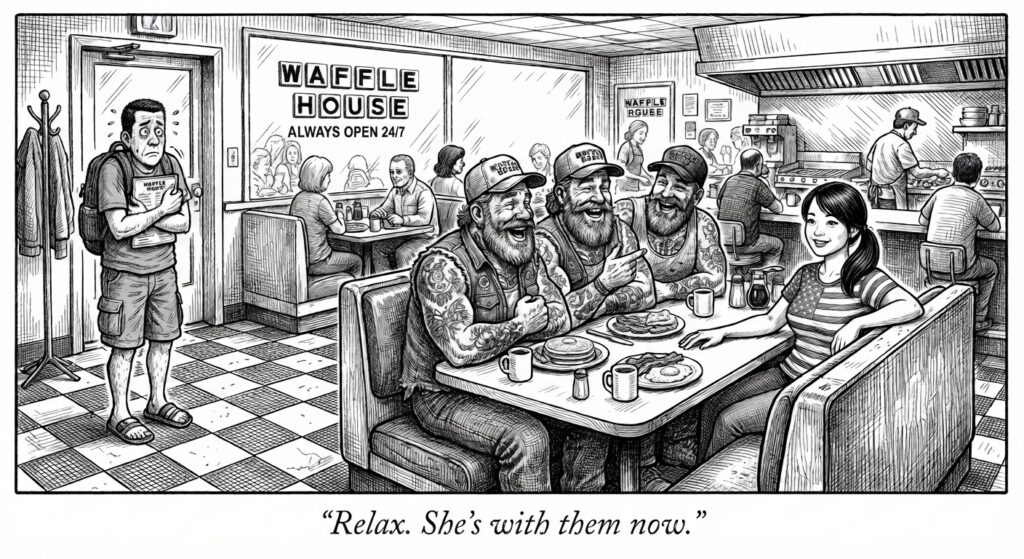
I took Ruth to a Waffle House once, on a trip to Florida, at roughly two in the morning, because I wanted her to understand something about my country that no embassy pamphlet was ever going to explain.
She looked at the menu board, the laminated one bolted above the grill listing hash browns in every possible configuration, scattered, smothered, covered, chunked, diced, peppered, capped, topped, and said, in the tone of someone diagnosing a medical condition, “This is a cha chaan teng that got into a fight with a Denny’s and won.” I have been trying to improve on that description for nine years and I haven’t managed it.
What she couldn’t have known yet, reading that menu board for the first time, is that the words on it are only the outer layer. Waffle House servers call orders back to the grill the way a dockworker calls out cargo, fast, clipped, and entirely without vowels to spare, but the real system runs underneath that, and it doesn’t involve words at all.
Grill operators mark every plate as the order comes in, using whatever’s on the counter, a jelly packet, a butter pat, a slice of cheese, a fork laid at an angle, so they never have to rely on memory or squint at a ticket while flipping four things at once. A jelly packet at the bottom of the plate means scrambled eggs. Flip that same packet face up or face down and you’ve told the cook how hard to scramble them. Two slices of cheese stacked in the right spot means queso, not cheddar. Where a piece of hash brown sits, and how far from the plate’s edge, tells the cook how done the steak needs to be, one of five gradations, communicated entirely by shredded potato. Waffle House’s own head of public relations has compared it to the Coca-Cola formula, a trade secret they’ve simply chosen to keep in plain sight, because nobody outside the kitchen has ever known to look for it.
It took a viral TikTok from one of the company’s own cooks to blow this open to the rest of us, and even then half the internet assumed he was joking. He wasn’t. New hires spend six to eight weeks learning it, and old-timers get visibly impatient with anyone who tries to shortcut it by just handing over a printed ticket instead of calling the order and marking the plate, on the theory, which after watching it happen I believe completely, that reading a stack of tickets is slower than reading a plate. It is, as far as I can tell, the only fast-food restaurant in America where the food itself is also the paperwork.
For anyone who’s never had the pleasure, Denny’s is Waffle House’s slightly more respectable cousin, best known for a plate called the Moons Over My Hammy, ham, egg, and cheese between two slices of French toast, a name that sounds like a threat and eats like a dare. If Waffle House is the diner that never left the South, Denny’s is the one that followed you to the highway exit outside every city in America, wearing a slightly nicer jacket.
For readers who’ve never had either, a cha chaan teng is Hong Kong’s answer to the question “what do you get when a British colony tries to make Western food out of ingredients a Cantonese kitchen actually has on hand.” Seventy years later the answer is macaroni soup with ham, a pork chop drowned in something that tastes like soy sauce fell in love with Worcestershire, and milk tea strained through a cloth bag until locals just call it silk-stocking tea, a name considerably more poetic than anything on a Waffle House menu, where the closest thing to poetry is a hash brown described using the word “diced.”
Different questions, suspiciously similar answers. Both involve tea or coffee nobody asked to be that strong. Both run on a clientele that includes a judge, a nurse coming off a shift, and a man clearly still finishing last night. And both, crucially, never, under any circumstances, close, on the theory that civilization itself might not survive the gap.
Waffle House takes this so seriously that FEMA, the U.S. government’s disaster response agency, built an actual metric around it. For readers outside the States: FEMA is the federal body that shows up after hurricanes, and one of its more reliable ways of gauging how bad a storm actually was is checking whether the local Waffle House is open. It’s called the Waffle House Index. Green means full menu, the storm probably wasn’t that bad. Yellow means limited menu, worry a little. Red means closed, which the man who invented the index, a former FEMA administrator named Craig Fugate, once summarized with the full weight of federal authority: “If you get there and the Waffle House is closed? That’s really bad.”
Nobody has ever built a federal warning system around a cha chaan teng, but I’d like to point out, entirely unofficially, that the Australia Dairy Company in Jordan has served the same scrambled eggs and evaporated milk tea since 1970 through handovers, financial crises, a pandemic, and at least one typhoon that peeled the scaffolding off the building next door. Somebody at FEMA should look into this. I suspect the milk tea alone qualifies as critical infrastructure.
Both institutions are staffed by people who have, at some point, had to physically defend themselves, and both have turned the footage into folklore. In December 2022, a Waffle House employee in Austin named Halie caught a chair thrown at her head mid-flight, one hand, no flinch, set it down, and went back to work, and the internet promptly renamed her the Last Chairbender, with Lynda Carter, the original Wonder Woman, publicly co-signing. The chain has had messier moments, too, a customer in Atlanta once claimed a waitress pulled a gun on him over a cheese-eggs order gone sideways, which is a genuinely bad Tuesday even by Waffle House standards. But the chair catch is the one that made it into the culture, because it had a hero in it, and Americans will always prefer a hero to a cautionary tale.
Every cha chaan teng has its own Halie, minus the viral video, in the form of the auntie who takes your order with the specific energy of a woman personally inconvenienced by your continued existence. She has never once thrown a chair, but I promise you she could, and she will make you feel it in the way she slaps your bill down without breaking eye contact. Ruth’s theory, delivered with total confidence, is that the auntie could take Halie in a straight fight, on the grounds that Halie has only been doing this since the pandemic and the auntie has been doing it since before Ruth’s mother was born. I did not argue. I have learned not to argue with Ruth about aunties.
Hong Kong does produce its own viral confrontation footage, the genre just tends to start over a bill instead of a chair. A diner at a Sheung Shui cha chaan teng went viral this past Lunar New Year describing a “welcome” that consisted of a bellowed head count and a glass of water slammed down hard enough to splash the table, which locals nicknamed a “championship of clearing plates,” a phrase I intend to steal for the next time I get bad service anywhere on Earth. That’s a lesser cousin of the granddaddy of all Hong Kong viral confrontations, the Bus Uncle video from 2006, two men arguing on a KMB bus, nothing to do with breakfast, everything to do with the fact that this city knew how to turn a bad mood into content years before anyone called it content.
Waffle House goes one further than folklore: the company has its own record label. It’s called Waffle Records, it’s been putting out songs since the 1980s, and the jukeboxes in nearly two thousand locations carry original tracks with names like “There Are Raisins in My Toast” and “Last Night I Saw Elvis at the Waffle House,” getting about one percent of total jukebox plays, a number the label’s director says she’s perfectly happy with, because the point was never the radio.
The Jonas Brothers liked the concept enough to write their own song called “Waffle House” in 2023, which they insist isn’t really about the restaurant, it’s about family, which is the exact thing everyone says right before admitting it’s absolutely about the restaurant. I built my own memories there watching a man get handcuffed to a pole directly outside the window while I finished a pecan waffle, because leaving felt rude to the waffle. Cha chaan tengs have never needed a record label. They’ve got a wall-mounted television playing horse racing at a volume that suggests the jockey personally offended the owner, and somewhere behind the counter, a cassette of Cantopop from roughly 1987 that nobody has updated and nobody dares ask about, possibly out of respect, possibly out of fear.
I have my own contribution to this shared canon. At a Waffle House near base back when I was in the Army, I peeled the plastic O off a cracked exterior sign and carried it in my jacket pocket for the better part of a year, producing it without warning whenever anyone said something I found genuinely interesting, holding it up to my own mouth like a tiny stolen megaphone to go “Ohhhhhh.” I could not tell you why this felt necessary at the time. I can tell you it felt necessary. Ruth has heard this story enough times now that she does the “Ohhhhhh” herself, flatly, without the prop, whenever I circle back to a point I’ve already made, which she considers the joke’s true and correct final form and which I consider theft, filed under all the other theft.
Trevor showed up at one of these, eventually, because Trevor shows up everywhere eventually.
If you’ve read about the K-car that rattled into a Disney valet line looking like it had been condemned by FEMA and made a young man in a pressed uniform question his career choices, you already know the car. What you don’t know is how differently that car reads outside a Waffle House at one in the morning. At the Dolphin Resort it was a crime scene. At a Waffle House it was camouflage. Nobody looked twice. It fit in, at an angle, between a pickup missing its tailgate and a sedan running on what I can only assume was faith, and for the first time in that car’s documented history, Trevor was briefly the least remarkable thing in the parking lot.
We sat at the counter. At some point I set my coffee cup down in a ring of something sticky the previous occupant of my stool had left behind, and didn’t think about it again until I tried to pick the cup back up and it did not move. It required both hands and enough force that when it finally let go, the coffee didn’t slosh so much as launch, a small brown geyser clearing the rim and landing on the counter with real velocity. The waitress did not react. Trevor did not react. I have come to believe nothing short of an actual fire gets a reaction at a Waffle House at that hour, and I respect that about the place enormously.
There was another Florida trip, a different one, where the plan was simpler and somehow went worse. We were driving to see a friend for dinner, and Ruth and I decided, with the total confidence of people who have never once been defeated by a waffle, to stop along the way for “a few.” A few became considerably more than a few, the kind of quantity that stops being a snack and starts being a life decision, and we rolled up to our friend’s house forty minutes later so thoroughly stuffed that walking felt optional.
It was only once we were inside, being handed a Haggadah and pointed toward a seat at a table set for a full Seder, that we understood what we’d done. We had eaten ourselves into a stupor directly before a holiday built entirely around eating. We made it through most of the meal on willpower and the occasional discreetly abandoned bite. I have been to exactly one Passover dinner in my life and the greatest struggle of the evening was not the four questions, it was the waffles I’d had no business finishing an hour earlier.
My order hasn’t changed in twenty years. Ruth’s is a pecan waffle, ordered without fail, every time, no negotiation. The chili omelette is mine alone at the restaurant, hash browns scattered, smothered, and covered, delivered by someone who calls it back to the kitchen in a shorthand that sounds like a second language, which, three decades and one record label into this institution’s life, it more or less is. Ruth won’t touch it at Waffle House itself, on principle I’ve never fully understood, but she’ll eat it happily when I make one at home, which tells you everything about how Ruth’s principles actually work. She still won’t touch the raisin toast song. I remain hopeful.
Not every cha chaan teng gets to grow old the way Waffle House does. A few have started closing lately, the kind of closures that make the local news for a day, an owner too tired to keep going, a lease that finally runs out, and I asked Ruth once if it bothered her, watching the places she grew up in disappear one lease at a time.
She thought about it longer than she usually thinks about anything I ask her.
“No,” she said. “It bothers me that you’ll never know what we lost. You’ll just have the version I tell you about. That’s the part that actually disappears.”
Then she ate the rest of my hash browns without asking, which felt like the correct way to end that conversation.
Comments