Twelve years ago this weekend, a seventeen-year-old in glasses climbed the fence around Civic Square outside the government headquarters in Admiralty. Joshua Wong was dragged out by police and held for 46 hours before a judge let him go. Two days later the tear gas came, the umbrellas went up, and the Western press had its picture of Hong Kong for the next decade.
On September 2 of this year, the same man, now a few weeks short of thirty, stood in the High Court and pleaded guilty to conspiracy to collude with a foreign country or external elements to endanger national security. He was already serving four years and eight months for subversion.
Between the fence and the plea, a theory of the world died. It was not Joshua Wong’s theory. It belonged to Barack Obama.
You probably already know a version of this story. Brave students, an umbrella, a democracy crushed by Beijing. I am not going to ask you to drop it on my say-so. I am going to ask you to look at four documents: a clause in Hong Kong’s constitution, a White House transcript, a Legislative Council vote count, and a court judgment. Each one takes a few minutes to read, and I’ll tell you where to find them. Then decide for yourself which story holds up.
I am not a natural defender of Obama. Two weeks ago I spent seven thousand words on this site arguing that his New Hampshire speech was a list of contracts he broke one at a time. I stand by every word. But on China, Obama placed a bet, and he held his nerve longer than anyone else in Washington. This essay is about that bet: who made it, who raised it, and who paid when it went bad.
Short version: Obama bet on political change and never insured the workers who would cover the stake. The protesters pushed every chip they had into the middle of the table. The American factory towns lost their shirts. And the Hongkongers who never sat down at the table are still paying the bill.
I am one of those Hongkongers. I chose this city, I married into it, and I qualified to practice law here. In 2017 I expected to vote for its Chief Executive, along with about five million other people. I didn’t get to, and neither did they. Three weeks ago I wrote about what that did to Hong Kong. This essay is about what the same veto did in Washington.
* * *
Let me get the history straight, because it usually gets told backward.
Bill Clinton, not Obama, opened the game. On March 8, 2000, at the Nitze School of Advanced International Studies in Washington, he made the case for permanent normal trade relations with China. “By joining the WTO,” he said, “China is not simply agreeing to import more of our products; it is agreeing to import one of democracy’s most cherished values, economic freedom.” On Beijing’s efforts to police the internet, he gave us the line everyone remembers: “good luck. That’s sort of like trying to nail Jello to the wall.”
Congress passed the bill. China joined the World Trade Organization in December 2001, under George W. Bush. The theory was simple. Trade first, then prosperity, and political liberalization would follow the way water follows gravity.
Clinton sold the theory. Obama made it a philosophy. Clinton’s version had a whiff of triumph about it, as if China would wake up one morning and turn into Ohio. Obama’s was about patience and respect.
In Shanghai in November 2009, at a town hall with Chinese university students, he said: “We welcome China as a strong and prosperous and successful member of the community of nations.” He called free expression and political participation universal rights, and in the same breath said something American presidents rarely say out loud: “I believe that each country must chart its own course.”
Standing next to Xi Jinping in Beijing in November 2014, he put it more bluntly: “we want China to succeed.” And in 2016, looking back with Jeffrey Goldberg of The Atlantic, he gave the clearest statement of the whole bet: “we have more to fear from a weakened, threatened China than a successful, rising China.”
Don’t topple the system. Don’t humiliate it. Trade with it, argue with it, and let prosperity, institutions and time do the work. That was the wager.
But look at the assumption buried in Clinton’s version, because it is the most American thing about it. The theory only works if the destination is obvious: China gets rich, looks across the Pacific, and decides it wants to be Washington. China’s system was the problem. America’s was the answer. Nobody in the room thought to ask whether the answer needed any work.
That is arrogance, and it should be called by its name.
Consider the system Americans assume the rest of the world should copy. The Treasury’s own daily statement put the federal debt at $40.11 trillion on September 21. A KFF Health News investigation found that about 100 million Americans carry health care debt. Twice in the last quarter century, the candidate with fewer votes became president. I have spent years on this site writing about what that system did to Adams. A country in that condition can offer advice. It is in no position to issue instructions.
No system of government is finished. The American founders knew it. They built an amendment process because they expected to be wrong about things. The arrogance is not in believing in your own system. It is in believing yours needs no improvement while insisting that someone else’s must change, and then treating the other country’s refusal to become you as proof that it is broken.
And the China that Americans think they are arguing with mostly doesn’t exist anymore. Say “communist” to a Western reader and he pictures ration cards, collective farms and gray men in identical jackets. Get on the high-speed train at West Kowloon, and in less time than it takes to cross Manhattan in a cab you are in Shenzhen, one of the most ferociously capitalist cities on earth.
The numbers are not subtle. Private firms produce about 60 percent of China’s GDP, 70 percent of its innovation and 80 percent of its urban jobs, according to Harvard Kennedy School’s Edward Cunningham. China has more billionaires than any other country, 1,110 on this year’s Hurun Global Rich List. A 2019 survey by the People’s Bank of China found that 96 percent of urban households own their home; in the United States the figure is about 65 percent. Chinese drivers have 366 million cars on the road. Chinese travelers made 148 million trips abroad last year, and China is now the world’s largest source of international tourists. The country has built more than 50,000 kilometers of high-speed rail. America’s closest equivalent is the Acela. And the life expectancy of a child born in China in 2024 was 79 years, the same as a child born in the United States.
The Communist Party kept its name. The economy kept almost nothing else.
Walk through a new housing estate in Shenzhen or Chengdu and you will find a young couple who own their flat, drive an electric car, order dinner on an app, argue about which school their daughter should get into, and fly to Osaka for the cherry blossoms. Those are the comforts of the American middle class, and hundreds of millions of Chinese now live them. Average incomes are still well below America’s, and nobody in Beijing pretends otherwise. But the World Bank credits China with lifting some 800 million people out of extreme poverty since 1978, the largest reduction in human history. A system that did that is not a system waiting to be rescued by Washington.
So the Clinton theory was wrong twice. China did change, enormously, just not into America. And it did not need to become America to give its people what Americans measure a good life by.
Obama understood the better half of this. His version of the bet did not require China to turn into Ohio. “Each country must chart its own course” is the humblest thing an American president has said about China, and I think it was the truest part of his wager. He was betting on change on China’s own terms, at China’s own pace. In Hong Kong, the Basic Law had already written down what that change looked like.
I grew up in Adams, Massachusetts, a mill town that learned in 1958 what happens to a place when the factory leaves. So I don’t write the next part lightly. Here is what Obama got wrong, and it is the same thing I hammered him for two weeks ago. He bet on political change in Beijing and never built a safety net under the people in Ohio and North Carolina whose jobs were the stake. MIT economist David Autor and his colleagues estimate the China trade shock cost the United States about 2.4 million jobs by 2011, including about a million in manufacturing. Autor’s follow-up work found the hardest-hit places never recovered: lower employment, lower earnings, more dependence on government transfers. Trade Adjustment Assistance, the program meant to catch those workers, was a rounding error dressed up as a policy.
Obama placed a long bet with other people’s paychecks. That is a real failure, and I have no interest in excusing it.
But a long bet needs time to pay off, and it needs somewhere to prove it can. Obama’s somewhere was Hong Kong.
* * *
There was no better table on earth for this wager.
Consider what Hong Kong had in 2014. A common-law legal system. An independent judiciary with foreign judges on its top court. A free press, loud to the point of rudeness. One of the world’s great financial centers. And a written constitution with a written promise about democracy and a written method for getting there.
That constitution is the Basic Law. It grew out of the Sino-British Joint Declaration of 1984 and was promulgated by the National People’s Congress in 1990 after years of drafting that included Hong Kong members. Read Article 45 slowly, because everything in this story turns on it:
“The method for selecting the Chief Executive shall be specified in the light of the actual situation in the Hong Kong Special Administrative Region and in accordance with the principle of gradual and orderly progress. The ultimate aim is the selection of the Chief Executive by universal suffrage upon nomination by a broadly representative nominating committee in accordance with democratic procedures.”
Gradual and orderly progress. Universal suffrage. A nominating committee. All of it in black and white since 1990.
Now compare what Britain offered. For 156 years, Hong Kong’s governors arrived from London, and not one was elected by the people he governed. The British discovered their passion for Hong Kong democracy in the final few years of their rule, when it cost them nothing and would become somebody else’s problem. Beijing wrote the vote into the constitution. London never did.
Gradualism was not a Communist stalling tactic. It is how every durable democracy on earth was built. Americans could not directly elect their senators until the Seventeenth Amendment in 1913, a hundred and twenty-four years after the Constitution took effect. Women got the vote in 1920. Black Americans in the South could not safely cast a ballot until the Voting Rights Act of 1965. Nobody says the American republic was illegitimate in 1912 because it was moving in steps.
The steps matter even more in a city through which trillions of dollars flow, where Chinese companies meet global capital. If Hong Kong lurches, the shock does not stay in Hong Kong. Gradualism was the sensible way to change something the rest of the world depended on not breaking.
That is Obama’s philosophy applied to a city of seven million. And in Hong Kong, the bet was about to pay.
* * *
In December 2007, the Standing Committee of the National People’s Congress decided that the 2017 Chief Executive election “may be implemented by the method of universal suffrage.” A real date, published and official.
On August 31, 2014, the Standing Committee set the framework, and in April 2015 the Hong Kong government turned it into a concrete package. Here is how it worked.
A 1,200-member nominating committee, set out in law, built on the existing election committee, most of its members chosen in sector elections across the professions, industries, labor, social services and politics, the rest sitting by virtue of public office. Anyone who could gather the endorsements of 120 committee members, up to a maximum of 240, could enter the race. The committee then voted by secret ballot, under published rules, and the two or three candidates who each won the backing of more than half its members, over 600 votes, went on the ballot. Then every registered voter in Hong Kong, roughly five million people, would choose. Whoever got the most votes would win. No electoral college. No faithless electors. No swing states. One person, one vote, and the person with the most votes takes office.
Before I say what I think of that system, answer three questions for yourself.
Should the candidate with the most votes win?
Should the rules for getting on the ballot be written down where anyone can read them?
Should the people who screen candidates hold their seats under published law, rather than because they write the biggest checks?
If you answered yes three times, you have just endorsed the 2015 package over the way Americans choose a president. That is not a halfway house. It is a complete, working democratic system, and in the ways you just said matter, it is cleaner than the one I grew up with.
Set it beside the American presidential election. Candidates in the United States are filtered too, just less honestly. In 2016 the Democratic Party had more than 700 superdelegates, party insiders whose convention votes counted whether or not a single primary voter had chosen them. The real nominating committee in America is the donor class: the bundlers, the super PACs, the people who decide in hotel ballrooms, a year before anyone votes, which candidates are “viable.” Nobody elected them. Nobody publishes their thresholds.
Then comes the general election, where 538 electors, not the people, pick the winner. Twice in the last quarter century, in 2000 and 2016, the candidate with the most votes lost. Under the Hong Kong package, that could never happen. The most votes wins. Full stop.
France, for the record, won’t let you run for president without 500 sponsorship signatures from elected officials across at least 30 departments. Every serious democracy filters candidates. The only question is whether it tells you how.
Hong Kong’s filter was written down. The thresholds were numbers: 120, 240, 600, 1,200. You could read the whole mechanism in an afternoon and know exactly who could run and why. America’s filter lives in donor spreadsheets and party rules that change between cycles. Ask yourself which one is more transparent. It is not the one with the super PACs.
Even the Obama White House saw where the line was. On September 29, 2014, the day after the tear gas, press secretary Josh Earnest stood at the podium and said: “We support universal suffrage in Hong Kong in accordance with the Basic Law.” In accordance with the Basic Law. Not in accordance with whatever the crowd in Admiralty was chanting. Six weeks later in Beijing, Obama said the United States “had no involvement in fostering the protests.” He kept his distance on purpose. That was the bet at work: respect the framework, back the vote, don’t flip the table.
* * *
The protesters flipped the table.
Their demand was “civil nomination,” putting candidates directly on the ballot by public petition. Joshua Wong’s group, Scholarism, was pushing it by June 2014. It appears nowhere in the Basic Law. Article 45 specifies a nominating committee. The movement’s central demand was a demand to rewrite the constitution in the street.
It was also a demand built to be refused. If Beijing said no, the headline read “Beijing denies Hong Kong democracy.” If the government offered a vote without civil nomination, the headline read “fake democracy.” No answer could end the show, because the show was the point.
Occupy lasted 79 days. It shut down Admiralty, Causeway Bay and Mong Kok and put Joshua Wong on the cover of Time. It did not produce a single additional vote for a single Hongkonger.
And notice how it ended. Not with tanks. With civil lawsuits. The people who went to court were a taxi association, minibus operators and a bus company, working people whose roads had been blocked for weeks. Starting on October 20, 2014, the High Court granted them injunctions to clear the occupied streets. When the protesters tried to stall the Admiralty order, Mr Justice Thomas Au refused and said he hoped to see it “executed in an orderly manner with as little chaos as possible.” Bailiffs read out the orders. Police cleared Mong Kok in late November and Admiralty in December.
Joshua Wong was among those who defied the Mong Kok order. In January 2018, Mr Justice Andrew Chan sentenced him to three months for contempt, finding that he had “played a leading role that day.” The Court of Appeal later cut the sentence to two months, but agreed that his involvement was “deep and extensive and that he played a leading role.” The judge’s summary of the whole occupation is the best one anyone has written: by November 2014, he said, it had become apparent that the continued occupation “would not alter anything and would affect no one except ordinary citizens.”
The movement that said it was fighting for the rule of law lost, repeatedly, under the rule of law.
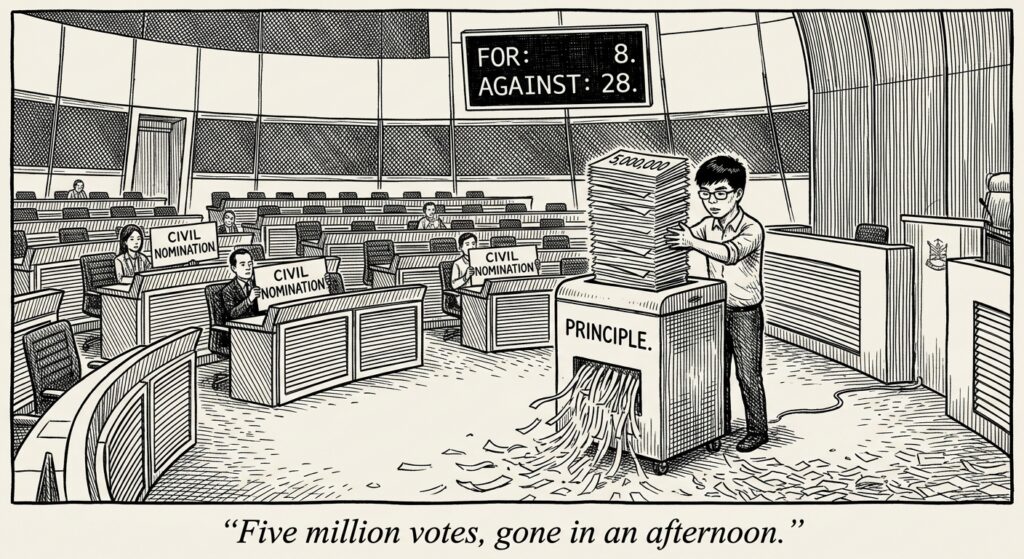
The vote itself came down to June 18, 2015. The package needed two-thirds of the 70-member Legislative Council, 47 votes. The pan-democrats had enough seats to block it, and all 27 of them voted no. Final count: 28 against, 8 in favor.
I’ll grant the other side one thing. The pro-Beijing camp handled the vote like a farce. Most of them walked out in a botched attempt to delay the count, which is why the scoreboard shows only eight votes in favor. But the walkout did not kill the package. The pan-democrats had announced their veto for months. The embarrassment lasted a news cycle. The veto lasted forever.
And the veto did not speak for Hong Kong. In the final weeks, polls had support for the package running as high as 51 percent. Inside the pan-democratic camp, the price of saying so was steep. Nelson Wong Sing-chi, a former Democratic Party legislator, publicly urged the pan-democrats to back the package. He was expelled from the party in July 2015. When a movement expels its own members for suggesting that people should be allowed to vote, you have learned what it values.
Nor was this only Beijing’s view. Richard Bush of the Brookings Institution, who spent years as Washington’s top unofficial envoy to Taiwan and is nobody’s idea of a Beijing sympathizer, wrote that the package the pan-democrats dismissed “would have created a narrow pathway to the election of a pan-democrat as chief executive.” A pan-democrat. Running the city. By popular vote. They voted against the chance to win.
The offer was on the table for one vote, on one afternoon. It has not come back.
Five million votes, gone in an afternoon. Mine was one of them.
I think about the day it would have been. Sunday, March 26, 2017. I would have walked to the polling station near our flat in Mei Foo, handed over my identity card, and marked a ballot for the person I wanted to run my city. Instead, that Sunday, an election committee of 1,194 people chose the Chief Executive. Carrie Lam won with 777 votes. Seven hundred and seventy-seven, where there could have been five million. The rest of us read about it on our phones.
* * *
Then the real goal came out.
In April 2016, Joshua Wong launched a new party, Demosisto, with fellow student leaders. Its founding call was for Hong Kong’s “democratic self-determination,” with a pledge to push for a referendum on the city’s future after 2047. In 2014 the fight was over a nominating method. By 2016 it was over whether Hong Kong should remain part of China at all.
And how deeply held was that principle? In January 2020, with its members facing disqualification from elections, Demosisto quietly dropped self-determination from its manifesto and replaced it with “democratic and progressive values.” A cause worth a city’s stability in 2016 was worth less than a ballot line four years later.
Here is what makes the self-determination story almost too neat. When the movement collapsed, its leaders scattered to Britain, the United States and Canada, among other places. Look at what those countries say about self-determination at home.
Britain’s Supreme Court ruled unanimously in November 2022 that Scotland cannot even hold an independence referendum without Westminster’s permission. The United States Supreme Court held in Texas v. White in 1869 that the Union is indissoluble and no state can leave it. Canada’s Supreme Court ruled in 1998 that Quebec has no right to secede unilaterally. Not one of the governments that took these activists in recognizes, for its own people, the right they claimed for Hong Kong.
They demanded from Beijing what London, Washington and Ottawa deny to Edinburgh, Austin and Quebec City. Then they asked London, Washington and Ottawa for shelter. Nobody in those capitals noticed the irony. Nobody in the Western press pointed it out.
* * *
To understand how they got here, you have to remember one thing about the people who led this movement. They had never lived in a Western democracy. Joshua Wong was born in October 1996, nine months before the handover. He grew up in a British colony and then a Chinese Special Administrative Region. His idea of Washington came from films, from foreign consulates and from hearing rooms on Capitol Hill, where congressmen who needed a good clip treated a teenager like a prophet.
People who have actually lived in the American system know something the students did not. America picks up freedom fighters when they are useful and puts them down when they are not.
Ask the Iraqi Shia and Kurds, who rose up in 1991 after an American president urged them to, and were left to Saddam’s helicopters. Ask the Syrian Kurds, who lost thousands of fighters against ISIS and were abandoned when American troops pulled out of northern Syria in October 2019. That was the month after Joshua Wong testified in Washington. Ask the Afghans who worked alongside Americans for twenty years and were left on the tarmac in Kabul in August 2021.
Hong Kong’s movement never looked at that record. It should have.
On September 17, 2019, Wong sat before the Congressional-Executive Commission on China and urged Congress to pass the Hong Kong Human Rights and Democracy Act. He told them Hong Kong was becoming “One Country, One System.” Congress cheered. The House passed the act 417 to 1, the Senate by unanimous consent.
Look at what the President of the United States was saying that same summer and fall. On August 1, 2019, Donald Trump called the protests “riots” and said: “Hong Kong is a part of China, they’ll have to deal with that themselves.” CNN later reported that he had privately promised Xi Jinping in June that he would stay quiet on Hong Kong while trade talks went on. On November 22, 2019, days before signing the act, he told Fox & Friends: “We have to stand with Hong Kong, but I’m also standing with President Xi.” Anyone who had lived through a few American election cycles would have heard the message. The kids heard applause.
Now fast forward to this summer. On July 14, 2026, Washington let the national emergency over Hong Kong expire. Three days later the Treasury removed nine Hong Kong and mainland officials from its main sanctions list outright, among them the current Secretary for Justice and Commissioner of Police. John Lee, Carrie Lam and dozens of others were moved off that list onto a lesser one. China’s Ministry of Commerce said the move fulfilled commitments made in last year’s trade talks in Madrid. The Treasury called it “sanctions modernization.” Everyone else called it what it was: Hong Kong’s freedom fighters, traded for soybeans and tariff relief.
Meanwhile, many of the Hongkongers who fled to America are living on a temporary program called Deferred Enforced Departure, extended by the Biden administration on its way out the door. It runs to February 5, 2027. Former legislator Baggio Leung told Radio Free Asia that, with his asylum case unresolved, he had “little likelihood” of finding professional work, and was getting by on commodity trading. Others wait years for asylum hearings, cut off from parents they cannot safely call. Some carry bounties on their heads and will never come home.
They were told the free world stood with them. The free world had a trade deal to finish.
* * *
So here is how the bet settled.
Obama bet that patience would change China, and he left the American worker uninsured. The workers lost their shirts: 2.4 million jobs by 2011 and towns that never came back.
The protesters were handed a vote and pushed it back across the table because they wanted the whole pot: civil nomination, then self-determination, then foreign sanctions on their own city. They went all in.
And Hong Kong ended up covering the bet. The protests helped tip the city into its first annual recession since 2009. The economy shrank 1.2 percent in 2019, and exports of services fell by a quarter in the last quarter of the year as the tourists stayed away. The Hong Kong Human Rights and Democracy Act and the executive order that followed stripped Hong Kong of separate trade treatment and forced goods made here to carry a “Made in China” label. The cost did not land on the Politburo. It landed on the small manufacturers and traders of Kwun Tong and Kowloon Bay, as I wrote in Hong Kong’s Tariff Identity, Erased Twice. Families split across airports. Parents in Tsuen Wan and Tai Po are raising the grandchildren of sons and daughters who can only visit on video calls. And in 2021 the city got a new electoral system far tighter than the one the pan-democrats rejected.
Obama’s legacy died along the way. For twenty years the hawks in Washington had argued that engagement was a fool’s bet, and for twenty years they lacked a clean case. Hong Kong gave them the television footage: burning barricades, a besieged university, a trashed legislature. The American viewer never saw Article 45 or the 2015 vote count or the five million lost ballots. He saw chaos, was told it was Beijing’s fault, and concluded that engagement had failed.
He also never saw what Hong Kong’s courts were doing. On October 31, 2019, at the height of the unrest, Mr Justice Russell Coleman granted the Secretary for Justice an interim injunction against posting or spreading messages that promoted or incited violence, naming the two platforms the protests ran on, LIHKG and Telegram. The movement called it censorship. The order said nothing about opinions. It covered incitement to injure people and smash property.
If you want to know whether that was a Beijing puppet at work, look at what the same judge did next. I have written about Justice Coleman before, and I have appeared before him, won in front of him and lost in front of him. As the judge in charge of the Constitutional and Administrative Law List, the most politically sensitive posting in the High Court, he struck down the rules barring transgender people from public toilets matching their gender in July 2025. In September 2025 he ruled that parts of the Parent and Child Ordinance “significantly impede” the rights of a boy born to a lesbian couple through IVF. And he quashed the environmental approval for the government’s own flagship plan to put 12,000 flats on the Fanling golf course. The Court of Appeal upheld him on August 31 this year, and the government announced last week that it would not take the case further. He was promoted to the Court of Appeal on September 7.
That is not a man who takes orders. It is a British-trained former chairman of the Bar Association who rules against whoever the law says is wrong. In 2019 it was the people inciting violence online. In 2025 and 2026 it was the government. The protesters told the world Hong Kong’s courts had become instruments of the state. The record says the courts told the protesters no for the same reason they told the government no.
Obama’s critics had been writing engagement’s obituary in policy journals for years. But ideas don’t die in journals. They die when the public decides they have been discredited, and the public needs a story. Hong Kong was supposed to be the place where Obama’s bet proved itself. The protesters made sure it became the place where the bet looked lost.
Some will say the 2015 package was a trap and the protesters saw through it. Then explain what the veto won. No vote in 2017. No vote in 2022. A recession, a sanctions regime, an exodus, and a stricter system in 2021. If refusing the offer was the smart play, the winnings are hard to find.
* * *
On the day he pleaded guilty, I wrote that Joshua Wong should not go to jail for conspiracy. Some readers took the headline as mercy. It wasn’t. He stood in court and confirmed the prosecution’s account, the lobbying and the coordination with Nathan Law, and the law will deal with that. My point was that the conspiracy is the smaller offense. The bigger one will never be read out in a courtroom. He helped take the vote away from five million people, and then he helped bring sanctions down on the city those five million live in.
This essay is the other half of that bill. The vote he killed was not only Hong Kong’s. It was the proof Obama’s bet needed, and without it the bet went bust in Washington too.
He and the people around him were offered what Americans still don’t have: a vote where the person with the most votes wins. They turned it down for a slogan, traded the slogan for self-determination, and traded self-determination for the applause of a foreign government that dropped them the moment the trade numbers mattered more.
Obama bet on patience and forgot to insure the workers.
The protesters bet everything on Washington, and they bet our votes along with their own.
The factory towns lost.
The city lost.
I lost a ballot I never got to cast.
The exiles are still waiting for a hearing date.
The only people who never lost a dollar were the ones who told them to keep playing.
The four documents, so you can check me: Article 45 of the Basic Law. The White House press briefing of September 29, 2014. The Legislative Council’s record of the June 18, 2015 vote, summarized by the US Congressional Research Service. And the Court of Appeal’s May 2019 judgment in Secretary for Justice v Wong Chi Fung, reviewing his contempt sentence for the Mong Kok clearance.
Goodreads Book Giveaway
The Wound That Never Closed
by Adam Clermont
Giveaway ends October 27.
A clear-eyed look at the Taiwan question—from its 1895 origins to the limits of strategic ambiguity.
Comments